Pferdekopfprotome
1125 - 1050 v. Chr.
The askos belongs to a group that is represented by a good number of specimens, all found in tombs. Tall cylindrical body with sharply carinated shoulder and lower part. Conical foot. The top of the body is conical, with a knob in the center. On either side of the shoulder there is a spout. One spout is in the form of a horse protome with an upright neck, sharply ridged mane, tubular muzzle, funnel mouth, small pointed ears, pellet eyes. The spout on the opposite side is broken. Between the two spouts there is a raised twin basket-handle. Decoration in diluted black to dark-brown matte paint. Latticed triangles on either side of the spouts and handle. Ladder pattern on front part of horse’s neck, bands and ladder pattern along muzzle, paint on mane and ears, transversal bands on handle, solid paint on knob. The cylindrical body is divided into two horizontal narrow panels, the upper one is filled with a horizontal chain of solid diamonds, the lower one with tangent hatched triangles. Horizontal bands around lower part of body, paint on foot.
A. Bernhard-Walcher u.a., Die Sammlung zyprischer Antiken im KHM. Sammlungskataloge des KHM Bd. 2, Wien 1999 (V. Karageorghis)
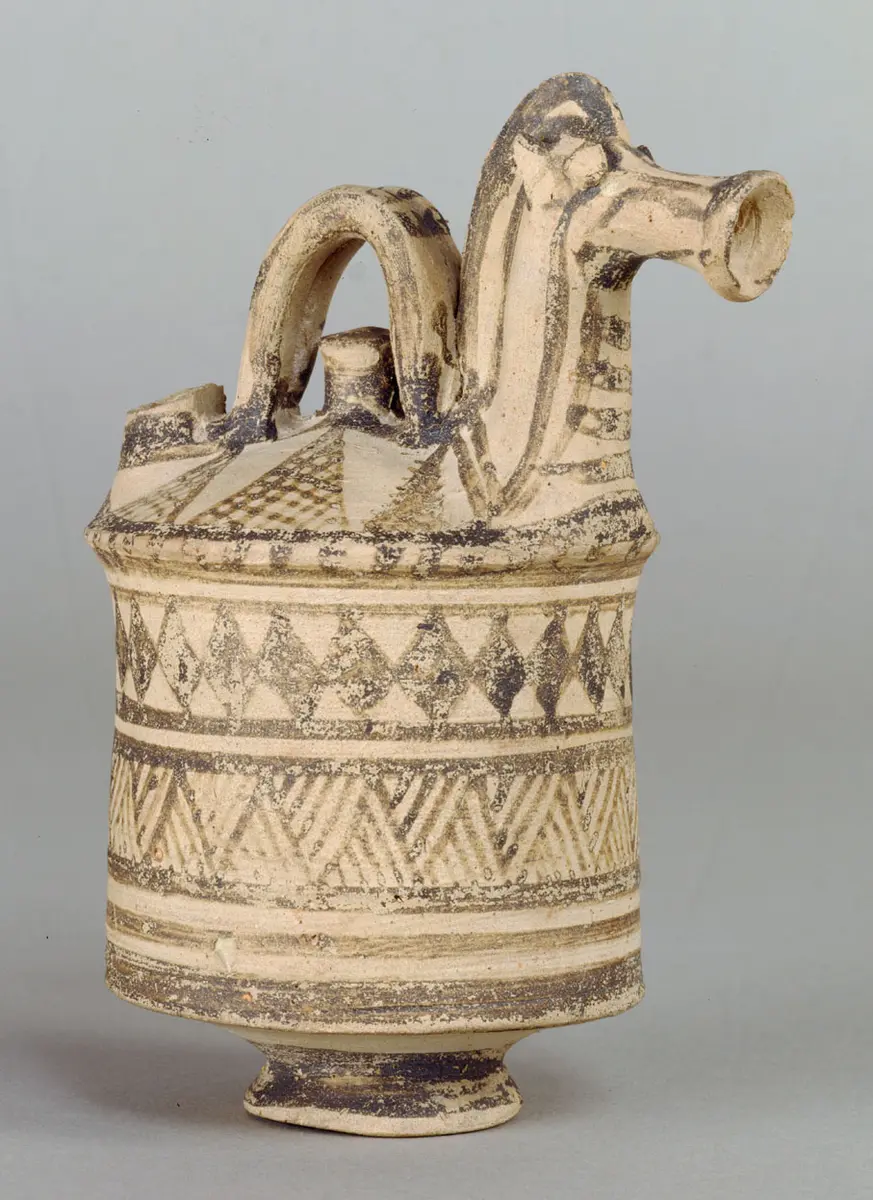
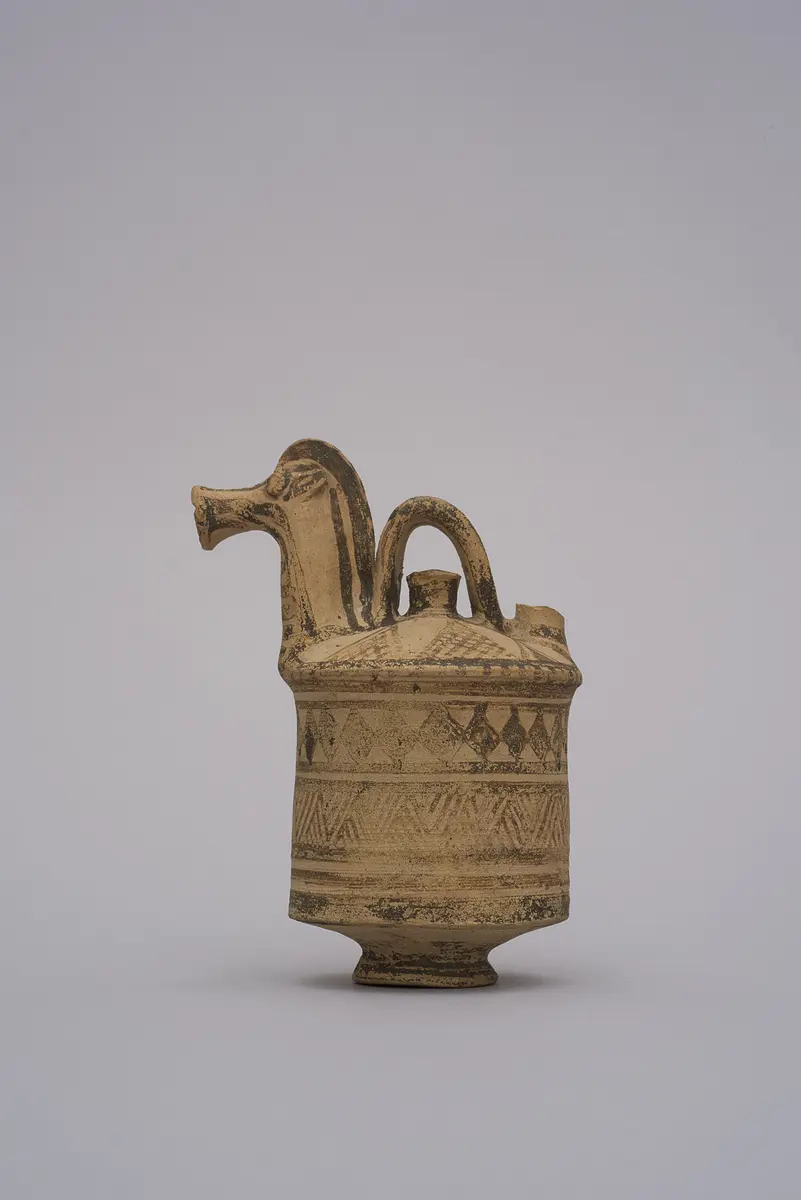
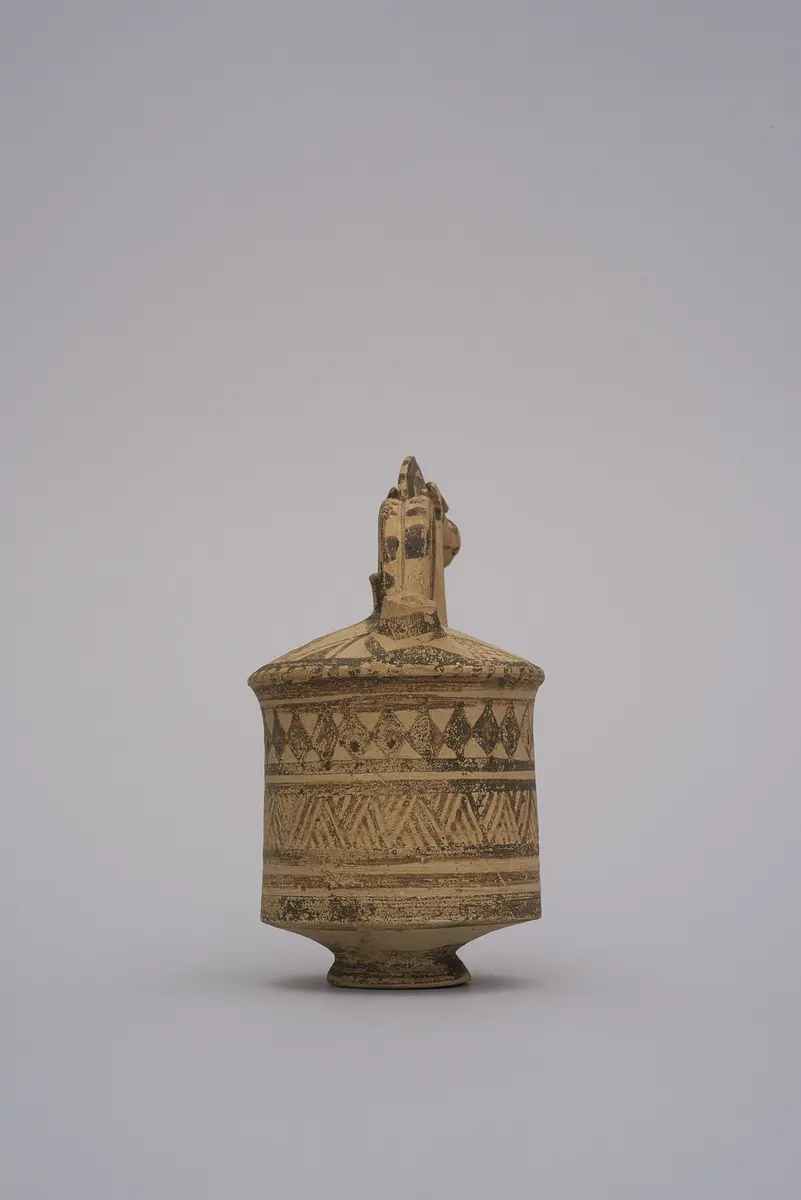
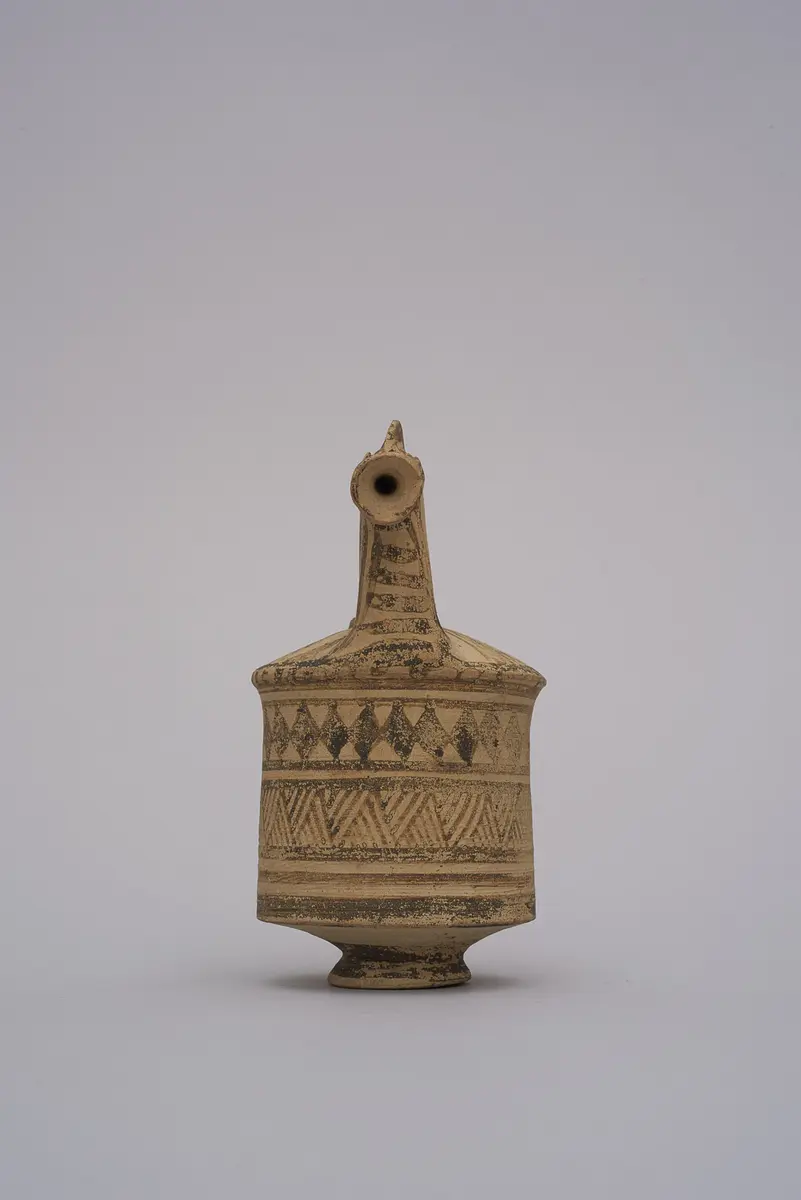
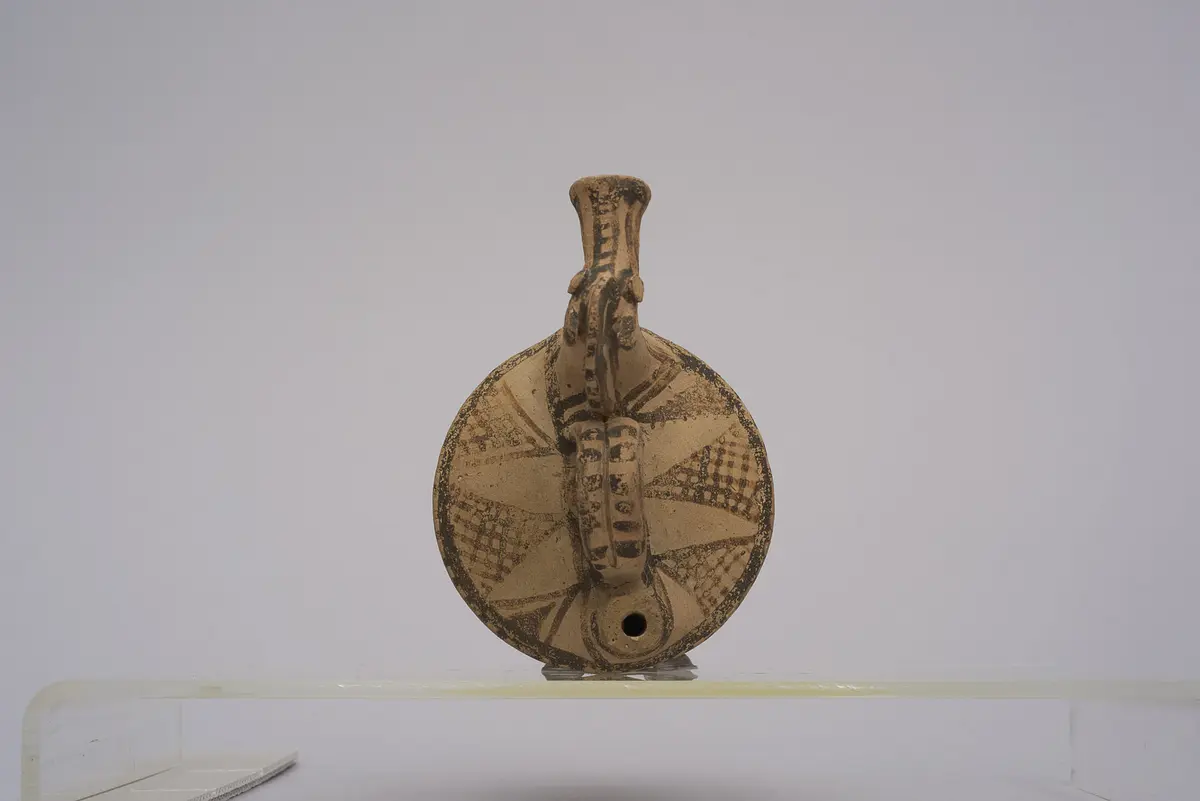
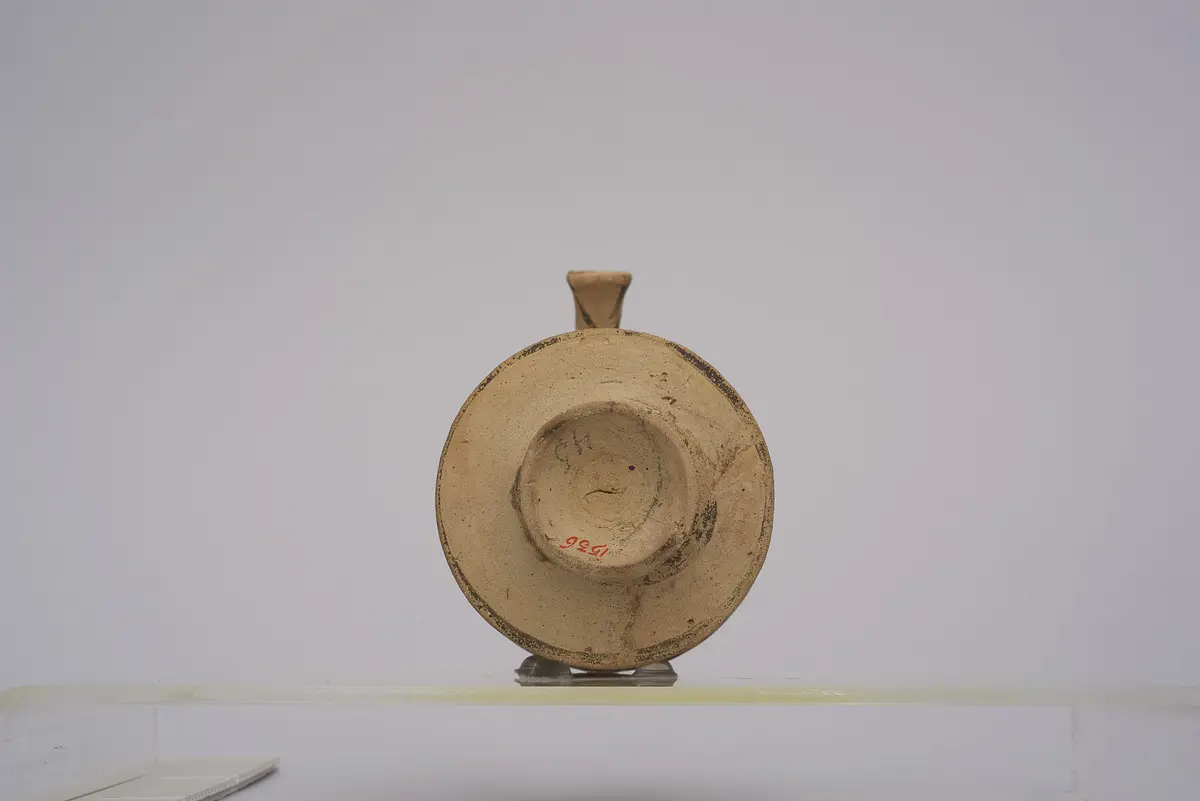
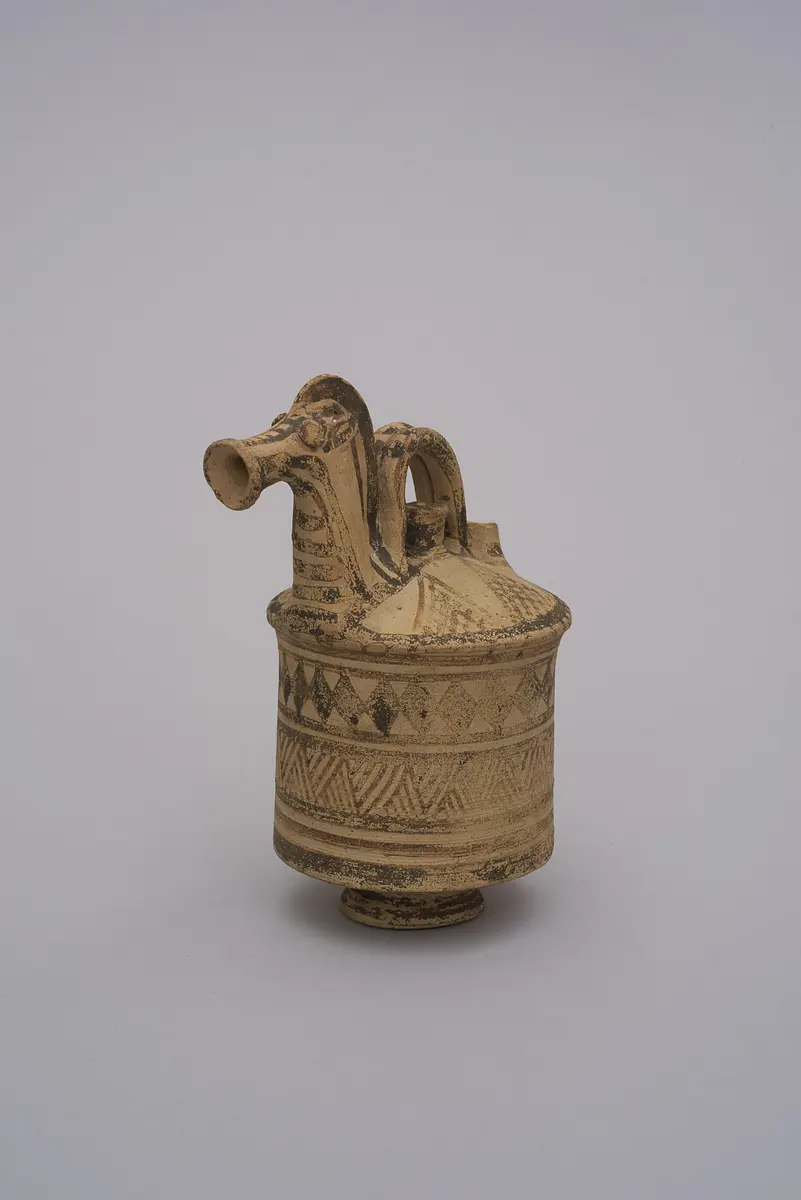
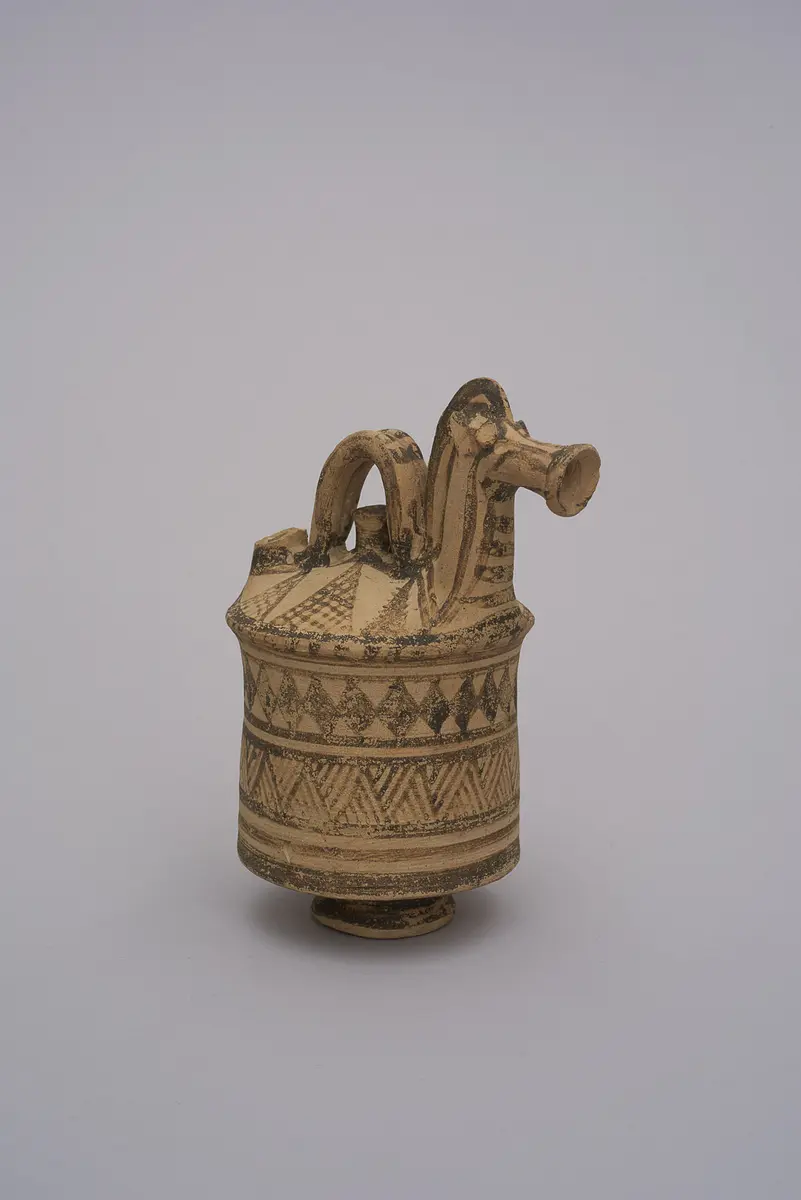
The askos belongs to a group that is represented by a good number of specimens, all found in tombs. Tall cylindrical body with sharply carinated shoulder and lower part. Conical foot. The top of the body is conical, with a knob in the center. On either side of the shoulder there is a spout. One spout is in the form of a horse protome with an upright neck, sharply ridged mane, tubular muzzle, funnel mouth, small pointed ears, pellet eyes. The spout on the opposite side is broken. Between the two spouts there is a raised twin basket-handle. Decoration in diluted black to dark-brown matte paint. Latticed triangles on either side of the spouts and handle. Ladder pattern on front part of horse’s neck, bands and ladder pattern along muzzle, paint on mane and ears, transversal bands on handle, solid paint on knob. The cylindrical body is divided into two horizontal narrow panels, the upper one is filled with a horizontal chain of solid diamonds, the lower one with tangent hatched triangles. Horizontal bands around lower part of body, paint on foot.
A. Bernhard-Walcher u.a., Die Sammlung zyprischer Antiken im KHM. Sammlungskataloge des KHM Bd. 2, Wien 1999 (V. Karageorghis)
Time:
1125 - 1050 v. Chr.
Object Name
Askos der Proto-White Painted Ware
Culture
Zyprisch
Location of discovery:
Zypern
Material/technology:
Ton hellbraun; Bemalung dunkelbraun bis schwarz; Drehscheibenarbeit.
Dimensions:
H. 13,4 cm, B. 9,8 cm
Copyright
Kunsthistorisches Museum, Antikensammlung
Invs.
Antikensammlung, IV 1536
Provenance
Ludolf, Graf, Emanuel, Madrid; 1879 Geschenk
Browse more
Similar items you might be interested in
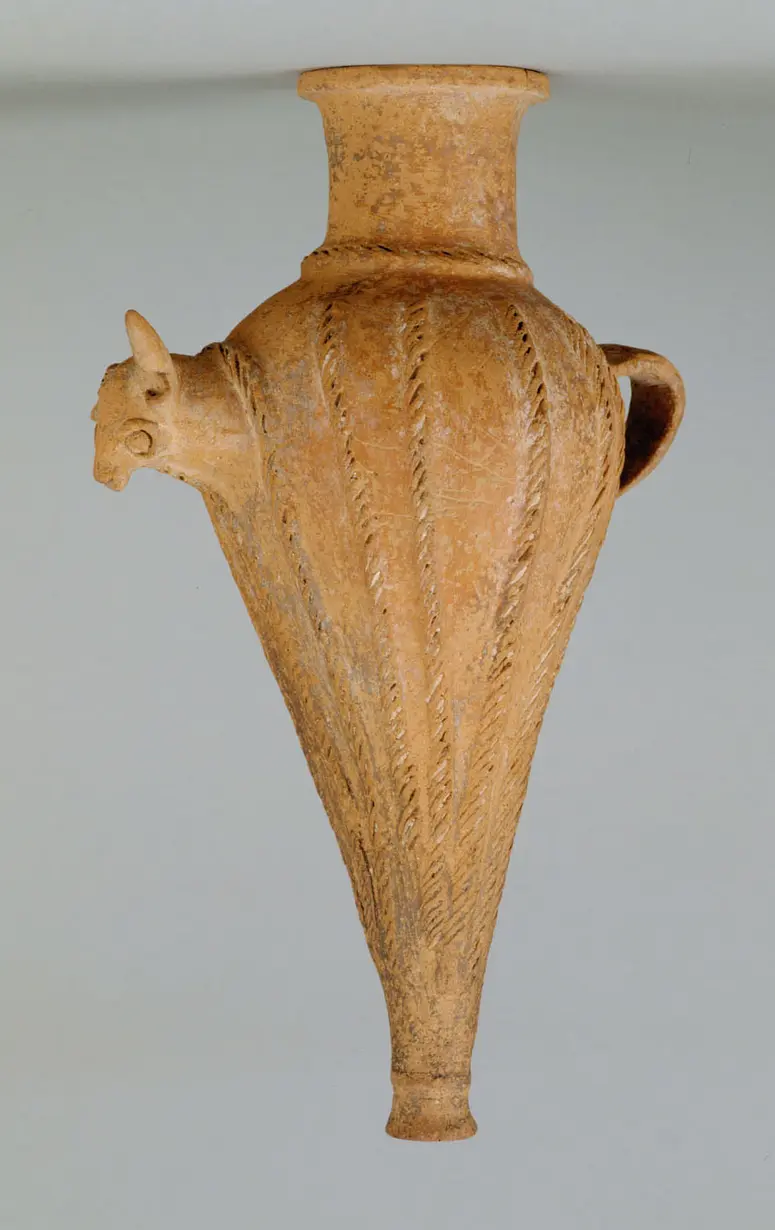
Trichter der Base-Ring I Ware: Stierkopfprotome Zyprisch, Bronzezeit, Spätzyprisch 1625 - 1450 v. Chr.

Schnabelkännchen mit Tierprotome der White Painted Ware: Liniendekor Zyprisch, Bronzezeit, Spätzyprisch 1625 - 1450 v. Chr.
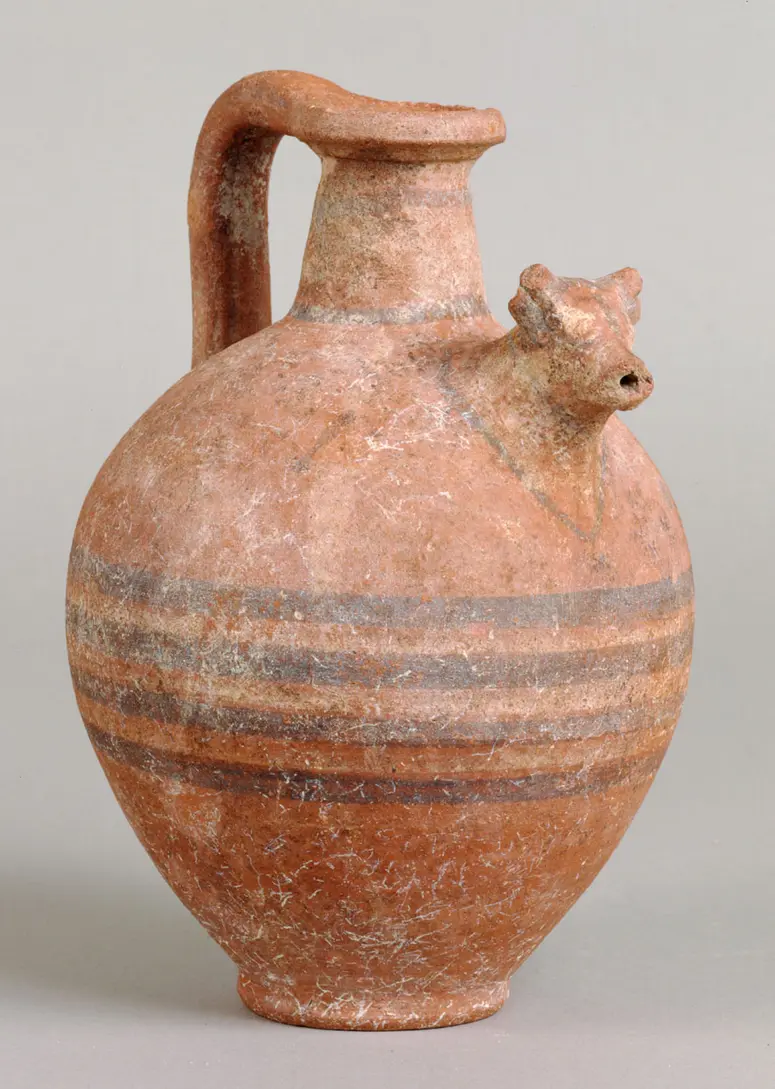
Kanne der Bichrome Red II (V) Ware: Stierkopfprotome Zyprisch, Eisenzeit, archaisch 600 - 480 v. Chr.
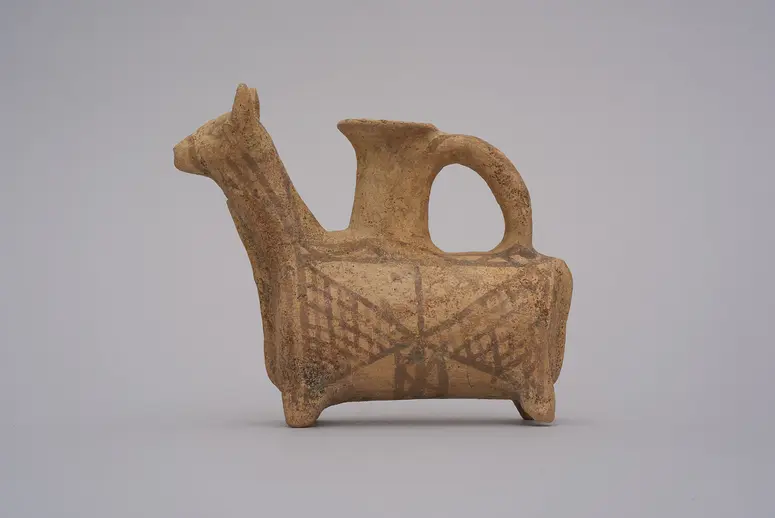
Askos in Stierform der Proto-White Painted Ware: Form eines Stieres Zyprisch, Bronzezeit, Spätzyprisch 1125 - 1050 v. Chr.
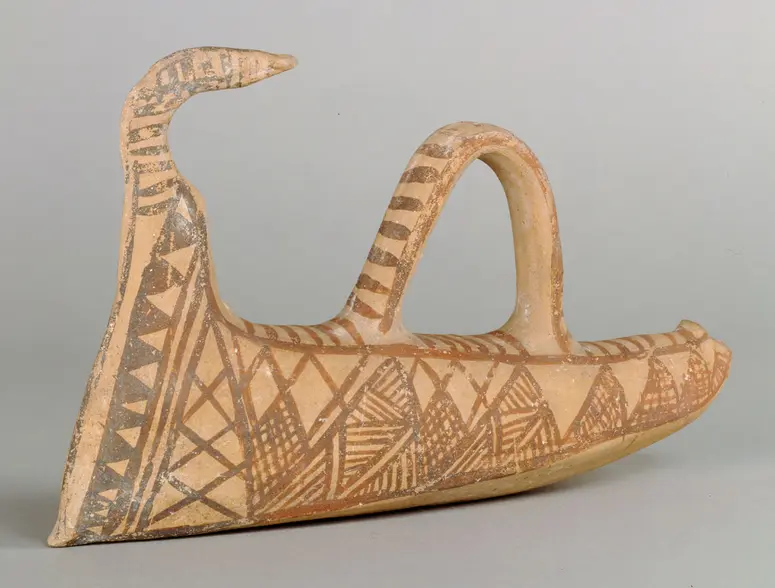
Askos der Proto-White Painted Ware: Form eines Schiffes Zyprisch, Bronzezeit, Spätzyprisch 1125 - 1050 v. Chr.
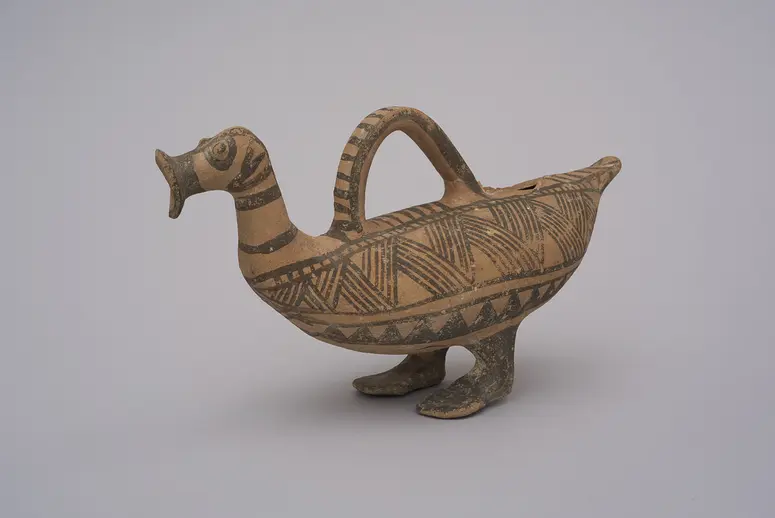
Askos der Proto-White Painted Ware: Form eines Vogels Zyprisch, Bronzezeit, Spätzyprisch 1125 - 1050 v. Chr.
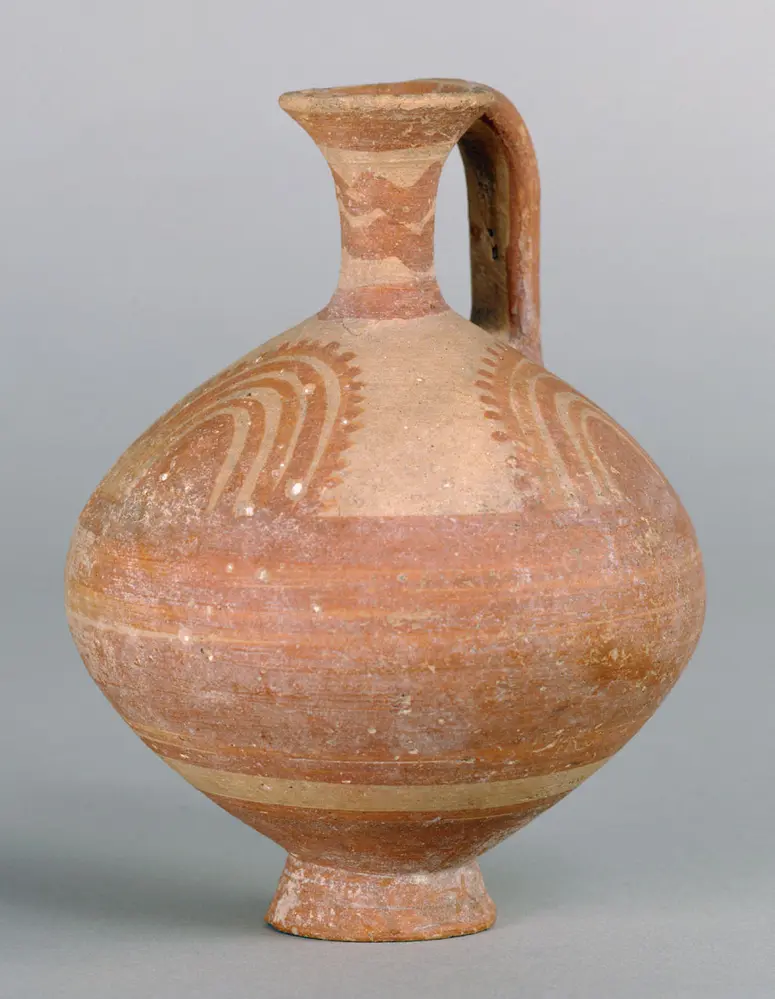
Kännchen der Proto-White Painted Ware Zyprisch, Bronzezeit, Spätzyprisch 1125 - 1050 v. Chr.
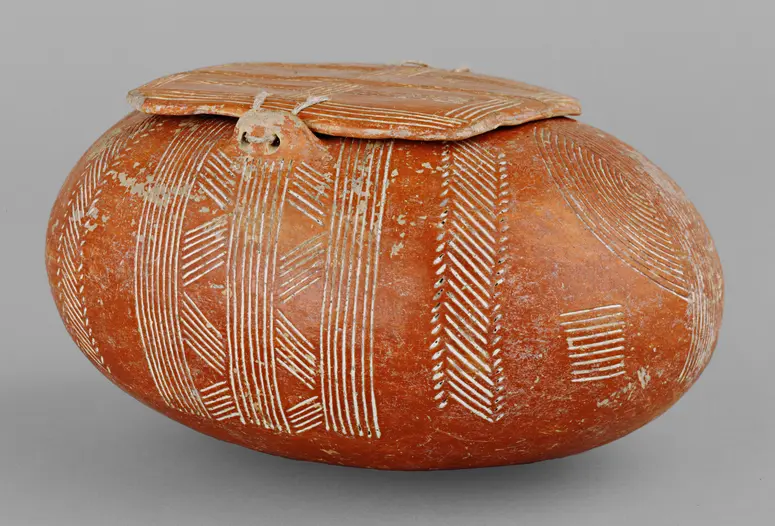
Deckelbüchse (Pyxis) der Red Polished III Ware: Ritzdekor Zyprisch, Bronzezeit, Früh- bis Mittelzyprisch 2000 - 1800 v. Chr.
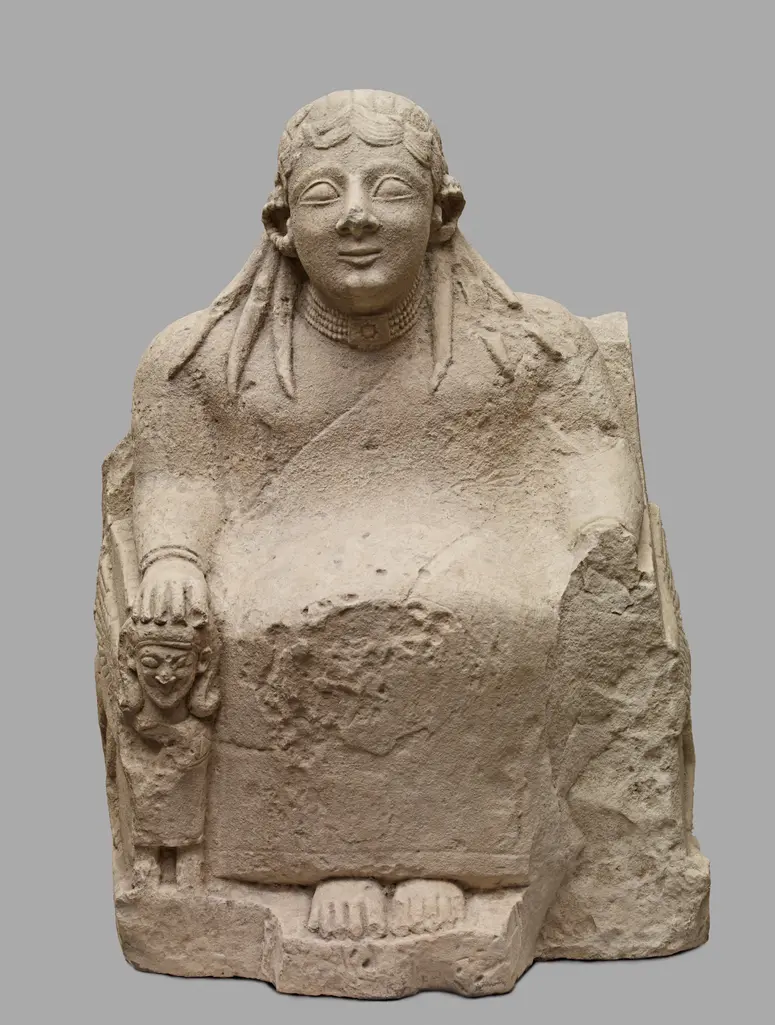
Statuette: Thronende Göttin (Astarte?) Zyprisch, Eisenzeit, archaisch 1. Hälfte 6. Jh. v. Chr.
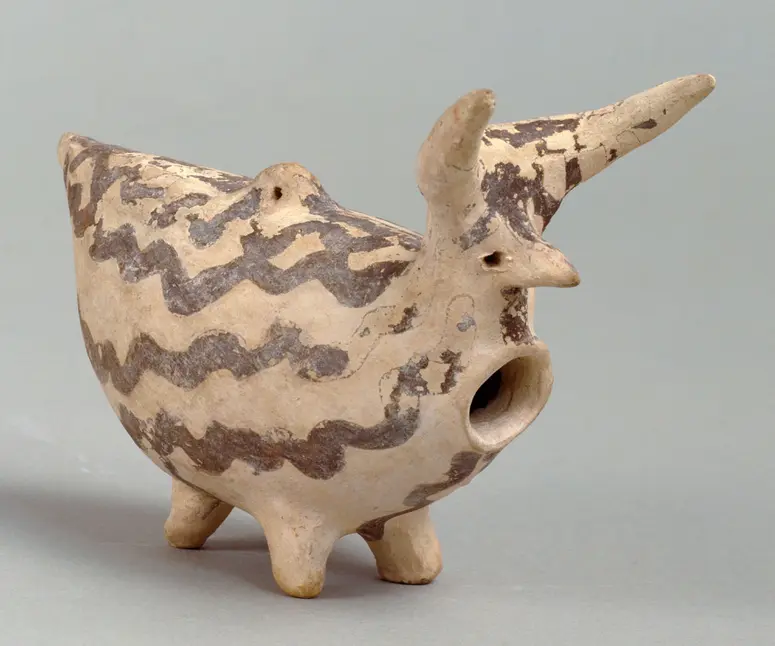
Askos der White Painted Ware: Form eines Stieres Zyprisch, Bronzezeit, Mittelzyprisch 1725 - 1600 v. Chr.
Rhyton der Base-Ring II Ware: Form eines Stieres Zyprisch, Bronzezeit, Spätzyprisch 1450 - 1200 v. Chr.
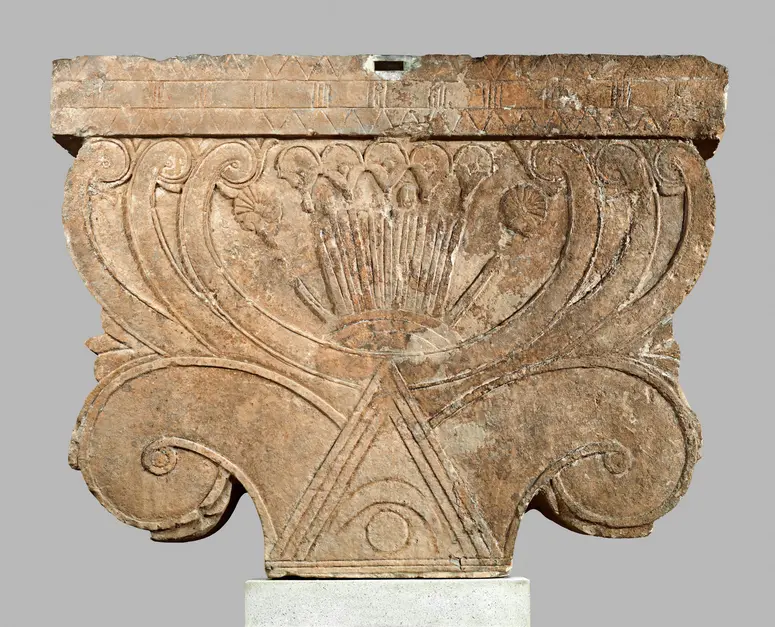
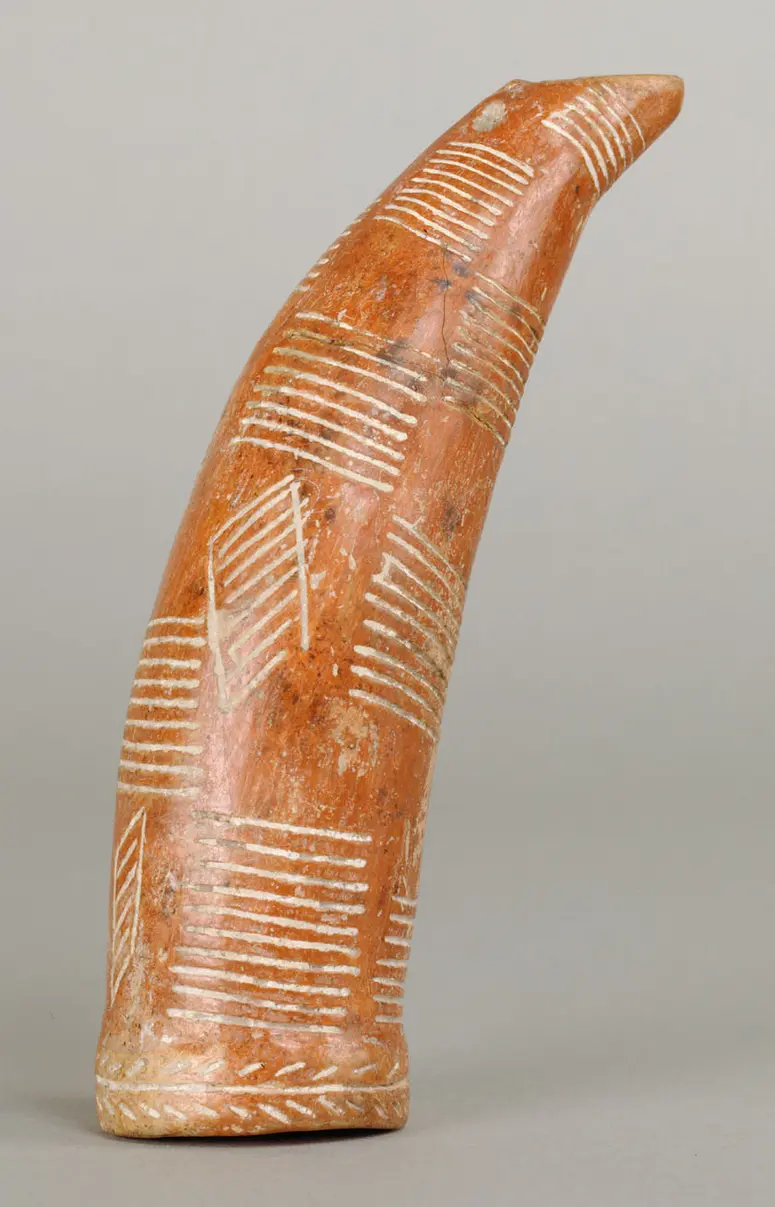
Hornförmiges Gefäß der Red Polished III Ware: Ritzdekor Zyprisch, Bronzezeit, Früh- bis Mittelzyprisch 2000 - 1800 v. Chr.
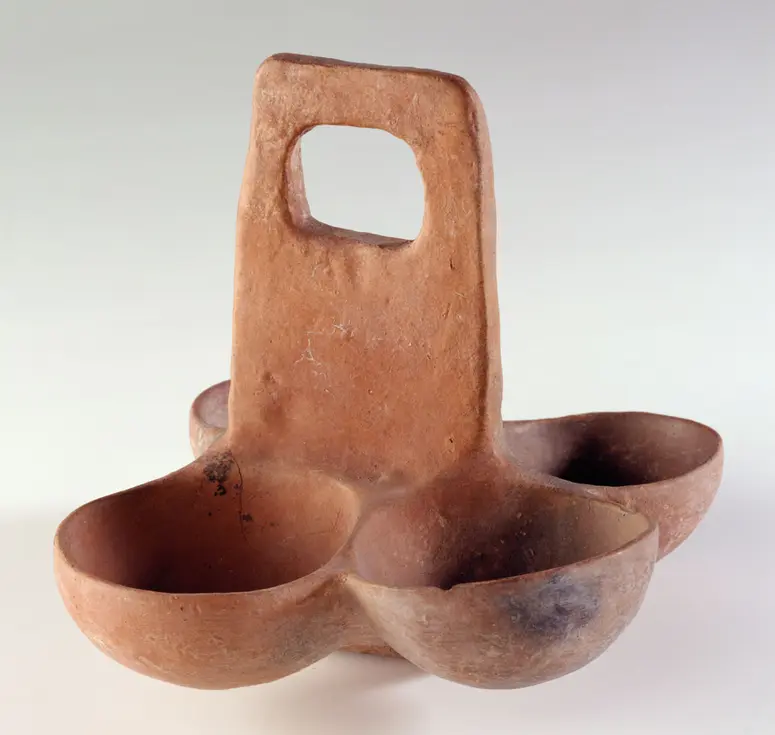
Kompositgefäß der Base-Ring I Ware (?): Halbkugelförmige Schalen Zyprisch, Bronzezeit, Spätzyprisch 1625 - 1450 v. Chr.
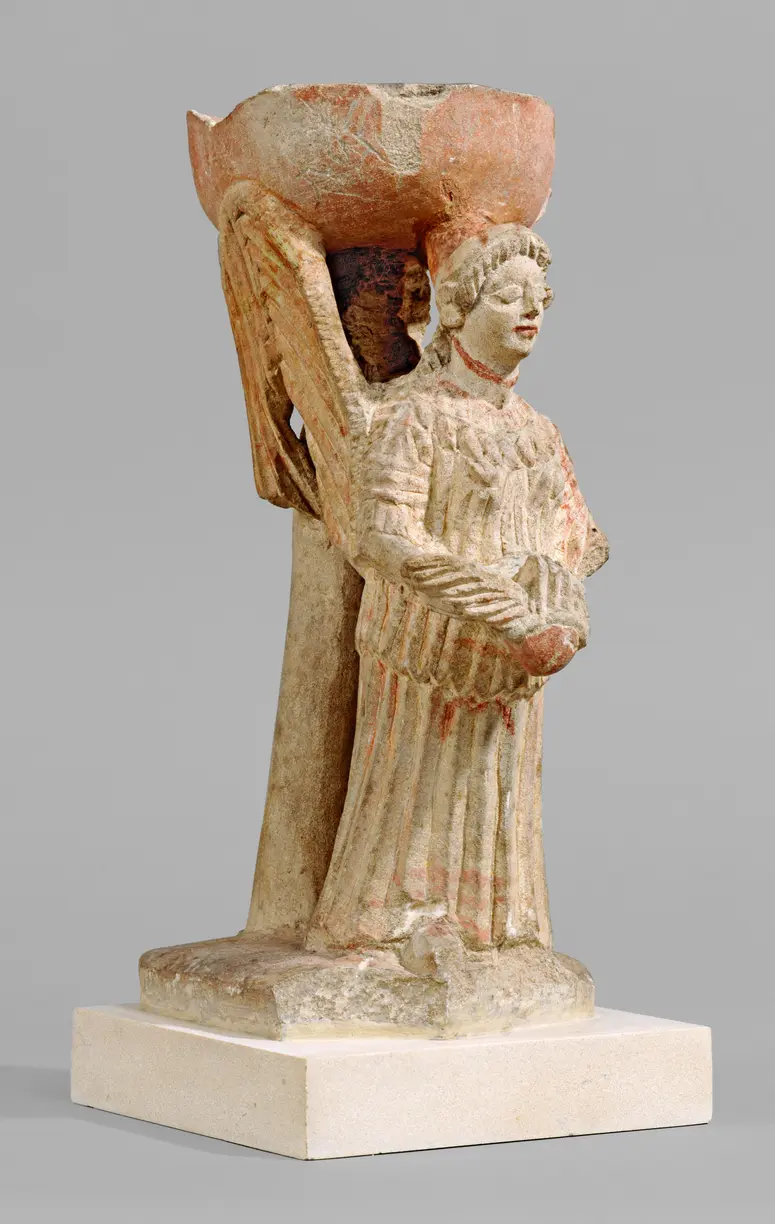
Räuchergefäß: Flügelfrau mit Räucherbecken Zyprisch, Eisenzeit, archaisch 1. Viertel 5. Jh. v. Chr.
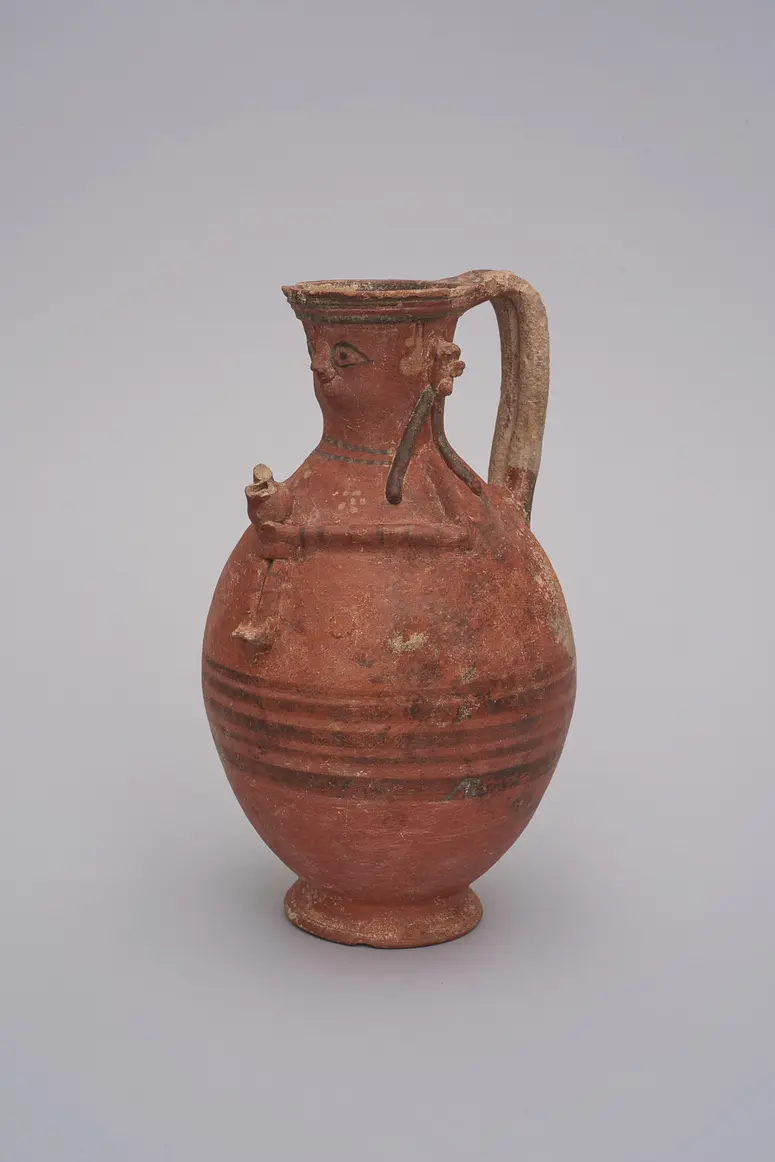
Kanne der Bichrome Red II (V) Ware: Anthropomorphe Form Zyprisch, Eisenzeit, archaisch 6. Jh. v. Chr.
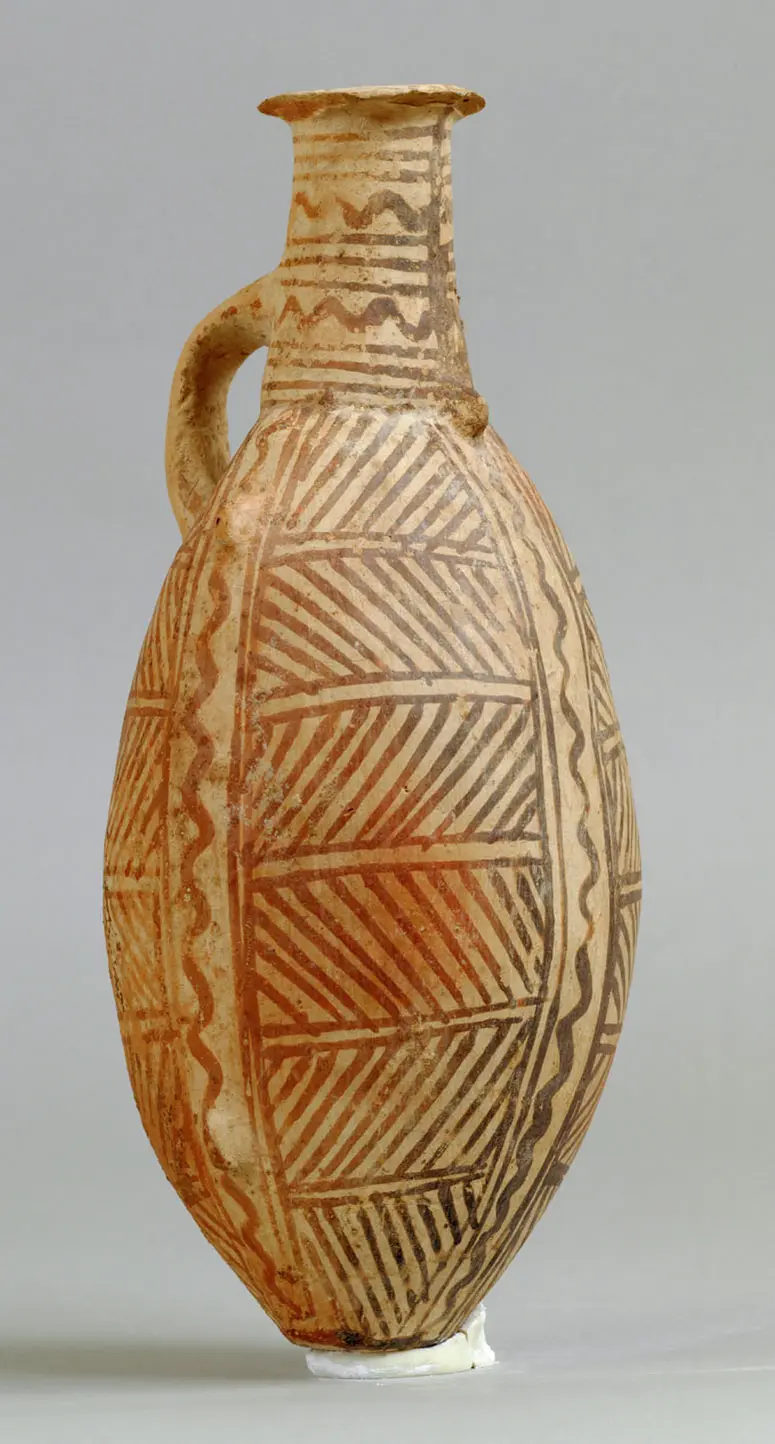
Flasche der White Painted IV Ware: Liniendekor Zyprisch, Bronzezeit, Mittelzyprisch 1725 - 1625 v. Chr.