Lebensbaum
6. Jh. v. Chr.
This large fluted capital, which was discovered in the eastern part of the Idalion Acropolis, served as the crown for a sacred obelisk (stele). On the front are two Ionic flutes, which are separated by a simple triangle, within are representations of the sun and sickle moon. From the gusset of the capital rise one of six fluted Phoenician palms, which spread out into a fan of lotus blooms and papyrus. The upper, three-part end-piece consists of a band of vertical scored lines, between two rows of engraved triangles. The back of the pillar is unadorned, and only roughly worked. The fluted capital belongs to a series of monuments, which from the 7th to the 5th Centuries B. C., were placed primarily in the cemeteries of Idalion, Golgoi and Tamassos. It symbolizes the Egyptian/Oriental motif of the „Tree of Life.“
A. Bernhard-Walcher u. a., Die Sammlung zyprischer Antiken im KHM. Sammlungskataloge des KHM Bd. 2, Wien: 1999
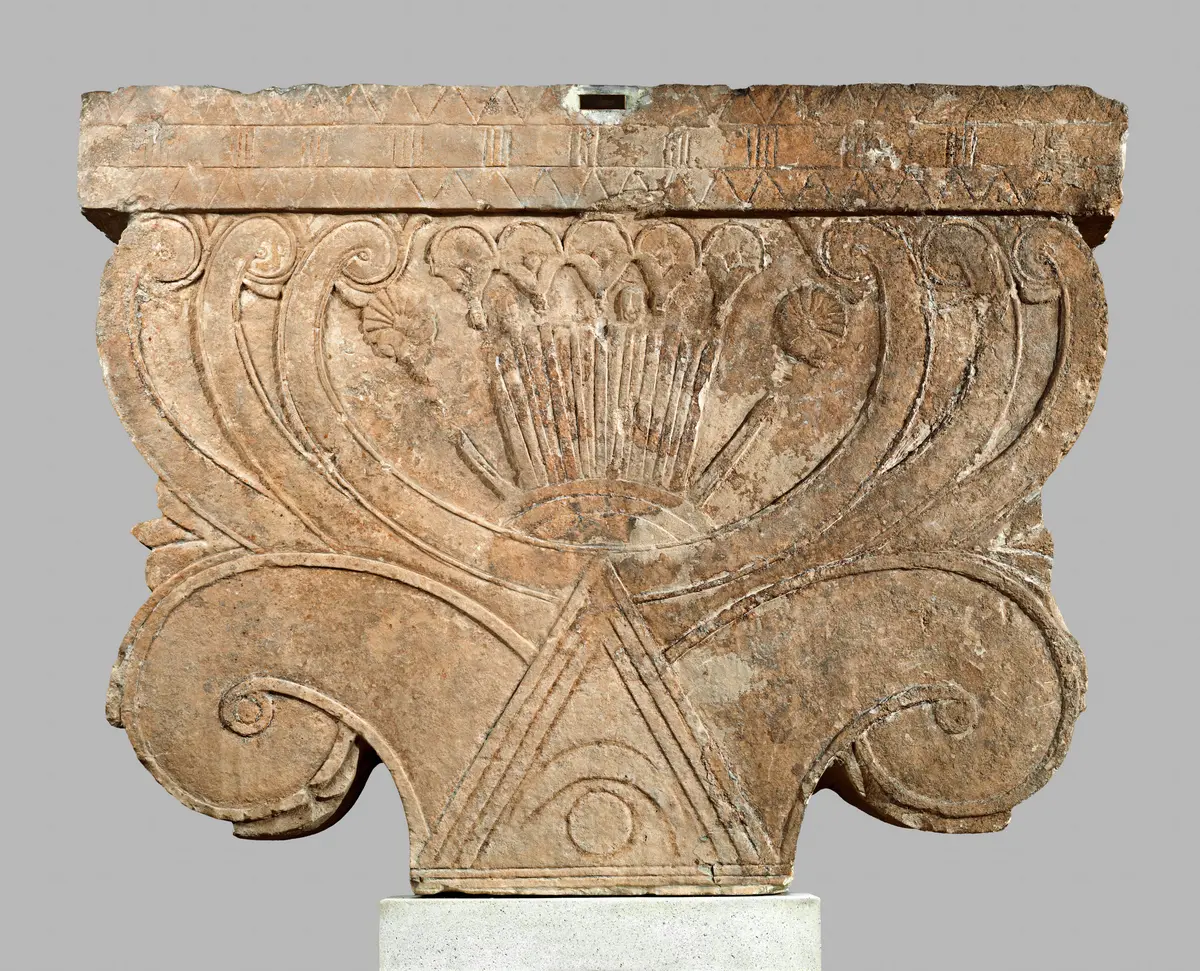
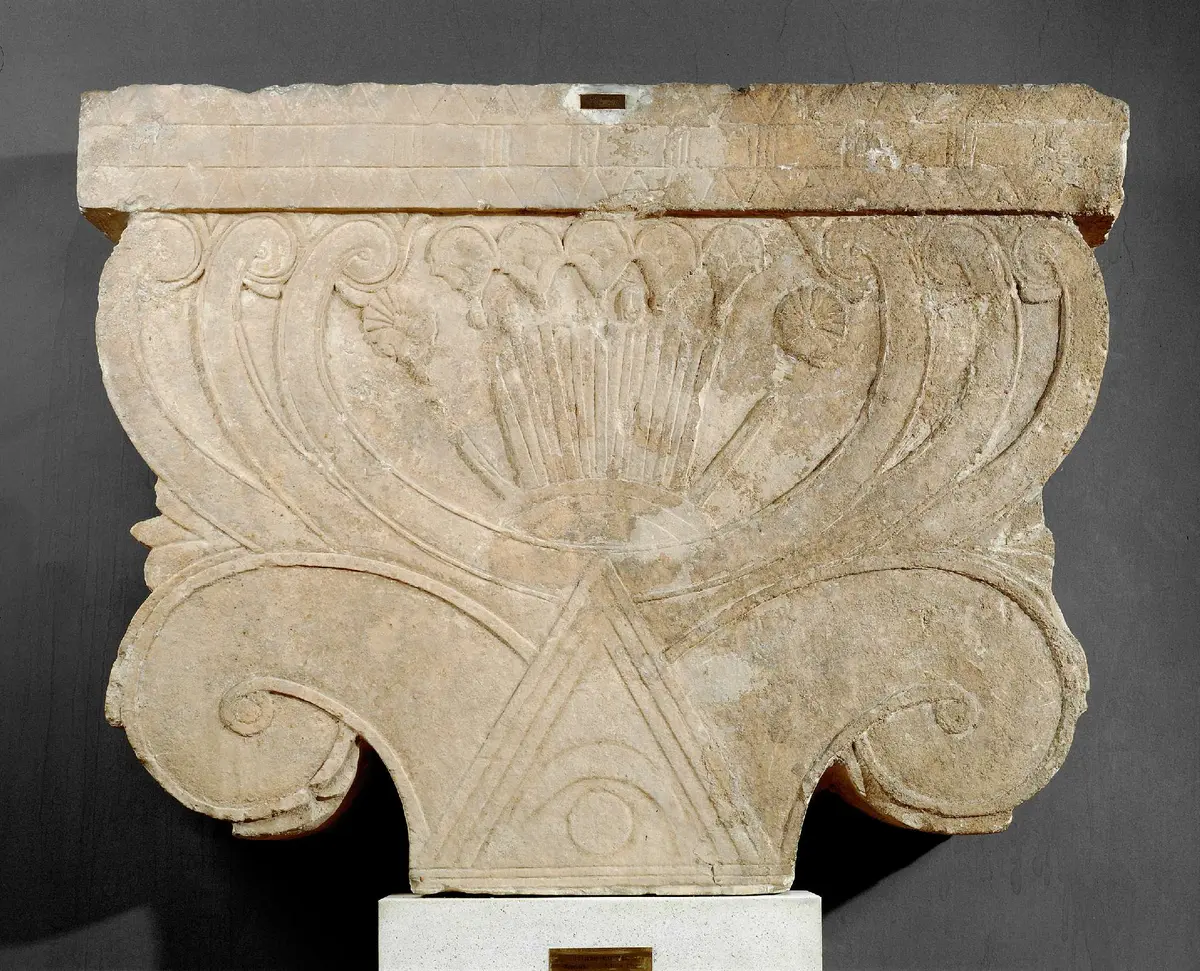
This large fluted capital, which was discovered in the eastern part of the Idalion Acropolis, served as the crown for a sacred obelisk (stele). On the front are two Ionic flutes, which are separated by a simple triangle, within are representations of the sun and sickle moon. From the gusset of the capital rise one of six fluted Phoenician palms, which spread out into a fan of lotus blooms and papyrus. The upper, three-part end-piece consists of a band of vertical scored lines, between two rows of engraved triangles. The back of the pillar is unadorned, and only roughly worked. The fluted capital belongs to a series of monuments, which from the 7th to the 5th Centuries B. C., were placed primarily in the cemeteries of Idalion, Golgoi and Tamassos. It symbolizes the Egyptian/Oriental motif of the „Tree of Life.“
A. Bernhard-Walcher u. a., Die Sammlung zyprischer Antiken im KHM. Sammlungskataloge des KHM Bd. 2, Wien: 1999
Time:
6. Jh. v. Chr.
Object Name
Pfeilerkapitell
Culture
Zyprisch
Location of discovery:
Idalion Akropolis (Dhali, Zypern)
Material/technology:
Kalkstein
Dimensions:
H. 90 cm, B. 117 cm, T. 21 cm
Copyright
Kunsthistorisches Museum, Antikensammlung
Invs.
Antikensammlung, I 717
Provenance
Ohnefalsch-Richter, Max; 1895 Kauf