Kommandostab
1648/49 | Ferdinand III. (1637-1657), Kaiser
This commander’s baton, made for Emperor Ferdinand III, is a sophisticated objet d’art. The long, helical, turned-ivory handle is hollow and has been fitted with optical lenses so that it can also function as a telescope. The gilt silver lids are decorated with polychrome enamel depicting trophies, garlands, musical instruments, and the signs of the Zodiac.
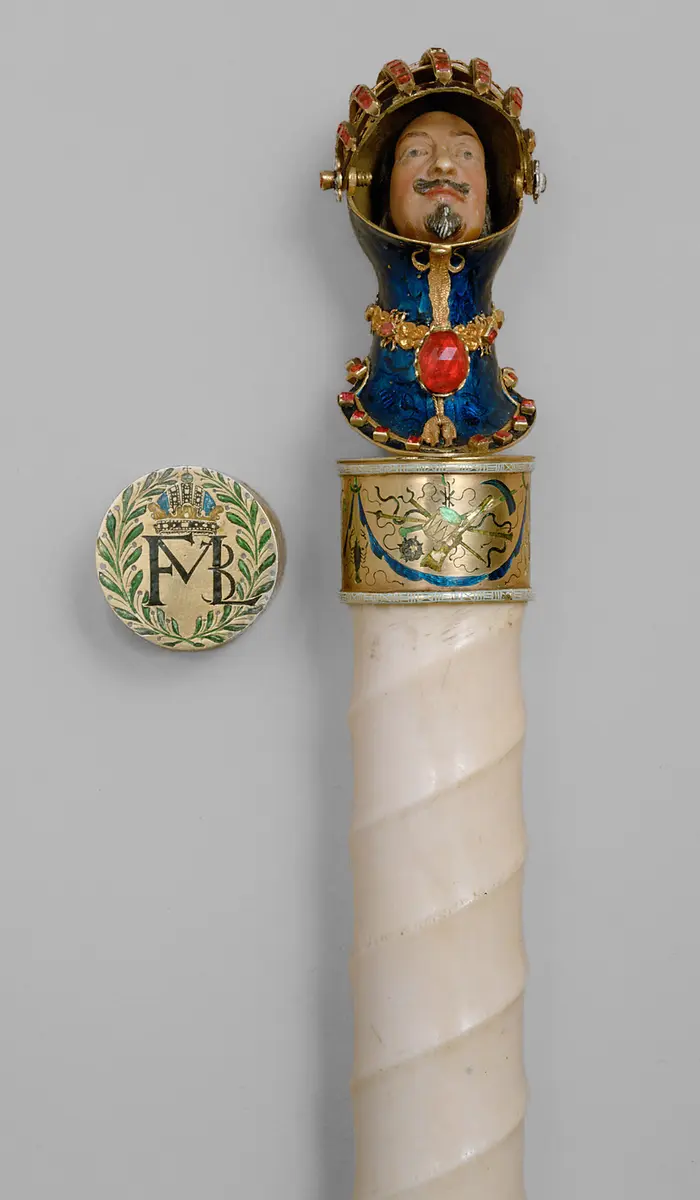
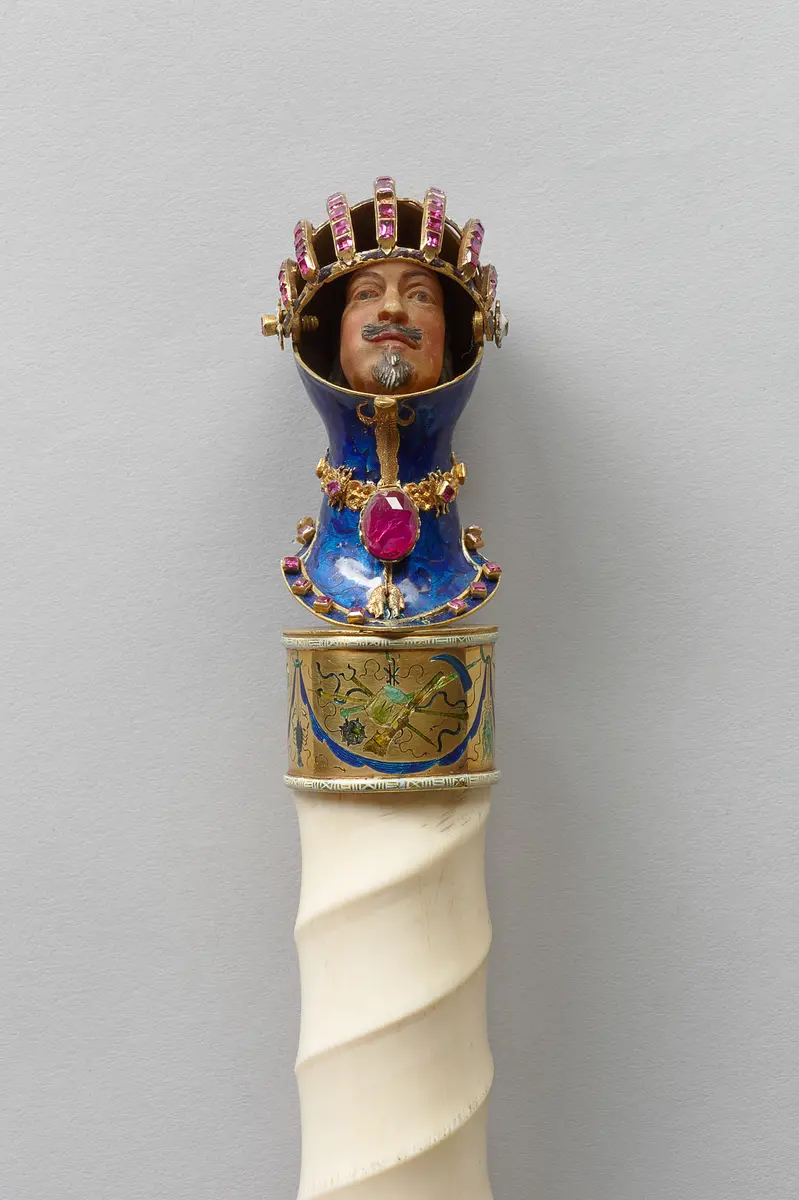
The upper lid is surmounted by a tournament helmet embellished with a blue pattern of plant and flower ornamentation. This type of helmet was worn for a combat on foot or a Kolbenturnier (fought with wooden clubs), but by the 1640s it was already antiquated and only used for heraldic purposes. On the back of the helmet sits a tiny plume-holder enamelled in turquoise below two small drilled holes that presumably once held minute feathers, possibly gold and enamelled. Note the collar of the Order of the Golden Fleece around the neck of the tiny helmet; a large ruby is mounted above the Fleece. The visor, too, is studded with rubies, and when opened reveals a naturalistic polychrome portrait head of Emperor Ferdinand III.
The baton’s lower lid is decorated with the enamelled monogram F3ML surmounted by the imperial crown. F3 refers to Ferdinand III, ML to his second wife, Archduchess Maria Leopoldine, a daughter of Archduke Leopold V and Claudia de’ Medici. The imperial couple celebrated their nuptials on 2 July 1648 at Linz in Upper Austria. Maria Leopoldine died the following year, on 7 August 1649, shortly after giving birth to their son Charles Joseph. This allows us to date the object to within a year. It may have been commissioned either for their wedding or to commemorate the signing of the Peace of Westphalia in the summer of 1648.
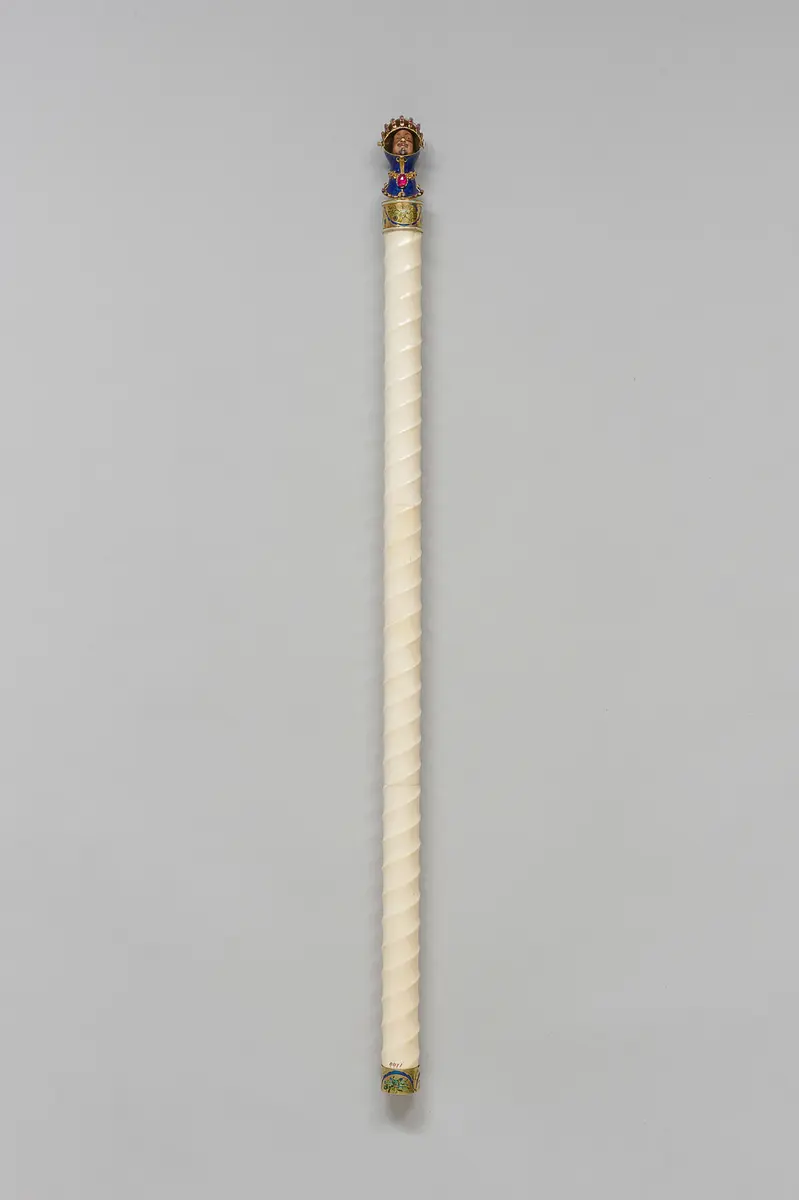
This commander’s baton, made for Emperor Ferdinand III, is a sophisticated objet d’art. The long, helical, turned-ivory handle is hollow and has been fitted with optical lenses so that it can also function as a telescope. The gilt silver lids are decorated with polychrome enamel depicting trophies, garlands, musical instruments, and the signs of the Zodiac.
The upper lid is surmounted by a tournament helmet embellished with a blue pattern of plant and flower ornamentation. This type of helmet was worn for a combat on foot or a Kolbenturnier (fought with wooden clubs), but by the 1640s it was already antiquated and only used for heraldic purposes. On the back of the helmet sits a tiny plume-holder enamelled in turquoise below two small drilled holes that presumably once held minute feathers, possibly gold and enamelled. Note the collar of the Order of the Golden Fleece around the neck of the tiny helmet; a large ruby is mounted above the Fleece. The visor, too, is studded with rubies, and when opened reveals a naturalistic polychrome portrait head of Emperor Ferdinand III.
The baton’s lower lid is decorated with the enamelled monogram F3ML surmounted by the imperial crown. F3 refers to Ferdinand III, ML to his second wife, Archduchess Maria Leopoldine, a daughter of Archduke Leopold V and Claudia de’ Medici. The imperial couple celebrated their nuptials on 2 July 1648 at Linz in Upper Austria. Maria Leopoldine died the following year, on 7 August 1649, shortly after giving birth to their son Charles Joseph. This allows us to date the object to within a year. It may have been commissioned either for their wedding or to commemorate the signing of the Peace of Westphalia in the summer of 1648.
Owner:
Ferdinand III. (1637-1657), Kaiser (1608 - 1657) DNB
Time:
1648/49
Object Name
Kommandostab
Culture
Wien (?)
Material/technology:
Gold, teils graviert. Email. Rubine. Linsen: Glas. Elfenbein, teils bemalt.
Dimensions:
L 74 cm × Dm 2,9 cm
Inscribed
Unterer Beschlag: Monogramm bestehend aus F (Ferdinand), M.L (Maria Leopoldina) und B (?) oder 3 für Ferdinand III.
Copyright
Kunsthistorisches Museum, Hofjagd- und Rüstkammer
Invs.
Hofjagd- und Rüstkammer, A 1166
Browse more
Similar items you might be interested in
Maximilian II. (1564-1576), Kaiser vor 1552
Rudolf II. (1576-1612), Kaiser, römischer König ab 1575, König von Ungarn ab 1572, von Böhmen se 4. Viertel 16. Jahrhundert
Franz (1792-1835), von 1792-1806 als Franz II. Kaiser, seit 1806 als Franz I. Kaiser von Österreich Anfang 19. Jahrhundert

Duc Philippe III le Bon de Jean sans Peur Valois um 1460

Rudolf II. (1576-1612), Kaiser, römischer König ab 1575, König von Ungarn ab 1572, von Böhmen se um 1602-1610

Franz Joseph I. (1848-1916), Kaiser von Österreich, König von Böhmen und Ungarn kurz nach 1874
Ferdinand I. (1521-1564), Erzherzog, seit 1531 König und seit 1558 Kaiser nach 1526
Ferdinand II. (1564-1595), Erzherzog von Österreich und Landesherr von Tirol um 1560
Ferdinand II. (1474-1516), ab 1479 König von Aragon, 1474-1504, ab 1506 als Ferdinand V. König von um 1490
Karl von Österreich, Sohn des Tiroler Landesfürsten Erzherzog Ferdinands II. von Habsburg und der Philippine Welser datiert 1582

Ferdinand II. (1564-1595), Erzherzog von Österreich und Landesherr von Tirol vor 1596
Ferdinand III. (1637-1657), Kaiser datiert 1638
Maximilian I. (1477-1519), seit 1493 deutscher König, 1508 Kaiser 1509

Ferdinand II. (1564-1595), Erzherzog von Österreich und Landesherr von Tirol 1559/60
All'antica-Sturmhaube, sog. Löwen-Sturmhaube: All'antica burgonet, so-called Lion Burgonet Karl I. (V.) (1516-1556), als Karl I. König von Spanien, ab 1519 deutscher König, ab 1520 Kaiser c. 1550 - 1555