All'antica burgonet, so-called Lion Burgonet
c. 1550 - 1555 | Karl I. (V.) (1516-1556), als Karl I. König von Spanien, ab 1519 deutscher König, ab 1520 Kaiser
In the sixteenth century, burgonets with Classicising mask visors were called alla romana antica, that is helmets in the ancient Roman manner. They reflect themes from Classical antiquity, allowing their wearer to assume the role of a celebrated ancient ruler or hero.
By donning this burgonet, the wearer assumed the role of Hercules, the personification of prowess and valour. The visor, shaped like the head of the lion of Cithaeron that Hercules slew, clearly references the demi-god, which is why the helmet has traditionally been attributed to Emperor Charles V, who felt a deep affinity with this hero from Classical mythology.
The lion burgonet comprises ten parts: a skull, a forehead-piece, a visor, a tripartite neck protection, and a pair of bipartite cheek guards. The comb is decorated with fighting tritons. The sides of the skull feature Siren-like figures flanked by the personifications of victory (right) and fame (left). Each cheek guard features a winged putto clutching, respectively, a trident and a sail. The visor has no eye slits, which means it can only be worn cocked back. It is fixed with a hinged bar to an eyelet on the forehead-piece. The holes drilled into the helmet along the comb for plumes of feathers also suggest it was intended solely to be worn on festive or ceremonial occasions.
The helmet entered the collection of Archduke Ferdinand II in the 1560s, if not earlier. Around 1560, he ordered the so-called ‘German Armour’ (Deutsche Rüstung; inv. A 693) from a workshop in Prague to wear with this helmet. A number of portraits painted in the 1560–70s show Ferdinand in this armour with the lion burgonet, for instance an engraving by Francesco Terzio in Imagines Gentis Austriacae (1569), a fresco in the Spanish Hall at Ambras Castle (c.1575), and a painting now in the Picture Gallery of the Kunsthistorisches Museum Vienna (inv. 8049).
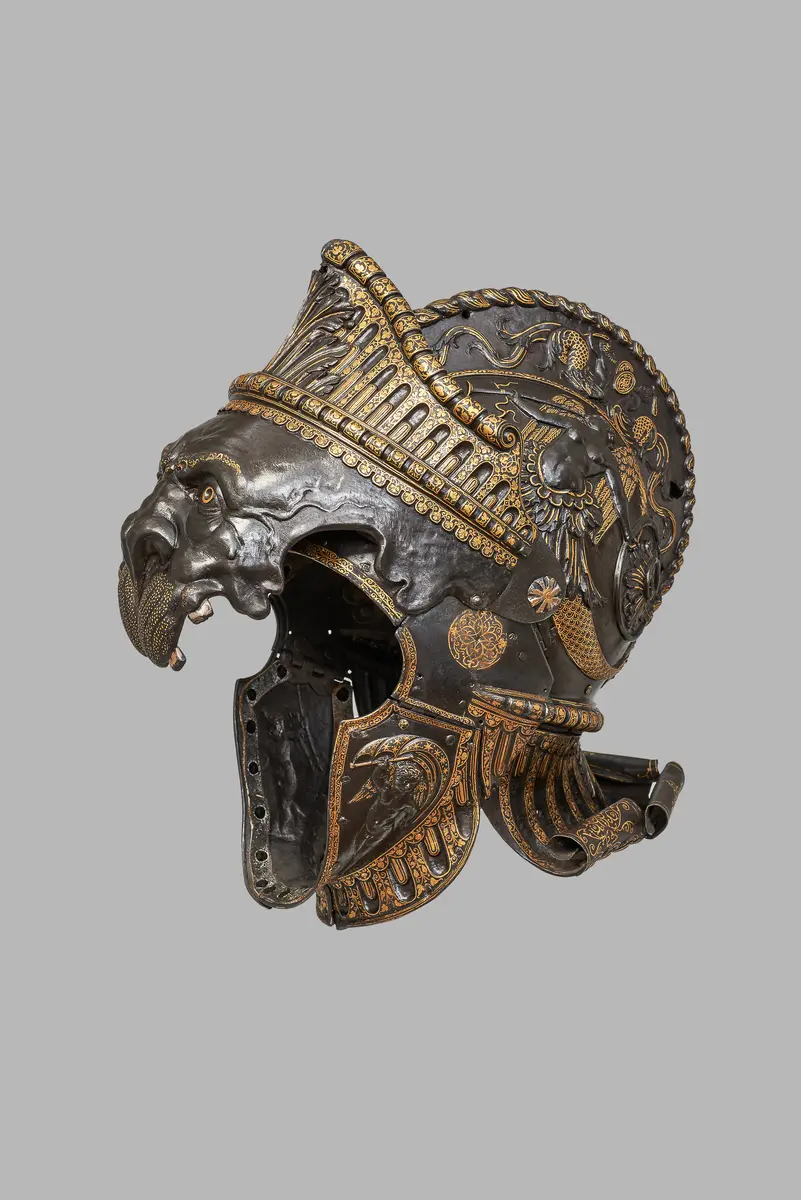
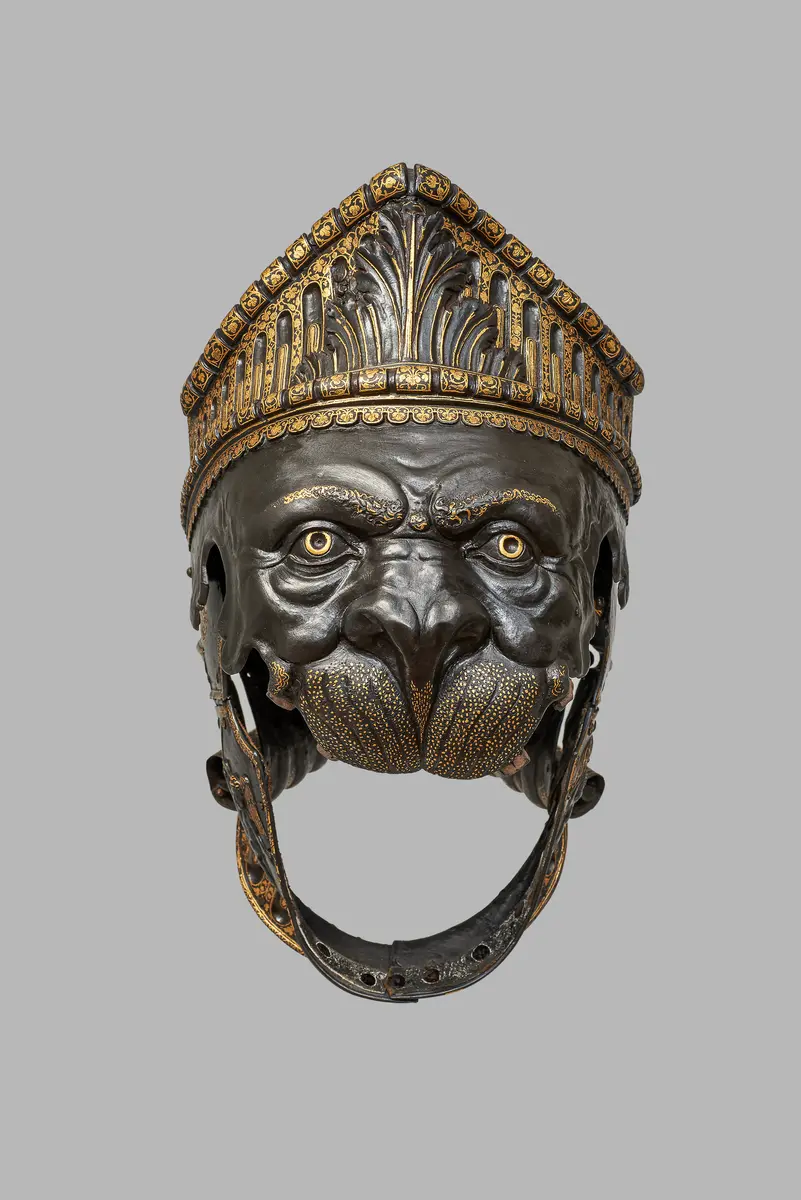
In the sixteenth century, burgonets with Classicising mask visors were called alla romana antica, that is helmets in the ancient Roman manner. They reflect themes from Classical antiquity, allowing their wearer to assume the role of a celebrated ancient ruler or hero.
By donning this burgonet, the wearer assumed the role of Hercules, the personification of prowess and valour. The visor, shaped like the head of the lion of Cithaeron that Hercules slew, clearly references the demi-god, which is why the helmet has traditionally been attributed to Emperor Charles V, who felt a deep affinity with this hero from Classical mythology.
The lion burgonet comprises ten parts: a skull, a forehead-piece, a visor, a tripartite neck protection, and a pair of bipartite cheek guards. The comb is decorated with fighting tritons. The sides of the skull feature Siren-like figures flanked by the personifications of victory (right) and fame (left). Each cheek guard features a winged putto clutching, respectively, a trident and a sail. The visor has no eye slits, which means it can only be worn cocked back. It is fixed with a hinged bar to an eyelet on the forehead-piece. The holes drilled into the helmet along the comb for plumes of feathers also suggest it was intended solely to be worn on festive or ceremonial occasions.
The helmet entered the collection of Archduke Ferdinand II in the 1560s, if not earlier. Around 1560, he ordered the so-called ‘German Armour’ (Deutsche Rüstung; inv. A 693) from a workshop in Prague to wear with this helmet. A number of portraits painted in the 1560–70s show Ferdinand in this armour with the lion burgonet, for instance an engraving by Francesco Terzio in Imagines Gentis Austriacae (1569), a fresco in the Spanish Hall at Ambras Castle (c.1575), and a painting now in the Picture Gallery of the Kunsthistorisches Museum Vienna (inv. 8049).
Time:
c. 1550 - 1555
Object Name
All'antica-Sturmhaube, sog. Löwen-Sturmhaube
Culture
Mailand
Material/technology:
Eisen, geschmiedet, getrieben, teils ziseliert, teils geschwärzt, teils gebläut, teils mit Gold und Silber tauschiert. Leder.
Dimensions:
H 40 cm x B 20 cm x T 38 cm
Gewicht: 3,35 kg
Inscribed
VICTOR DO
CAROLO VIMSA D
FE. D. ALP FVD
ΠΡΟΣΤΑ ΑΣΤΡΑ ΔΙΑ/ ΤΑΥΤΑ
SCIPIO AEMIL. APHRICANVS / D.(ivus) IVLIVS CAE. IMP. P.(ontifex) M.(aximus) / D. AVGVSTVS CAE. IMP. / TI. CLAVDIVS CAE. AUG. IMP.
Copyright
Kunsthistorisches Museum, Hofjagd- und Rüstkammer
Invs.
Hofjagd- und Rüstkammer, A 693d
Browse more
Similar items you might be interested in
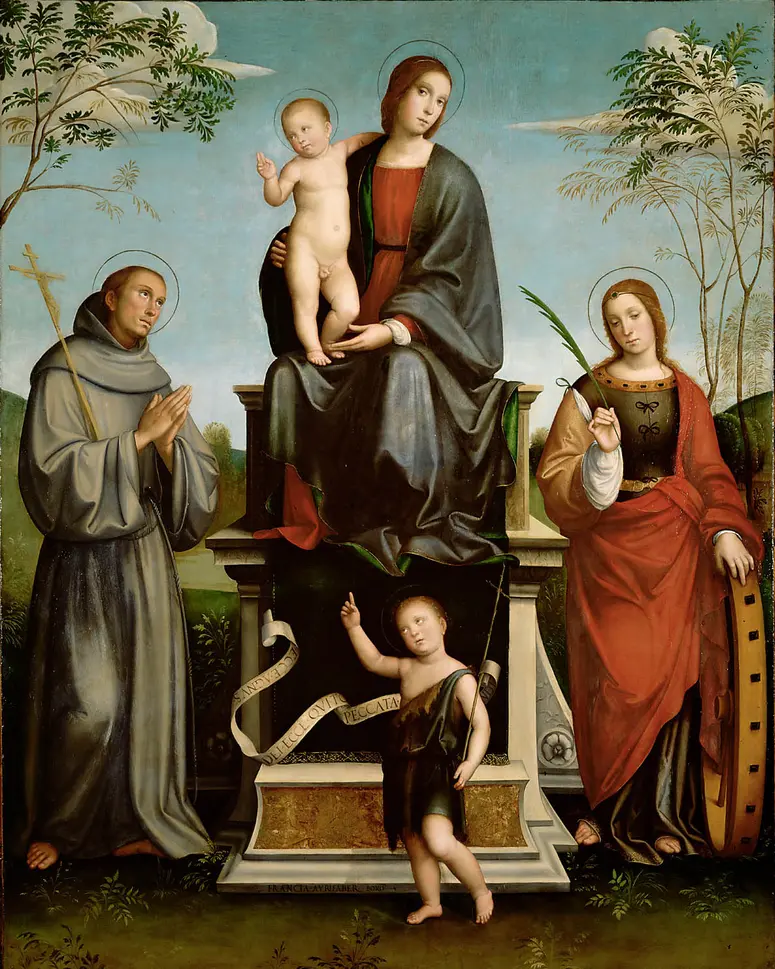
Mary with Child and the Saints Francis, Catherine and John Francesco Raibolini, gen. Francia around 1504

Isabella von Portugal, Statue, Statuette, Terracotta Isabella von Portugal um 1600

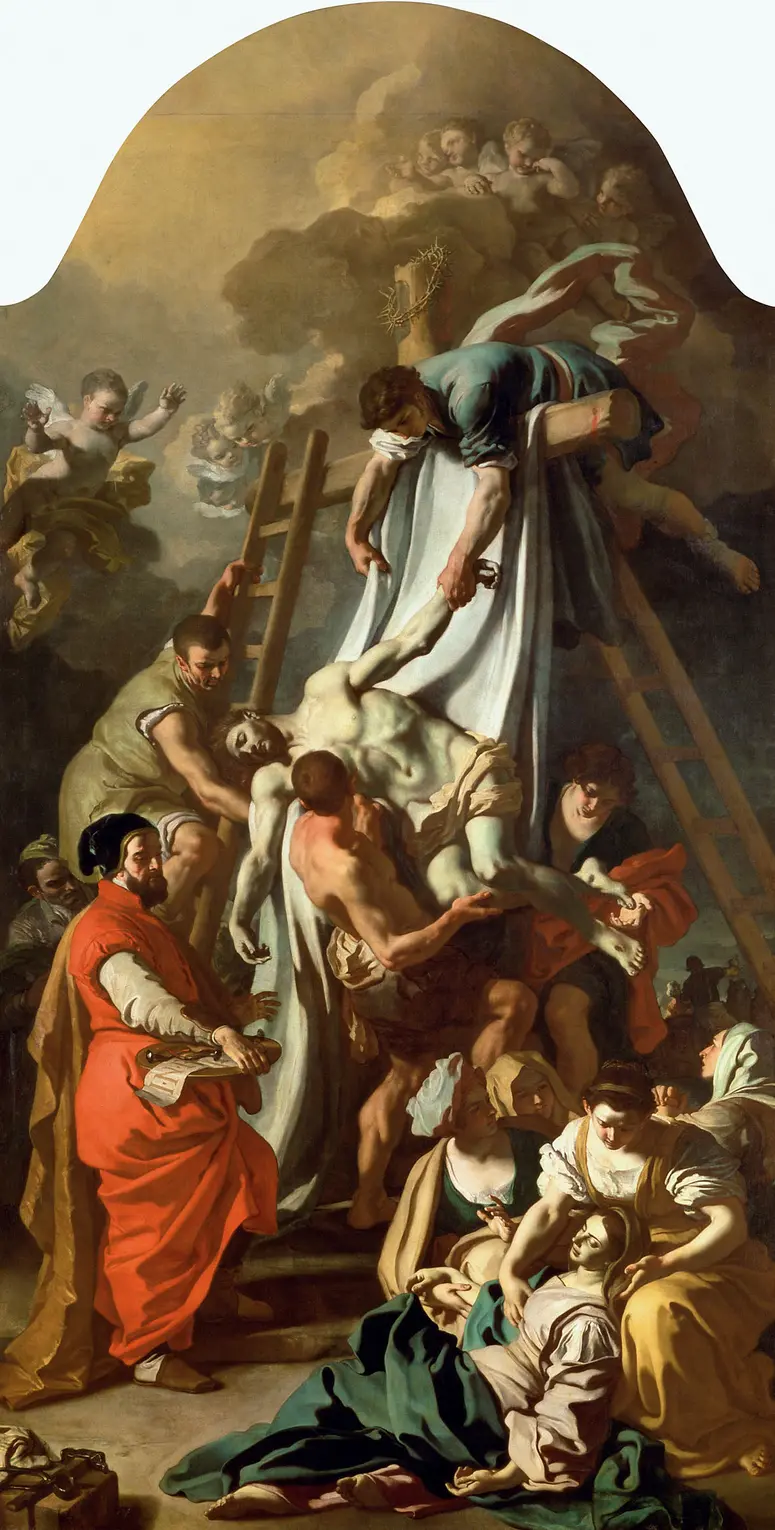
Kreuzabnahme J. Löwy, K. und K. Hof-Photograph, Kunst- und Verlagsanstalt (Wien) 1888 bis 1891
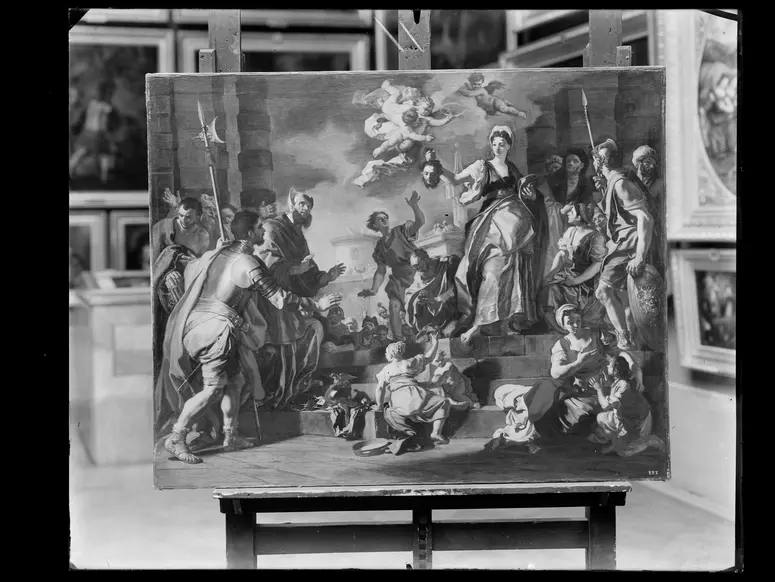
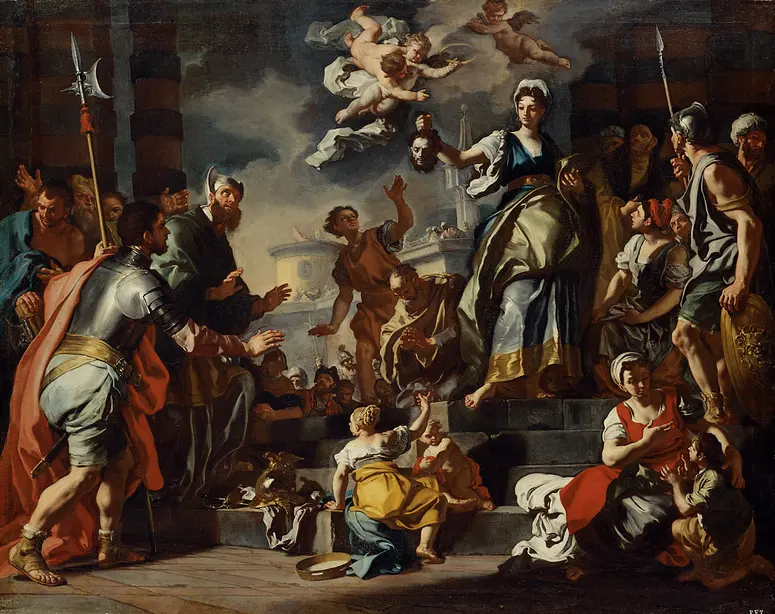
Judith mit dem Haupt des Holofernes J. Löwy, K. und K. Hof-Photograph, Kunst- und Verlagsanstalt (Wien) 1888 bis 1910

Martyrium des heiligen Januarius und seiner Gefährten J. Löwy, K. und K. Hof-Photograph, Kunst- und Verlagsanstalt (Wien) 1888 bis 1910

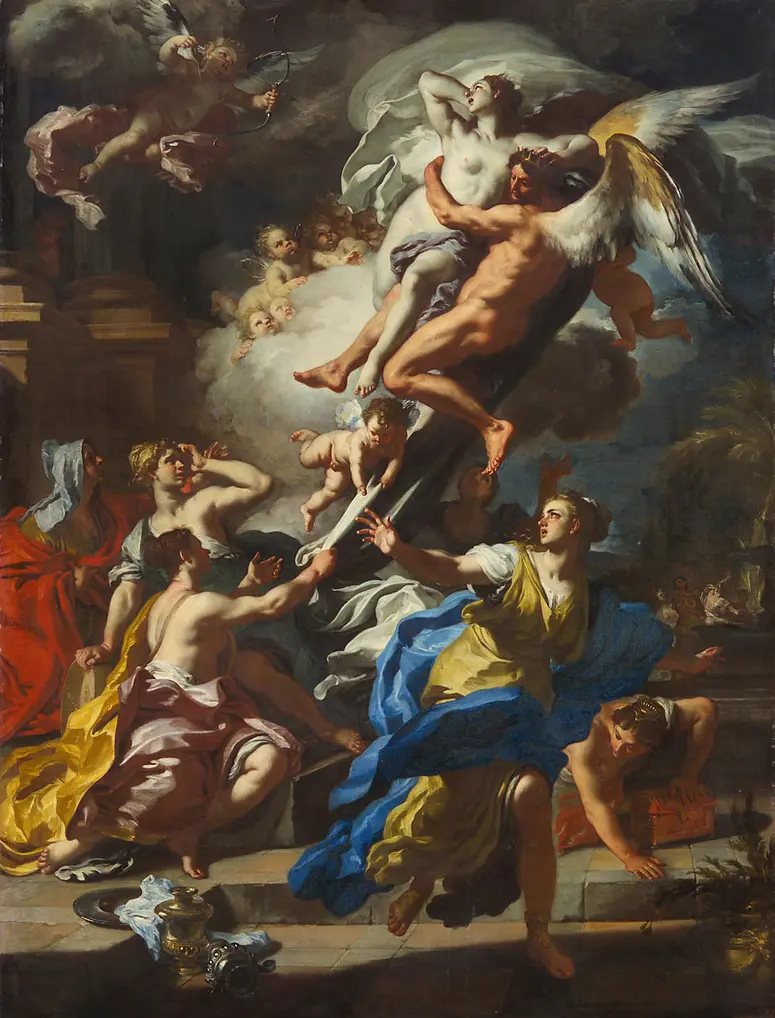
Boreas raubt Orethyia J. Löwy, K. und K. Hof-Photograph, Kunst- und Verlagsanstalt (Wien) 1888 bis 1891

Thronende Madonna mit Heiligen J. Löwy, K. und K. Hof-Photograph, Kunst- und Verlagsanstalt (Wien) 1888 bis 1910

Kaiser Karl V., Statue, Statuette, Terracotta Karl I. (V.) (1516-1556), als Karl I. König von Spanien, ab 1519 deutscher König, ab 1520 Kaiser um 1600

Maria von Burgund, Statue, Statuette, Terracotta Maria (1477-1482), Herzogin von Burgund um 1600


Isabella von Geldern, Statue, Statuette, Terracotta Francesco Terzio um 1600

Gertrud (Anna) von Hohenberg, Terracotta, Statue, Statuette Anna von Hohenberg um 1600