Laternenschild mit Eisenhandschuh und einschiebbarer Stoßklinge
Mannerist artists had a weakness for unusual technical inventions. This shield, named after the oil lamp installed on its reverse, is an excellent example. The shield plays with the idea of a nocturnal fight, in which the bearer could use the lantern to blind an enemy. The shield is an attempt to conflate different fencing weapons into a single one. It combines a round shield, a long gauntlet, and a dagger. The long blade is an offensive weapon, as are the spikes in the centre of the shield and the gauntlet; the latter is worked like a sword-breaker with a jagged blade, as are the riveted, concentric bands on the shield.
The price for this sophisticated conceit is a loss of practicality. Despite its gimbal mounting, the instant the hand clutching the shield moves, the lamp will be snuffed out or the bearer will douse himself in scalding oil. Ingenious though highly impractical, the shield presumably functioned as a conversation piece.
The lantern shield belonged to Ferdinand II, Archduke of Austria. In the inventory of his estate compiled after his death in 1596 it is described as ‘a round shield, lined with crimson silk and trimmed with silver and gold passementerie, with an inside lantern, silver and gilt, also a metal gauntlet lined with mail, and the gauntlet set with two spikes’ (Mer ain rundell, mit rotem sammet gefuetert auch mit silber und gulden passeman verbrämbt, hat inwendig ain luthern, silber und vergult, auch ain plechhandschuech, mit panzer ausgefuettert, und auf dem plechhendschuech sein 2 spücz).
In 1678, a similar shield formerly in the possession of Archduke Ernest was mentioned as being in the imperial armoury at Stallburg Palace in Vienna: ‘a black iron round shield with a serrated edge, together with an iron gauntlet, a lantern and a large blade, lined in crimson silk ... which Archduke Ernest brought back from Spain’ (ein schwarz eyserne zipflete rundeln, sambt einen daran gefügten eysernen handtschuech, wie auch einer latern und einer wehr klingen, mit rothen samet gefüedert … so erzherzog Ernst auß Hispanien mit gebracht).
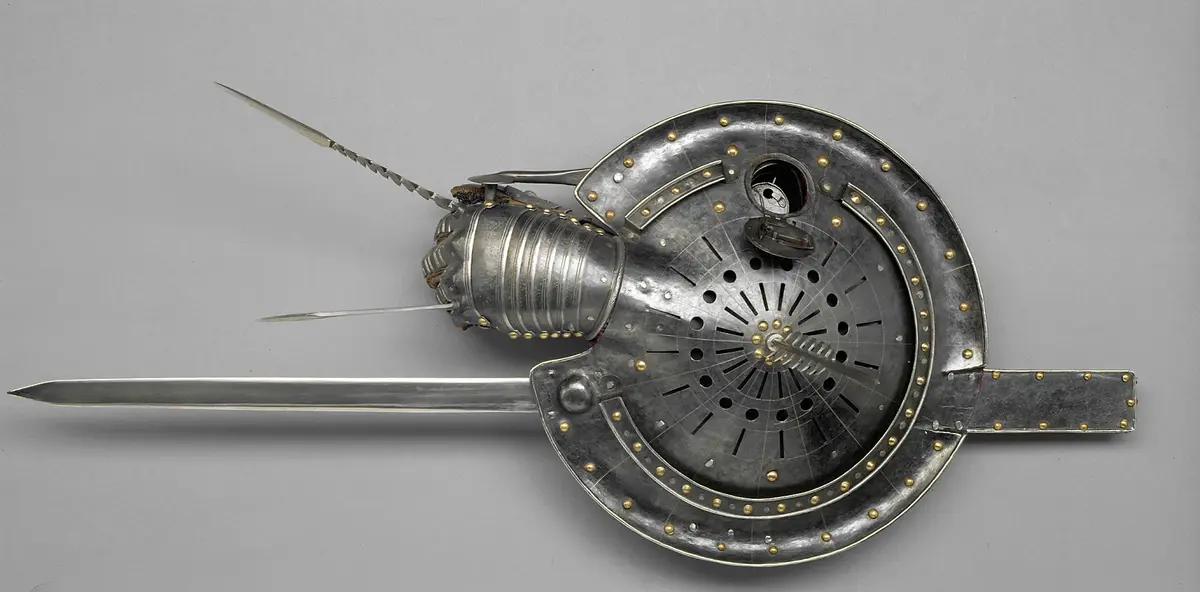
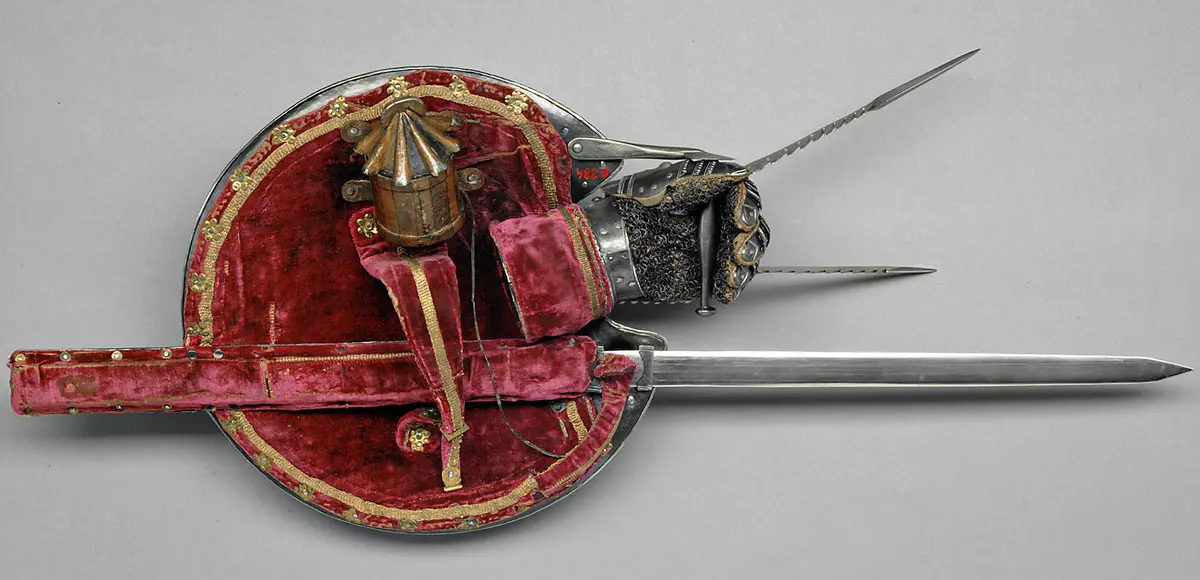
Mannerist artists had a weakness for unusual technical inventions. This shield, named after the oil lamp installed on its reverse, is an excellent example. The shield plays with the idea of a nocturnal fight, in which the bearer could use the lantern to blind an enemy. The shield is an attempt to conflate different fencing weapons into a single one. It combines a round shield, a long gauntlet, and a dagger. The long blade is an offensive weapon, as are the spikes in the centre of the shield and the gauntlet; the latter is worked like a sword-breaker with a jagged blade, as are the riveted, concentric bands on the shield.
The price for this sophisticated conceit is a loss of practicality. Despite its gimbal mounting, the instant the hand clutching the shield moves, the lamp will be snuffed out or the bearer will douse himself in scalding oil. Ingenious though highly impractical, the shield presumably functioned as a conversation piece.
The lantern shield belonged to Ferdinand II, Archduke of Austria. In the inventory of his estate compiled after his death in 1596 it is described as ‘a round shield, lined with crimson silk and trimmed with silver and gold passementerie, with an inside lantern, silver and gilt, also a metal gauntlet lined with mail, and the gauntlet set with two spikes’ (Mer ain rundell, mit rotem sammet gefuetert auch mit silber und gulden passeman verbrämbt, hat inwendig ain luthern, silber und vergult, auch ain plechhandschuech, mit panzer ausgefuettert, und auf dem plechhendschuech sein 2 spücz).
In 1678, a similar shield formerly in the possession of Archduke Ernest was mentioned as being in the imperial armoury at Stallburg Palace in Vienna: ‘a black iron round shield with a serrated edge, together with an iron gauntlet, a lantern and a large blade, lined in crimson silk ... which Archduke Ernest brought back from Spain’ (ein schwarz eyserne zipflete rundeln, sambt einen daran gefügten eysernen handtschuech, wie auch einer latern und einer wehr klingen, mit rothen samet gefüedert … so erzherzog Ernst auß Hispanien mit gebracht).
Owner:
Ferdinand II. (1564-1595), Erzherzog von Österreich und Landesherr von Tirol (1529 - 1595) DNB
Time:
vor 1596
Object Name
Laternenschild mit Eisenhandschuh und einschiebbarer Stoßklinge
Material/technology:
Schild: Eisen, geschmiedet, getrieben, geschwärzt, teils geschnitten. Nietkappen, Rosetten: Messing. Laterne: Eisenblech, teils getrieben, teils vergoldet). Textil (Samt). Goldlahn. Handschuh: Eisen, geschmiedet, getrieben, gebläut. Nietkappen: Messing. Ringpanzergeflecht: Eisen. Leder. Textil (Samt). Goldlahn.
Dimensions:
L 82 cm x T 40 cm x L bei ausgefahrener Klinge101 cm x Dm 40 cm
Copyright
Kunsthistorisches Museum, Hofjagd- und Rüstkammer
Invs.
Hofjagd- und Rüstkammer, A 384
Browse more
Similar items you might be interested in
Philipp I. (1482-1506), Herzog von Burgund, seit 1504 König von Kastilien und León zwischen 1496 und 1506
Moritz Sohn des Wilhem von Oranien 1590-1595
Gloomy Day (Early Spring) Pieter Bruegel d. Ä. 1565
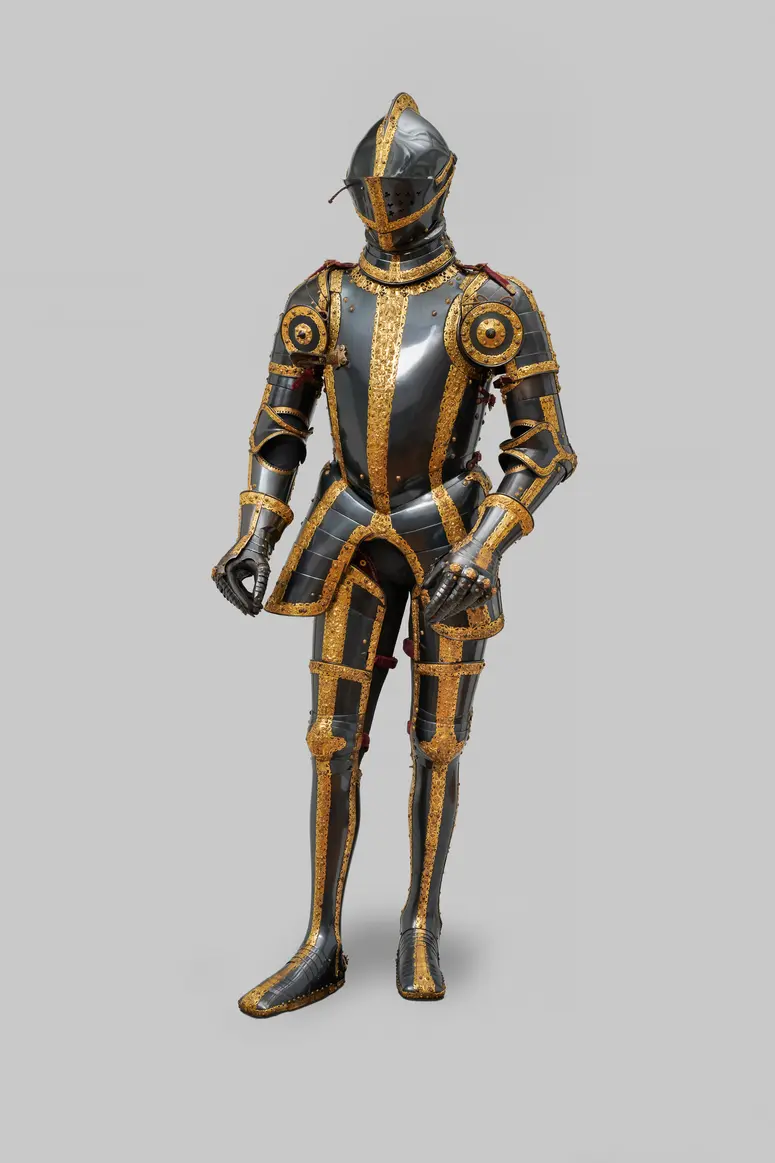
Maximilian II. (1564-1576), Kaiser datiert 1557
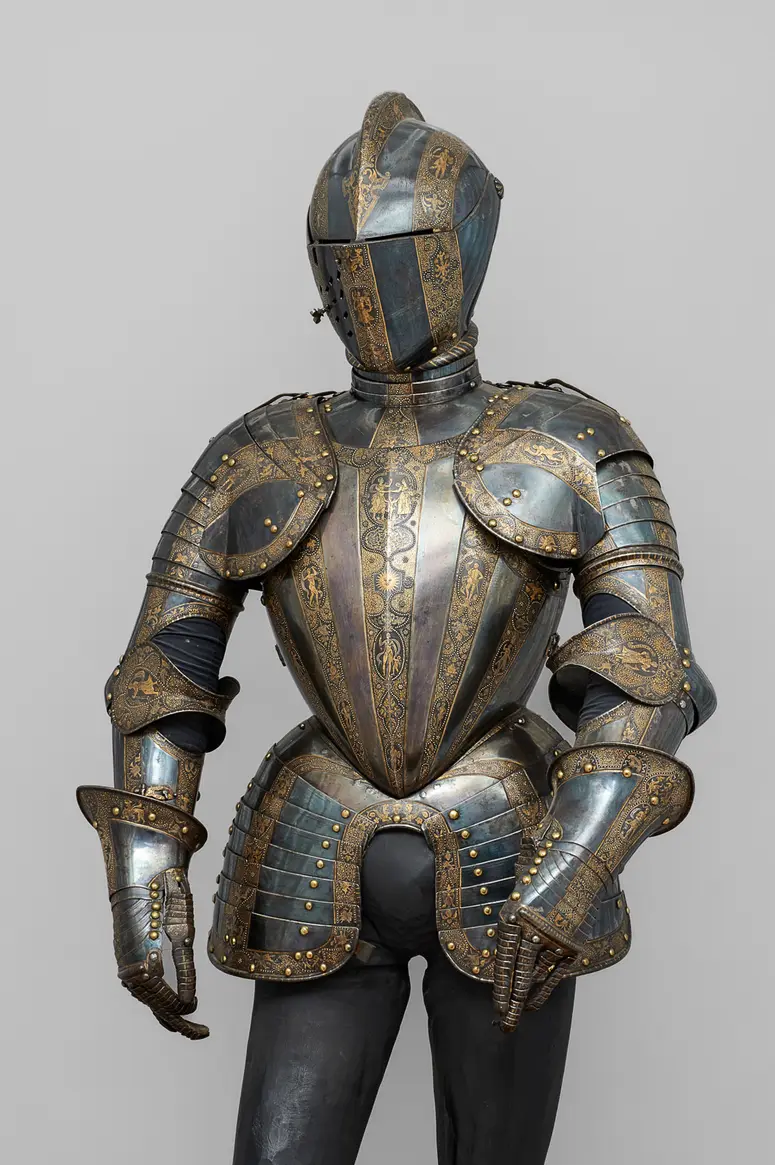
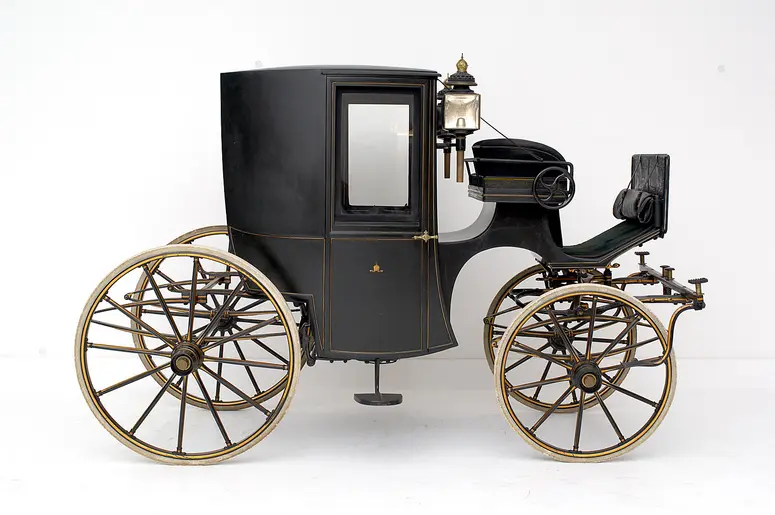
Personal Coupé Manufacturer: Hofwagenfabrik Marius (Wien) 1887
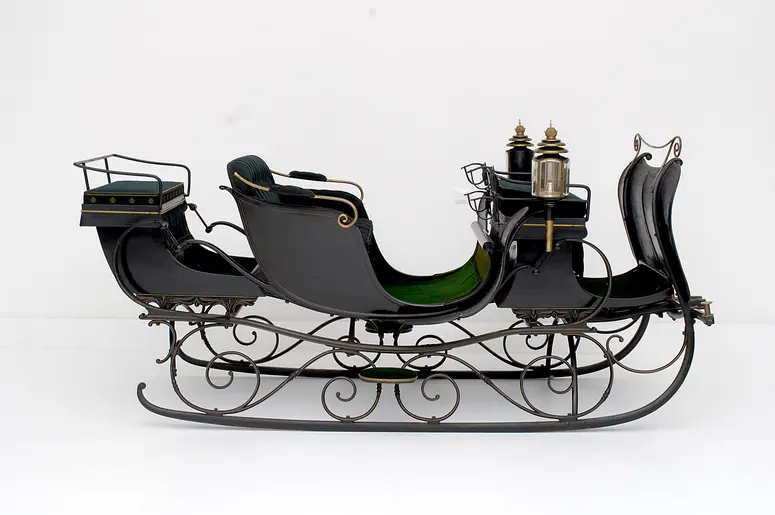
Large spring-suspended personal sleigh Hofwagenfabrik Armbruster (Wien) 1897

Lavish Personal State Chariot Manufacturer: Cesare Sala 1857

Personal Landaulet of Empress Elisabeth Manufacturer: Carl Marius 1885
Four-seater Ceremonial State Carriage Carl Marius 1865
Rüstung zum Plankenstechen (welsches Stechen), ganzer blanker Turnierharnisch Manufacturer: Jakob Topf um 1580/1590
Karl I. (V.) (1516-1556), als Karl I. König von Spanien, ab 1519 deutscher König, ab 1520 Kaiser vor 1535