Die Handschuhe
vor 1220
Made of plain red samite, the gloves are densely decorated on the back. Golden tendrils embroidered in couched work fill the ground upon which enamel plaques, precious stones and pearls are mounted. On the back of each glove there is a central cloisonné appliqué in the shape of a palmette with a small pointed oval shield on either side with a bird's head above each of these. Between the heads, the left glove has a pentagonal niello plaque with a half-length depiction of an angel, probably added in the 14th century. At the same place on the right glove is the remainder of what was once a star-shaped enamel plaque. At the base of the index and ring fingers of both gloves are round enamel plaques depicting a siren with a single tail. Like the backs of the gloves, the palms were embroidered with gold tendrils. In addition, they have a one-headed eagle with a halo, the heraldic symbol of the Hohenstaufen dynasty. On the right glove most of the embroidery is missing, thus revealing the dark preliminary drawing of the motif. At the lower edge of the gloves is a narrow band framed at the top and bottom by double rows of pearls. The red silk ground is filled with enamel plaques, precious stones, gold embroidery and individual pearls that have been sewn on. Stylistically the enamel plaques match the decoration on the sheath of the Ceremonial Sword (Inv. No. SK_WS_XIII_16) as well as the Crown of Constance, the wife of Frederick II, which is kept in Palermo. This supports the assumption that the gloves were made for the coronation of Frederick II in 1220. The first mention of them is probably that in the inventory of 1246, in which they were called "two gloves with precious stones".
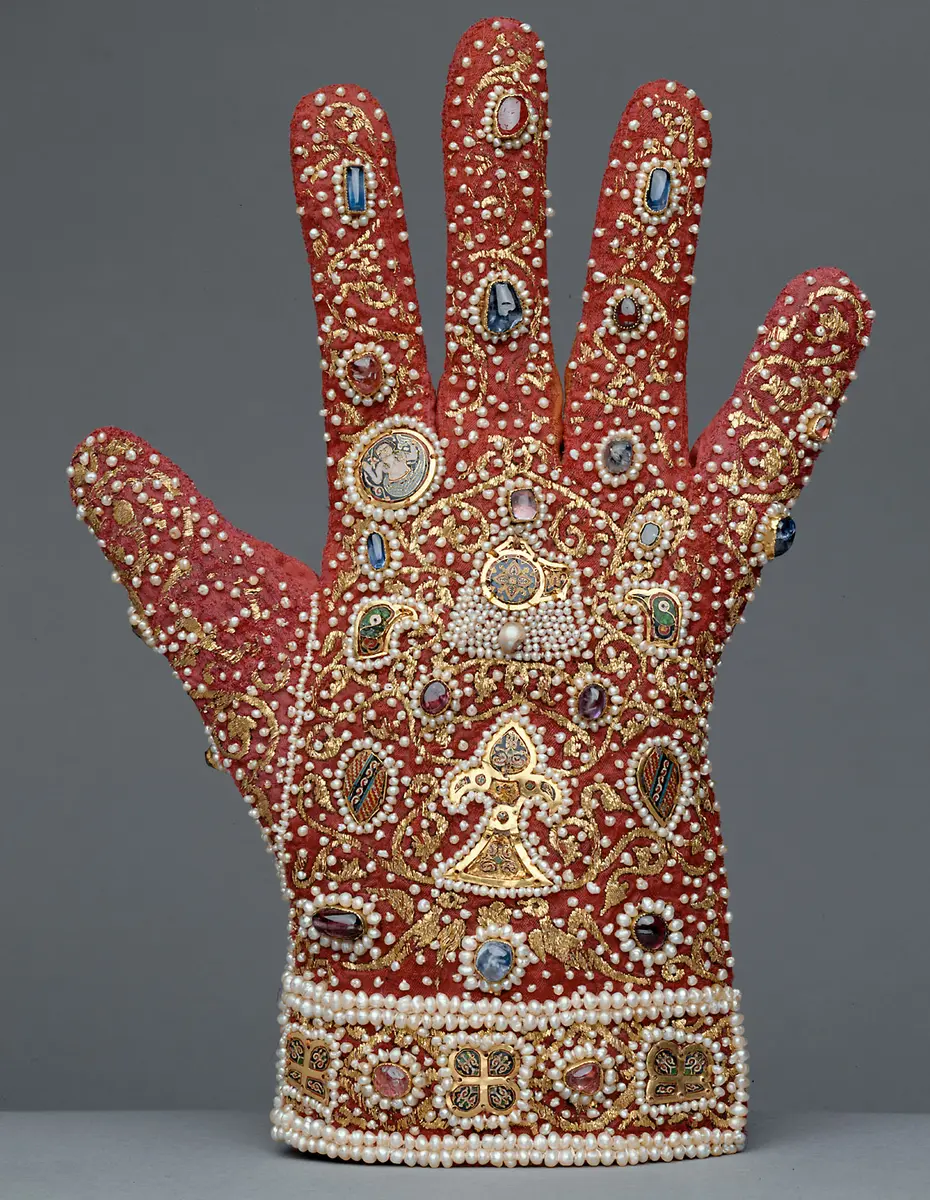
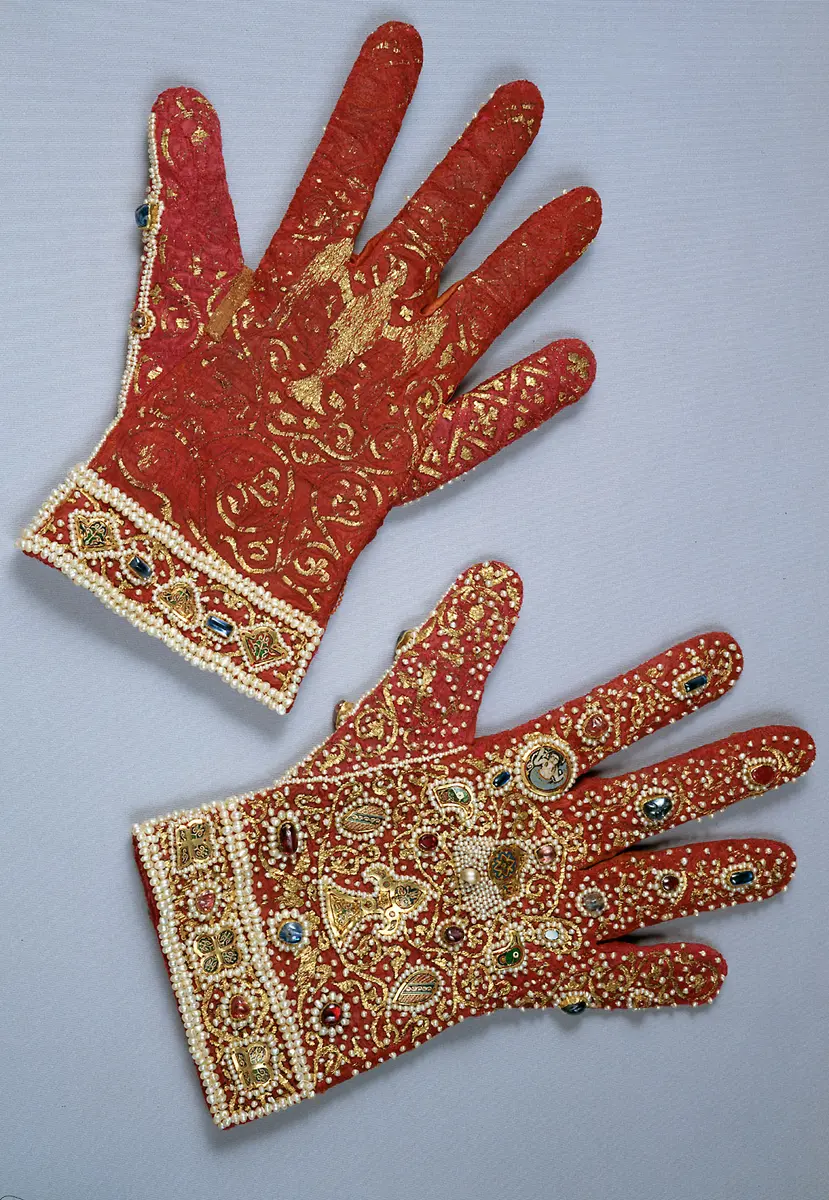
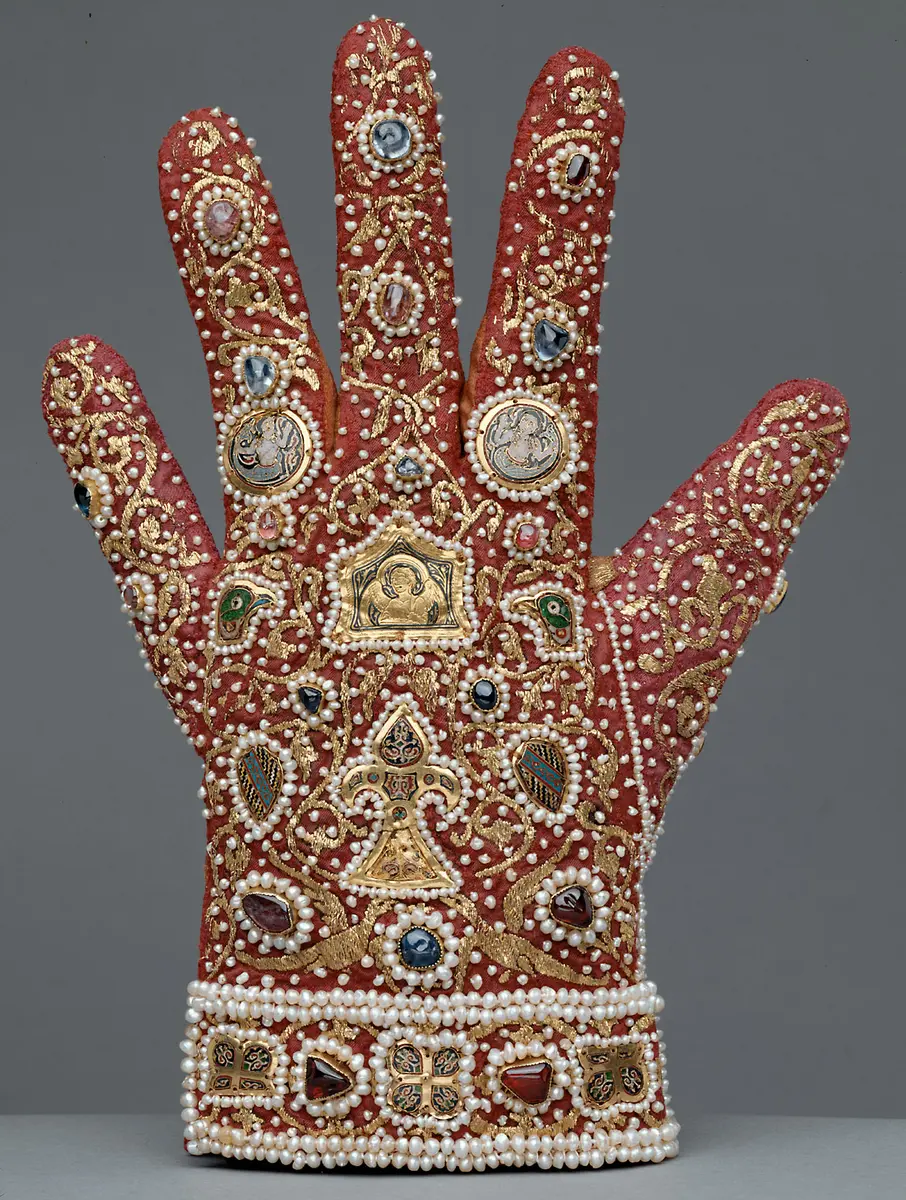
Made of plain red samite, the gloves are densely decorated on the back. Golden tendrils embroidered in couched work fill the ground upon which enamel plaques, precious stones and pearls are mounted. On the back of each glove there is a central cloisonné appliqué in the shape of a palmette with a small pointed oval shield on either side with a bird's head above each of these. Between the heads, the left glove has a pentagonal niello plaque with a half-length depiction of an angel, probably added in the 14th century. At the same place on the right glove is the remainder of what was once a star-shaped enamel plaque. At the base of the index and ring fingers of both gloves are round enamel plaques depicting a siren with a single tail. Like the backs of the gloves, the palms were embroidered with gold tendrils. In addition, they have a one-headed eagle with a halo, the heraldic symbol of the Hohenstaufen dynasty. On the right glove most of the embroidery is missing, thus revealing the dark preliminary drawing of the motif. At the lower edge of the gloves is a narrow band framed at the top and bottom by double rows of pearls. The red silk ground is filled with enamel plaques, precious stones, gold embroidery and individual pearls that have been sewn on. Stylistically the enamel plaques match the decoration on the sheath of the Ceremonial Sword (Inv. No. SK_WS_XIII_16) as well as the Crown of Constance, the wife of Frederick II, which is kept in Palermo. This supports the assumption that the gloves were made for the coronation of Frederick II in 1220. The first mention of them is probably that in the inventory of 1246, in which they were called "two gloves with precious stones".
Time:
vor 1220
Object Name
Textil; liturgisches Gewand; Krönungsornat
Culture
Palermo
Material/technology:
Textil; Roter Samit, Goldstickerei, Goldappliken mit Zellenschmelzemail, Nielloplättchen, Perlen, Rubine, Saphire, Amethyste, Granate, Spinelle, Korunde
Dimensions:
L. 26,3 bzw. 27,7 cm, B. 12 cm
Copyright
Kunsthistorisches Museum, Weltliche Schatzkammer
Invs.
Schatzkammer, WS XIII 11