Gabel, Vorschneidemesser und Vorlegemesser
4. Viertel 16. Jahrhundert | Rudolf II. (1576-1612), Kaiser, römischer König ab 1575, König von Ungarn ab 1572, von Böhmen se
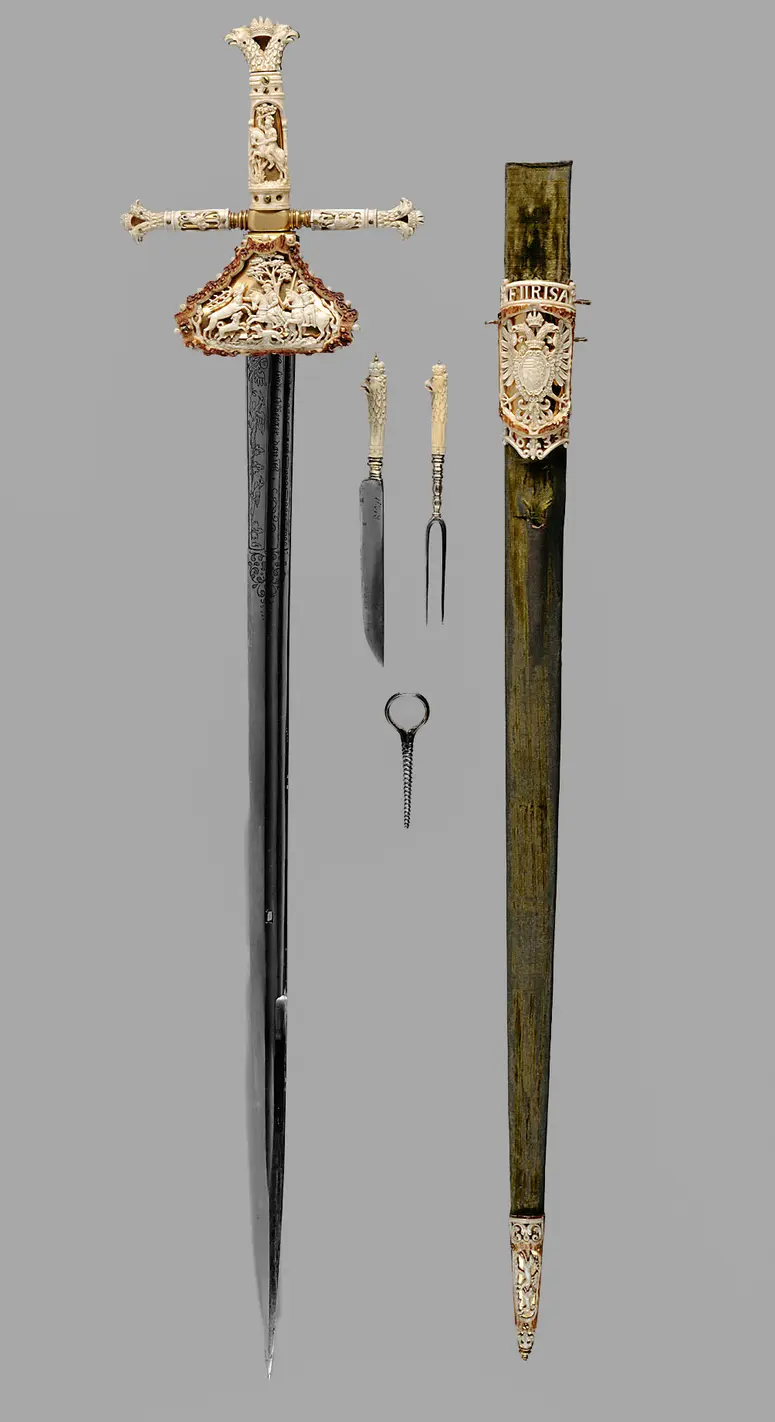
This garniture comprises a fork, a carving knife, and a trowel-shaped serving knife (presentoir). The fork and carving knife were used to carve the food that was then served or presented to a guest on the serving knife. The handles of all three are made of agate, attached to the blade with an enamelled gold setting. The blade of the serving knife is wide and rounded; note the unidentified bladesmith’s mark (a five-pointed star above a crescent moon) at the edge of the blade. The carving knife (bearing the same mark) has a single-edged blade and an enlarged, curved, double-edged tip. The fork has a long octagonal handle made of gilt silver and ends in two short prongs.
The set was probably made in Milan. This is suggested by the decoration of the mounts – blue-and-white enamelled crescent moons are only found on works produced by Milanese workshops. The way the handles are attached, with the mount joining blade and handle, also suggests they originated south of the Alps; north of the Alps, a hole was drilled into the mount and a thin extension of the blade riveted to the ends of the handle.
The precious and elegant handling suggest this set was never actually used. It is presumably an objet d’art for a Kunstkammer, though it may have been used on special occasions for serving at court banquets. The set comes from the imperial gun room (Kaiserliche Hofgewehrkammer, cat. 509) in Vienna, where it was attributed to Emperor Matthias: ‘from the first half of the seventeenth century, Matthias’ (aus der 1tn. Hälfte des 17. Jahrhunderts Mathias). We can no longer determine if it originally belonged to Matthias or his older brother Rudolf; Rudolf’s close contacts with Milanese artists would suggest that it was he who ordered it.
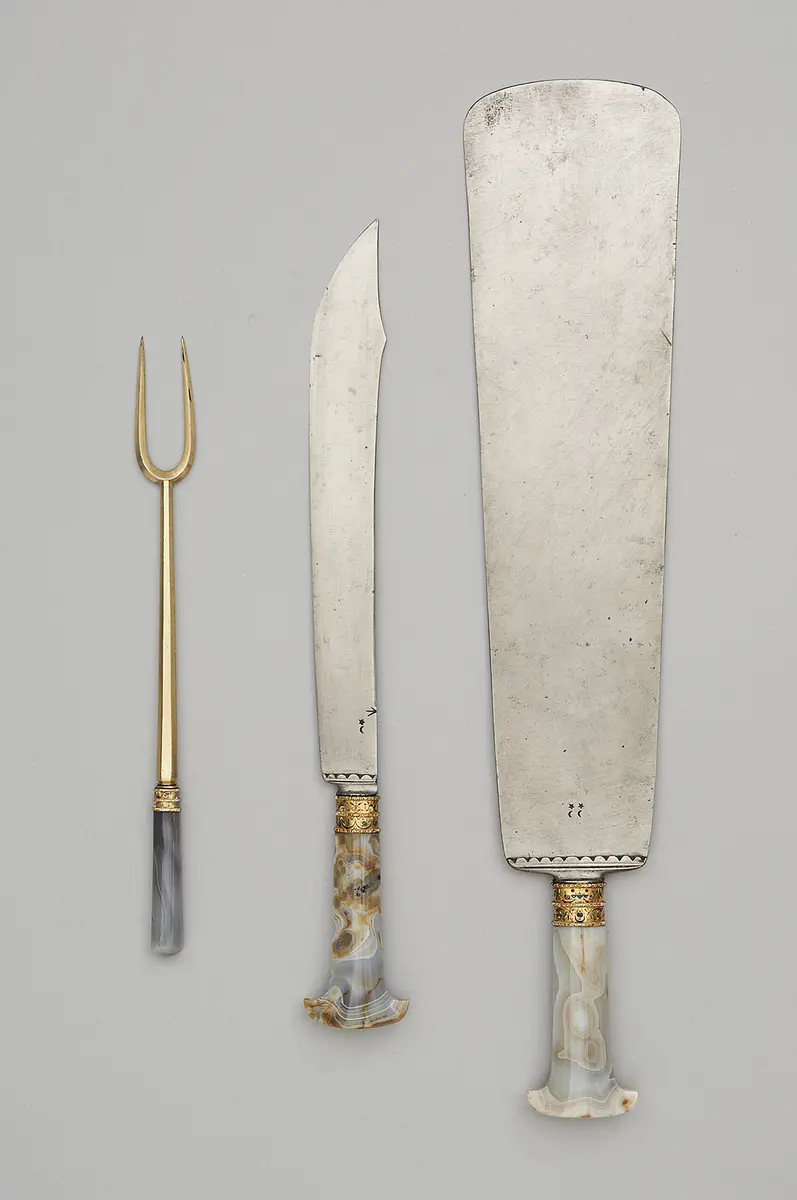
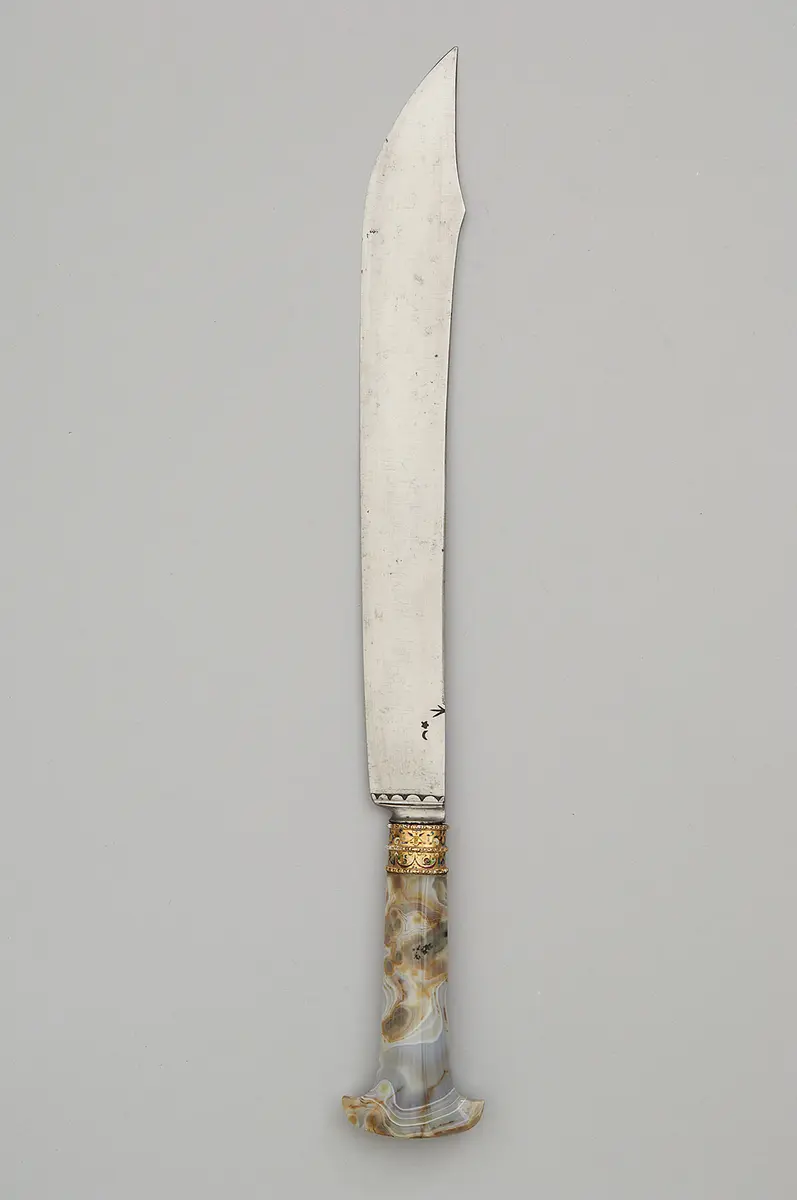
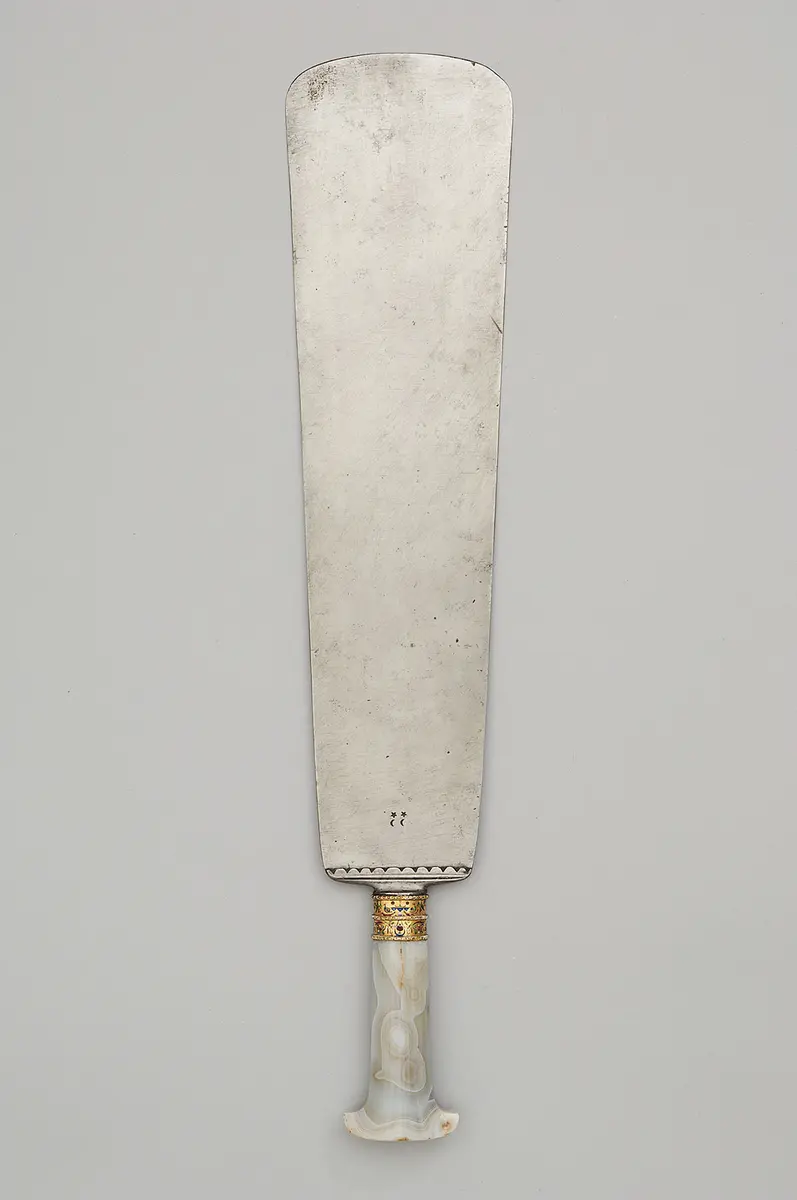
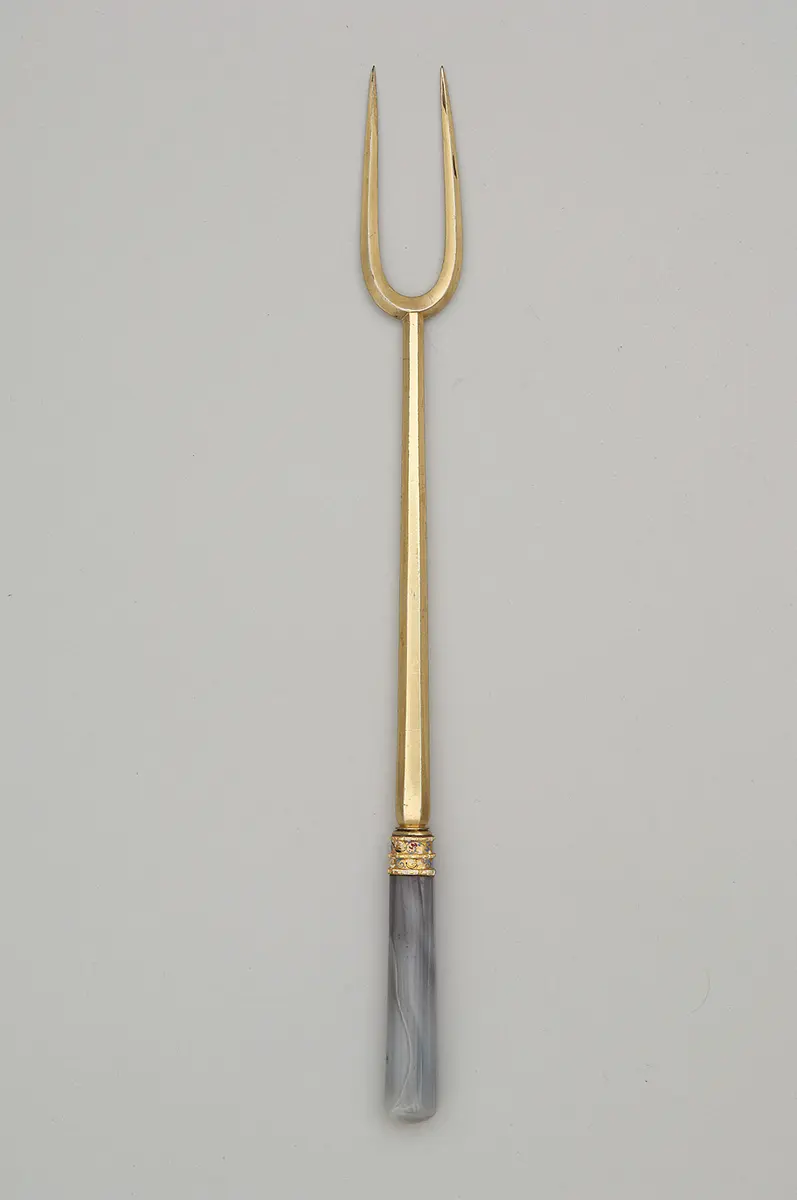
This garniture comprises a fork, a carving knife, and a trowel-shaped serving knife (presentoir). The fork and carving knife were used to carve the food that was then served or presented to a guest on the serving knife. The handles of all three are made of agate, attached to the blade with an enamelled gold setting. The blade of the serving knife is wide and rounded; note the unidentified bladesmith’s mark (a five-pointed star above a crescent moon) at the edge of the blade. The carving knife (bearing the same mark) has a single-edged blade and an enlarged, curved, double-edged tip. The fork has a long octagonal handle made of gilt silver and ends in two short prongs.
The set was probably made in Milan. This is suggested by the decoration of the mounts – blue-and-white enamelled crescent moons are only found on works produced by Milanese workshops. The way the handles are attached, with the mount joining blade and handle, also suggests they originated south of the Alps; north of the Alps, a hole was drilled into the mount and a thin extension of the blade riveted to the ends of the handle.
The precious and elegant handling suggest this set was never actually used. It is presumably an objet d’art for a Kunstkammer, though it may have been used on special occasions for serving at court banquets. The set comes from the imperial gun room (Kaiserliche Hofgewehrkammer, cat. 509) in Vienna, where it was attributed to Emperor Matthias: ‘from the first half of the seventeenth century, Matthias’ (aus der 1tn. Hälfte des 17. Jahrhunderts Mathias). We can no longer determine if it originally belonged to Matthias or his older brother Rudolf; Rudolf’s close contacts with Milanese artists would suggest that it was he who ordered it.
Time:
4. Viertel 16. Jahrhundert
Object Name
Gabel, Vorschneidemesser und Vorlegemesser
Culture
Mailand (?)
Material/technology:
Messer: Klinge: Eisen, geschmiedet, teils geschnitten. Griff: Weißer Bandachat. Fassung: Goldblech, graviert, emailliert. Gabel: Silber, feuervergoldet. Griff: Goldblech, graviert, emailliert.
Dimensions:
Waidblatt: L 49,5 cm x B 10,5 cm x T 2,5 cm
Messer: L 39 cm x B 5,5 cm x T 2,2 cm
Gabel: L 30 cm x B 3 cm x T 1,4 cm
Stamp / markings
Auf dem Waidblatt einseitig zweimal Halbmond mit Stern; auf dem Aufbruchmesser einseitig einmal Halbmond mit Stern.
Copyright
Kunsthistorisches Museum, Hofjagd- und Rüstkammer
Invs.
Hofjagd- und Rüstkammer, D 206
Browse more
Similar items you might be interested in

Hirschfänger; Ein Paar Vorlegmesser; Vorschneide- und Vorlegebesteck; Zwei Jagdmesser oder Vorlegemesser samt Scheide; Saudegen; Saudegen; Jagdbesteck J. Löwy, K. und K. Hof-Photograph, Kunst- und Verlagsanstalt (Wien) 1892
Daniel Sadeler Klinge: um 1600; Fassung: 1. Drittel 17. Jahrhundert
Duc Philippe III le Bon de Jean sans Peur Valois um 1460

Maximilian I. (1477-1519), seit 1493 deutscher König, 1508 Kaiser 1496


Franz I. (1745-1765), Kaiser, 1729-1737 als Franz III. Herzog von Lothringen, ab 1737 als Franz II um 1740/45

Ferdinand II. (1617-1637), ab 1619 Kaiser, ab 1617 König von Böhmen, ab 1618 König von Ungarn datiert 1633

Relief (Talatat) mit Schlachtungsszene Hermopolis - Amarna (vermutlich) 18. Dynastie, Zeit des Echnaton, 1372-1355 v. Chr.