Hirschfänger
This hunting sword is a masterpiece of late Gothic blade smithery. We can attribute it to Hanns Sumersperger, a swordsmith active in Hall, a town east of Innsbruck, in the late fifteenth century. Both the attribution to him and dating the sword to around 1496 reflect the marked similarities between this weapon and the ceremonial sword of Emperor Maximilian I (Kunsthistorisches Museum Vienna, Imperial Treasury, inv. WS XIV 4), which is signed by Sumersperger and dated 1496. A number of other swords by the master-craftsman have survived, among them a short sword now in Copenhagen.
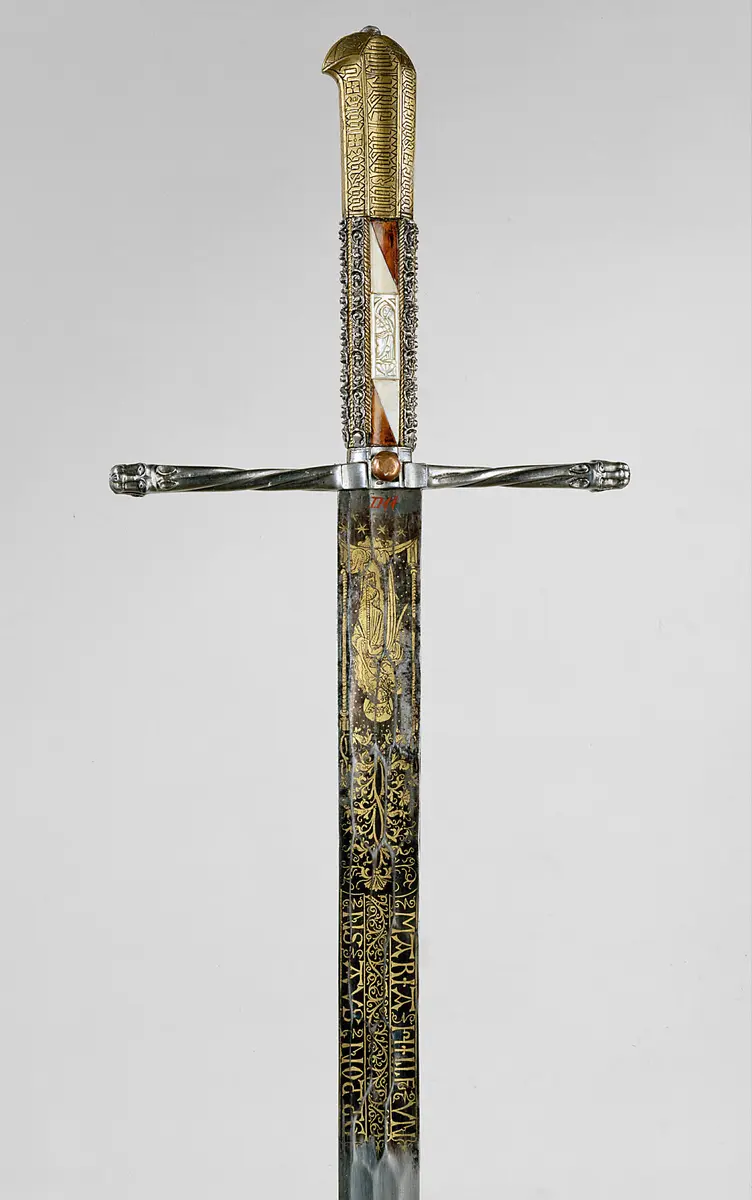
This hunting sword has a pommel made of cast gilt brass engraved with the inscription, in Gothic minuscules, Maria hilf uns aus der Not (‘Virgin Mary aid us in our distress’). The obverse of the handle is decorated with wood and bone pendentives flanking a small, central, carved mother-of-pearl plate depicting a female saint, probably Catherine or Barbara. The sides are framed with narrow ledges cast in silver with three-dimensional garlands. The spiral crossguard is straight and ends in dogs’ heads.
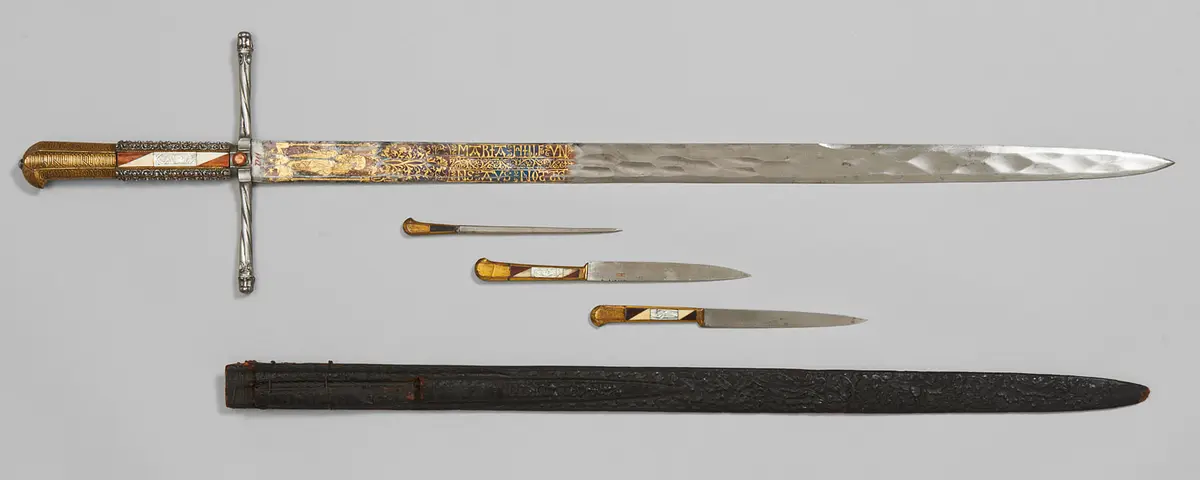
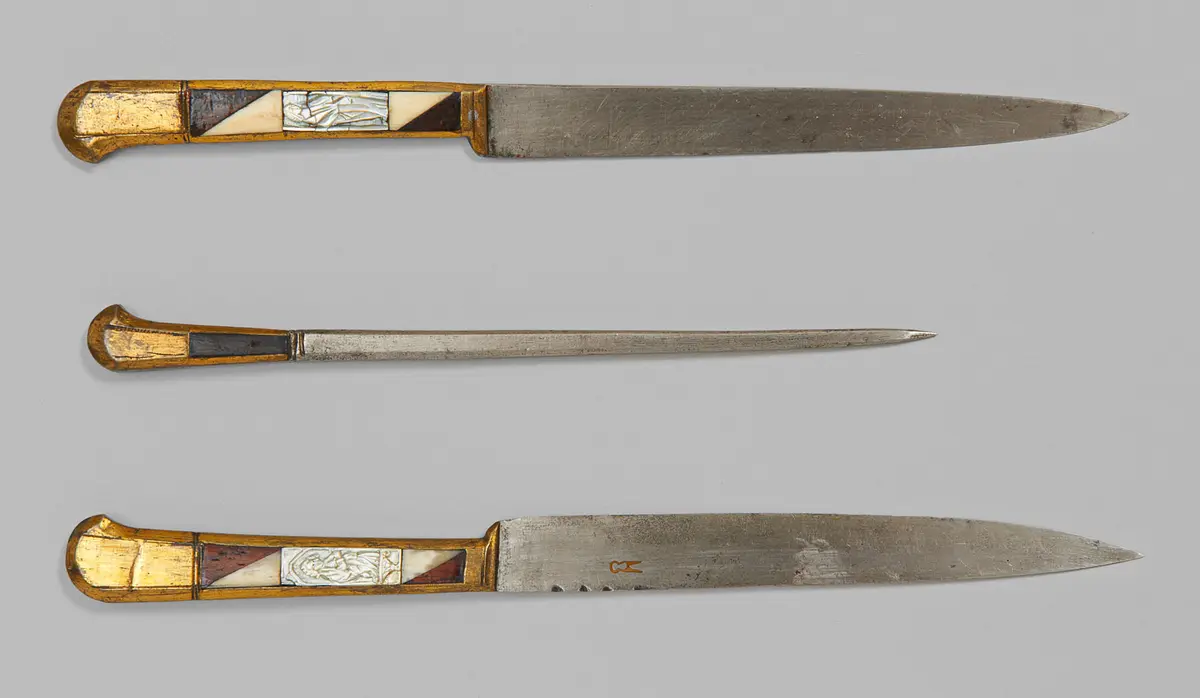
The facetted blade is mostly single-edged. Its first third features a fire-gilt Woman of the Apocalypse on a blued ground below the inscription, in Gothic majuscules, MARIA HILLF VN/NS AVS NOTTG (‘Virgin Mary, aid us in our distress’). On the reverse is St Sebastian with the inscription HIILLF SANNDT/ SEWASTTIANN (‘Aid [us] St Sebastian’). A richly embellished black leather scabbard made for this hunting sword has also survived, together with two small hunting knives and a pricker. The sword was formerly in the imperial gun room (Hofgewehrkammer) in Vienna (cat. 495).
Hunting swords were used in the fifteenth and sixteenth centuries to kill boars and bears from horseback or on foot. This was very dangerous and therefore considered an act of courage.
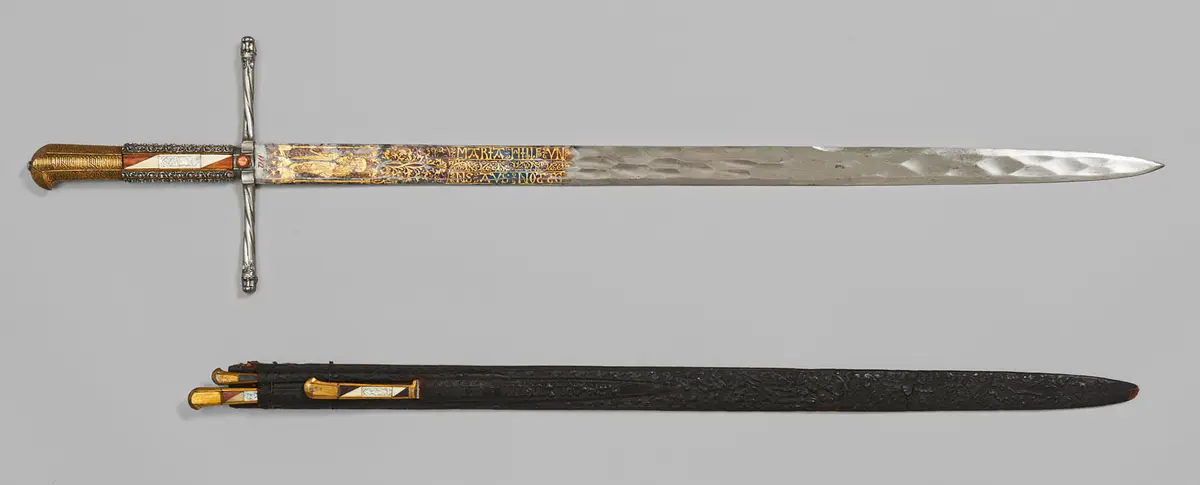
This hunting sword is a masterpiece of late Gothic blade smithery. We can attribute it to Hanns Sumersperger, a swordsmith active in Hall, a town east of Innsbruck, in the late fifteenth century. Both the attribution to him and dating the sword to around 1496 reflect the marked similarities between this weapon and the ceremonial sword of Emperor Maximilian I (Kunsthistorisches Museum Vienna, Imperial Treasury, inv. WS XIV 4), which is signed by Sumersperger and dated 1496. A number of other swords by the master-craftsman have survived, among them a short sword now in Copenhagen.
This hunting sword has a pommel made of cast gilt brass engraved with the inscription, in Gothic minuscules, Maria hilf uns aus der Not (‘Virgin Mary aid us in our distress’). The obverse of the handle is decorated with wood and bone pendentives flanking a small, central, carved mother-of-pearl plate depicting a female saint, probably Catherine or Barbara. The sides are framed with narrow ledges cast in silver with three-dimensional garlands. The spiral crossguard is straight and ends in dogs’ heads.
The facetted blade is mostly single-edged. Its first third features a fire-gilt Woman of the Apocalypse on a blued ground below the inscription, in Gothic majuscules, MARIA HILLF VN/NS AVS NOTTG (‘Virgin Mary, aid us in our distress’). On the reverse is St Sebastian with the inscription HIILLF SANNDT/ SEWASTTIANN (‘Aid [us] St Sebastian’). A richly embellished black leather scabbard made for this hunting sword has also survived, together with two small hunting knives and a pricker. The sword was formerly in the imperial gun room (Hofgewehrkammer) in Vienna (cat. 495).
Hunting swords were used in the fifteenth and sixteenth centuries to kill boars and bears from horseback or on foot. This was very dangerous and therefore considered an act of courage.
Owner:
Maximilian I. (1477-1519), seit 1493 deutscher König, 1508 Kaiser (1459 - 1519) DNB
Artist:
Hans Sumersperger , (Messerschmied) (1492 - 1498 in Hall/Tirol nachweisbar)
Time:
1496
Object Name
Hirschfänger
Culture
Hall in Tirol
Material/technology:
Hirschfänger: Klinge: Eisen, geschmiedet, teils gebläut, teils feuervergoldet (Goldschmelz). Griff: Messing, teils graviert. Silber, gegossen, Messing, Bein, Perlmutt, geschnitzt. Holz. Parierstange: Eisen, geschmiedet, teilweise geschnitten. Niete: Kupfer, feuervergoldet. Messer: Klinge: Eisen, geschmiedet, teils mit Kupfer, tauschiert. Griff: Messing, feuervergoldet, teilweise punziert. Bein, Perlmutt, geschnitzt. Holz. Pfriem: Eisen, geschmiedet. Griff: Messing, feuervergoldet, teilweise punziert. Holz. Scheide: Leder, geprägt und geschnitten.
Dimensions:
Schwert: 106,5 cm x 24,5 cm x 2,8 cm
Scheide: L 84,7 cm x B 4,3 cm x T 2,4 cm
Messer 1: L 25,6 cm x B 1,7 cm x T 0,5 cm
Messer 2: L 25,7 cm x B 2,3 cm x T 0,5 cm
Pfriem: L 20,4 cm x B 1,8 cm x T 0,5 cm
Inscribed
Klingeninschrift: “MARIA.HILLF.VNNS.AVS.NOTTG.” bzw. auf der Gegenseite
“HILFF.SANNDT.SEWASTTIANN” (Maria hilf uns aus Not) und (Hilf Sankt Sebastian)
Scheideinschriften “maria”, bzw. “hilf maria” (schwer lesbar)
Stamp / markings
Messer 1: ein in Kupfer tauschiertes Klingenschmiedzeichen unidentifizierte Form
Messer 2: einseitig ein in Kupfer tauschiertes Klingenschmiedzeichen Schere
Copyright
Kunsthistorisches Museum, Hofjagd- und Rüstkammer
Invs.
Hofjagd- und Rüstkammer, D 11
Browse more
Similar items you might be interested in
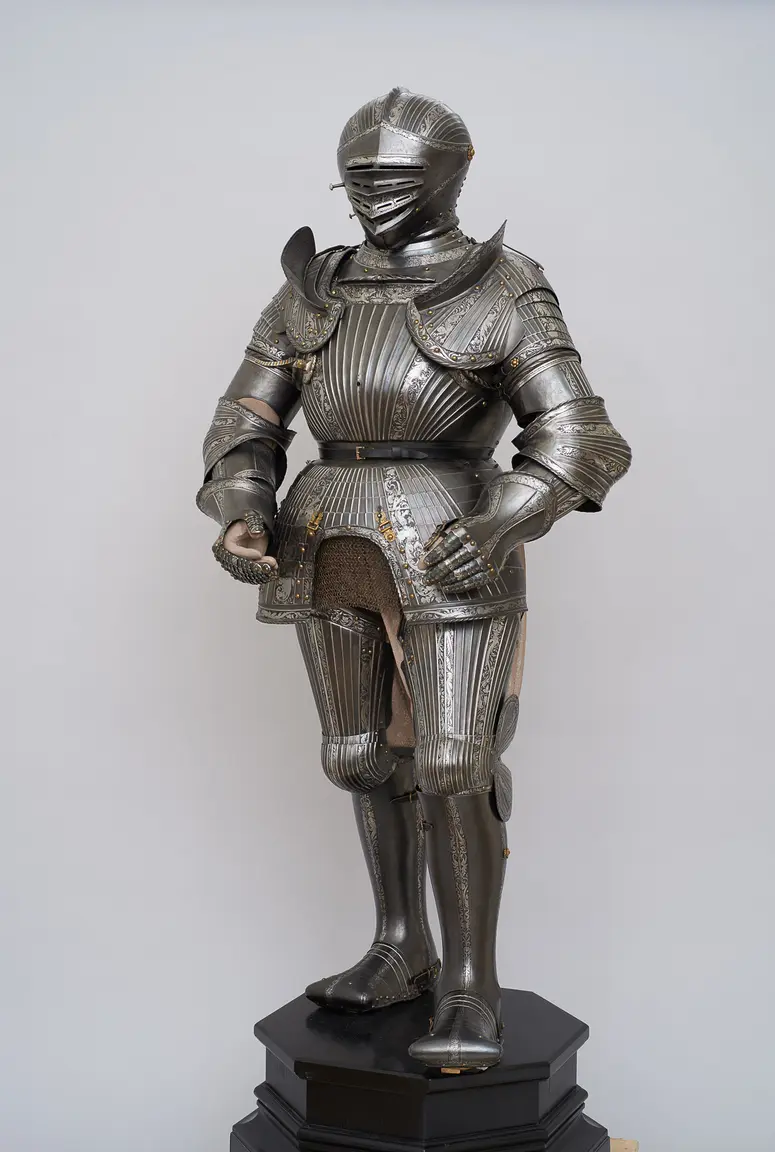
Riefelharnisch, Riefelküriss: Fluted field armour Johann Friedrich I. (1532-1547), Kurfürst von Sachsen Dated 1530
“Joking Couple”, Self-Portrait of the Artist with his Wife Hans von Aachen around 1596
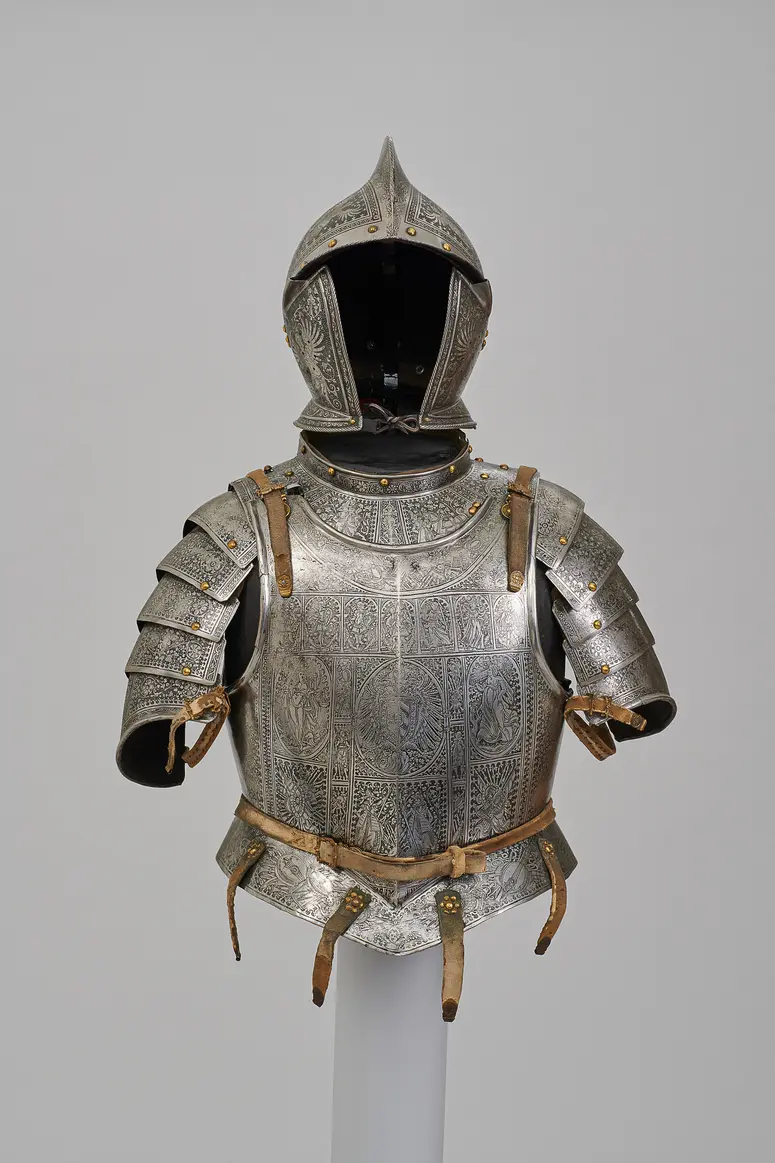
Hans Becher d. Ä. Plattnerarbeiten spätes 16. Jahrhundert, Ätzung datiert 1618, tlw. Ergänzungen
Johann Friedrich I. (1532-1547), Kurfürst von Sachsen datiert 1530
Sigismund Franz (1662-1665), Erzherzog von Vorderösterreich um 1635-1638