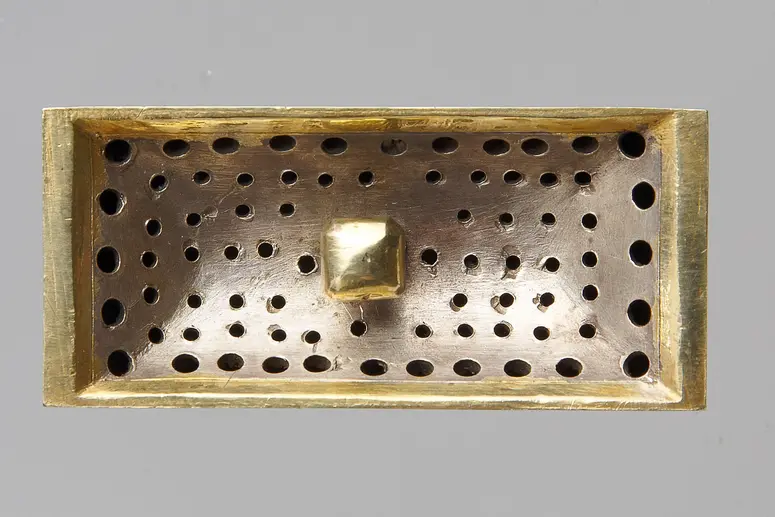
Vorlegebesteck oder Jagdbesteck
um 1350 | Rudolf von Wartensee
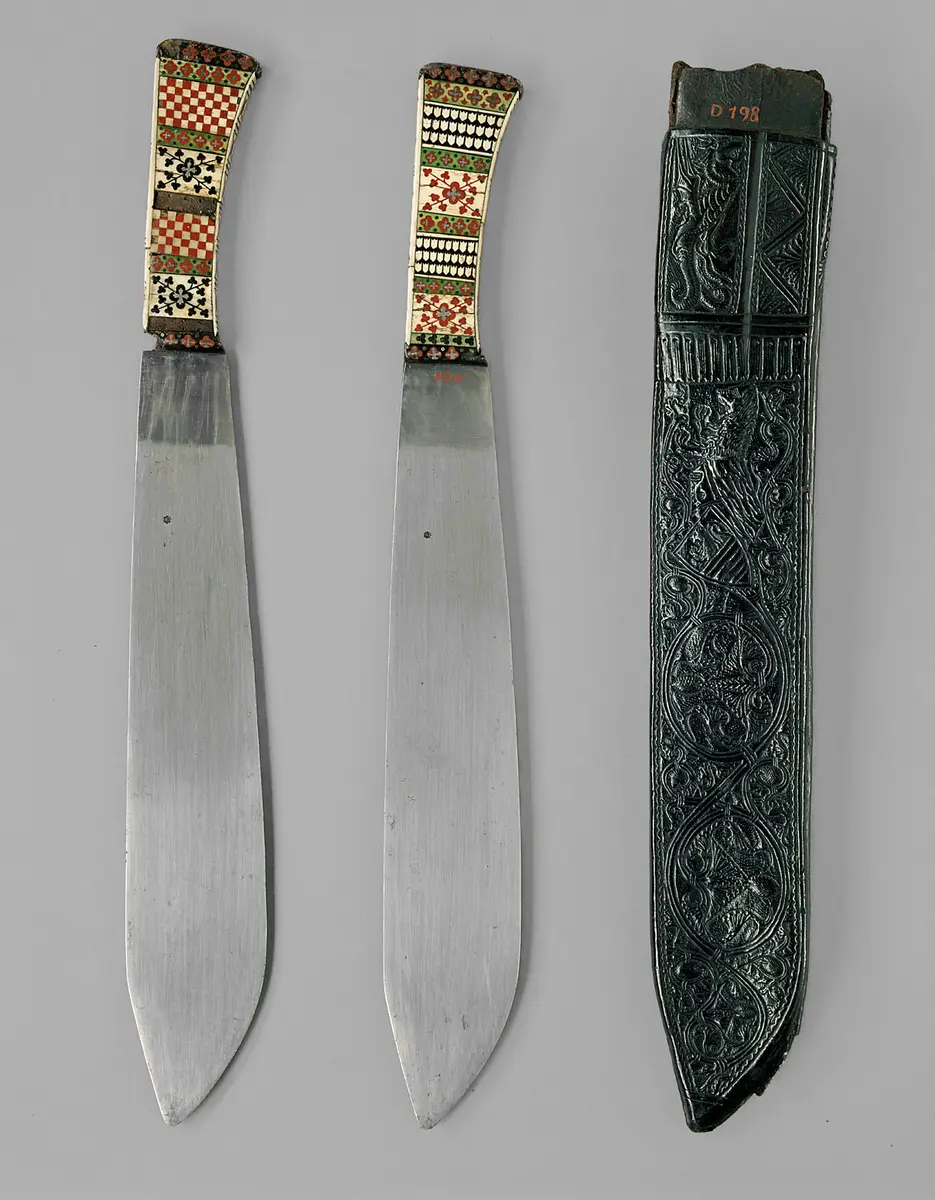
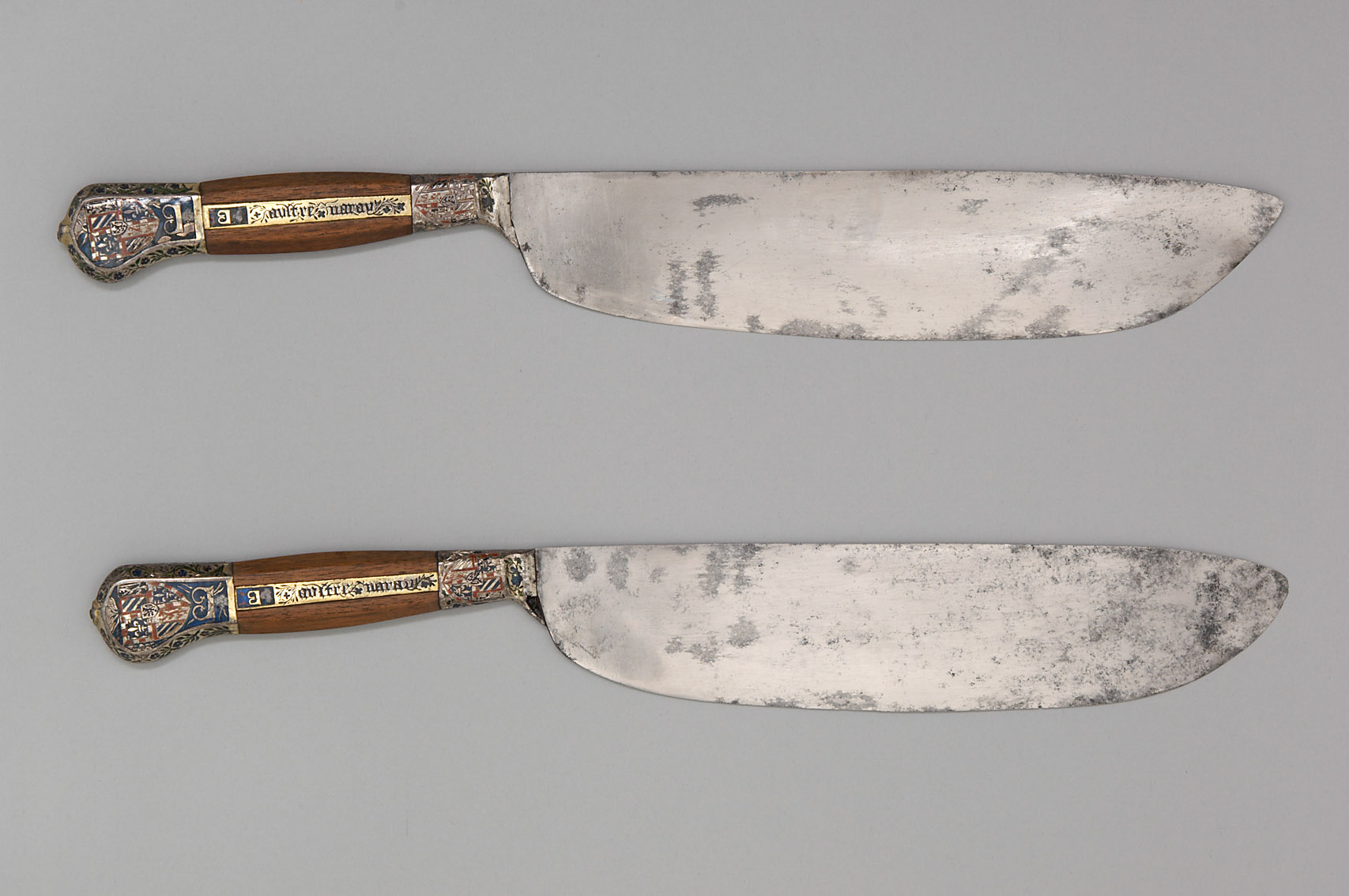
This is one of the oldest extant sets of medieval knives. The box is embossed with the arms of the Wartensee family, a family of officials recorded in St Gallen in the thirteenth and fourteenth century. According to the Zurich Roll of Arms from around 1330–45, their escutcheon is divided horizontally and features a silver lion above silver and blue bars (party per fess a lion argent dimidated horizontally with bars argent and azure).
Konrad of Wartensee died before 1372, upon which the male line became extinct. Rudolf of Wartensee was prior of Zurich Cathedral from 1339 to 1354; he was probably the original owner of these knives. Wartensee tried to negotiate a peace between Albert II, Duke of Austria, and the Swiss Confederacy. Zurich joined the latter in 1371 but tried to stay on friendly terms with the Habsburg duke by presenting him with gifts at Brugg in Aargau. This elegant set of knives may have been one of these diplomatic presents. Note the polychrome decoration of the handles of the two knives, which are encased in strips of horn and bone embellished with a pattern comprising quatrefoil, checkerboard, and floral motifs. In various places silver pins are arranged to form dots or small crosses. The blades of both knives are stamped with a master’s mark, a twelve-petalled rosette.
The precious box housing the knives is made of black pressed and cut leather; the lid is missing. Its front is decorated with a dragon and a field of trefoil palmettes above the afore-mentioned owner’s arms, framed by late Romanesque garlands. The back of the box features a simple interlaced pattern. The two now empty recesses between those for the two big blades probably once held a pricker or a small knife.
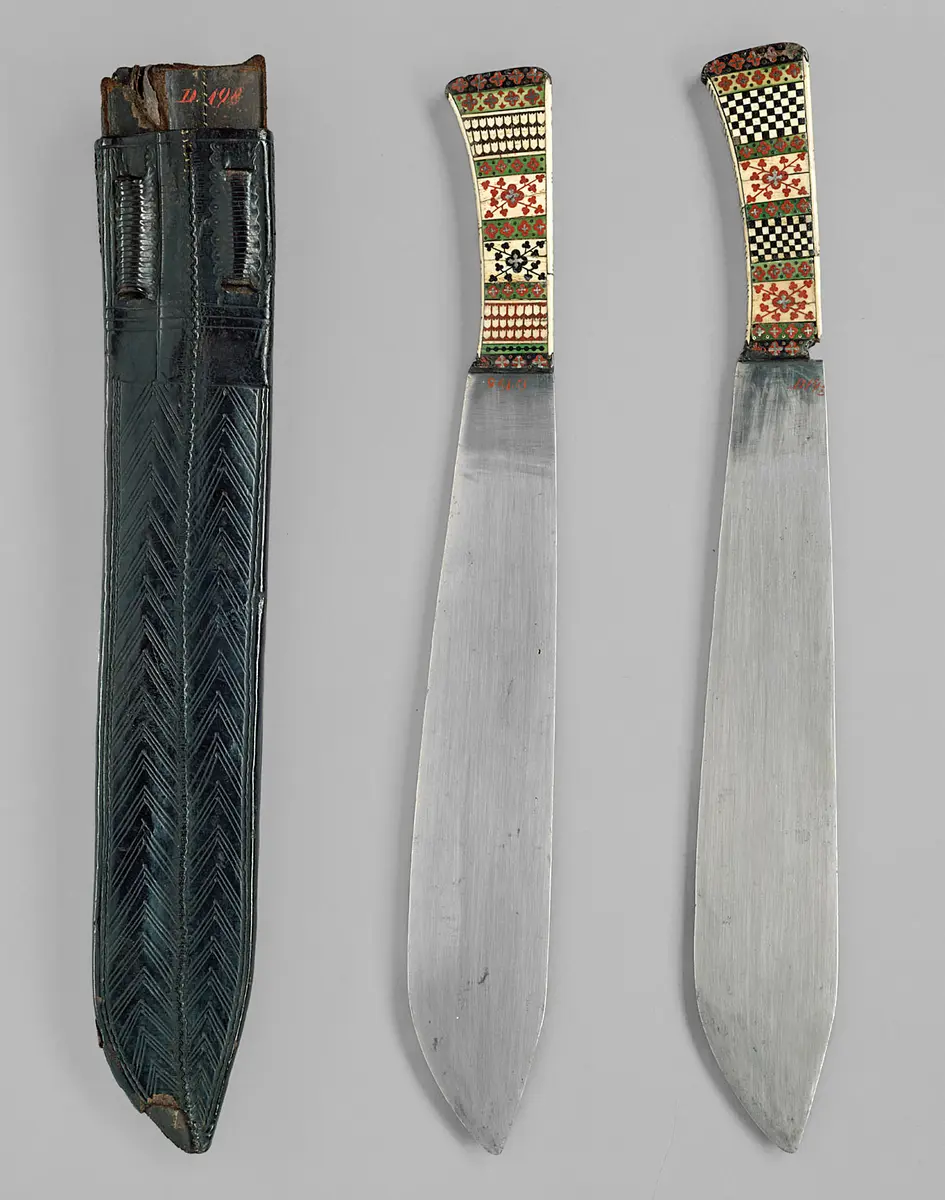
This is one of the oldest extant sets of medieval knives. The box is embossed with the arms of the Wartensee family, a family of officials recorded in St Gallen in the thirteenth and fourteenth century. According to the Zurich Roll of Arms from around 1330–45, their escutcheon is divided horizontally and features a silver lion above silver and blue bars (party per fess a lion argent dimidated horizontally with bars argent and azure).
Konrad of Wartensee died before 1372, upon which the male line became extinct. Rudolf of Wartensee was prior of Zurich Cathedral from 1339 to 1354; he was probably the original owner of these knives. Wartensee tried to negotiate a peace between Albert II, Duke of Austria, and the Swiss Confederacy. Zurich joined the latter in 1371 but tried to stay on friendly terms with the Habsburg duke by presenting him with gifts at Brugg in Aargau. This elegant set of knives may have been one of these diplomatic presents. Note the polychrome decoration of the handles of the two knives, which are encased in strips of horn and bone embellished with a pattern comprising quatrefoil, checkerboard, and floral motifs. In various places silver pins are arranged to form dots or small crosses. The blades of both knives are stamped with a master’s mark, a twelve-petalled rosette.
The precious box housing the knives is made of black pressed and cut leather; the lid is missing. Its front is decorated with a dragon and a field of trefoil palmettes above the afore-mentioned owner’s arms, framed by late Romanesque garlands. The back of the box features a simple interlaced pattern. The two now empty recesses between those for the two big blades probably once held a pricker or a small knife.
Owner:
Rudolf von Wartensee Probst des Großmünsterstiftes Zürich (1339 - 1354) DNB
Time:
um 1350
Object Name
Vorlegebesteck oder Jagdbesteck
Culture
Oberrhein (?)
Material/technology:
Messer: Klinge: Eisen, geschmiedet. Griff: Holz, mit Belag aus Bein- und Hornplatten sowie roter und schwarzer Farbpaste. Silbereinlagen. Silberstifte.
Beinplatten, teilweise eingefärbt.
Scheide: Holz. Leder, geprägt und teilweise graviert.
Dimensions:
Scheide: L 55,7 cm x B 9 cm x T 5,5 cm
Messer 1 rotes Schachbrett: L 57,3 cm x B 7,5 cm x T 1,9 cm
Messer 2: L 56,3 cm x B 7,2 cm x T 1,9 cm
Stamp / markings
Auf beiden Klingen einseitig ein Klingenschmiedstempel (Stern oder Sonne)
Copyright
Kunsthistorisches Museum, Hofjagd- und Rüstkammer
Invs.
Hofjagd- und Rüstkammer, D 198
Browse more
Similar items you might be interested in
The Imperial Palace Hof: Garden Side Bernardo Bellotto, gen. Canaletto 1759/61
Rudolf II. (1576-1612), Kaiser, römischer König ab 1575, König von Ungarn ab 1572, von Böhmen se 4. Viertel 16. Jahrhundert
Das kaiserliche Lustschloß Schönbrunn, Gartenseite J. Löwy, K. und K. Hof-Photograph, Kunst- und Verlagsanstalt (Wien) 1888 bis 1891
Das kaiserliche Lustschloß Schloss Hof, Gartenseite J. Löwy, K. und K. Hof-Photograph, Kunst- und Verlagsanstalt (Wien) 1888 bis 1891

Schönbrunn Palace: Garden Side Bernardo Bellotto, gen. Canaletto 1758/61
Duc Philippe III le Bon de Jean sans Peur Valois um 1460


Maximilian II. (1564-1576), Kaiser vor 1549

Friedrich III. (1439-1493), Erzherzog von Österreich, als F. V., seit 1440 König, 1452 Kaiser 1430-1440
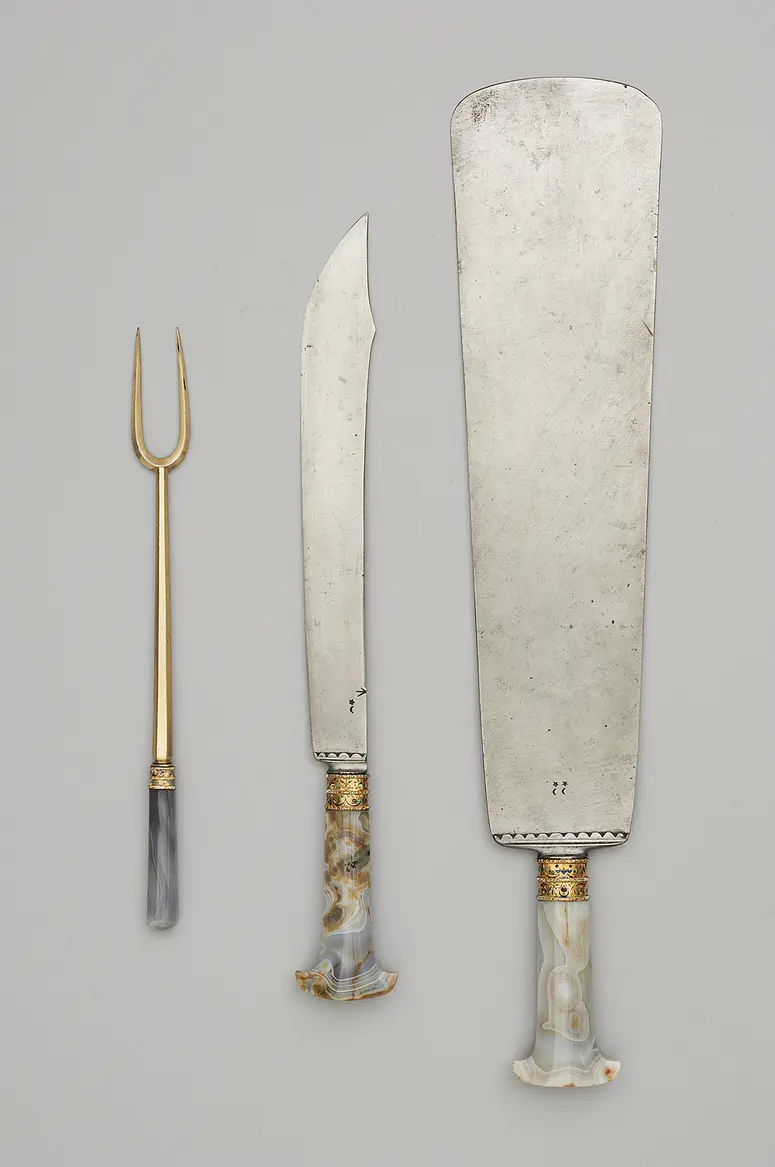
Vorlegebesteck oder Jagdbesteck: Set of hunting knives comprising a carving, slicing and serving knife Maximilian I. (1477-1519), seit 1493 deutscher König, 1508 Kaiser 1475 - 1477

Hirschfänger; Ein Paar Vorlegmesser; Vorschneide- und Vorlegebesteck; Zwei Jagdmesser oder Vorlegemesser samt Scheide; Saudegen; Saudegen; Jagdbesteck J. Löwy, K. und K. Hof-Photograph, Kunst- und Verlagsanstalt (Wien) 1892

Graviertes Nautilusgehäuse, Nautilus-Schale, Nautilus-Gehäuse, Nautlius, Meeresschnecke 2. Hälfte 16. Jahrhundert

Ferdinand II. (1617-1637), ab 1619 Kaiser, ab 1617 König von Böhmen, ab 1618 König von Ungarn datiert 1633
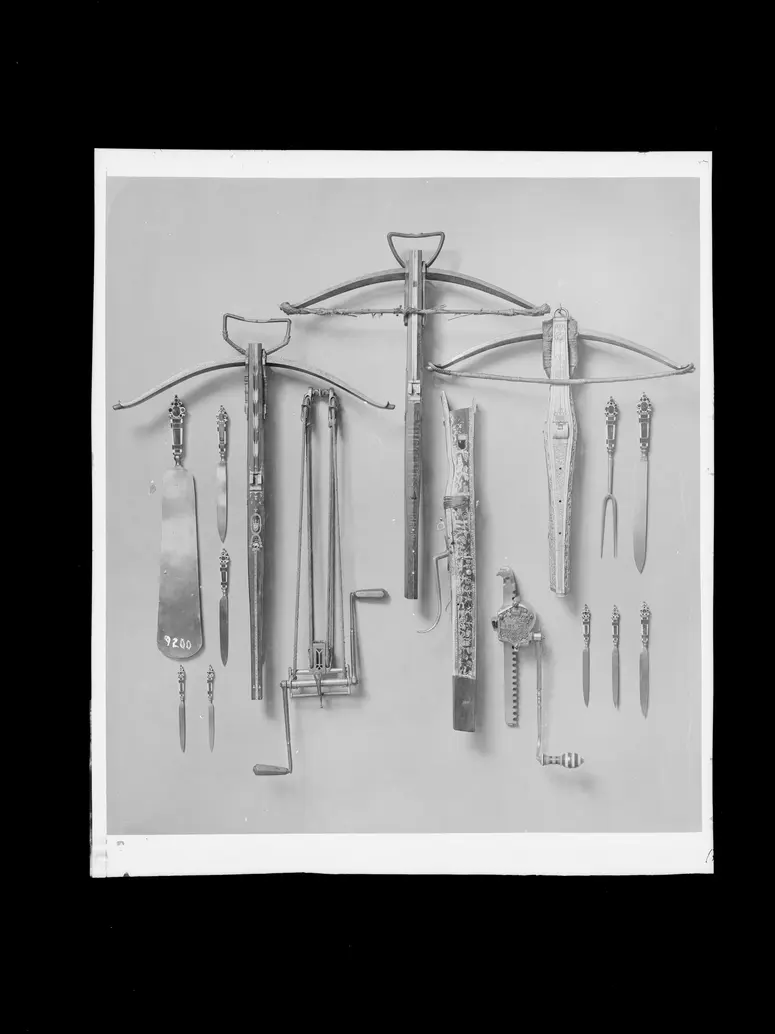
Jagdbesteck (bestehend aus einem Waidblatt, einer Gabel und acht Aufbruch- und Zerwirkmessern) mit Lederetui; Armbrust; Flaschenzugwinde; Jagdarmbrust; Säule einer Armbrust; Armbrust; Deutsche Winde J. Löwy, K. und K. Hof-Photograph, Kunst- und Verlagsanstalt (Wien) 1892

Rudolf II. (1576-1612), Kaiser, römischer König ab 1575, König von Ungarn ab 1572, von Böhmen se frühes 17. Jahrhundert