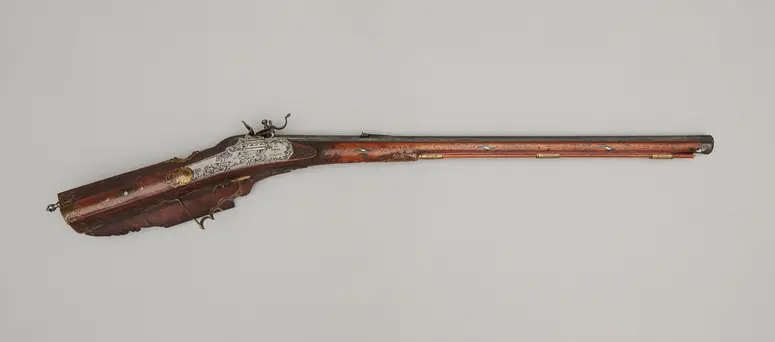
Radschlossbüchse
frühes 17. Jahrhundert | Rudolf II. (1576-1612), Kaiser, römischer König ab 1575, König von Ungarn ab 1572, von Böhmen se
This wheellock gun was long in the imperial arsenal (Zeughaus) in Vienna before it was transferred to the imperial collection of arms and armour in today’s Arsenal when the former was closed in 1856. In 1868, it was moved to the imperial gun room (Kaiserliche Hofgewehrkammer), where it was inventoried as no. 236: ‘A magnificent hunting gun with wheellock … the lock with 2 cocks, which are gilt and beautifully carved … the grip veneered in ivory with only the rims and arabesques with wood inlays … from the time of Rudolf II’ (Eine prachtvolle Jagdbüchse mit Radschloß. … Das Schloß hat 2 Hahnen, welche vergoldet und schön verschnitten sind. … Der Schaft ist ganz mit Elfenbein fourniert und nur die Kanten und Arabesken sind mit Holz ausgelegt … Aus der Zeit Rudolf II).
The iron parts of the gun can be attributed to Daniel Sadeler, a master-smith who worked for the courts in Prague and Munich (see cat. 81). The stock is by Hieronymus Borstorffer the Elder, a gunsmith from Munich; his monogram, HB, is behind the breech plug at the back of the barrel. Extant records list Borstorffer as a journeyman in 1596 and a master from 1598. He mainly worked for the court of the Duke of Bavaria in Munich. His son, Hieronymus the Younger, collaborated with him, and his widow continued the workshop until 1665.
Here, and in a number of other works by him, Borstorffer refrained from adding then-popular highly detailed engraved decoration. Instead, the emphasis is on restrained elegance; the weapon was given a veneer of white bone, sparingly inlaid with arabesques and set in a thin frame, both made of ebony. In contrast, the barrel and lock are lavishly decorated with garlands of flowers and foliage, tritons battling sea monsters, and much else. The two cocks of the lock end in dragon-like heads. As in many of his works, Sadeler contrasted blued (and partially sanded) raised reliefs with a gilt background.
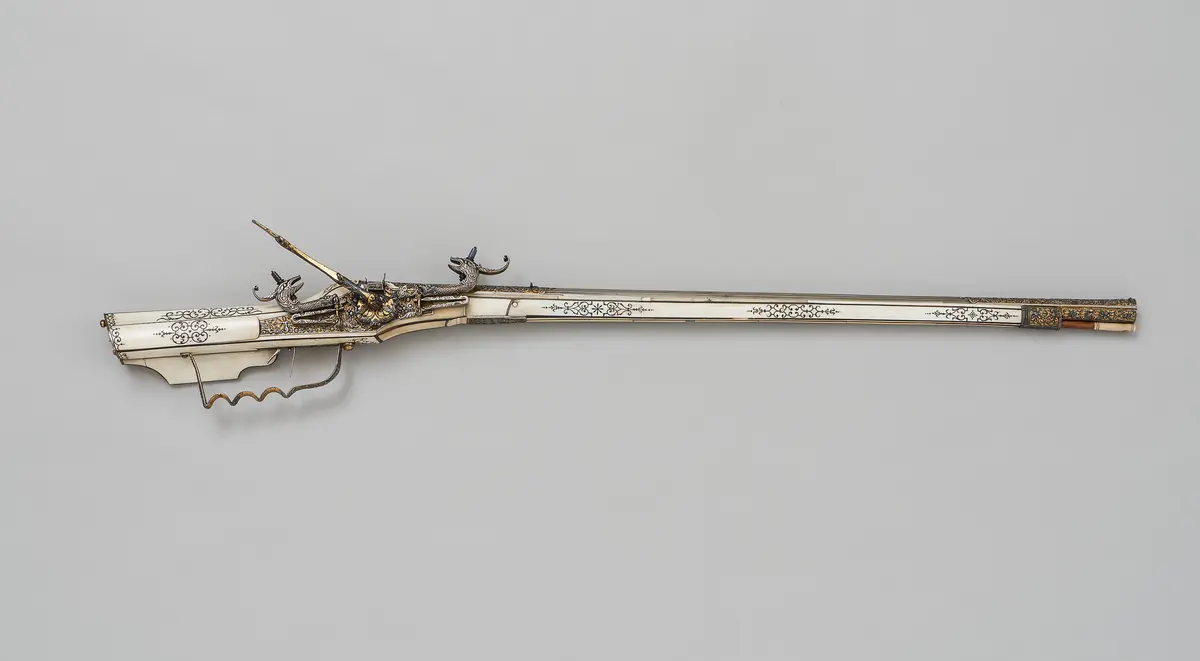
This wheellock gun was long in the imperial arsenal (Zeughaus) in Vienna before it was transferred to the imperial collection of arms and armour in today’s Arsenal when the former was closed in 1856. In 1868, it was moved to the imperial gun room (Kaiserliche Hofgewehrkammer), where it was inventoried as no. 236: ‘A magnificent hunting gun with wheellock … the lock with 2 cocks, which are gilt and beautifully carved … the grip veneered in ivory with only the rims and arabesques with wood inlays … from the time of Rudolf II’ (Eine prachtvolle Jagdbüchse mit Radschloß. … Das Schloß hat 2 Hahnen, welche vergoldet und schön verschnitten sind. … Der Schaft ist ganz mit Elfenbein fourniert und nur die Kanten und Arabesken sind mit Holz ausgelegt … Aus der Zeit Rudolf II).
The iron parts of the gun can be attributed to Daniel Sadeler, a master-smith who worked for the courts in Prague and Munich (see cat. 81). The stock is by Hieronymus Borstorffer the Elder, a gunsmith from Munich; his monogram, HB, is behind the breech plug at the back of the barrel. Extant records list Borstorffer as a journeyman in 1596 and a master from 1598. He mainly worked for the court of the Duke of Bavaria in Munich. His son, Hieronymus the Younger, collaborated with him, and his widow continued the workshop until 1665.
Here, and in a number of other works by him, Borstorffer refrained from adding then-popular highly detailed engraved decoration. Instead, the emphasis is on restrained elegance; the weapon was given a veneer of white bone, sparingly inlaid with arabesques and set in a thin frame, both made of ebony. In contrast, the barrel and lock are lavishly decorated with garlands of flowers and foliage, tritons battling sea monsters, and much else. The two cocks of the lock end in dragon-like heads. As in many of his works, Sadeler contrasted blued (and partially sanded) raised reliefs with a gilt background.
Artist:
Daniel Sadeler , (Eisenschneider) (vor 1602 Antwerpen - 1632 München, tätig in Prag und München) DNB
Time:
frühes 17. Jahrhundert
Object Name
Radschlossbüchse
Culture
Prag
Material/technology:
Lauf: Eisen, geschmiedet, gezogen, teils geschnitten. teils vergoldet. Visier: Eisen, teils geschnitten, teils vergoldet. Korn: Silber. Hähne, sonstige Schlossteile, Abzugsbügel, Kolbenblech: Eisen, teils gegossen, teils geschnitten, teils vergoldet, teils gebläut. Schaft: Holz. Beinplatten, teils mit Einlegearbeiten aus Ebenholz. Schrauben: Eisen, vergoldet. Ladestock: Holz. Bein, teils graviert.
Dimensions:
L 115 cm
Gewicht: 3,00 kg
Stamp / markings
ligiertes Monogramm "HB" hinter Schwanzschraube
Copyright
Kunsthistorisches Museum, Hofjagd- und Rüstkammer
Invs.
Hofjagd- und Rüstkammer, D 86
Browse more
Similar items you might be interested in

Rudolf II. (1576-1612), Kaiser, römischer König ab 1575, König von Ungarn ab 1572, von Böhmen se frühes 17. Jahrhundert
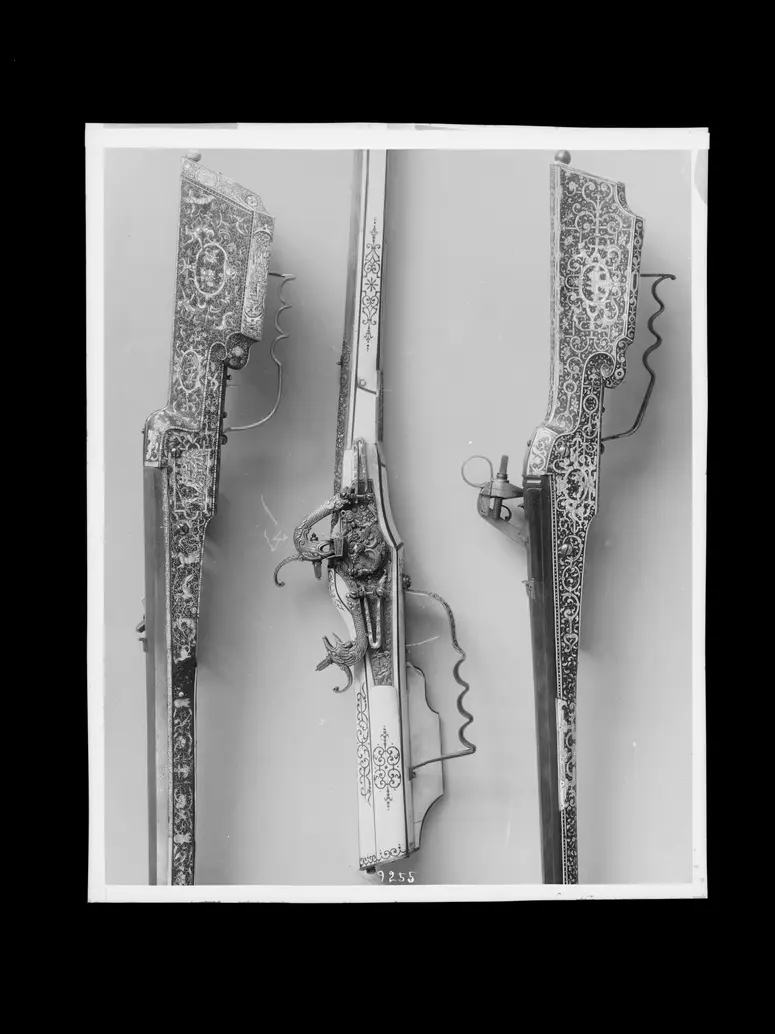
Radschlossgewehr; Radschlossbüchse J. Löwy, K. und K. Hof-Photograph, Kunst- und Verlagsanstalt (Wien) 1892
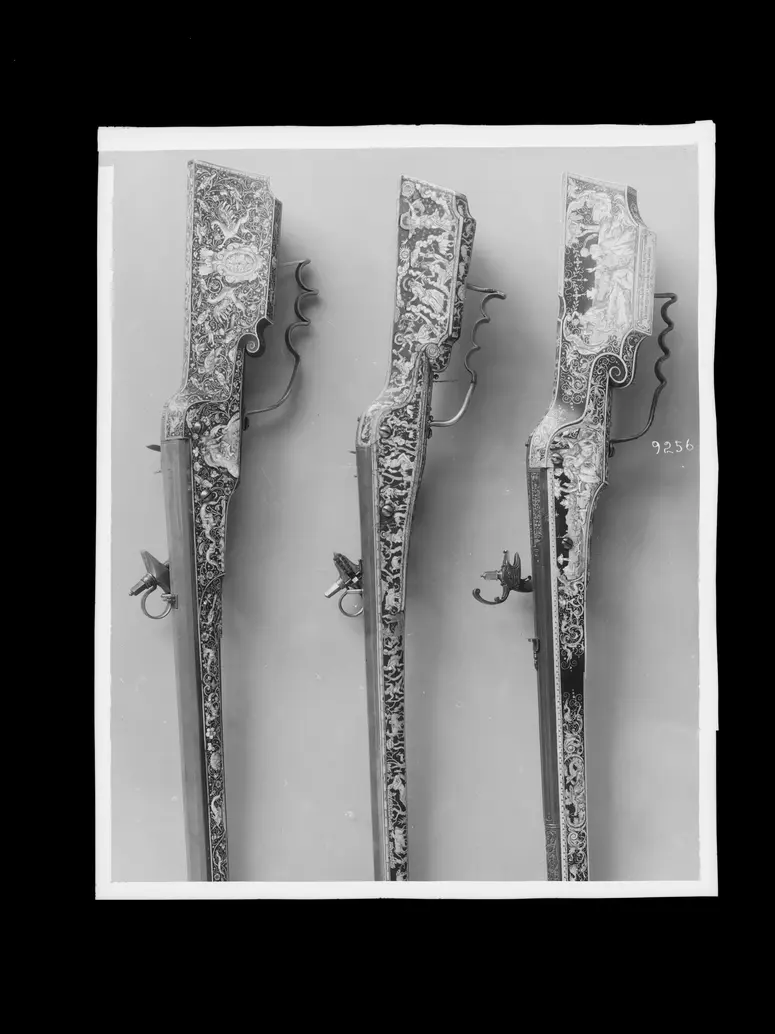
Radschlossgewehre; Radschlossbüchse J. Löwy, K. und K. Hof-Photograph, Kunst- und Verlagsanstalt (Wien) 1892


Leopold V. (1619-1632), Erzherzog und Graf von Tirol, Bischof von Passau und Straßburg 1628

Karl VI. (1711-1740), Kaiser datiert 1733

Franz (1792-1835), von 1792-1806 als Franz II. Kaiser, seit 1806 als Franz I. Kaiser von Österreich 1810
Karl VI. (1711-1740), Kaiser datiert 1722

Leopold I. (1658-1705), Kaiser um 1680/1690


Manufacturer: Franz Wilhelm Weyer um 1700