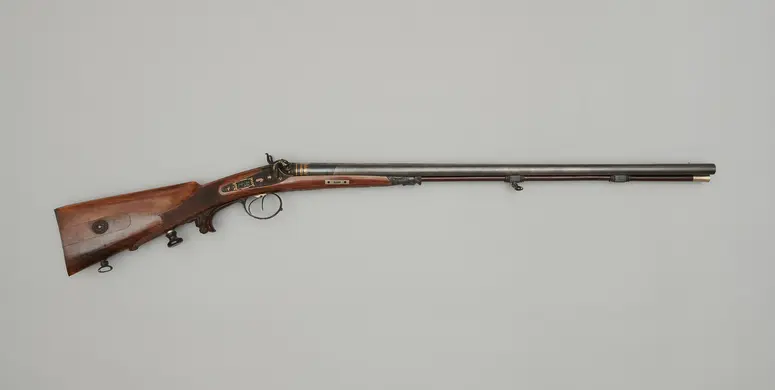
Steinschlossflinte zur Vogeljagd
datiert 1722 | Karl VI. (1711-1740), Kaiser
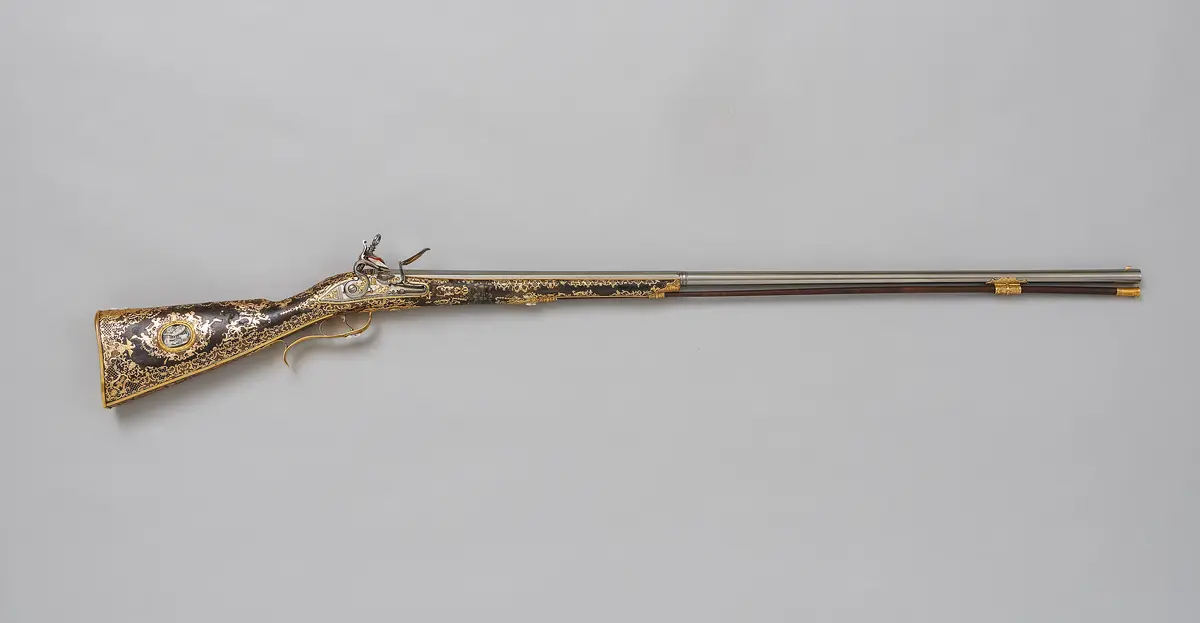
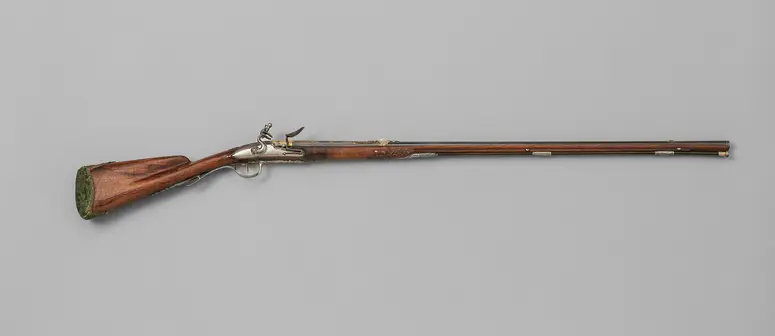
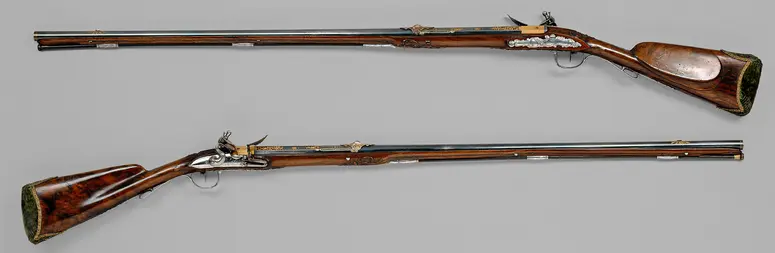
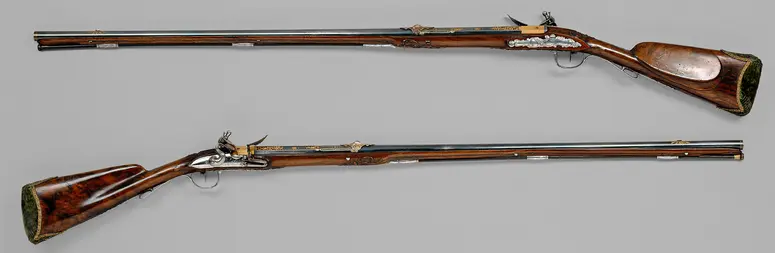
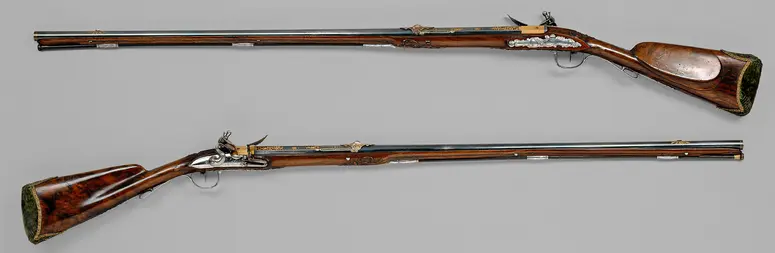
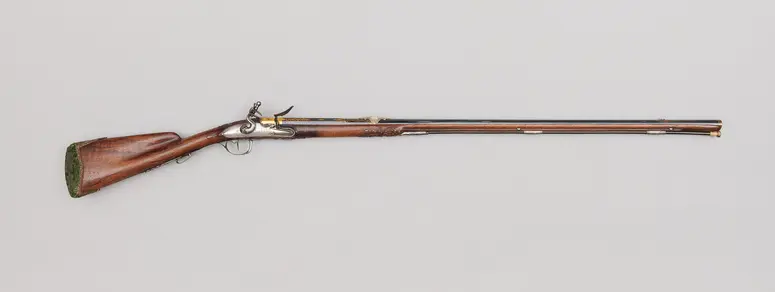
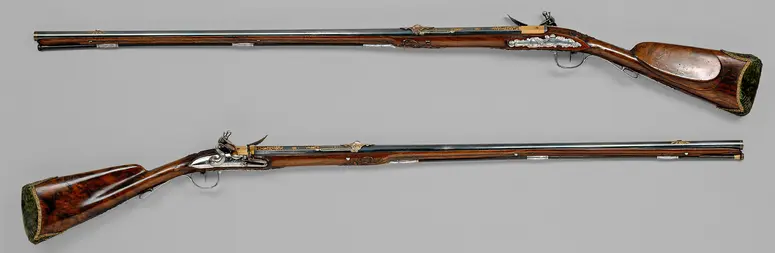
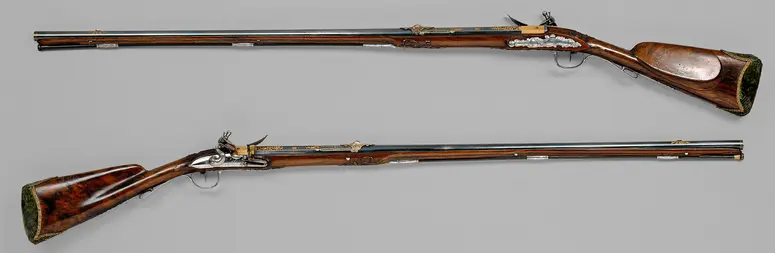
The lavish decoration on this flintlock gun allows us to identify Emperor Charles VI as its original owner. In 1713, following the end of the War of the Spanish Succession and the Habsburgs’ ultimate loss of Spain, Charles became King of Naples.
Note on the gun’s butt the victory goddess Victoria in front of a silhouette of Naples harbour. Seated on clouds on her left, Fama (the personification of fame) points heavenwards to the portrait medallion of the emperor being borne upwards by putti. The gold frame of this scene combines the Austrian coat of arms with another view of Naples. Here, the city is shown with the smoking Mount Vesuvius in the distance.
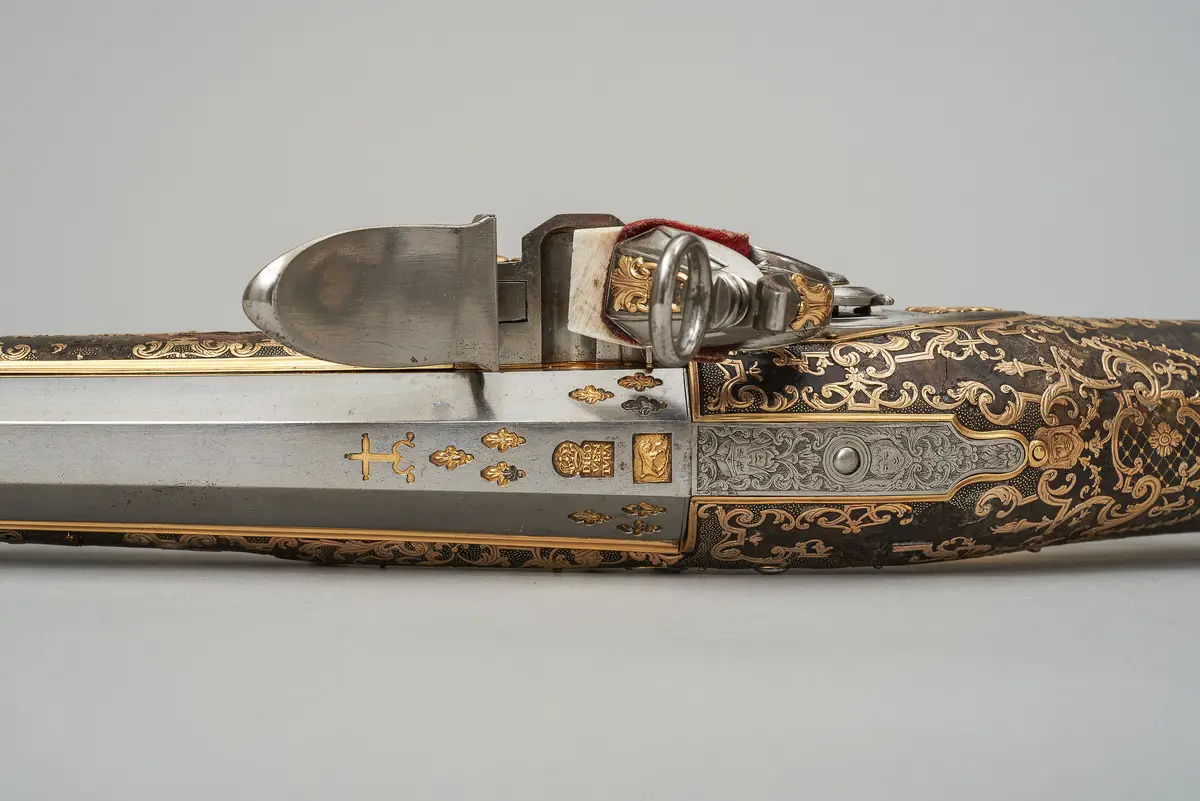
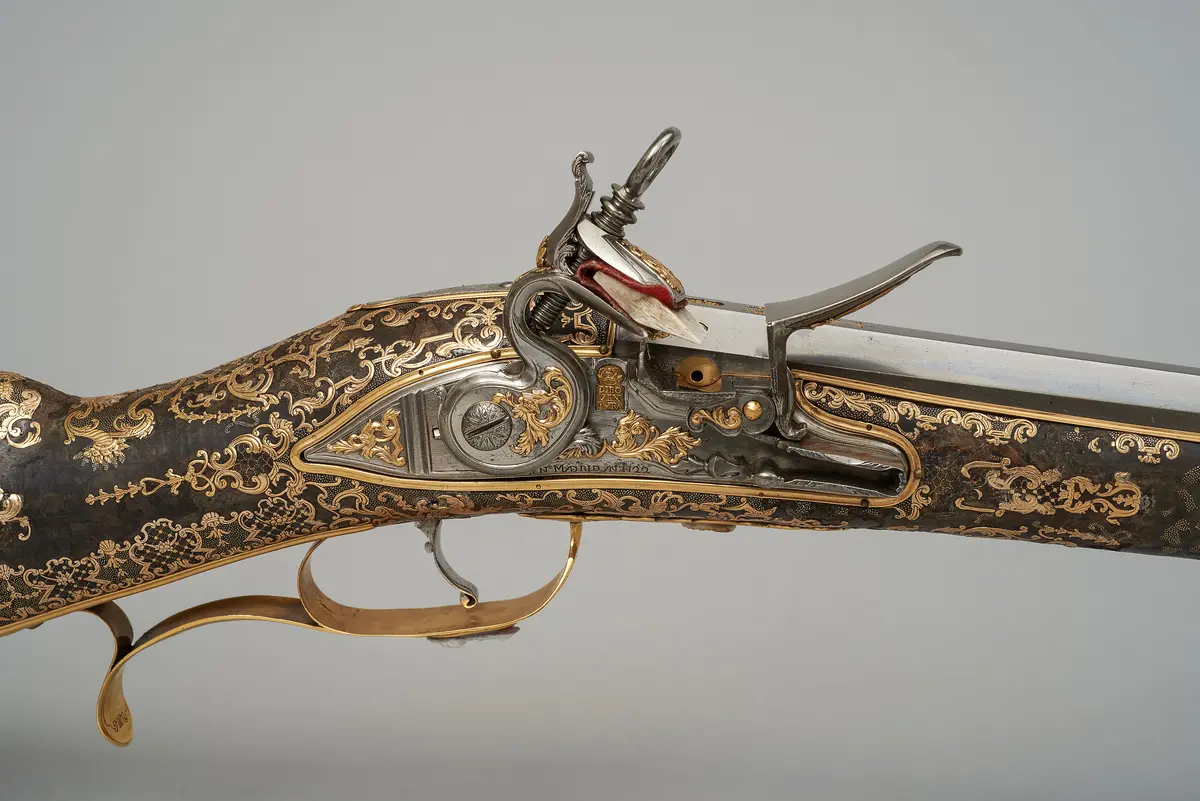
Barrel and lock are by Diego Ventura, a gunmaker active in Madrid. The smooth plain barrel is marked DIEO/VEN/TVRA with a crown, the lock is decorated with delicately carved garlands and mascarons, and, again, Ventura’s master’s mark. The inscription on the bottom edge of the lockplate records when and where the gun was produced: EN MADRID AN 1722 (‘in Madrid AD 1722’). The stock is the work of an anonymous, probably Austrian (Viennese?) gunmaker. It is encased in tortoise shell and lavishly decorated with partially engraved gold inlays and agate cameos. Both sides of the butt feature a large cameo in the style of the Milanese stonecarver Alessandro Masnago: Jupiter and Io (after an ancient cameo now in the Kunsthistorisches Museum’s Collection of Greek and Roman Antiquities, inv. XII 15), and tritons and nereids (inv. XII 2).
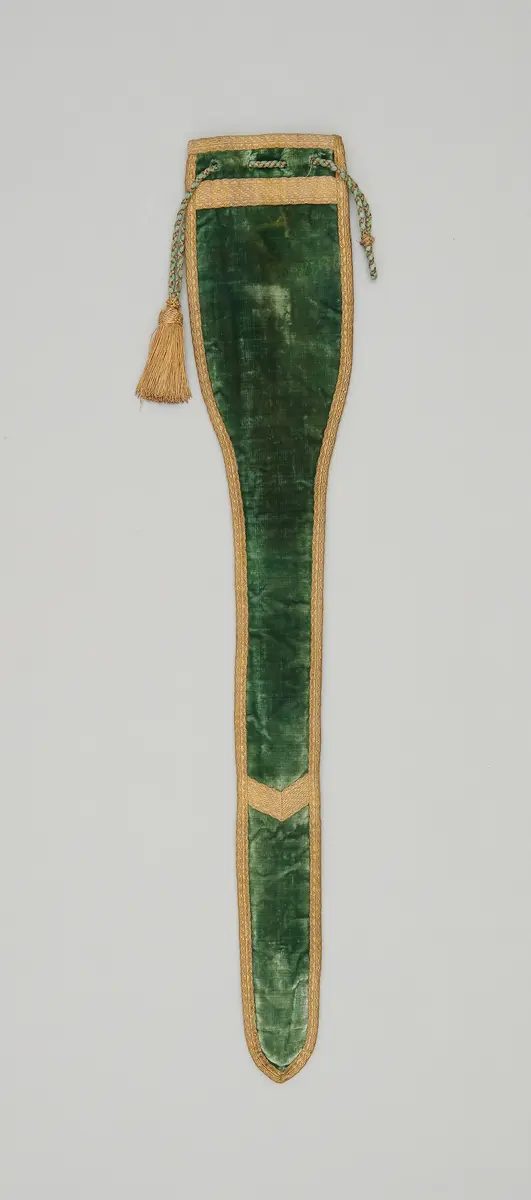
The gun is listed in the 1750 inventory of the treasury (eleventh cupboard, no. 10) as ‘A beautiful and precious gun, lock and barrel Spanish, but the stock made of tortoise shell mounted and artfully inlaid with gold, also studded with nine beautiful cameos of which the largest two are damaged’ (Ein schöne und kostbahre flinten, das schlosz und lauf Spänisch, der schaft aber von schildkrott und künstlich mit gold eingelegt und gefast, anbei mit neün schönen cameen besetzet, wovon aber die zwei grösten beschediget). Its gun bag, made of green velvet edged in gold, also survives (inv. A 1758a).
The lavish decoration on this flintlock gun allows us to identify Emperor Charles VI as its original owner. In 1713, following the end of the War of the Spanish Succession and the Habsburgs’ ultimate loss of Spain, Charles became King of Naples.
Note on the gun’s butt the victory goddess Victoria in front of a silhouette of Naples harbour. Seated on clouds on her left, Fama (the personification of fame) points heavenwards to the portrait medallion of the emperor being borne upwards by putti. The gold frame of this scene combines the Austrian coat of arms with another view of Naples. Here, the city is shown with the smoking Mount Vesuvius in the distance.
Barrel and lock are by Diego Ventura, a gunmaker active in Madrid. The smooth plain barrel is marked DIEO/VEN/TVRA with a crown, the lock is decorated with delicately carved garlands and mascarons, and, again, Ventura’s master’s mark. The inscription on the bottom edge of the lockplate records when and where the gun was produced: EN MADRID AN 1722 (‘in Madrid AD 1722’). The stock is the work of an anonymous, probably Austrian (Viennese?) gunmaker. It is encased in tortoise shell and lavishly decorated with partially engraved gold inlays and agate cameos. Both sides of the butt feature a large cameo in the style of the Milanese stonecarver Alessandro Masnago: Jupiter and Io (after an ancient cameo now in the Kunsthistorisches Museum’s Collection of Greek and Roman Antiquities, inv. XII 15), and tritons and nereids (inv. XII 2).
The gun is listed in the 1750 inventory of the treasury (eleventh cupboard, no. 10) as ‘A beautiful and precious gun, lock and barrel Spanish, but the stock made of tortoise shell mounted and artfully inlaid with gold, also studded with nine beautiful cameos of which the largest two are damaged’ (Ein schöne und kostbahre flinten, das schlosz und lauf Spänisch, der schaft aber von schildkrott und künstlich mit gold eingelegt und gefast, anbei mit neün schönen cameen besetzet, wovon aber die zwei grösten beschediget). Its gun bag, made of green velvet edged in gold, also survives (inv. A 1758a).
Owner:
Karl VI. (1711-1740), Kaiser (1685 - 1740) DNB
Artist:
Lauf: Diego Ventura , (Büchsenmacher) (erw. 1720 - 1762, tätig in Madrid) DNB
Time:
datiert 1722
Object Name
Steinschlossflinte zur Vogeljagd
Culture
Madrid
Material/technology:
Lauf: Eisen, geschmiedet, teils mit Gold tauschiert. Korn: Silber, vergoldet. Schlossplatte, Hahn, Batterie: Eisen, teils gegossen, teils geschnitten, teils vergoldet. Abzugbügel, Kolbenblech, Appliken, Fassungen, Ladestockröhrchen: Messing, feuervergoldet, teils graviert, teils punziert. Schaft: Holz. Schilpattbelag, Einlegearbeiten. Schlossgegenplatte, Einlegearbeiten: Goldblech, graviert, Goldstifte. Kameen: Achat (?) . Ladestock: Holz. Messing, feuervergoldet, teils graviert. Futterale: Samt. Schnur: Seide. Goldlahn. Borte, Quaste: Goldlahn.
Dimensions:
L 144 cm
Gewicht: 3,60 kg
Inscribed
auf Schlossplatte "EN MADRID AN:1722"
Stamp / markings
oben auf Lauf und auf Schlossplatte: Krone darunter "DIEO/VEN/TVRA"
oben auf Lauf: Kuh/Ochse/Stier
Copyright
Kunsthistorisches Museum, Hofjagd- und Rüstkammer
Invs.
Hofjagd- und Rüstkammer, A 1758
Browse more
Similar items you might be interested in

Leopold I. (1658-1705), Kaiser um 1680/1690
Maria Theresia (1740-1780), Königin von Ungarn und Böhmen, Kaiserin 3. Drittel 18. Jahrhundert
Maria Theresia (1740-1780), Königin von Ungarn und Böhmen, Kaiserin 3. Drittel 18. Jahrhundert
Maria Theresia (1740-1780), Königin von Ungarn und Böhmen, Kaiserin 3. Drittel 18. Jahrhundert
Maria Theresia (1740-1780), Königin von Ungarn und Böhmen, Kaiserin 3. Drittel 18. Jahrhundert
Maria Theresia (1740-1780), Königin von Ungarn und Böhmen, Kaiserin 3. Drittel 18. Jahrhundert
Maria Theresia (1740-1780), Königin von Ungarn und Böhmen, Kaiserin 3. Drittel 18. Jahrhundert
Maria Theresia (1740-1780), Königin von Ungarn und Böhmen, Kaiserin 3. Drittel 18. Jahrhundert
Maria Theresia (1740-1780), Königin von Ungarn und Böhmen, Kaiserin 3. Drittel 18. Jahrhundert

Maria Theresia (1740-1780), Königin von Ungarn und Böhmen, Kaiserin 3. Drittel 18. Jahrhundert
Maria Theresia (1740-1780), Königin von Ungarn und Böhmen, Kaiserin 3. Drittel 18. Jahrhundert
Karl VI. (1711-1740), Kaiser Anfang 18. Jahrhundert
Karl VI. (1711-1740), Kaiser Anfang 18. Jahrhundert
Ferdinand I. (1835-1848), Kaiser von Österreich, König von Ungarn datiert 1841
