Steinschlossflinte
um 1680/1690 | Leopold I. (1658-1705), Kaiser
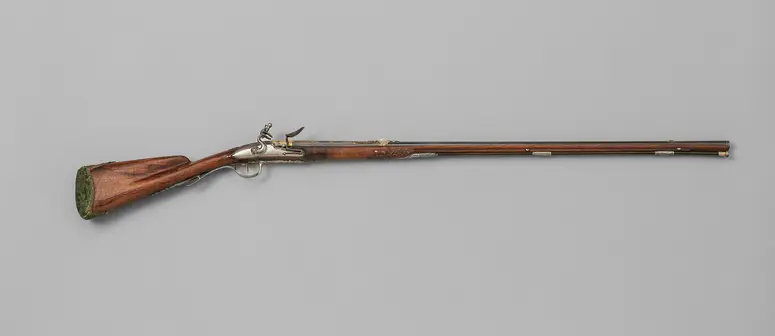
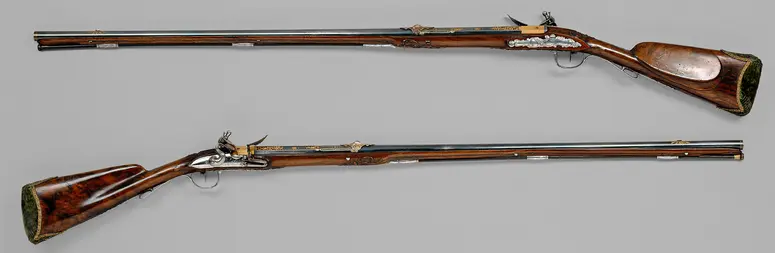
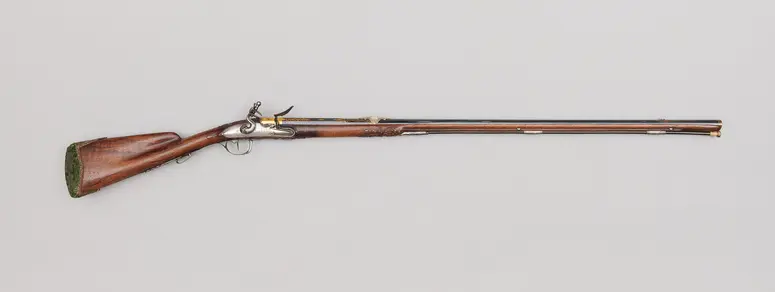
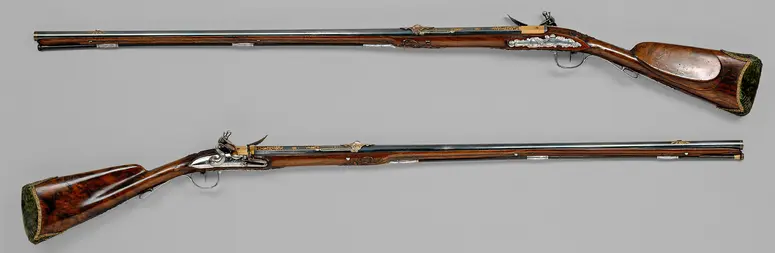
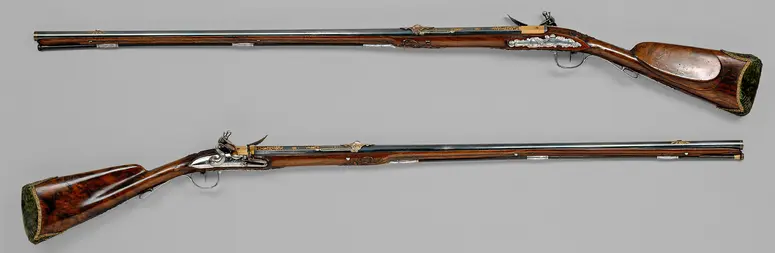
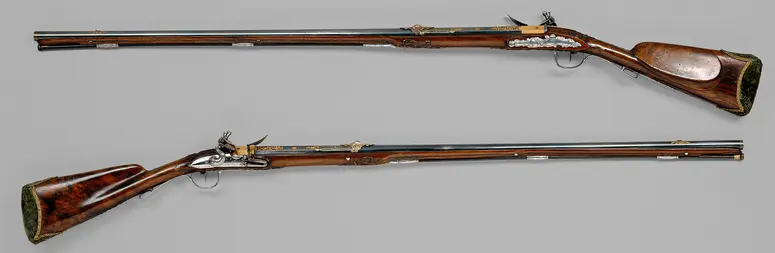
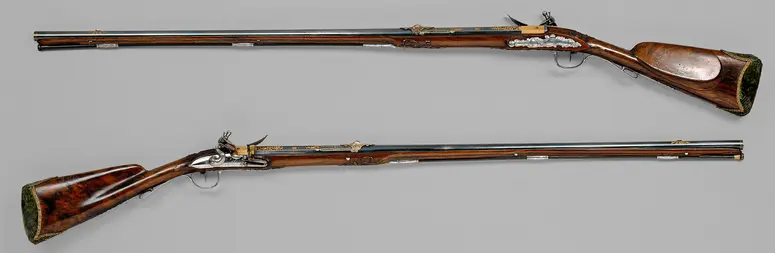
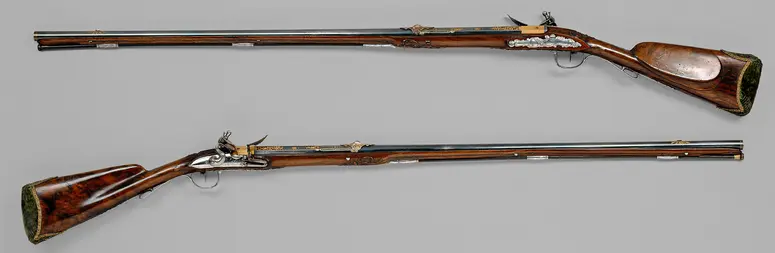
The armourer signed this flintlock gun in two places: one signature is on the lock (LA MARRE A VIENNE) and one on the breech plug (La Marre). This allows us to attribute the weapon to the leading imperial gunsmith active in the late seventeenth century. Jacques Lamarre was first recorded in Paris in 1657. He moved to Vienna around 1670, but as he was employed by the court, he is not listed in the records kept by the city’s gunsmiths’ guild. He specialized in the production of firearms with flintlocks, a technique then much advanced in France. An invitation to work for the imperial court as a flintlock specialist may have been the reason he moved from Paris to Vienna.
Both sides of the butt stock of this rifle are decorated with inlays made of pierced and engraved iron and gilt portrait medallions of Emperors Leopold I and Charles VI. The gun seems to have been reworked because the wood on both sides of the butt was repaired. In addition, an inlaid crowned coat of arms behind the breech plug was removed. Charles VI was the younger of the two sons born to Emperor Leopold I and his third wife Eleonore Magdalena of Palatine-Neuburg. He succeeded to the throne in 1711 after the untimely death of his elder brother, Emperor Joseph I, who died without issue.
The inventory of the imperial gun room (Kaiserliche Hofgewehrkammer) in Vienna, begun in 1868, lists this gun as no. 102: ‘A gun with a French lock, on the barrel and the lock ‘La Mare in Vienna’. The stock mounted in silver and iron. Charles VI’ (Eine Flinte mit französischem Schloße, auf dem Laufe und Schloße ‘La Mare in Wien’. Der Schaft mit Silber und Eisen montirt. Carl VI).
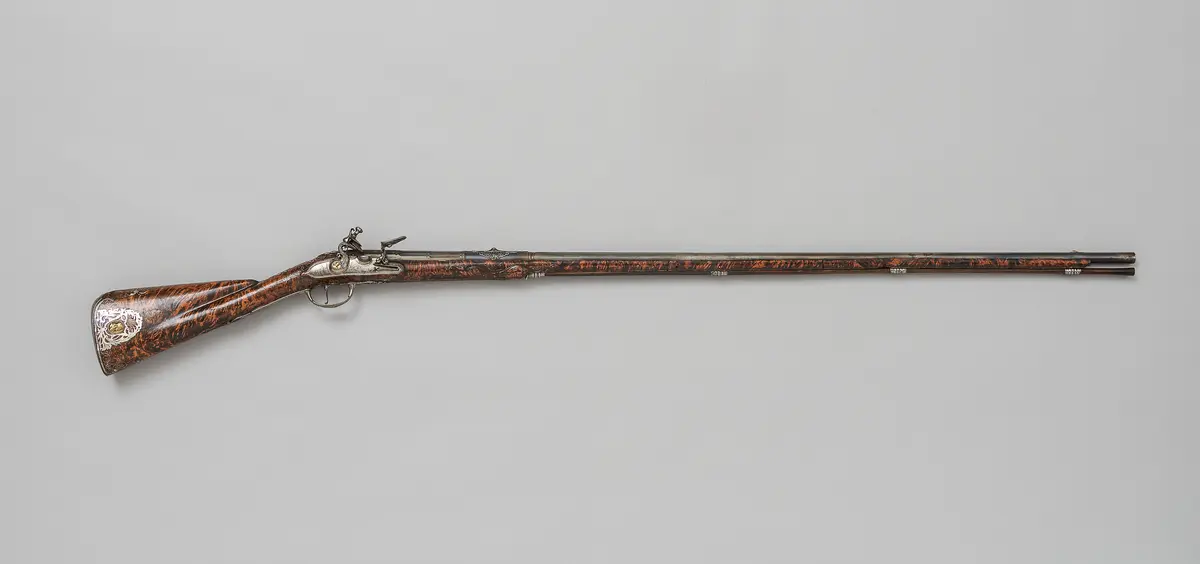
The armourer signed this flintlock gun in two places: one signature is on the lock (LA MARRE A VIENNE) and one on the breech plug (La Marre). This allows us to attribute the weapon to the leading imperial gunsmith active in the late seventeenth century. Jacques Lamarre was first recorded in Paris in 1657. He moved to Vienna around 1670, but as he was employed by the court, he is not listed in the records kept by the city’s gunsmiths’ guild. He specialized in the production of firearms with flintlocks, a technique then much advanced in France. An invitation to work for the imperial court as a flintlock specialist may have been the reason he moved from Paris to Vienna.
Both sides of the butt stock of this rifle are decorated with inlays made of pierced and engraved iron and gilt portrait medallions of Emperors Leopold I and Charles VI. The gun seems to have been reworked because the wood on both sides of the butt was repaired. In addition, an inlaid crowned coat of arms behind the breech plug was removed. Charles VI was the younger of the two sons born to Emperor Leopold I and his third wife Eleonore Magdalena of Palatine-Neuburg. He succeeded to the throne in 1711 after the untimely death of his elder brother, Emperor Joseph I, who died without issue.
The inventory of the imperial gun room (Kaiserliche Hofgewehrkammer) in Vienna, begun in 1868, lists this gun as no. 102: ‘A gun with a French lock, on the barrel and the lock ‘La Mare in Vienna’. The stock mounted in silver and iron. Charles VI’ (Eine Flinte mit französischem Schloße, auf dem Laufe und Schloße ‘La Mare in Wien’. Der Schaft mit Silber und Eisen montirt. Carl VI).
Owner:
Leopold I. (1658-1705), Kaiser (1640 - 1705) DNB
Artist:
Jacques Lamarre (erw. 1657 - 1700, tätig in Paris, Prag und Wien)
Time:
um 1680/1690
Object Name
Steinschlossflinte
Culture
Wien
Material/technology:
Lauf: Eisen, teils gebläut, teils mit Gold tauschiert. Korn: Silber, feuervergoldet. Visier: Eisen, teils geschmiedet, teils durchbrochen gearbeitet, teils graviert. Schaft: Holz (Eschenflader), teils geschnitzt, teils mit Einlegearbeiten aus Silberdraht und Silberblech. Silberblecheinlagen: teils durchbrochen gearbeitet. Medaillons: Messing (?), feuervergoldet, teils ziseliert, teils graviert. Schlossplatte, Schlossgegenplatte, Ladestockröhrchen, Kolbenplatte: Eisenblech, teils graviert, teils geschnitten. Hahn, sonstige Schlossteile: Eisen, teils geschmiedet, teils gegossen, teils geschnitten, teils durchbrochen gearbeitet. Ladestock: Holz, Horn.
Dimensions:
L 150 cm
Gewicht: 2,85 kg
Signed
Schloss: La Marre à Vienne
Schwanzschraube: Marre
Stamp / markings
Jacob la Mort de Lamarre
Copyright
Kunsthistorisches Museum, Hofjagd- und Rüstkammer
Invs.
Hofjagd- und Rüstkammer, D 189
Browse more
Similar items you might be interested in
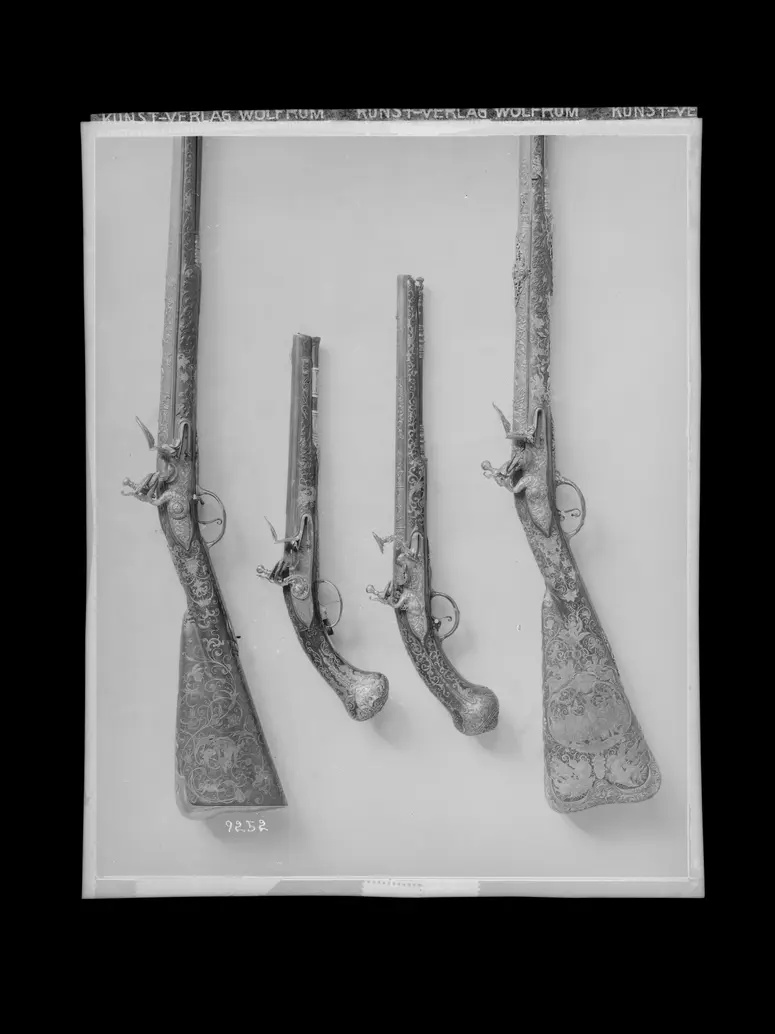
Steinschlossflinte; Steinschlosspistole; Steinschlossflinte; Steinschlosspistole J. Löwy, K. und K. Hof-Photograph, Kunst- und Verlagsanstalt (Wien) 1892
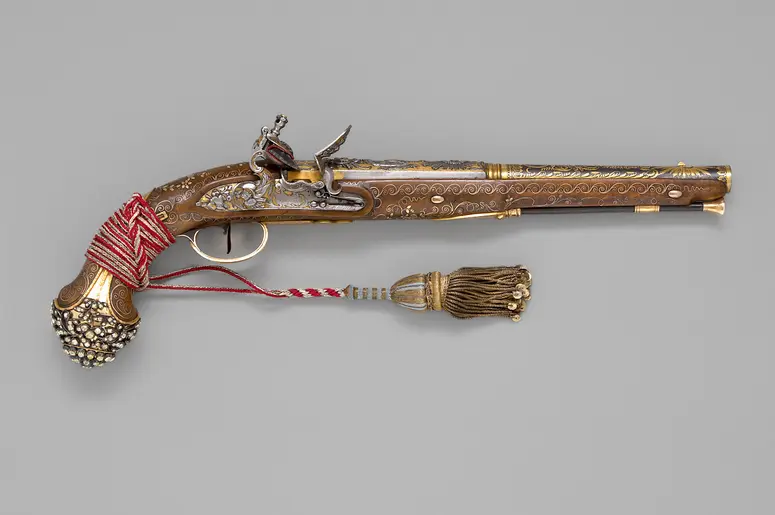
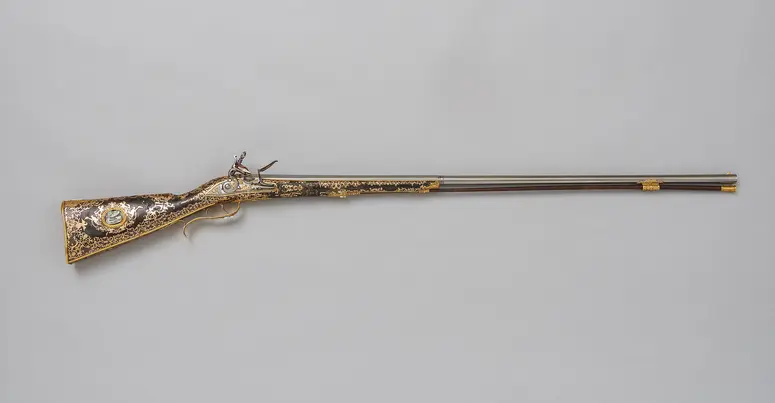
Karl VI. (1711-1740), Kaiser datiert 1722
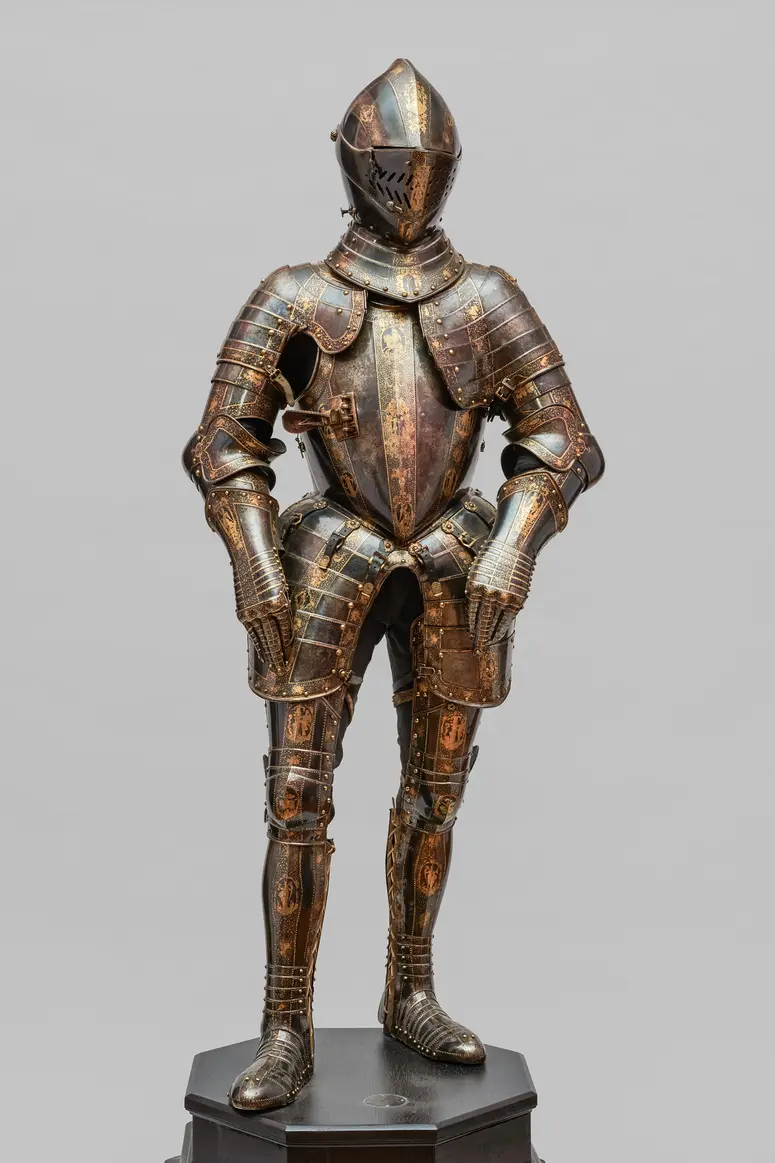
Karl von Österreich, Sohn des Tiroler Landesfürsten Erzherzog Ferdinands II. von Habsburg und der Philippine Welser datiert 1582
Manufacturer: Alexandre Voboam 1690
Maria Theresia (1740-1780), Königin von Ungarn und Böhmen, Kaiserin 3. Drittel 18. Jahrhundert
Maria Theresia (1740-1780), Königin von Ungarn und Böhmen, Kaiserin 3. Drittel 18. Jahrhundert
Maria Theresia (1740-1780), Königin von Ungarn und Böhmen, Kaiserin 3. Drittel 18. Jahrhundert
Maria Theresia (1740-1780), Königin von Ungarn und Böhmen, Kaiserin 3. Drittel 18. Jahrhundert
Maria Theresia (1740-1780), Königin von Ungarn und Böhmen, Kaiserin 3. Drittel 18. Jahrhundert
Maria Theresia (1740-1780), Königin von Ungarn und Böhmen, Kaiserin 3. Drittel 18. Jahrhundert
Maria Theresia (1740-1780), Königin von Ungarn und Böhmen, Kaiserin 3. Drittel 18. Jahrhundert

Maria Theresia (1740-1780), Königin von Ungarn und Böhmen, Kaiserin 3. Drittel 18. Jahrhundert
Maria Theresia (1740-1780), Königin von Ungarn und Böhmen, Kaiserin 3. Drittel 18. Jahrhundert
Maria Theresia (1740-1780), Königin von Ungarn und Böhmen, Kaiserin 3. Drittel 18. Jahrhundert
Matthäus Lang von Wellenburg (1519-1540), Erzbischof von Salzburg 1511

Karl VI. (1711-1740), Kaiser datiert 1733