Fußkampfharnisch/Kempfküriss der sog. Rosenblatt-Garnitur
This armour belongs to the so-called Rose Leaves Garniture, named after the main motif of its elaborate etched decoration: rose garlands, buds, and leaves. It may be the garniture for which Maximilian II authorized payment in January 1572 of the enormous sum of 2550 guilders to Franz Großschedel, an armourer from Landshut in Bavaria. The order may have been connected to the nuptials celebrated in 1571 of Archduke Charles II, Emperor Maximilian’s younger brother, and Maria Anna of Bavaria. This marriage was of great importance for the imperial court because it sealed an alliance between the two great Catholic powers in southern Germany – Austria and Bavaria – against the Protestant princes in central and northern Germany. The imperial court spared no expense for the wedding festivities held in Vienna and Graz (see inv. A 886).
The Rose Leaves Garniture differs from the Eagle Garniture produced in 1547 (see inv. A 638) in that the Eagle Garniture comprises pieces of exchange so the armour can be reconfigured for different types of jousting, whereas the Rose Leaves Garniture consists of a series of complete armours. The Rose Leaves Garniture comprises a bard, a field cuirass for fighting on foot and another for fighting on horseback, armours for, respectively, the joust of peace with and without the tilt, and armour for combat on foot. The latter includes a wide steel skirt (tonlet) that protected the wearer’s otherwise exposed waist and hips (see inv. A 638, B 33). Most pieces of this garniture are in Vienna, but a few were removed during the Napoleonic era and are now exhibited at, for instance, the Musée de l’Armée in Paris.
There is also an extant second version of the armour for the joust of peace with the tilt that is etched black (rather than gilt) and that does not have an etched collar of the Order of the Golden Fleece; it does, however, include two vamplates without a crest, a burgonet, and a pair of gauntlets. Perhaps these are all that remain of a second garniture featuring identical but less costly ornamentation.
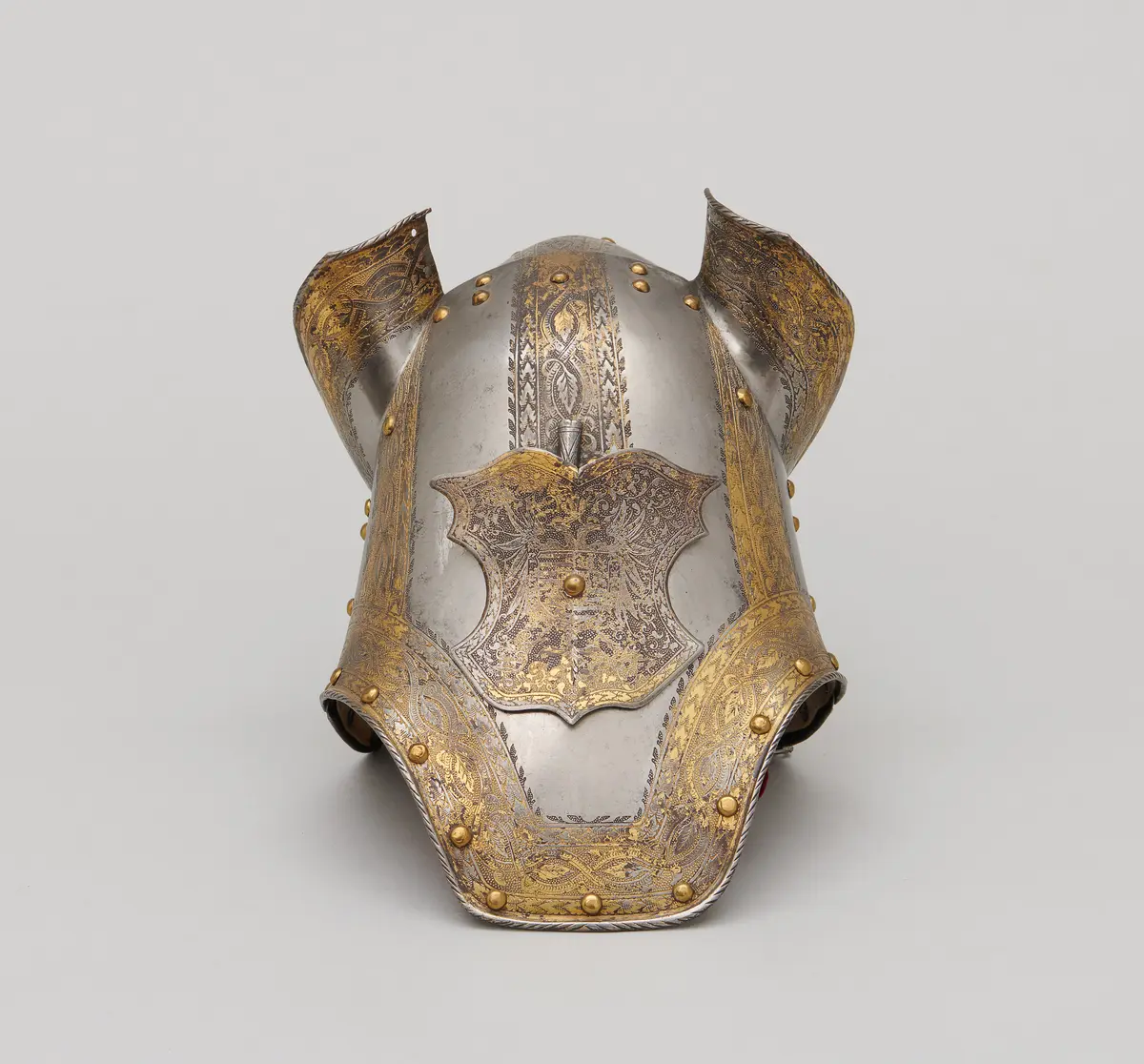
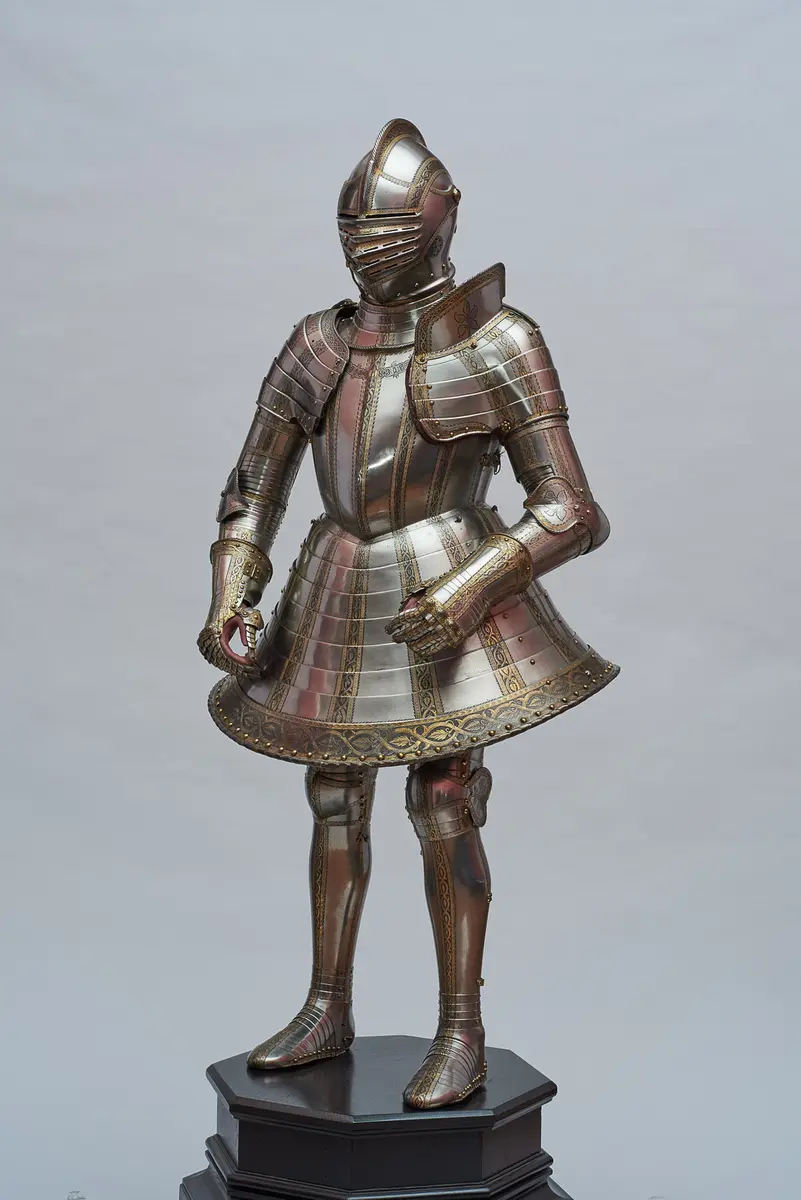
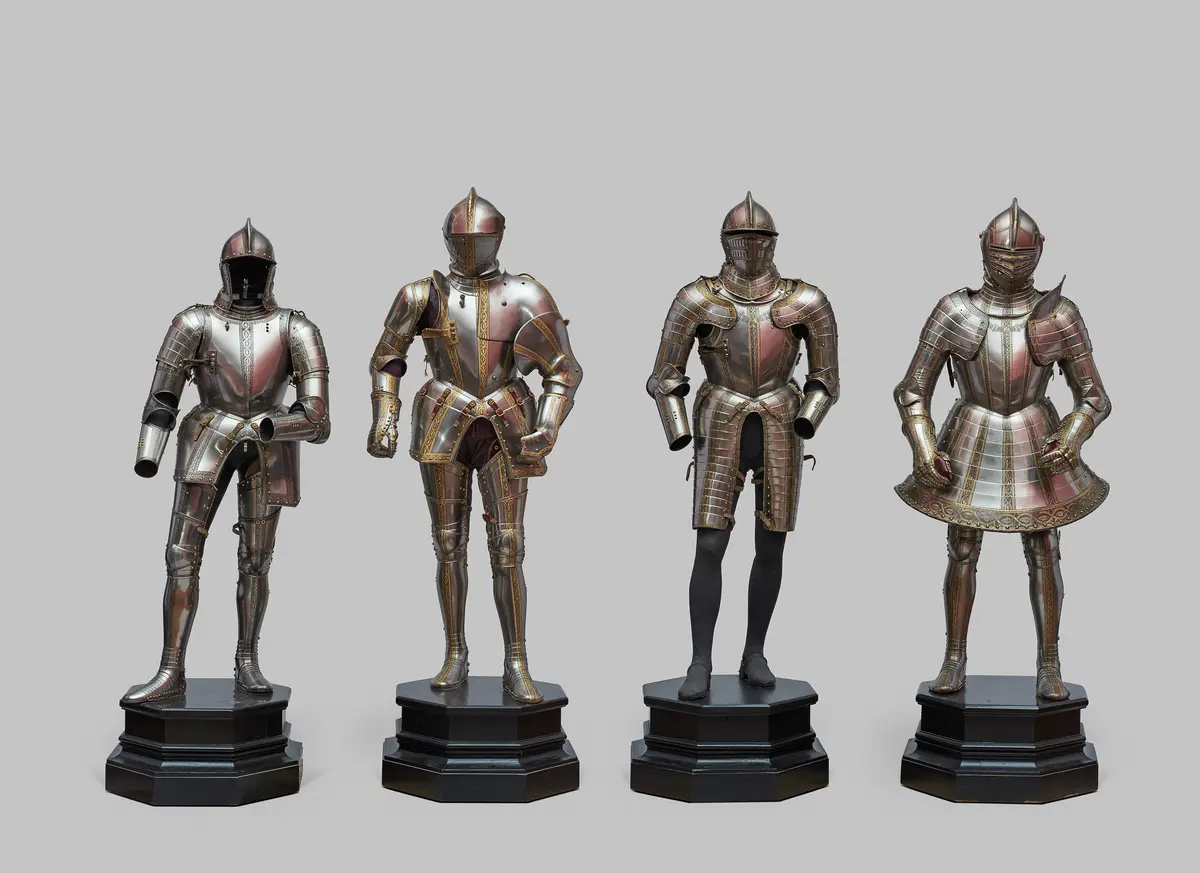
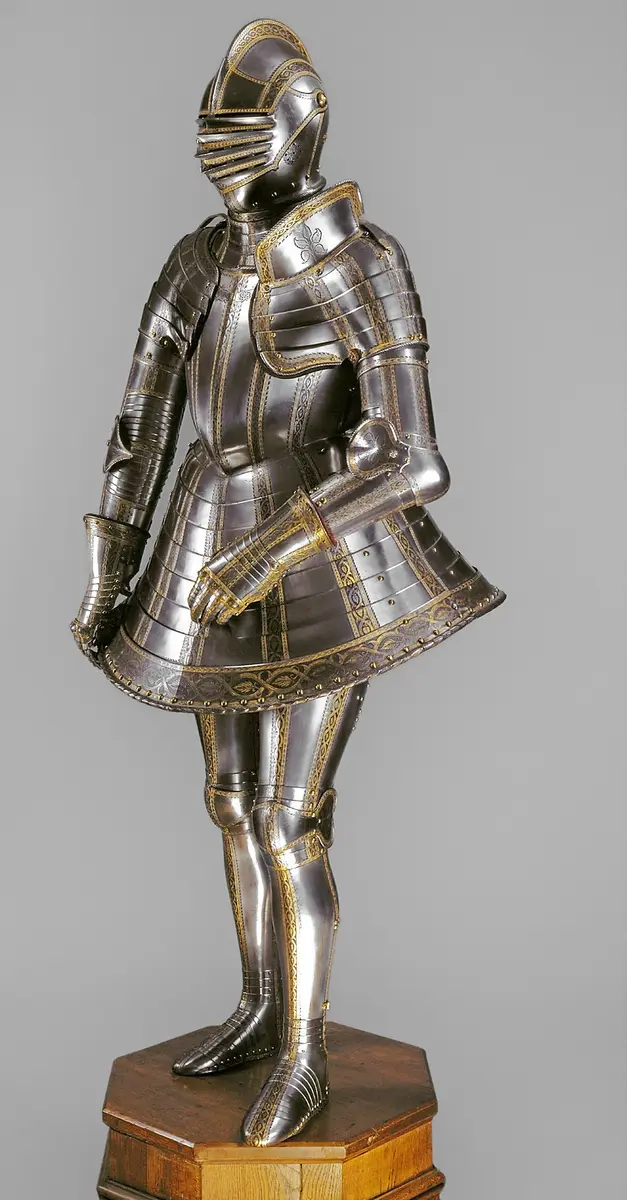
This armour belongs to the so-called Rose Leaves Garniture, named after the main motif of its elaborate etched decoration: rose garlands, buds, and leaves. It may be the garniture for which Maximilian II authorized payment in January 1572 of the enormous sum of 2550 guilders to Franz Großschedel, an armourer from Landshut in Bavaria. The order may have been connected to the nuptials celebrated in 1571 of Archduke Charles II, Emperor Maximilian’s younger brother, and Maria Anna of Bavaria. This marriage was of great importance for the imperial court because it sealed an alliance between the two great Catholic powers in southern Germany – Austria and Bavaria – against the Protestant princes in central and northern Germany. The imperial court spared no expense for the wedding festivities held in Vienna and Graz (see inv. A 886).
The Rose Leaves Garniture differs from the Eagle Garniture produced in 1547 (see inv. A 638) in that the Eagle Garniture comprises pieces of exchange so the armour can be reconfigured for different types of jousting, whereas the Rose Leaves Garniture consists of a series of complete armours. The Rose Leaves Garniture comprises a bard, a field cuirass for fighting on foot and another for fighting on horseback, armours for, respectively, the joust of peace with and without the tilt, and armour for combat on foot. The latter includes a wide steel skirt (tonlet) that protected the wearer’s otherwise exposed waist and hips (see inv. A 638, B 33). Most pieces of this garniture are in Vienna, but a few were removed during the Napoleonic era and are now exhibited at, for instance, the Musée de l’Armée in Paris.
There is also an extant second version of the armour for the joust of peace with the tilt that is etched black (rather than gilt) and that does not have an etched collar of the Order of the Golden Fleece; it does, however, include two vamplates without a crest, a burgonet, and a pair of gauntlets. Perhaps these are all that remain of a second garniture featuring identical but less costly ornamentation.
Owner:
Maximilian II. (1564-1576), Kaiser , zugeschrieben (1527 - 1576) DNB
Artist:
Franz Großschedel , zugeschrieben (um 1520-1579/80, Landshut) DNB
Time:
1571
Object Name
Fußkampfharnisch/Kempfküriss der sog. Rosenblatt-Garnitur
Culture
Landshut
Material/technology:
Eisen, geschmiedet, getrieben, teils feuervergoldet, teils geätzt. Ätzdekor: teils feuervergoldet, teils Goldretusche (modern), teils geschwärzt (schwarz geätzt?), teils mit schwarzer Farbe gefüllt (modern). Federhülse: Messing, teils feuervergoldet.Visierbolzen, Visierhalterung: Eisen, feuervergoldet. Seitenbügel, Schulterbügel: Eisen, geschmiedet, geätzt. Ätzdekor: teils feuervergoldet, teils geschwärzt (schwarz geätzt?), teils mit schwarzer Farbe gefüllt. Nietkappen, Schnallen, Rosetten, Riemenzungen: Messing, teils feuervergoldet. Textil: Samt (rot, braun). Seidenschnur. Samt (modern). Leder (teils modern).
Dimensions:
H (inkl. Sockel) 207 cm x B 79 cm x T 82 cm
H (exkl. Sockel) 175 cm
Maße Sockel: H 32 cm x B 67,5 cm x T 67,5 cm
Gesamtgewicht exkl. Figurine, exkl. Sockel: 39,50 kg
Signed
keine
Inscribed
keine
Stamp / markings
keine
Copyright
Kunsthistorisches Museum, Hofjagd- und Rüstkammer
Invs.
Hofjagd- und Rüstkammer, A 474b
Browse more
Similar items you might be interested in
Ferdinand II. (1564-1595), Erzherzog von Österreich und Landesherr von Tirol 1547

Maximilian II. (1564-1576), Kaiser datiert 1550
Maximilian II. (1564-1576), Kaiser 1549/1550
Maximilian II. (1564-1576), Kaiser datiert 1557
Ferdinand I. (1521-1564), Erzherzog, seit 1531 König und seit 1558 Kaiser nach 1526
Ferdinand II. (1564-1595), Erzherzog von Österreich und Landesherr von Tirol c. 1547 - 1550

Maximilian III. (1585-1618), Erzherzog von Österreich, Koadjutor und ab 1590 Hochmeister des Deuts um 1575

Philipp II. (1556-1598), König von Spanien, seit 1580 als Philipp I. König von Portugal 1544
Rudolf II. (1576-1612), Kaiser, römischer König ab 1575, König von Ungarn ab 1572, von Böhmen se 1571 (?)
Rudolf II. (1576-1612), Kaiser, römischer König ab 1575, König von Ungarn ab 1572, von Böhmen se 4. Viertel 16. Jahrhundert

Ferdinand II. (1564-1595), Erzherzog von Österreich und Landesherr von Tirol 1547
Maximilian II. (1564-1576), Kaiser um 1557

Ferdinand II. (1564-1595), Erzherzog von Österreich und Landesherr von Tirol 1559/60
Nikolaus IV. Radziwill (1515-1565) Großmarschall von Litauen um 1555
Fernando Alvarez de Toledo, Herzog von Alba um 1546
Taufkanne und Taufschüssel der Taufgarnitur Spanisch 1571