Feldharnisch der Adlergarnitur
A number of highly specialized sub-groups of jousting evolved during the late Middle Ages and the Renaissance, all of which required specially designed equipment and armour, which, in turn, gave rise to the garniture. A garniture comprises alternate pieces suiting different purposes that could be configured as required, and its size reflected both the period in which it was produced and the demands, status, and financial means of its owner.
The Eagle Garniture, made for Archduke Ferdinand II in 1547, is the largest extant Renaissance garniture. It appears to have survived intact and comprises around 90 individual pieces for the field and different types of tournaments such as the tilt, the melee, and the combat on foot. King (later Emperor) Ferdinand I commissioned the Eagle Garniture in 1546 (during the Schmalkaldic War) for his second son, seventeen-year-old Ferdinand, from Jörg Seusenhofer, his court armourer at Innsbruck. Archival evidence allows us to identify the painter Hans Perkhammer as the artist responsible for the etched ornamentation.
The name of the garniture derives from the main motif of the decoration that can be found on practically all its pieces – the single-headed eagle of Austria ancient. In coeval sources this motif is generally called a ‘lark’ (lerche).
The Eagle Garniture was exorbitantly expensive. According to the extant bill, dated 26 November 1547, the armourer alone was paid 400 guilders and the painter-etcher received 63 guilders. 110 guilders was spent on additional materials, and 265 ducats were used for the gilding. At the time, an official at the Habsburg court earned around 100 guilders a year.
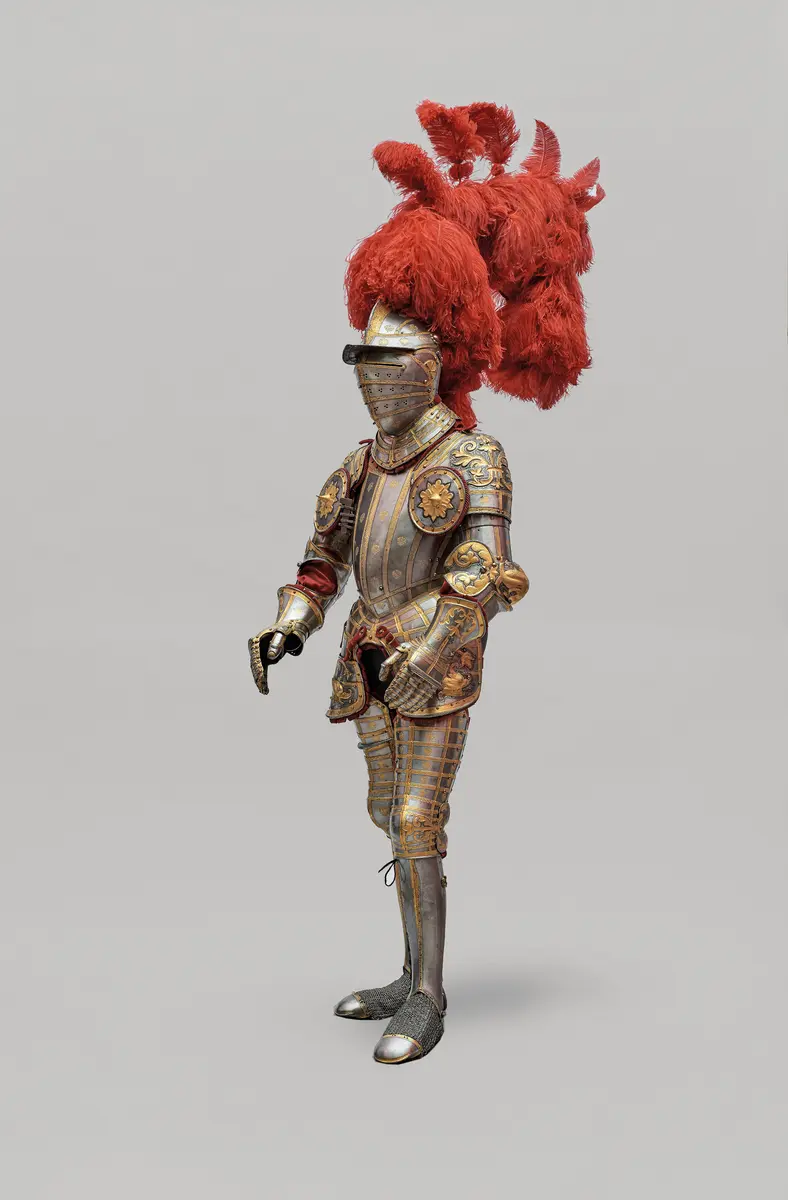
A number of highly specialized sub-groups of jousting evolved during the late Middle Ages and the Renaissance, all of which required specially designed equipment and armour, which, in turn, gave rise to the garniture. A garniture comprises alternate pieces suiting different purposes that could be configured as required, and its size reflected both the period in which it was produced and the demands, status, and financial means of its owner.
The Eagle Garniture, made for Archduke Ferdinand II in 1547, is the largest extant Renaissance garniture. It appears to have survived intact and comprises around 90 individual pieces for the field and different types of tournaments such as the tilt, the melee, and the combat on foot. King (later Emperor) Ferdinand I commissioned the Eagle Garniture in 1546 (during the Schmalkaldic War) for his second son, seventeen-year-old Ferdinand, from Jörg Seusenhofer, his court armourer at Innsbruck. Archival evidence allows us to identify the painter Hans Perkhammer as the artist responsible for the etched ornamentation.
The name of the garniture derives from the main motif of the decoration that can be found on practically all its pieces – the single-headed eagle of Austria ancient. In coeval sources this motif is generally called a ‘lark’ (lerche).
The Eagle Garniture was exorbitantly expensive. According to the extant bill, dated 26 November 1547, the armourer alone was paid 400 guilders and the painter-etcher received 63 guilders. 110 guilders was spent on additional materials, and 265 ducats were used for the gilding. At the time, an official at the Habsburg court earned around 100 guilders a year.
Owner:
Ferdinand II. (1564-1595), Erzherzog von Österreich und Landesherr von Tirol (1529 - 1595) DNB
Artist:
Jörg Seusenhofer (1528 - 1580, tätig in Innsbruck) DNB
Time:
1547
Object Name
Feldharnisch der Adlergarnitur
Culture
Innsbruck
Material/technology:
Eisen, geschmiedet, getrieben, teils geschnitten, teils geätzt, teils feuervergoldet. Ätzdekor: teils feuervergoldet, teils schwarz geätzt, teils geschwärzt (modern). Nietkappen, Ösen, Rosetten, Scharniere: Messing, teils feuervergoldet. Schnallen: Eisen, feuervergoldet. Leder (teils modern). Textil: originale Seidensamtreste, Samt (modern), Seide, Wolle (Füllmaterial). Visierbolzen: Eisen. Federhülse: Messing, feuervergoldet, teils graviert. Federbuschen (modern).
Dimensions:
Harnisch inkl. Federbusch, exkl. Eisenplatte: H 216 cm × B 72,5 cm × T 116,5 cm
Harnisch exkl. Federbusch, exkl. Eisenplatte: H 168,5 cm x B 72,5 cm x T 47 cm
Eisenplatte: H 4 cm x B 60 cm x T 60 cm
Copyright
Kunsthistorisches Museum, Hofjagd- und Rüstkammer
Invs.
Hofjagd- und Rüstkammer, A 638
Browse more
Similar items you might be interested in
Riefelharnisch, Riefelküriss: Fluted field armour Johann Friedrich I. (1532-1547), Kurfürst von Sachsen Dated 1530
Sigismund Franz (1662-1665), Erzherzog von Vorderösterreich um 1635-1638
Leopold V. (1619-1632), Erzherzog und Graf von Tirol, Bischof von Passau und Straßburg um 1620

Ferdinand II. (1564-1595), Erzherzog von Österreich und Landesherr von Tirol 1547

Karl I. (V.) (1516-1556), als Karl I. König von Spanien, ab 1519 deutscher König, ab 1520 Kaiser c. 1511-1512

Maximilian I. (1477-1519), seit 1493 deutscher König, 1508 Kaiser Datiert 1498
Gupfe der Adlergarnitur; Kempfküriss der Adlergarnitur; Stechküriss der Königsgarnitur Kaiser Maximilian II.; Die Adlergarnitur J. Löwy, K. und K. Hof-Photograph, Kunst- und Verlagsanstalt (Wien) 1892

Ferdinand Karl (1646-1662), Erzherzog von Österreich, Landesfürst von Tirol late 1630s (?)

Philipp I. (1482-1506), Herzog von Burgund, seit 1504 König von Kastilien und León 1488/89
Sigismund (1439-1496), Erzherzog von Österreich um 1480/1490
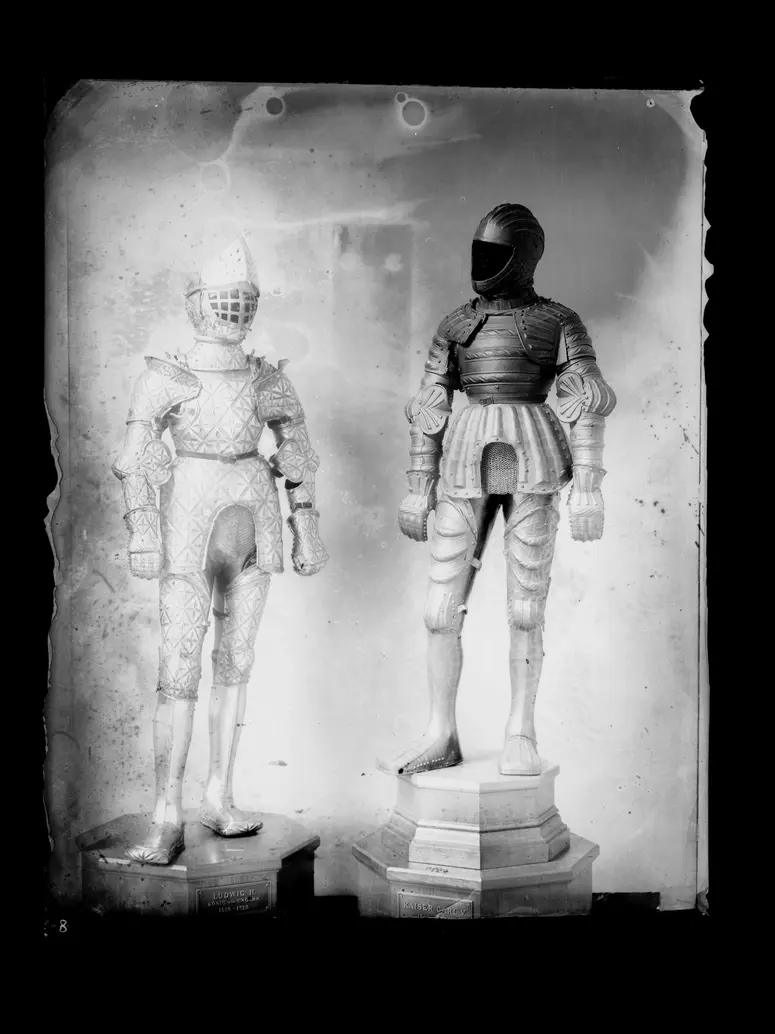
unvollendeter Kinder-Kostümharnisch; Prunkharnisch J. Löwy, K. und K. Hof-Photograph, Kunst- und Verlagsanstalt (Wien) 1892
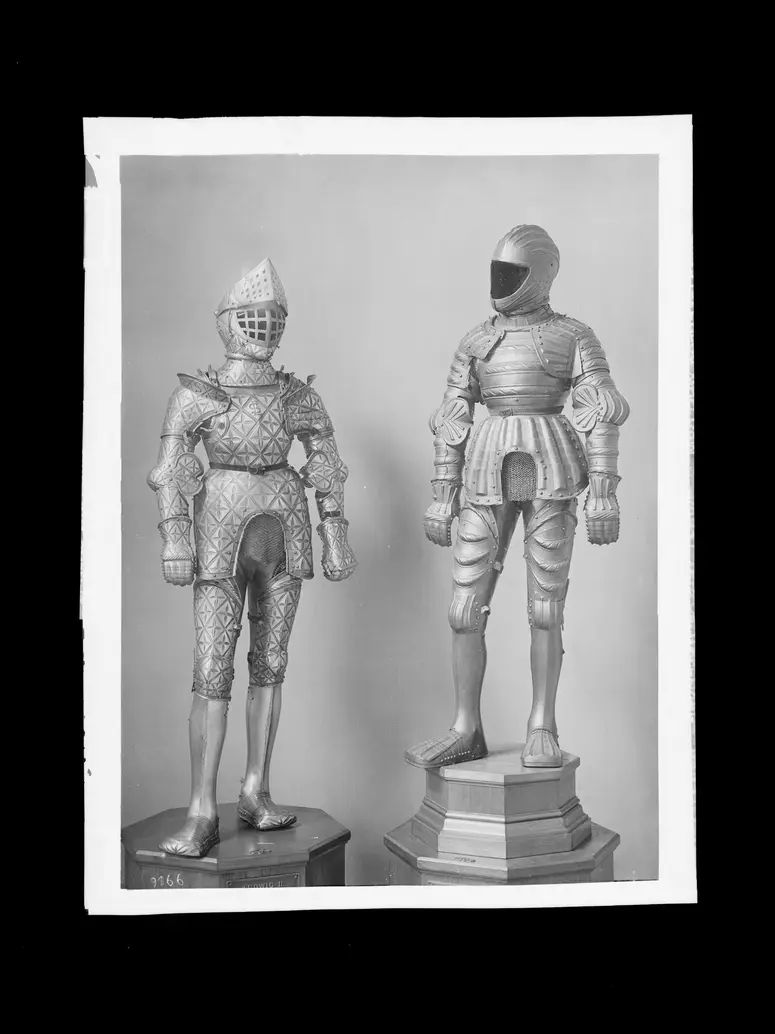
Prunkharnisch; unvollendeter Kinder-Kostümharnisch J. Löwy, K. und K. Hof-Photograph, Kunst- und Verlagsanstalt (Wien) 1892

Ferdinand II. (1564-1595), Erzherzog von Österreich und Landesherr von Tirol 1547

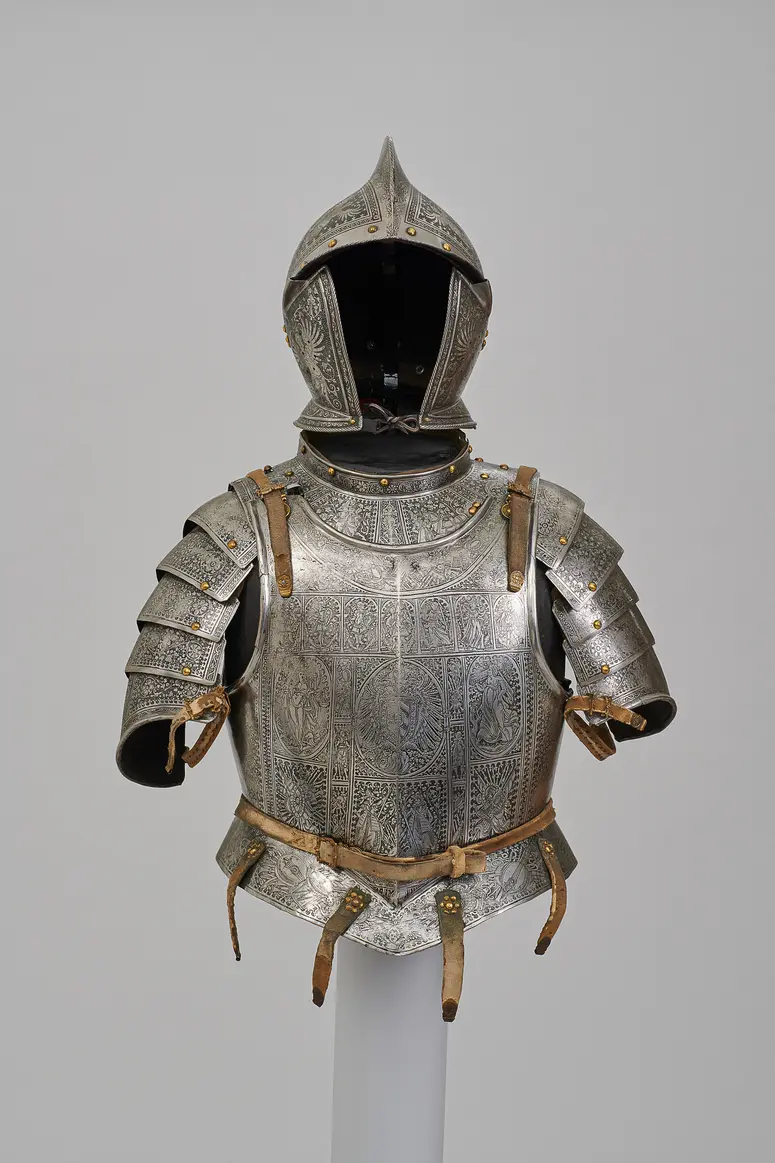
Hans Becher d. Ä. Plattnerarbeiten spätes 16. Jahrhundert, Ätzung datiert 1618, tlw. Ergänzungen

Ferdinand II. (1564-1595), Erzherzog von Österreich und Landesherr von Tirol 1547
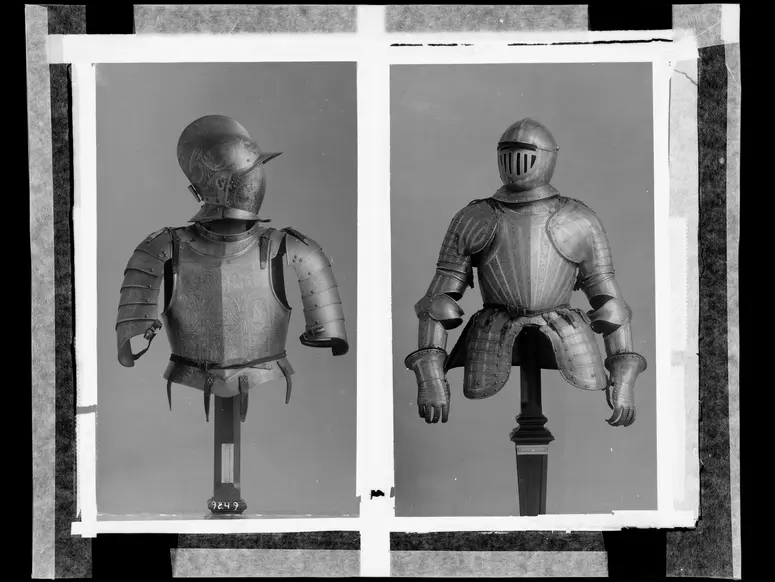
Halber Fußknechtharnisch; Feldküriss J. Löwy, K. und K. Hof-Photograph, Kunst- und Verlagsanstalt (Wien) 1892

Karl von Österreich, Sohn des Tiroler Landesfürsten Erzherzog Ferdinands II. von Habsburg und der Philippine Welser 1582 (datiert auf linkem Diechling A 1277j)