Rennzeug
The two main types of late medieval jousting are the joust of peace (Stechen; see cat. 13) and the mock joust of war (Rennen). In a mock joust of war, the focus was on the knights’ equestrian skills and their handling of the lance. A lance was between 3 and 4 metres long, and together with the necessary equipment – lance head and vamplate – could weigh up to 13.5 kilogrammes (30 pounds).
As in the joust of peace, the equipment worn by participants in a late medieval Rennen was purpose-built for the sport. Until the late fifteenth century, most jousters wore their normal field armour, but around 1490 at the latest a highly specialized armour for the Rennen – the Rennzeug – was devised, most probably at the court of Emperor Maximilian I. This comprised an asymmetrical, box-like breastplate with hook (lance rest) and long counter-hook (queue), a lighter backplate, and longer faulds. The jouster’s head was protected by a bevor, which covered the neck and the lower part of the face, and a sallet, often with reinforcing forehead plates.
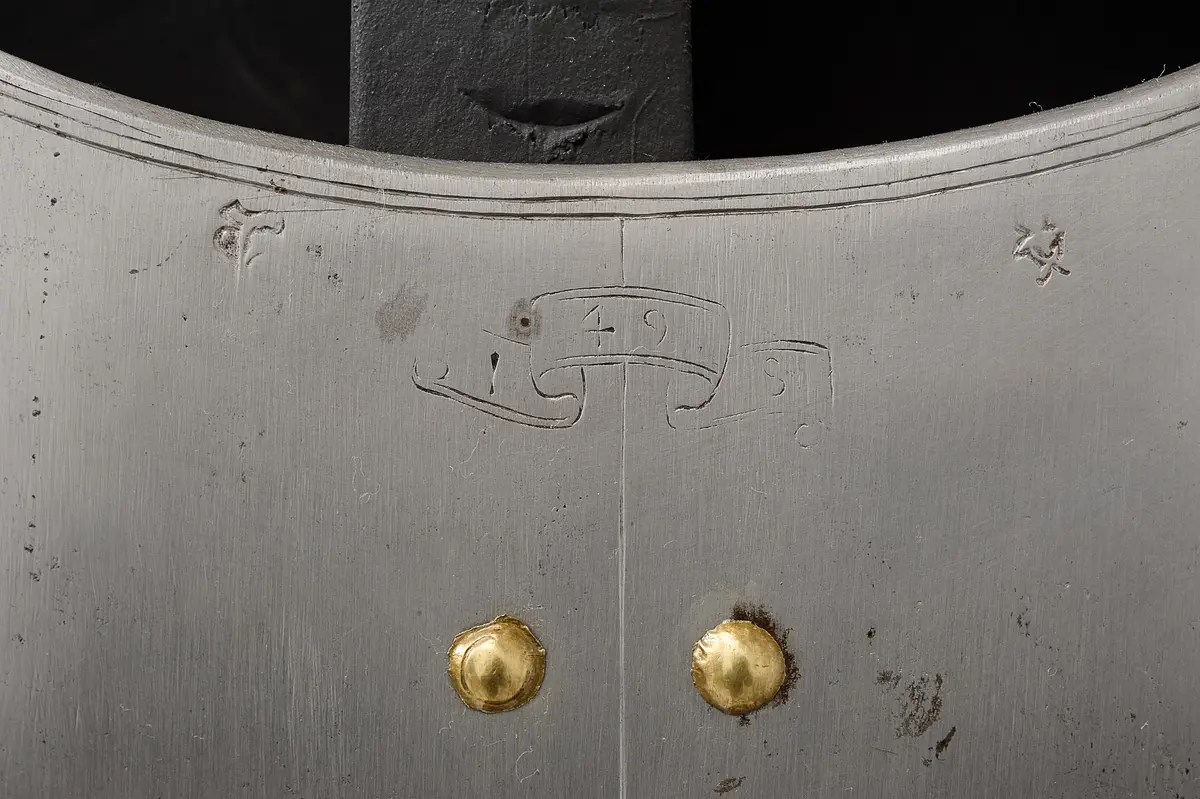
Produced by Matthes Deutsch, an armourer active in the Bavarian city of Landshut, this Rennzeug was designed to be worn for a mock joust of war with fixed shields. A massive shield bolted to the harness protected the wearer’s torso and the lower part of his face. The date 1498 is inscribed on the backplate. In that year, John, Elector of Saxony (from 1525) and his elder brother Elector Frederick III visited Innsbruck, where Emperor Maximilian I hosted a number of festivities in their honour, including a Rennen held on 25 February. Both the court of Saxony and the Habsburgs commissioned works from Matthes Deutsch.
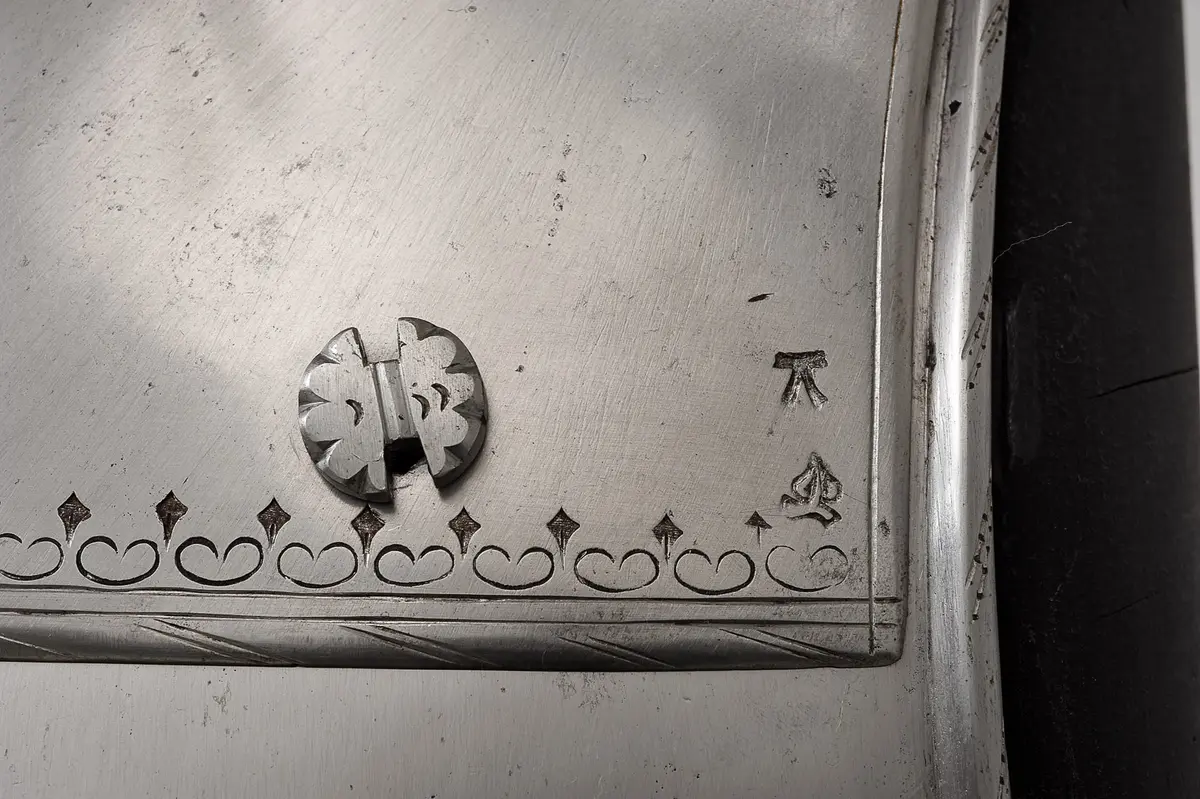
As all the pieces belonging to this armour are marked with three circle segments, we have recently been able to identify the matching helmet. It is decorated with the Cross of Burgundy and a fire steel, which shows that it was originally made for a Habsburg prince. Perhaps the armour was commissioned by John of Saxony as a gift for Maximilian I or for the latter’s son, Philip the Handsome.
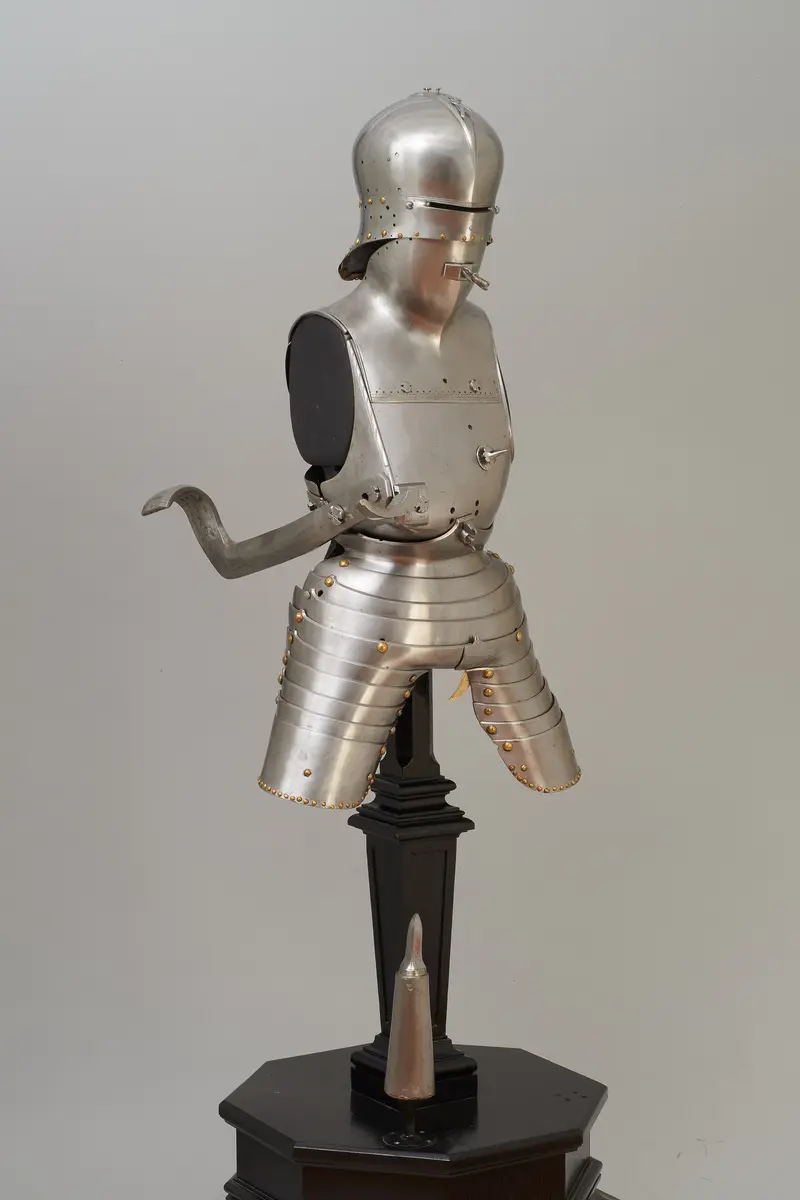
The two main types of late medieval jousting are the joust of peace (Stechen; see cat. 13) and the mock joust of war (Rennen). In a mock joust of war, the focus was on the knights’ equestrian skills and their handling of the lance. A lance was between 3 and 4 metres long, and together with the necessary equipment – lance head and vamplate – could weigh up to 13.5 kilogrammes (30 pounds).
As in the joust of peace, the equipment worn by participants in a late medieval Rennen was purpose-built for the sport. Until the late fifteenth century, most jousters wore their normal field armour, but around 1490 at the latest a highly specialized armour for the Rennen – the Rennzeug – was devised, most probably at the court of Emperor Maximilian I. This comprised an asymmetrical, box-like breastplate with hook (lance rest) and long counter-hook (queue), a lighter backplate, and longer faulds. The jouster’s head was protected by a bevor, which covered the neck and the lower part of the face, and a sallet, often with reinforcing forehead plates.
Produced by Matthes Deutsch, an armourer active in the Bavarian city of Landshut, this Rennzeug was designed to be worn for a mock joust of war with fixed shields. A massive shield bolted to the harness protected the wearer’s torso and the lower part of his face. The date 1498 is inscribed on the backplate. In that year, John, Elector of Saxony (from 1525) and his elder brother Elector Frederick III visited Innsbruck, where Emperor Maximilian I hosted a number of festivities in their honour, including a Rennen held on 25 February. Both the court of Saxony and the Habsburgs commissioned works from Matthes Deutsch.
As all the pieces belonging to this armour are marked with three circle segments, we have recently been able to identify the matching helmet. It is decorated with the Cross of Burgundy and a fire steel, which shows that it was originally made for a Habsburg prince. Perhaps the armour was commissioned by John of Saxony as a gift for Maximilian I or for the latter’s son, Philip the Handsome.
Owner:
Maximilian I. (1477-1519), seit 1493 deutscher König, 1508 Kaiser (1459 - 1519) DNB
Customer:
möglicherweise Johann der Beständige (1486-1532), Herzog, seit 1525 Kurfürst von Sachsen (1468 - 1532) DNB
Artist:
Matthes Deutsch (Plattner) (erwähnt 1485, aktiv bis um/nach 1515) DNB
Time:
Datiert 1498
Object Name
Rennzeug
Culture
Landshut
Material/technology:
Blankes Eisen
Dimensions:
Objektmaß: H 108,1cm x B 59,2cm x T 60,6cm
Inscribed
Rennhut: innen ehmals "A"
Brust: innen "A"
Rücken: Gravur einer Bandrolle mit "1498"
Stamp / markings
Lindenblattmarke (Meistermarke von Matthes Deutsch) und Landshütl (Landshuter Beschaumarke) auf Helm, Bart, Brust, Rücken und Magenblech.
? auf Brust, Bart, Rücken und Schößen
drei übereinanderstehenden, nach unten offenen Mondsicheln (???) auf Bart, Brust, Gerüst, Hinterhaken und Schrauben
Copyright
Kunsthistorisches Museum, Hofjagd- und Rüstkammer
Invs.
Hofjagd- und Rüstkammer, R IV
Browse more
Similar items you might be interested in
Riefelharnisch, Riefelküriss: Fluted field armour Johann Friedrich I. (1532-1547), Kurfürst von Sachsen Dated 1530
“Joking Couple”, Self-Portrait of the Artist with his Wife Hans von Aachen around 1596
Leopold V. (1619-1632), Erzherzog und Graf von Tirol, Bischof von Passau und Straßburg 1628
Hans Becher d. Ä. Plattnerarbeiten spätes 16. Jahrhundert, Ätzung datiert 1618, tlw. Ergänzungen
Langes Faustrohr mit Radschloss; Radschlosspistole (mit Ladestock) J. Löwy, K. und K. Hof-Photograph, Kunst- und Verlagsanstalt (Wien) 1892
Halber Fußknechtharnisch; Feldküriss J. Löwy, K. und K. Hof-Photograph, Kunst- und Verlagsanstalt (Wien) 1892
Johann Friedrich I. (1532-1547), Kurfürst von Sachsen datiert 1530