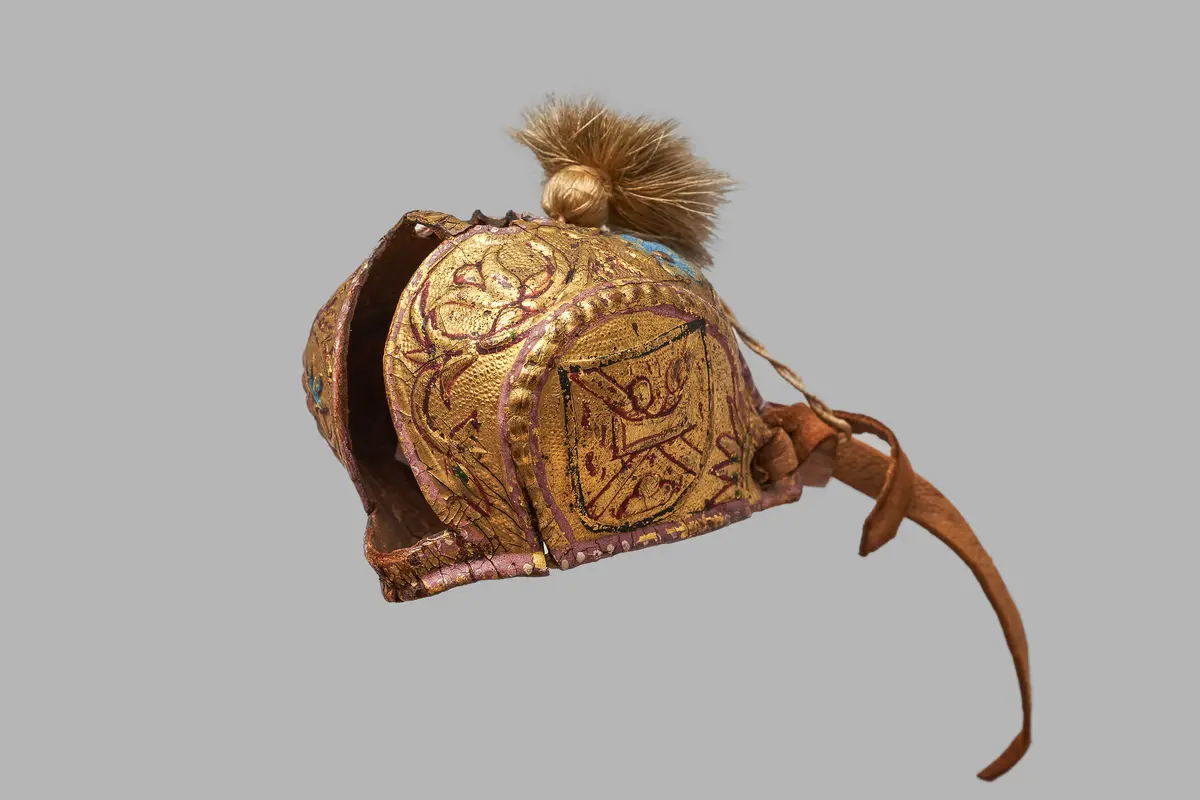
Falkenhaube
Zwischen 1494 und 1508 | Maximilian I. (1477-1519), seit 1493 deutscher König, 1508 Kaiser
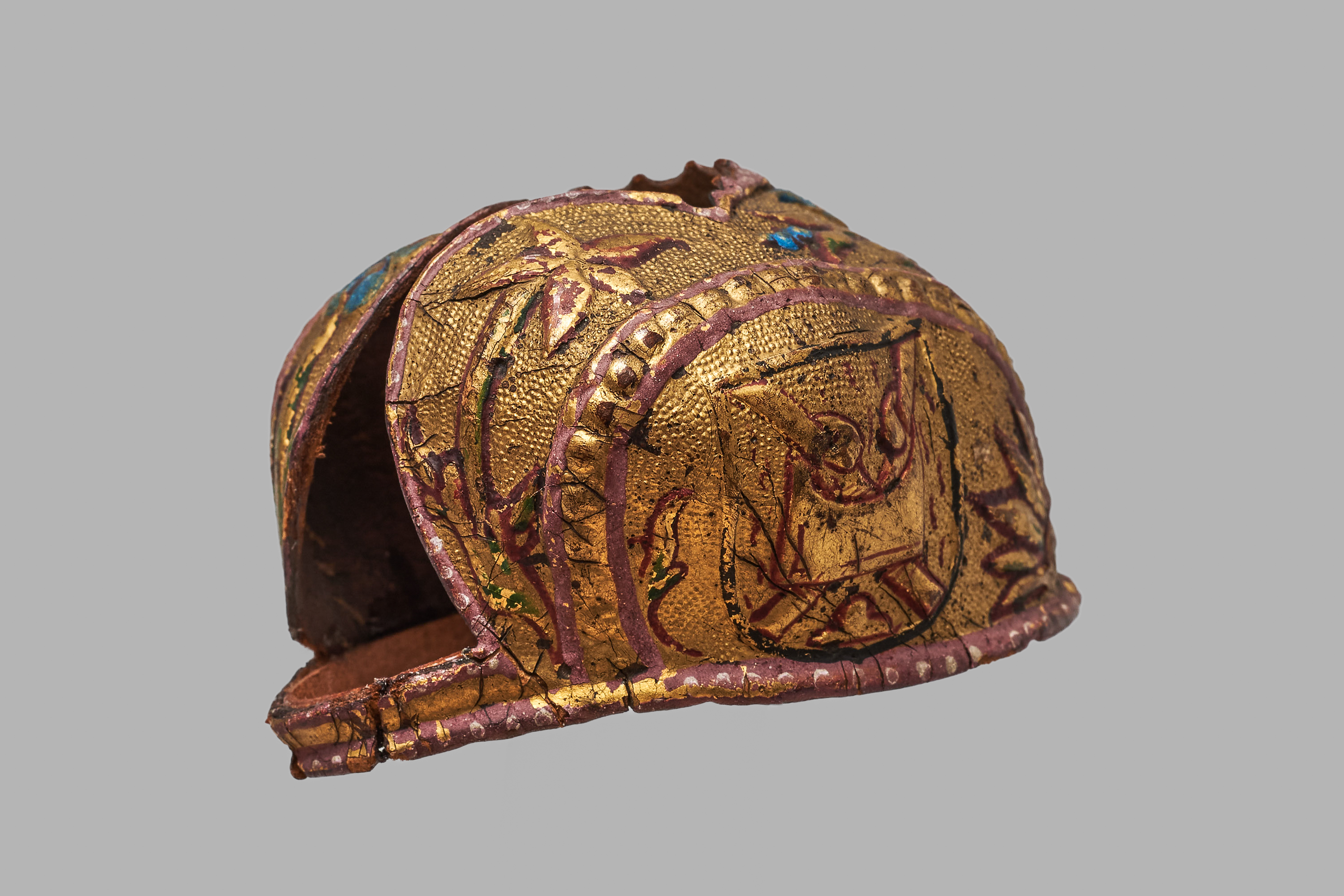
Europe witnessed a renewed flowering of falconry that began in the High Middle Ages and was probably inspired by contact with the Middle East – the use of leather hoods for the trained birds of prey before and after they were flown was pioneered in the Arab world. In his treatise De arte venandi cum avibus (‘On the Art of Hunting with Birds’), written in the 1240s, Emperor Frederick II noted that the Arabs had been the first in the Middle East to introduce such hoods, and because we ‘appreciated their great usefulness we, too, decided to use the hoods’.
This hood is one of a set of five (originally there were probably at least six) almost identical objects. Two of the extant hoods were worn by hawks, three by falcons. The cheekpieces of each hood are decorated with an escutcheon; one side shows the emblems of the Order of the Golden Fleece (St Andrew’s cross and fire steel), the other the royal Roman-German eagle emblazoned with the arms of Hungary, Austria, Burgundy, and the Tyrol. On one hood, the emblems of the order have been replaced by the arms of Milan-Savoy.
These heraldic devices allow us to attribute the hoods to King Maximilian I and his second wife, Bianca Maria Sforza, and to date them to between 1494 and 1508; Maximilian married Bianca Maria Sforza, the daughter of Galeazzo Maria Sforza, Duke of Milan and Bona of Savoy, in 1494. Maximilian was proclaimed Emperor of the Holy Roman Empire in 1508, after which he replaced the single-headed (German) royal eagle in his coat of arms with the double-headed imperial eagle.
Europe witnessed a renewed flowering of falconry that began in the High Middle Ages and was probably inspired by contact with the Middle East – the use of leather hoods for the trained birds of prey before and after they were flown was pioneered in the Arab world. In his treatise De arte venandi cum avibus (‘On the Art of Hunting with Birds’), written in the 1240s, Emperor Frederick II noted that the Arabs had been the first in the Middle East to introduce such hoods, and because we ‘appreciated their great usefulness we, too, decided to use the hoods’.
This hood is one of a set of five (originally there were probably at least six) almost identical objects. Two of the extant hoods were worn by hawks, three by falcons. The cheekpieces of each hood are decorated with an escutcheon; one side shows the emblems of the Order of the Golden Fleece (St Andrew’s cross and fire steel), the other the royal Roman-German eagle emblazoned with the arms of Hungary, Austria, Burgundy, and the Tyrol. On one hood, the emblems of the order have been replaced by the arms of Milan-Savoy.
These heraldic devices allow us to attribute the hoods to King Maximilian I and his second wife, Bianca Maria Sforza, and to date them to between 1494 and 1508; Maximilian married Bianca Maria Sforza, the daughter of Galeazzo Maria Sforza, Duke of Milan and Bona of Savoy, in 1494. Maximilian was proclaimed Emperor of the Holy Roman Empire in 1508, after which he replaced the single-headed (German) royal eagle in his coat of arms with the double-headed imperial eagle.
Owner:
Maximilian I. (1477-1519), seit 1493 deutscher König, 1508 Kaiser (1459 - 1519) DNB
Time:
Zwischen 1494 und 1508
Object Name
Falkenhaube
Culture
Oberitalienisch
Material/technology:
Leder, teils geprägt, teils blattvergoldet, teilweise bemalt. Helmbusch: Seidenfäden. Lederbänder.
Dimensions:
L 8 x B 6 x H 7cm
Copyright
Kunsthistorisches Museum, Hofjagd- und Rüstkammer
Invs.
Hofjagd- und Rüstkammer, D 24
Browse more
Similar items you might be interested in
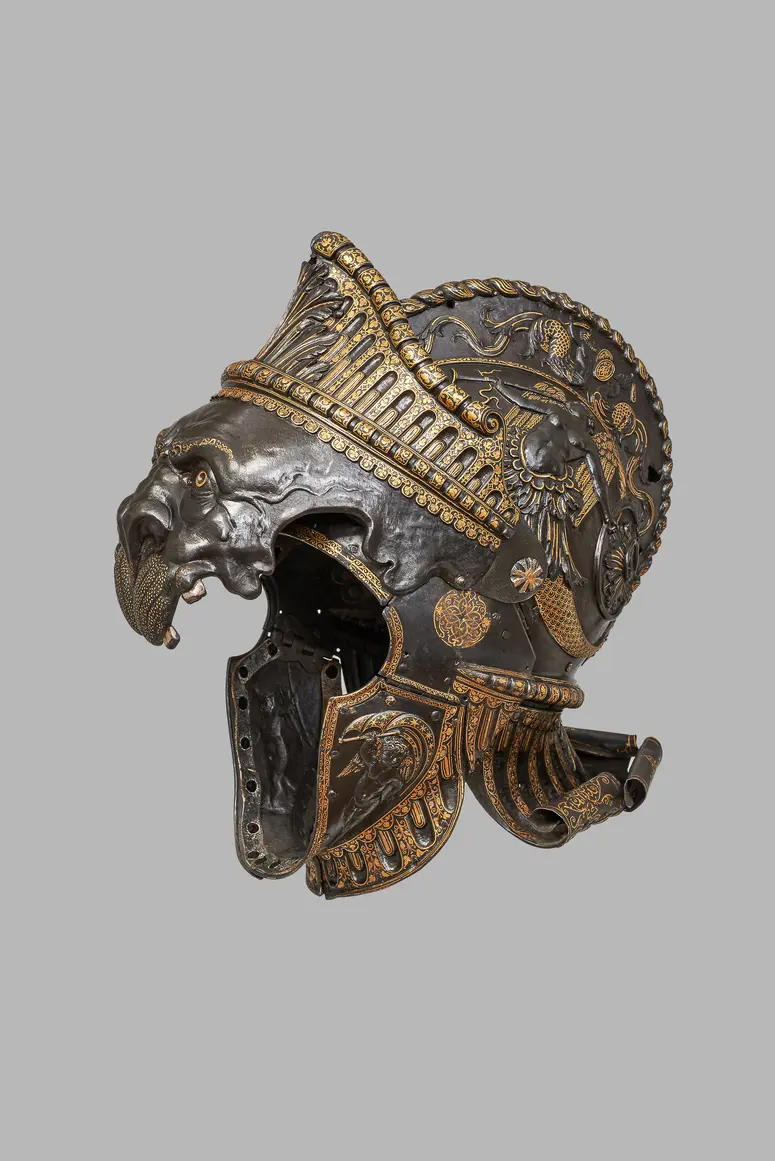
All'antica-Sturmhaube, sog. Löwen-Sturmhaube: All'antica burgonet, so-called Lion Burgonet Karl I. (V.) (1516-1556), als Karl I. König von Spanien, ab 1519 deutscher König, ab 1520 Kaiser c. 1550 - 1555

Ferdinand II. (1564-1595), Erzherzog von Österreich und Landesherr von Tirol um 1560
Herzog Leopold IV. Sohn von Leopold III. von Habsburg um 1400
Stephan Báthory (1576-1586), König von Polen, Großherzog von Litauen, 1571-1576 Fürst von Siebenbürg um 1560
Konrad von Boineburg (von Bemelberg) um 1535-1540
Nikolaus IV. Radziwill (1515-1565) Großmarschall von Litauen um 1555

Halbharnisch Ferdinands II. von Tirol mit Harnischröckchen ("Hochzeitsharnisch") 1582
Maximilian I. (1477-1519), seit 1493 deutscher König, 1508 Kaiser zwischen 1494 und 1508
Trabharnisch des Andreas Teufel (Andre Teuffel), Rüstung des Andreas Teufel um 1555
Ferdinand II. (1564-1595), Erzherzog von Österreich und Landesherr von Tirol c. 1547 - 1550

Ferdinand Karl (1646-1662), Erzherzog von Österreich, Landesfürst von Tirol late 1630s (?)


Karl VI. (1711-1740), Kaiser datiert 1733
Maximilian II. (1564-1576), Kaiser nach 1557/1563

Maximilian I. (1477-1519), seit 1493 deutscher König, 1508 Kaiser 1496