Helmhaube/Innenfutter für einen Stechhelm
In a joust of peace (see invs. S VIII, B 87), the most dangerous piece of equipment worn by the two mounted combatants were their own helmets. If a jouster’s head hit the inside wall of his steel helmet – caused either by the impact of his opponent’s lance or his subsequent fall from his horse – he might easily suffer a concussion or serious injury. In order to prevent this, knights wore thick, padded linen hoods under their helmets. Most of these balaclava-like hoods were filled with hemp and were firmly tied to the steel helmet with leather straps to ensure the distance between head and helmet remained constant. Steel helmets had special holes through which the straps were passed to be tied on the outside.
On the battlefield, a mounted knight had to be able to put on and take off his steel helmet quickly and without assistance, which means it would have been highly impractical to lash his head, encased in a linen ‘balaclava’, to his helmet. In the lists, however, safety was paramount, and there was plenty of time for a helper to ensure the steel helmet fitted perfectly and to tie the knight’s linen hood to it.
Only very few contemporary sources have survived that tell us about this practical detail of jousting. In his Collectanea (1509), Pietro Monte, for instance, advised his readers to protect their heads with padding lashed to their helmets with two straps, one from the front and one from the back. A layer of wax, too, apparently helped reduce the impact of a hit.
Eight padded linen hoods have survived in the Imperial Armoury, all of them constructed differently. Today, late medieval and Renaissance linen hoods are extremely rare. At the time they had little value, and once they were soaked with sweat and torn or ripped, they were simply discarded. In addition, the hoods stored in armouries were threatened by humidity, mice, and other vermin, which over time reduced their numbers further.
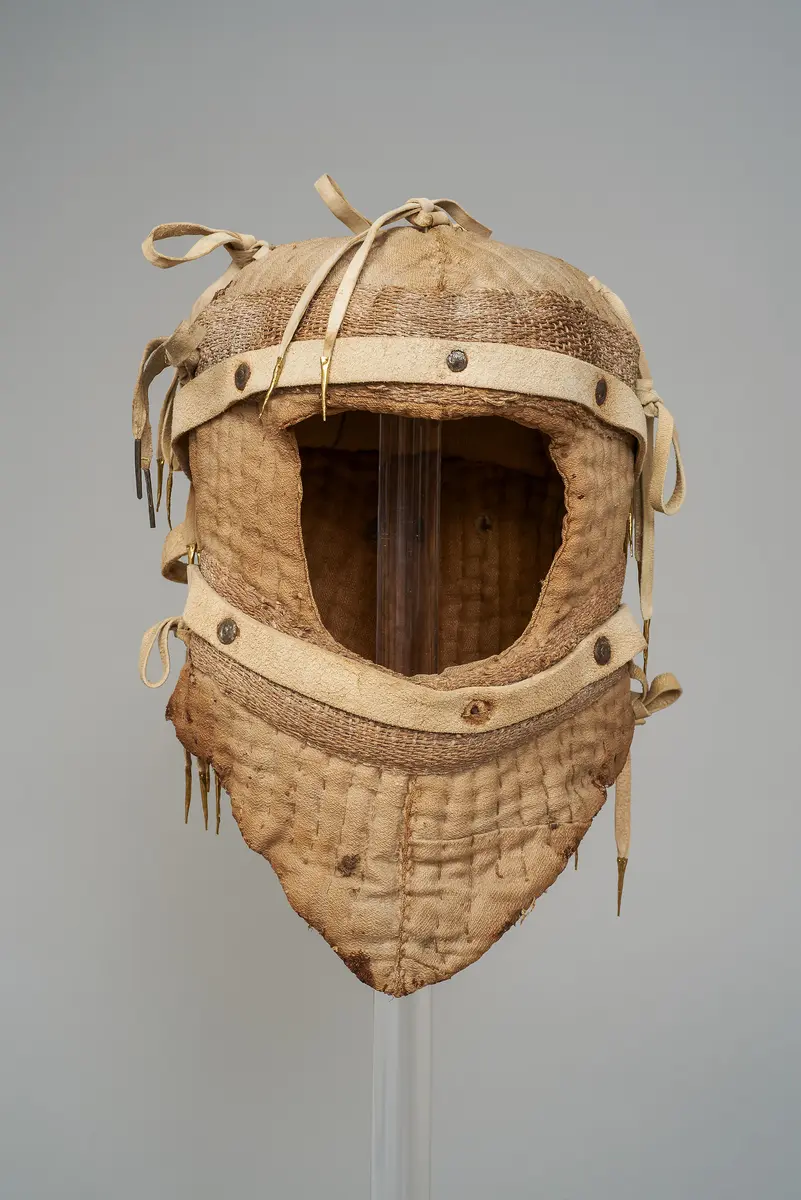
In a joust of peace (see invs. S VIII, B 87), the most dangerous piece of equipment worn by the two mounted combatants were their own helmets. If a jouster’s head hit the inside wall of his steel helmet – caused either by the impact of his opponent’s lance or his subsequent fall from his horse – he might easily suffer a concussion or serious injury. In order to prevent this, knights wore thick, padded linen hoods under their helmets. Most of these balaclava-like hoods were filled with hemp and were firmly tied to the steel helmet with leather straps to ensure the distance between head and helmet remained constant. Steel helmets had special holes through which the straps were passed to be tied on the outside.
On the battlefield, a mounted knight had to be able to put on and take off his steel helmet quickly and without assistance, which means it would have been highly impractical to lash his head, encased in a linen ‘balaclava’, to his helmet. In the lists, however, safety was paramount, and there was plenty of time for a helper to ensure the steel helmet fitted perfectly and to tie the knight’s linen hood to it.
Only very few contemporary sources have survived that tell us about this practical detail of jousting. In his Collectanea (1509), Pietro Monte, for instance, advised his readers to protect their heads with padding lashed to their helmets with two straps, one from the front and one from the back. A layer of wax, too, apparently helped reduce the impact of a hit.
Eight padded linen hoods have survived in the Imperial Armoury, all of them constructed differently. Today, late medieval and Renaissance linen hoods are extremely rare. At the time they had little value, and once they were soaked with sweat and torn or ripped, they were simply discarded. In addition, the hoods stored in armouries were threatened by humidity, mice, and other vermin, which over time reduced their numbers further.
Owner:
Sigismund (1439-1496), Erzherzog von Österreich (1427 - 1496) DNB
Time:
1484
Object Name
Helmhaube/Innenfutter für einen Stechhelm
Culture
Innsbruck
Material/technology:
Linen; deer leather
Dimensions:
H 40 cm x B 25 cm x T 25 cm
Copyright
Kunsthistorisches Museum, Hofjagd- und Rüstkammer
Invs.
Hofjagd- und Rüstkammer, B 47
Browse more
Similar items you might be interested in
Emperor Joseph II with Grand Duke Pietro Leopoldo of Tuscany Bernardino Regoli 1769–73
Taufe Christi J. Löwy, K. und K. Hof-Photograph, Kunst- und Verlagsanstalt (Wien) 1888 bis 1891
Büßender Hl. Hieronymus J. Löwy, K. und K. Hof-Photograph, Kunst- und Verlagsanstalt (Wien) 1888 bis 1891
Madonna mit dem Jesuskinde und den hll. Rosalia und Katharina J. Löwy, K. und K. Hof-Photograph, Kunst- und Verlagsanstalt (Wien) 1888 bis 1910
Maria mit Kind und den hll. Rosa (?) und Katharina (?) J. Löwy, K. und K. Hof-Photograph, Kunst- und Verlagsanstalt (Wien) 1888 bis 1891
Maria mit Kind und den hll. Petrus, Johannes Evangelist (?), Johannes d. Täufer und Paulus J. Löwy, K. und K. Hof-Photograph, Kunst- und Verlagsanstalt (Wien) 1888 bis 1891
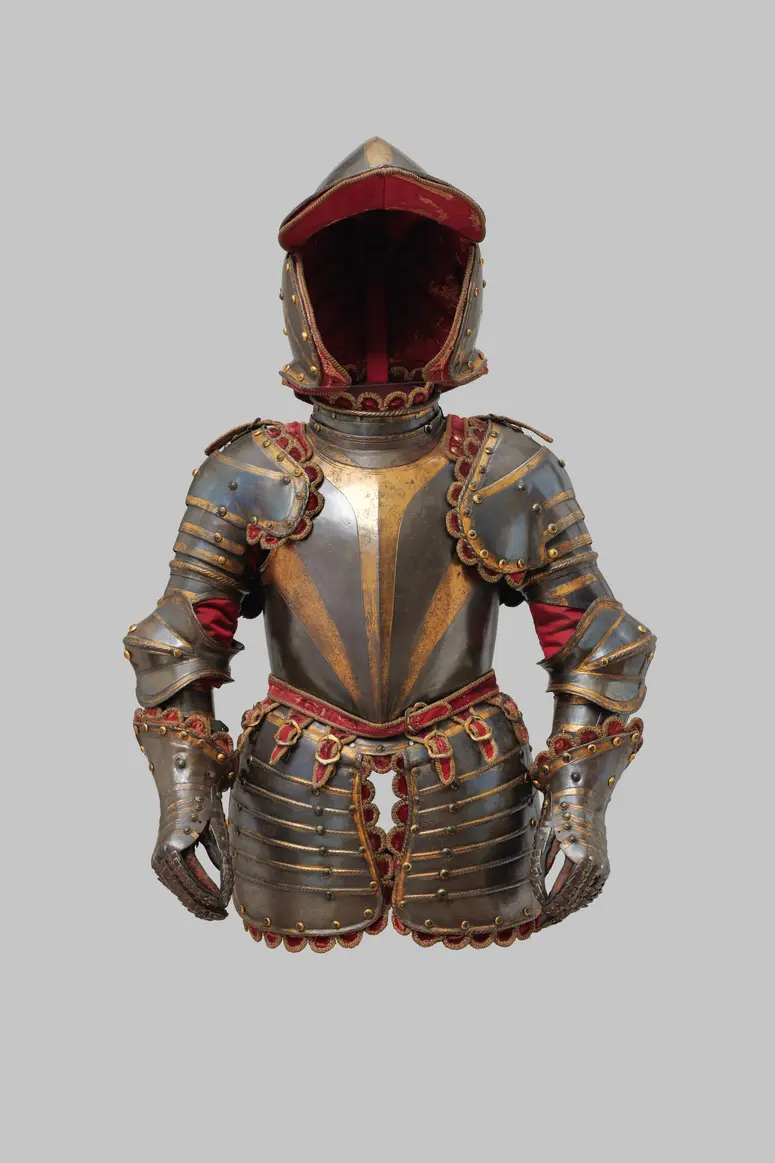
Paolo Francesco Carnesecchi, Sohn von Pietro Carnesecchi (1508-1567) um 1575
Heimkehr der Hagar J. Löwy, K. und K. Hof-Photograph, Kunst- und Verlagsanstalt (Wien) 1888 bis 1891
Salomons Urteil J. Löwy, K. und K. Hof-Photograph, Kunst- und Verlagsanstalt (Wien) 1888 bis 1910
Traum des Josef J. Löwy, K. und K. Hof-Photograph, Kunst- und Verlagsanstalt (Wien) 1888 bis 1910
Venus und Vulcan J. Löwy, K. und K. Hof-Photograph, Kunst- und Verlagsanstalt (Wien) 1888 bis 1910
Die Heilige Familie J. Löwy, K. und K. Hof-Photograph, Kunst- und Verlagsanstalt (Wien) 1888 bis 1910