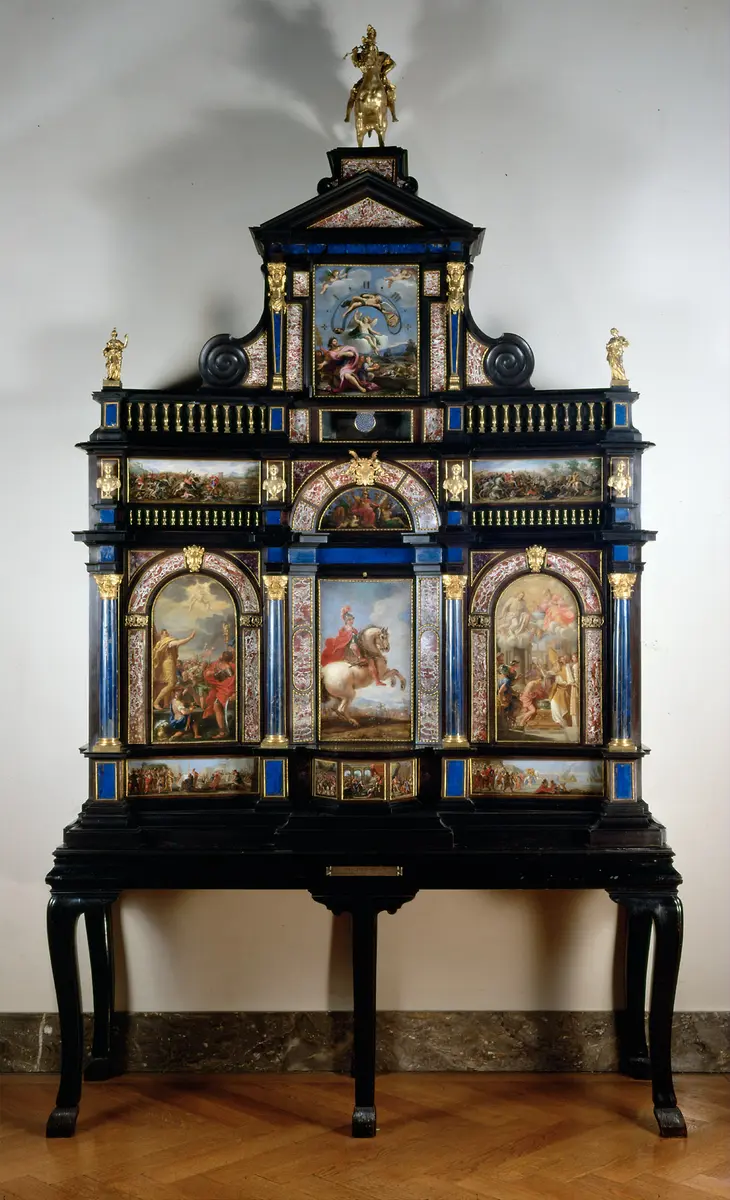
Cabinet with night clock
1663-1668 | Jakob Hermann
Jakob Herman (1615–1685) Night clock: Pietro Tommaso Campani Paintings: Carlo Maratta (1625-1713), Guglielmo Cortese (1628–1679), Pietro del Pò (1610–1692), Francesco Legerino (unknown), all active in Rome Cabinet with night clock 1663-1668 This highlight of baroque Roman cabinet-making combines the work of different master-craftsmen. Lavishly embellished with ebony, lapis lazuli and marble, the cabinet case by Jakob Herman is decorated with scenes from the life of Constantine the Great. The interior features views of Rome’s eight principal churches. The ca-binet is surmounted by a night clock – a clock that could be read in the dark which Campani had invented for Pope Alexander VII who had trouble sleeping at night and wanted a clock with a silent escapement for his be-droom. This impressive piece of furniture, its iconography a celebration of the supremacy of the Catholic Church, was presented to Emperor Leopold I by Cardinal Frederick of Hesse-Darmstadt, which is why it is now in Vienna.
Jakob Herman (1615–1685) Night clock: Pietro Tommaso Campani Paintings: Carlo Maratta (1625-1713), Guglielmo Cortese (1628–1679), Pietro del Pò (1610–1692), Francesco Legerino (unknown), all active in Rome Cabinet with night clock 1663-1668 This highlight of baroque Roman cabinet-making combines the work of different master-craftsmen. Lavishly embellished with ebony, lapis lazuli and marble, the cabinet case by Jakob Herman is decorated with scenes from the life of Constantine the Great. The interior features views of Rome’s eight principal churches. The ca-binet is surmounted by a night clock – a clock that could be read in the dark which Campani had invented for Pope Alexander VII who had trouble sleeping at night and wanted a clock with a silent escapement for his be-droom. This impressive piece of furniture, its iconography a celebration of the supremacy of the Catholic Church, was presented to Emperor Leopold I by Cardinal Frederick of Hesse-Darmstadt, which is why it is now in Vienna.
Artist:
Jakob Hermann (? 1615 - 1685 Rom)
Time:
1663-1668
Object Name
Furniture; Cabinet
Culture
Rome
Material/technology:
Ebony, walnut wood, oak, spruce, pietra dura, gilded bronze, mirror, enamel, lapis lazuli; oil on copper
Dimensions:
224 cm × 180 cm × 70 cm
Signed
Giacomo Hermann fecit Romae 1668 (E); Petrus Thomas Campanus inventor roma in via peregrin 1663 (U); f francesco Legerino
Copyright
Kunsthistorisches Museum, Kunstkammer
Invs.
Kunstkammer, 3395
Browse more
Similar items you might be interested in
Emperor Joseph II with Grand Duke Pietro Leopoldo of Tuscany Bernardino Regoli 1769–73
Taufe Christi J. Löwy, K. und K. Hof-Photograph, Kunst- und Verlagsanstalt (Wien) 1888 bis 1891
Büßender Hl. Hieronymus J. Löwy, K. und K. Hof-Photograph, Kunst- und Verlagsanstalt (Wien) 1888 bis 1891
Madonna mit dem Jesuskinde und den hll. Rosalia und Katharina J. Löwy, K. und K. Hof-Photograph, Kunst- und Verlagsanstalt (Wien) 1888 bis 1910
Maria mit Kind und den hll. Rosa (?) und Katharina (?) J. Löwy, K. und K. Hof-Photograph, Kunst- und Verlagsanstalt (Wien) 1888 bis 1891
Maria mit Kind und den hll. Petrus, Johannes Evangelist (?), Johannes d. Täufer und Paulus J. Löwy, K. und K. Hof-Photograph, Kunst- und Verlagsanstalt (Wien) 1888 bis 1891
Paolo Francesco Carnesecchi, Sohn von Pietro Carnesecchi (1508-1567) um 1575
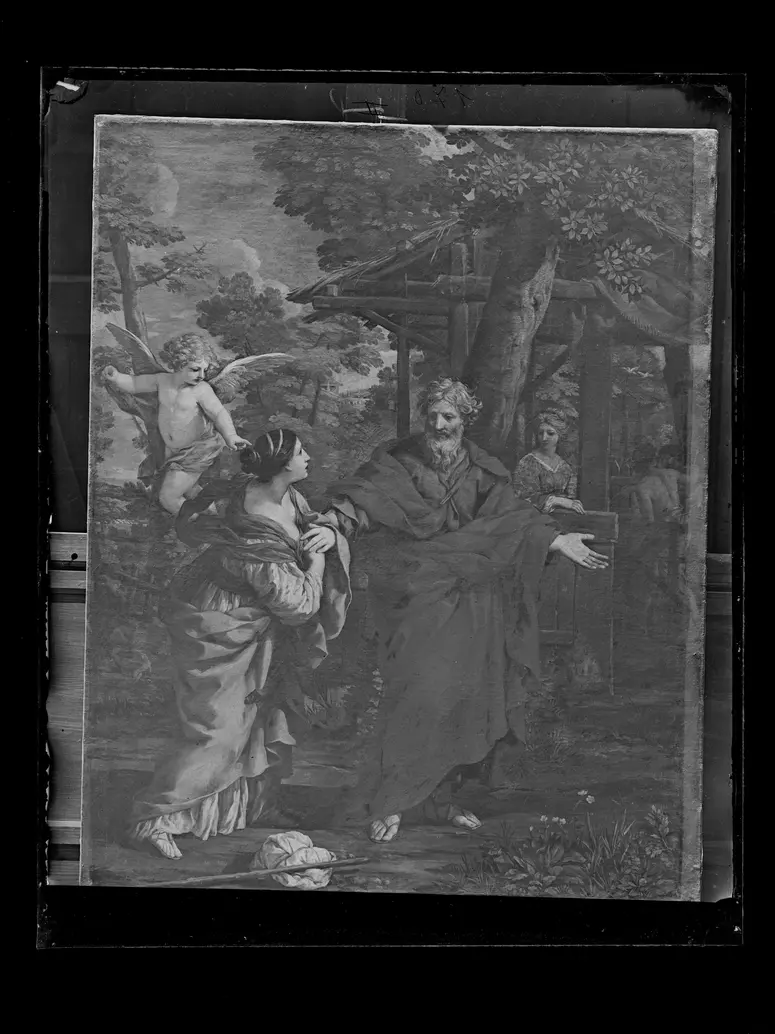
Heimkehr der Hagar J. Löwy, K. und K. Hof-Photograph, Kunst- und Verlagsanstalt (Wien) 1888 bis 1891
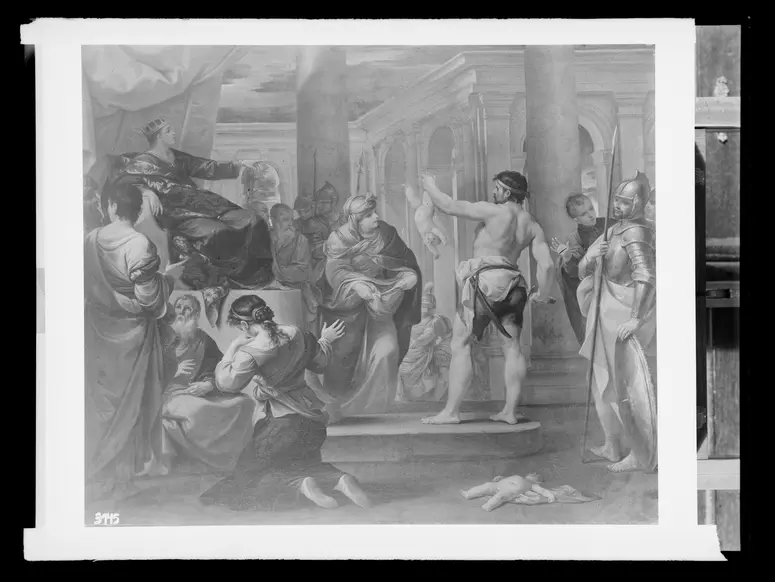
Salomons Urteil J. Löwy, K. und K. Hof-Photograph, Kunst- und Verlagsanstalt (Wien) 1888 bis 1910
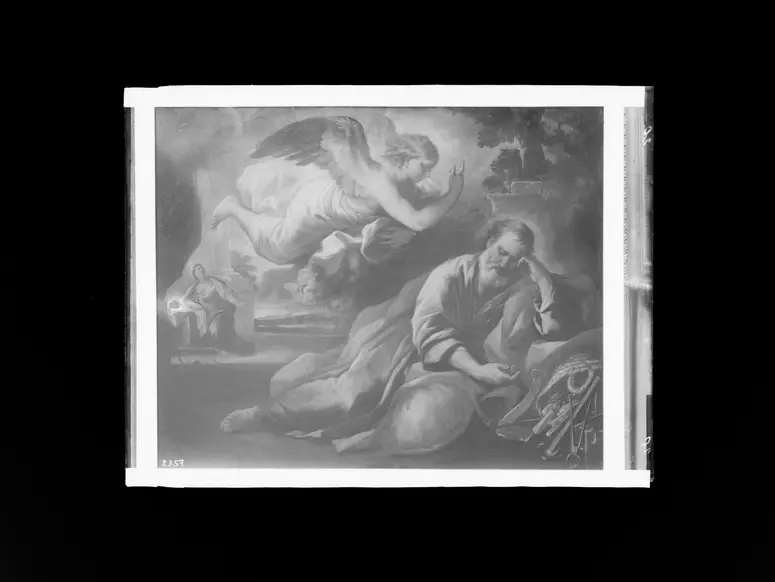
Traum des Josef J. Löwy, K. und K. Hof-Photograph, Kunst- und Verlagsanstalt (Wien) 1888 bis 1910
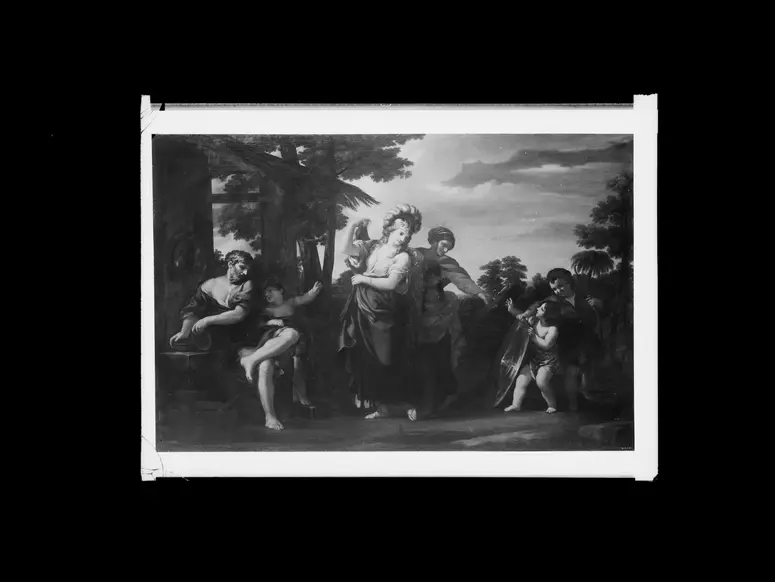
Venus und Vulcan J. Löwy, K. und K. Hof-Photograph, Kunst- und Verlagsanstalt (Wien) 1888 bis 1910
Die Heilige Familie J. Löwy, K. und K. Hof-Photograph, Kunst- und Verlagsanstalt (Wien) 1888 bis 1910