Chain with 49 Portrait Cameos of Habsburg Princes
mid-17th c.
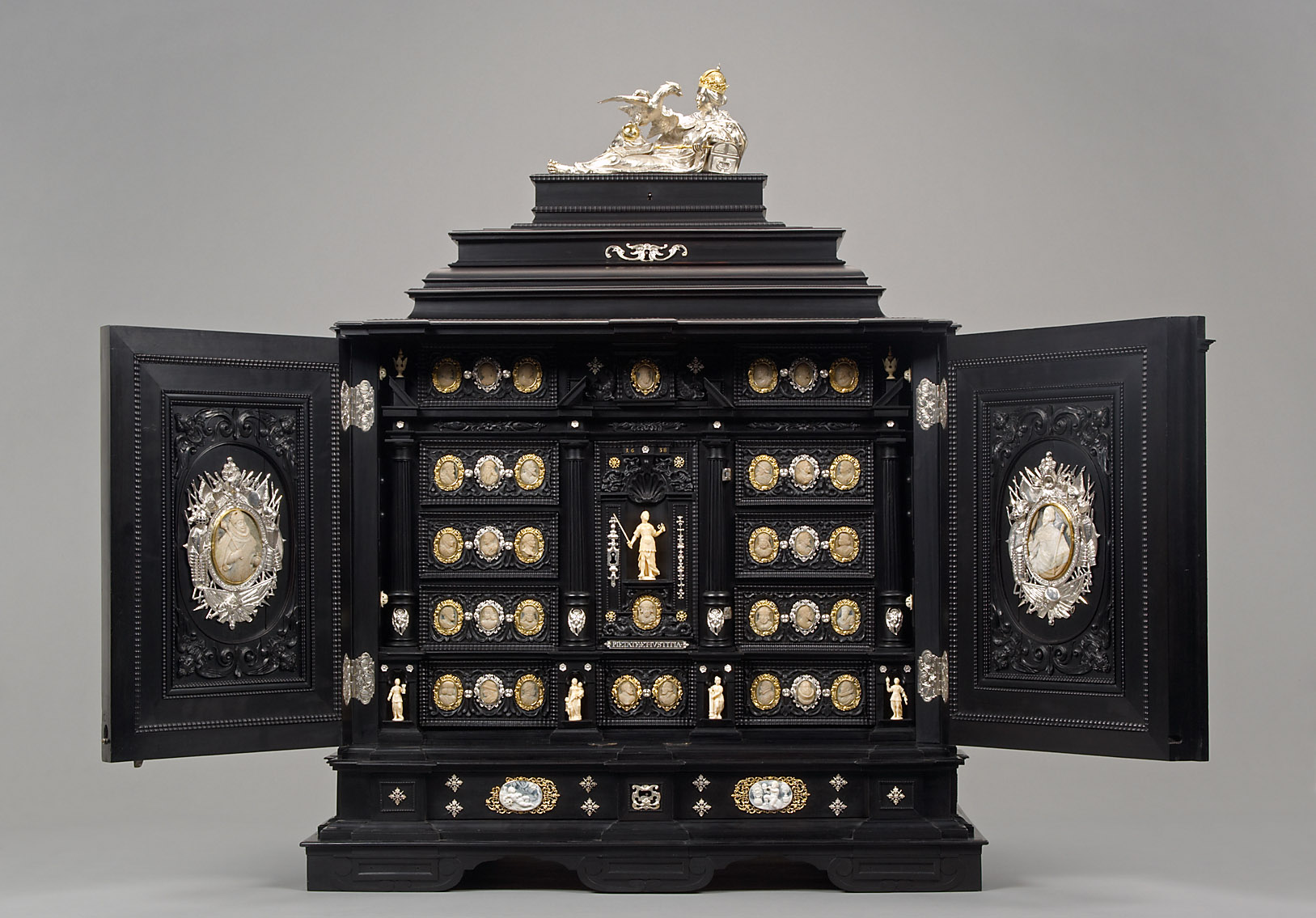
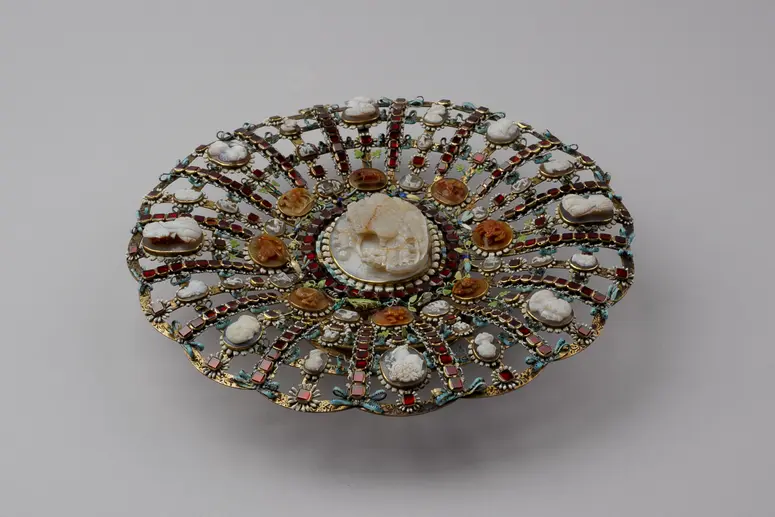
With their shell cameo decoration, the golden chain and the table cabinet depict a continuity of rule that places Ferdinand III in the line of princes of the Habsburg house and that of the emperors of the Holy Roman Empire. His legitimation is thus visually traced on the long “chain” of ancestors and predecessors in office. On the cabinet, personifications of virtue and the crowning figure refer additionally to emperor and empire.
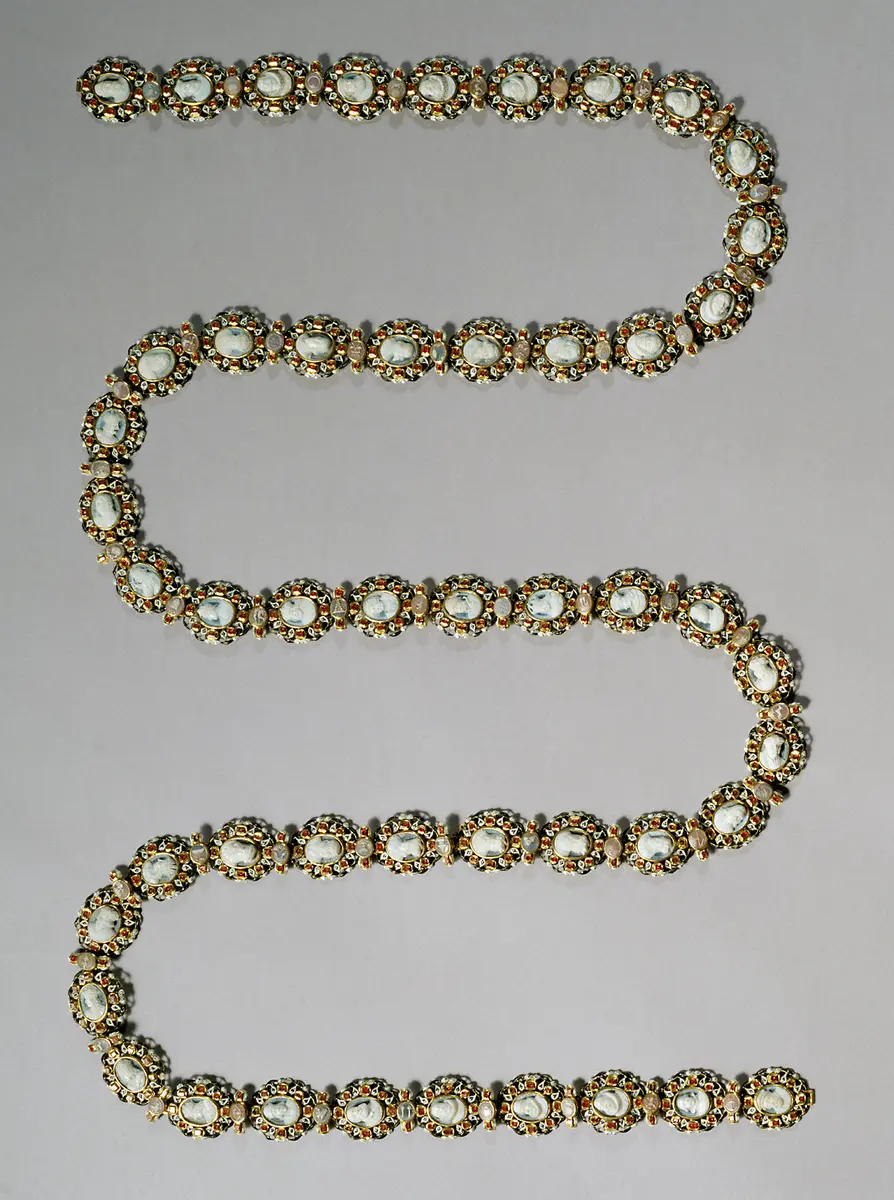
With their shell cameo decoration, the golden chain and the table cabinet depict a continuity of rule that places Ferdinand III in the line of princes of the Habsburg house and that of the emperors of the Holy Roman Empire. His legitimation is thus visually traced on the long “chain” of ancestors and predecessors in office. On the cabinet, personifications of virtue and the crowning figure refer additionally to emperor and empire.
Time:
mid-17th c.
Object Name
Cameo
Culture
Southern German
Material/technology:
Shell, gold, enamel, rubies
Dimensions:
L. 187 cm
Copyright
Kunsthistorisches Museum, Kunstkammer
Invs.
Antikensammlung, XII 53
Browse more
Similar items you might be interested in
Münzschrank, Kabinettschrank, Möbel Ende 16. Jahrhundert
Schrank zur Aufbewahrung der Schlüssel zu den Särgen der Habsburger Alexander Albert 1895
Korallenkabinett, Kabinettschrank mit Korallen 2. Hälfte 16. Jahrhundert
Karl VI. (1711-1740), Kaiser datiert 1722
Cabinet, so-called Wrangel Cabinet Ulrich Baumgartner 1631–34 (cabinet); dated 1776 (stand)
Glaskameo des Herophilos: Porträt des Drusus maior Römisch, Frühe Kaiserzeit um 20 n. Chr.
Möbel, Aufsatzschrank, Kabinettschrank, Schrank 1614
Kabinettschrank mit Pietra dura-Einlagen um 1675 und 19. Jahrhundert (Korpus)