Faveur (Schulterdecke)
3. Viertel 16. Jahrhundert | Ferdinand II. (1564-1595), Erzherzog von Österreich und Landesherr von Tirol
At a tournament, a lady might distinguish a favoured knight by presenting him with a faveur as a token of her esteem. In the lists, the knight thus singled out generally wore the faveur attached to his armour, his helmet, or his lance. To capture one’s opponent’s faveur was lauded as a heroic feat. A faveur honourably won in the lists was a treasured gift that, as an act of chivalry, could be presented to a lady watching the martial encounter. Losing his faveur spurred a knight to move heaven and earth to win it back. In Perceforest, one of the great French chivalrous novels of the late Middle Ages, we read: ‘At this moment a girl appeared and said: “Le Tor, noble lord, Queen Lydore sends you this helmet and the young Lyriope this sleeve made of red velvet to decorate your helmet. They summon you to defend it well.”’ Most faveurs were pieces of female attire or accessories like a sleeve, a belt, or a veil, but might also, as here, be a small shawl.
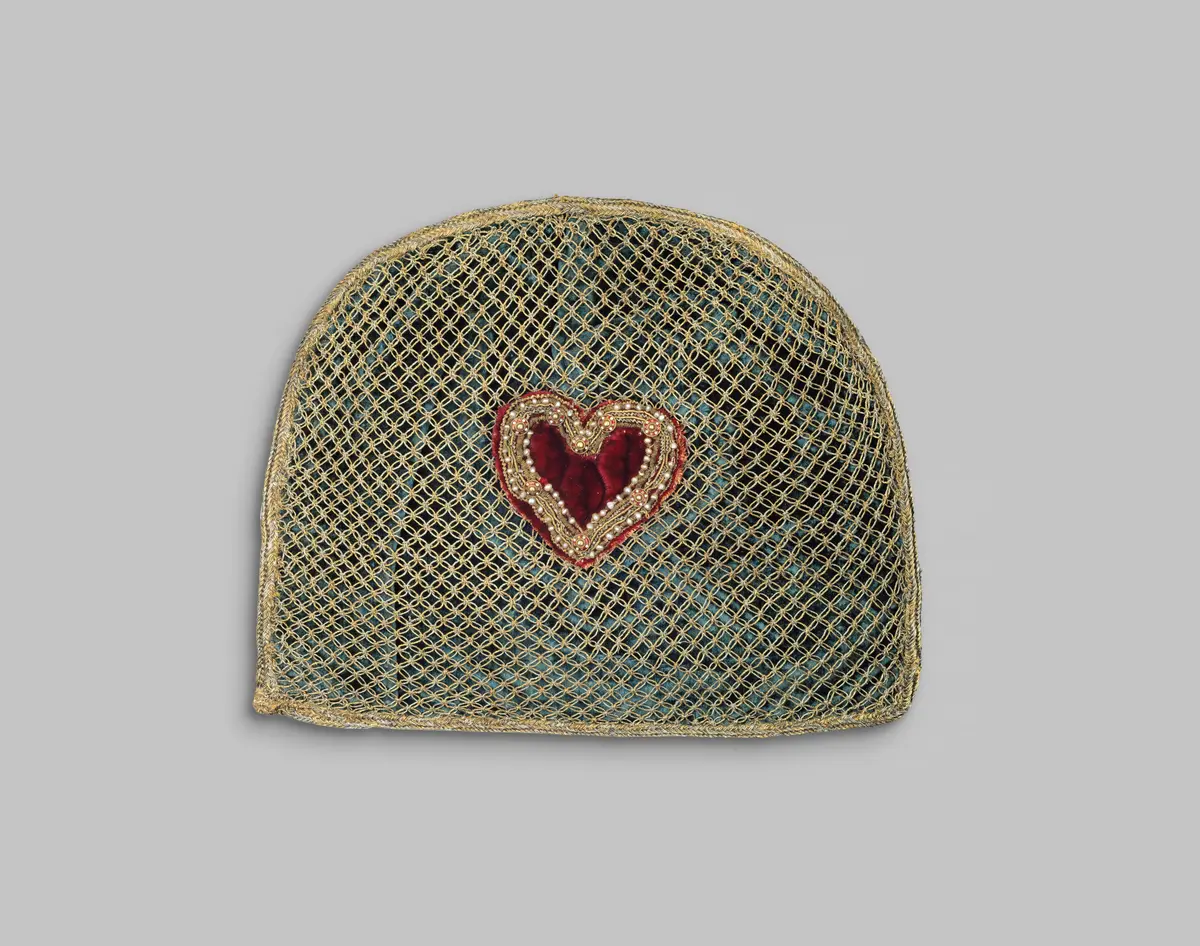
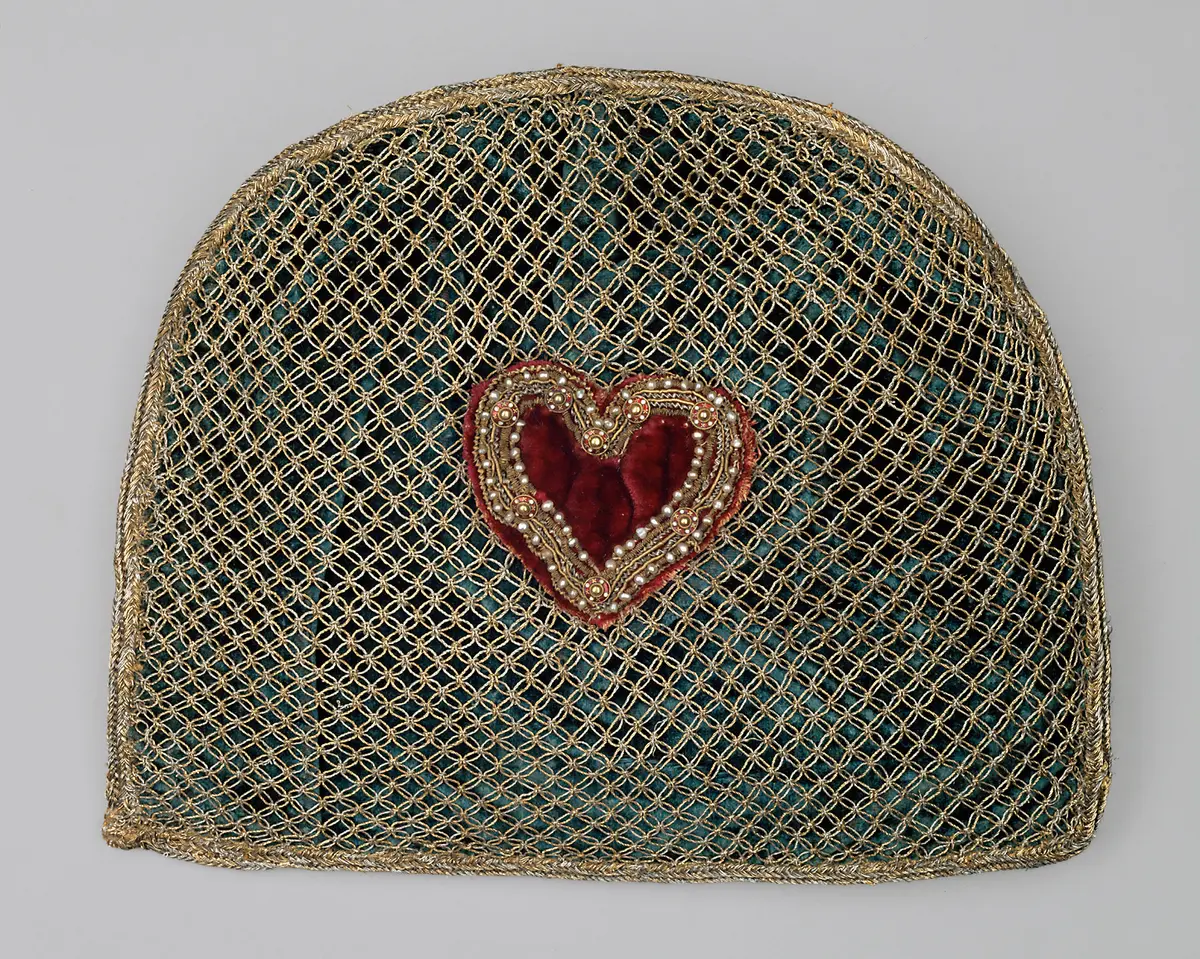
This faveur is one of eight (invs. B 76–B 83) formerly in the collection assembled by Ferdinand II, Archduke of Austria. It is made of blue velvet, over which is spread a delicate net made of gold thread. The central red velvet heart is embellished with gold and pearl embroidery.
In the 1583 inventory of the collection at Ambras Castle (fol. 66v) it is described as ‘A faveur worn over the pauldron made of blue velvet, on this is sewn a grid made of silver and gold cord, in the centre a red velvet heart, on this gold and white enamelled roses, the heart decorated with gold, silver, and pearls. The faveur is lined with gold-coloured atlas’ (Mer ain favor auf ain ächsele von plahem samat, darauf von silber und gulden schnierlen gätterwerch genäet, in der miten ain rot samates herz, darauf guldene und weisz geschmelzte reslen, das herz herumb mit gezognem gold, silber und perlen geziert. die favor ist inwendig mit goldfarbem atlas gefüettert).
At a tournament, a lady might distinguish a favoured knight by presenting him with a faveur as a token of her esteem. In the lists, the knight thus singled out generally wore the faveur attached to his armour, his helmet, or his lance. To capture one’s opponent’s faveur was lauded as a heroic feat. A faveur honourably won in the lists was a treasured gift that, as an act of chivalry, could be presented to a lady watching the martial encounter. Losing his faveur spurred a knight to move heaven and earth to win it back. In Perceforest, one of the great French chivalrous novels of the late Middle Ages, we read: ‘At this moment a girl appeared and said: “Le Tor, noble lord, Queen Lydore sends you this helmet and the young Lyriope this sleeve made of red velvet to decorate your helmet. They summon you to defend it well.”’ Most faveurs were pieces of female attire or accessories like a sleeve, a belt, or a veil, but might also, as here, be a small shawl.
This faveur is one of eight (invs. B 76–B 83) formerly in the collection assembled by Ferdinand II, Archduke of Austria. It is made of blue velvet, over which is spread a delicate net made of gold thread. The central red velvet heart is embellished with gold and pearl embroidery.
In the 1583 inventory of the collection at Ambras Castle (fol. 66v) it is described as ‘A faveur worn over the pauldron made of blue velvet, on this is sewn a grid made of silver and gold cord, in the centre a red velvet heart, on this gold and white enamelled roses, the heart decorated with gold, silver, and pearls. The faveur is lined with gold-coloured atlas’ (Mer ain favor auf ain ächsele von plahem samat, darauf von silber und gulden schnierlen gätterwerch genäet, in der miten ain rot samates herz, darauf guldene und weisz geschmelzte reslen, das herz herumb mit gezognem gold, silber und perlen geziert. die favor ist inwendig mit goldfarbem atlas gefüettert).
Owner:
Ferdinand II. (1564-1595), Erzherzog von Österreich und Landesherr von Tirol (1529 - 1595) DNB
Time:
3. Viertel 16. Jahrhundert
Object Name
Faveur (Schulterdecke)
Culture
Österreichisch
Material/technology:
Netz: Gold- und Silberlahn. Samt. Gold- und Perlenstickerei.
Dimensions:
L 23,5 cm × H 4 cm × B 29 cm
Gewicht: 0,10 kg
Copyright
Kunsthistorisches Museum, Hofjagd- und Rüstkammer
Invs.
Hofjagd- und Rüstkammer, B 81
Browse more
Similar items you might be interested in

Ferdinand II. (1564-1595), Erzherzog von Österreich und Landesherr von Tirol 3. Viertel 16. Jahrhundert

Ferdinand I. (1521-1564), Erzherzog, seit 1531 König und seit 1558 Kaiser 1. Hälfte 16. Jahrhundert
Franz I. (1745-1765), Kaiser, 1729-1737 als Franz III. Herzog von Lothringen, ab 1737 als Franz II um 1740/45

Ferdinand II. (1564-1595), Erzherzog von Österreich und Landesherr von Tirol 1559/60
Kurfürst Friedrich I. Sohn des Ludwig III. von der Pfalz around 1450. Gauntlets: around 1475/1485.

Maximilian II. (1564-1576), Kaiser vor 1552
Ulrich (1498-1550), Herzog von Württemberg c. 1525-1530
Schlangenglas mit symbolischen Darstellungen Kanonikus August Ernst von dem Busch um 1760 (Dekor)
Claude de Vaudrey, Seigneur de L'Aigle et de Chilly c. 1495

Das Reliquiar mit den Kettengliedern Italienisch, Florenz (?) um 1368
Otto Heinrich Sohn d. Ruprecht von der Pfalz 1516 (Stirnschild), 1523 (Rossstirn)