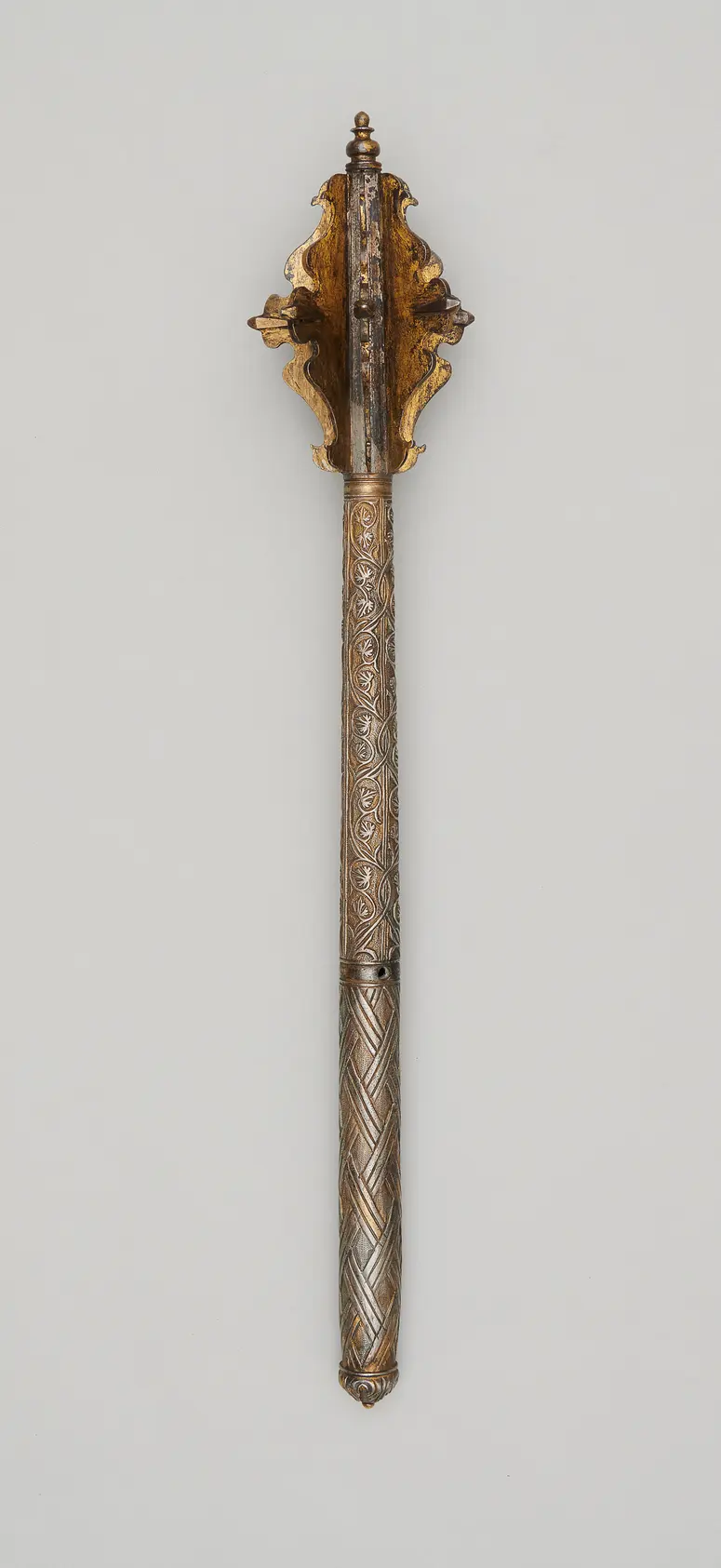
Cuirass
c. 1590 | Sinan Pascha
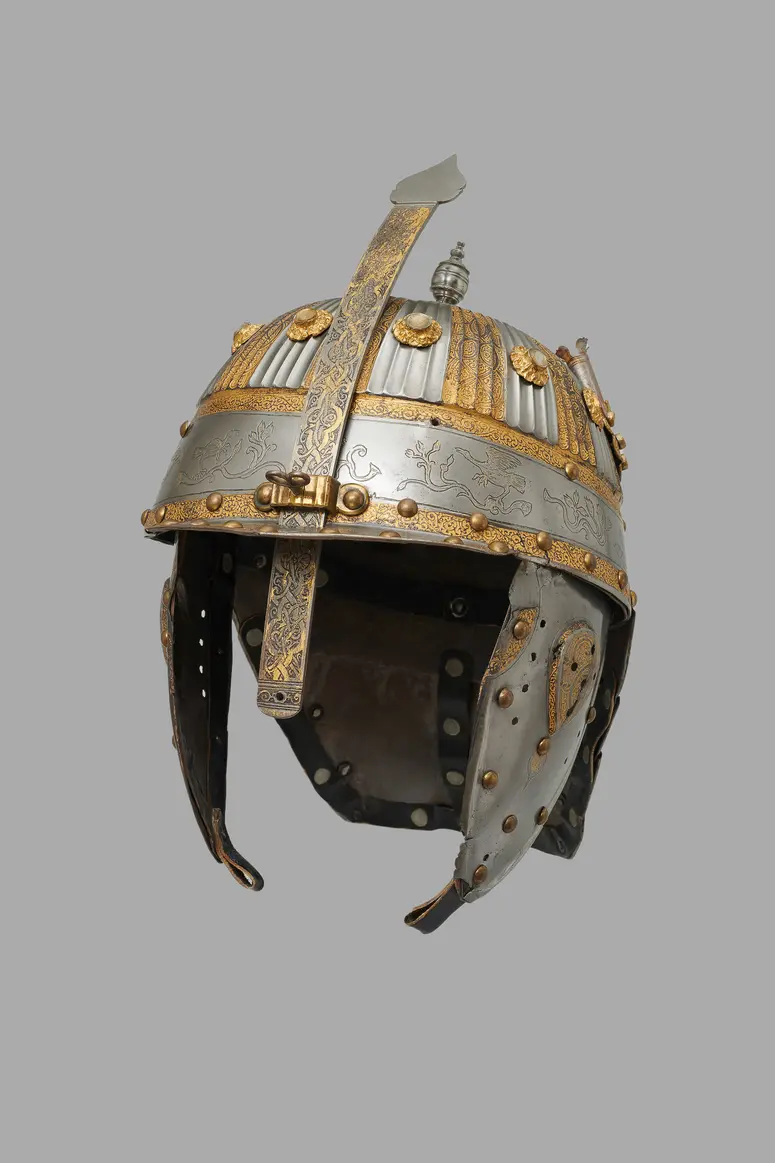
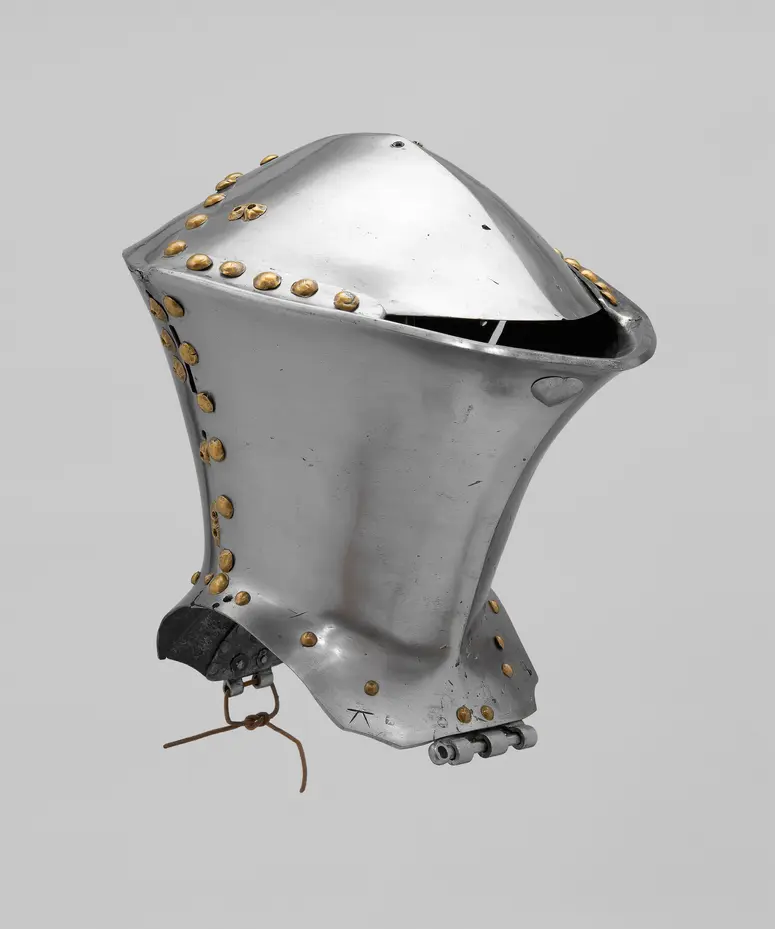
This armour comprises a cuirass and a zischägge (a Hungarian helmet). A cuirass consists of breastplate, backplate, and gorget. Typical characteristics of a zischägge, also known as a lobster-tailed pot helmet, are the rounded skull and the long, movable neck guard. Both objects are etched with gilt plant and floral ornamentation. Five riveted gilt-bronze medallions with semi-precious stones trace the central seam of the breastplate. The helmet is decorated with small rosettes and rock crystals.
In the sixteenth century, arms and armour in the Ottoman or Turkish manner were extremely popular in southern Germany. However, such objects were also produced as diplomatic or contractual gifts of honour for the Sublime Porte. The Austrian State Archive in Vienna houses preparatory drawings (dated 12 April 1590) for armour that is closely related to this one, and which was intended to be dispatched as a gift of honour to Sinan Pasha.
At the time, Sinan Pasha had just become Grand Vizir for the second time, which means he was effectively the head of government in the Ottoman Empire. The imperial court in Vienna ordered the armour conceived in the extant preparatory sketches from Michael Kobolt, an armourer from Nuremberg. In a letter dated 11 May 1590, Emperor Rudolf II refers to these ‘armours, mail, and leg/arm pieces ordered for Sinan Pasha and taken there by Oberhauser’ (für den Sinam Bassa begerten und durch den Oberhauser zugleich dahin gebrachten Rüstungen, Panzern und Röhren).
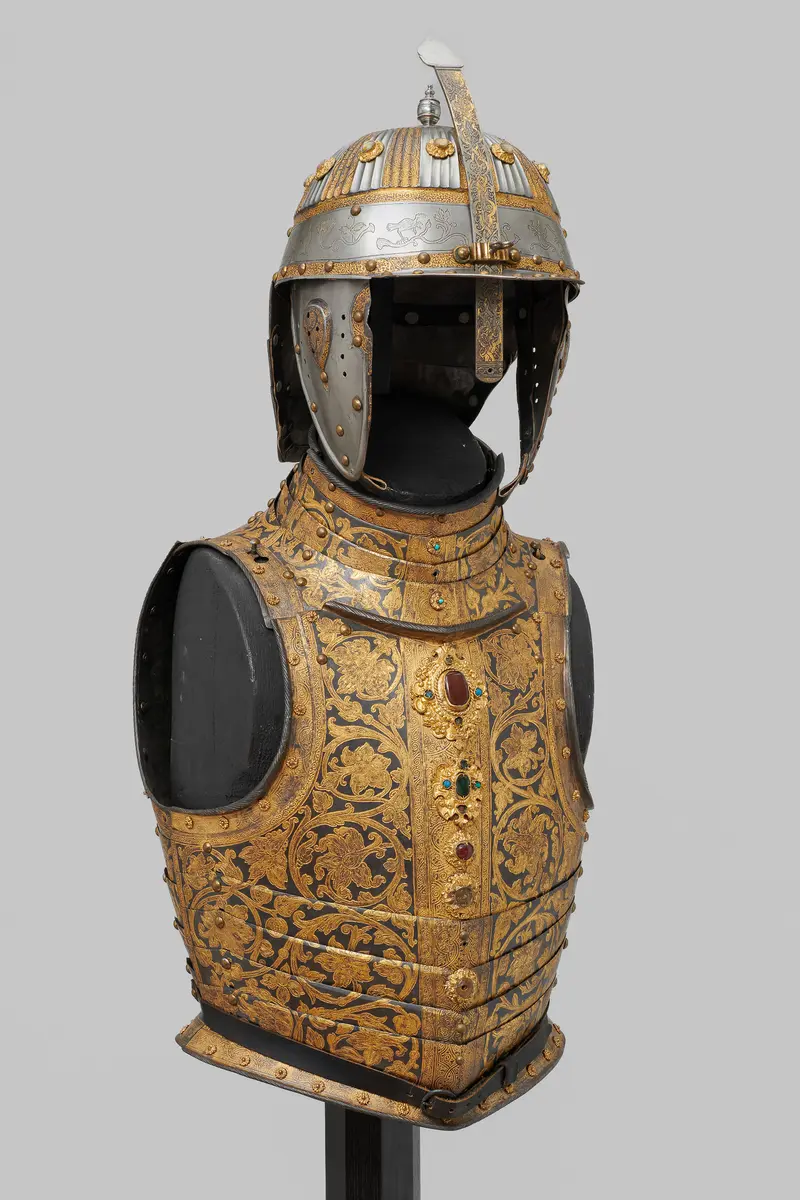
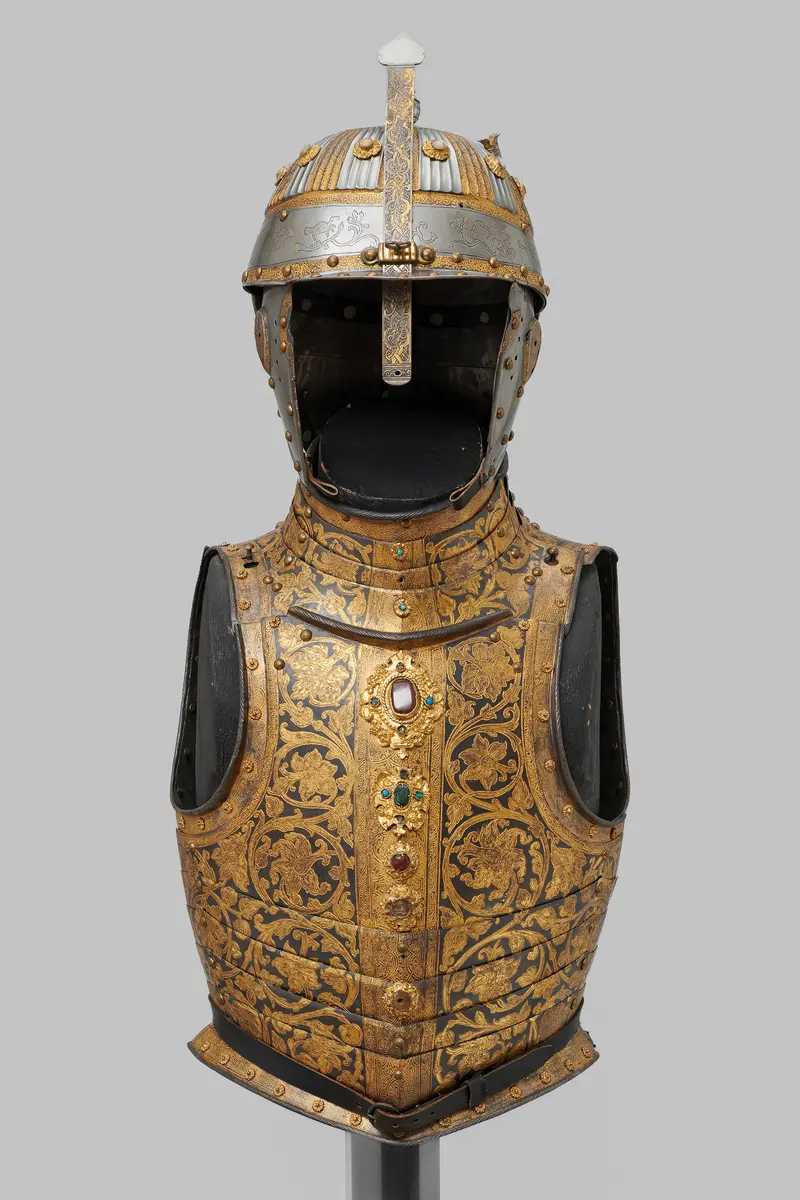
This armour comprises a cuirass and a zischägge (a Hungarian helmet). A cuirass consists of breastplate, backplate, and gorget. Typical characteristics of a zischägge, also known as a lobster-tailed pot helmet, are the rounded skull and the long, movable neck guard. Both objects are etched with gilt plant and floral ornamentation. Five riveted gilt-bronze medallions with semi-precious stones trace the central seam of the breastplate. The helmet is decorated with small rosettes and rock crystals.
In the sixteenth century, arms and armour in the Ottoman or Turkish manner were extremely popular in southern Germany. However, such objects were also produced as diplomatic or contractual gifts of honour for the Sublime Porte. The Austrian State Archive in Vienna houses preparatory drawings (dated 12 April 1590) for armour that is closely related to this one, and which was intended to be dispatched as a gift of honour to Sinan Pasha.
At the time, Sinan Pasha had just become Grand Vizir for the second time, which means he was effectively the head of government in the Ottoman Empire. The imperial court in Vienna ordered the armour conceived in the extant preparatory sketches from Michael Kobolt, an armourer from Nuremberg. In a letter dated 11 May 1590, Emperor Rudolf II refers to these ‘armours, mail, and leg/arm pieces ordered for Sinan Pasha and taken there by Oberhauser’ (für den Sinam Bassa begerten und durch den Oberhauser zugleich dahin gebrachten Rüstungen, Panzern und Röhren).
Owner:
ehemals Sinan Pascha zugeschrieben (1512 - 1596)
Time:
c. 1590
Object Name
Cuirass
Culture
Augsburg (?)
Material/technology:
Iron, forged, partly blued , partly etched. Etching: fire-gilded. Decorative appliques: cast brass, fire-gilded. Stones: Turquoise, various semi-precious stones, glass stones. Rivets: Brass, cast, fire-gilded. Rivet caps: Brass, fire-gilded. Leather (partly modern). Buckle: Iron (modern).
Dimensions:
H (inkl. Eisenplatte, inkl. Sturmhaube) 181 cm × B 60 cm × T 60 cm
Maße Eisenplatte: 4 cm x 60 cm x 60 cm
Gewicht Brust und Rücken: 5,55 kg
Copyright
Kunsthistorisches Museum, Hofjagd- und Rüstkammer
Invs.
Hofjagd- und Rüstkammer, A 613
Browse more
Similar items you might be interested in
Philipp I. (1482-1506), Herzog von Burgund, seit 1504 König von Kastilien und León between 1496/1506
Ferdinand II. (1564-1595), Erzherzog von Österreich und Landesherr von Tirol c. 1547 - 1550
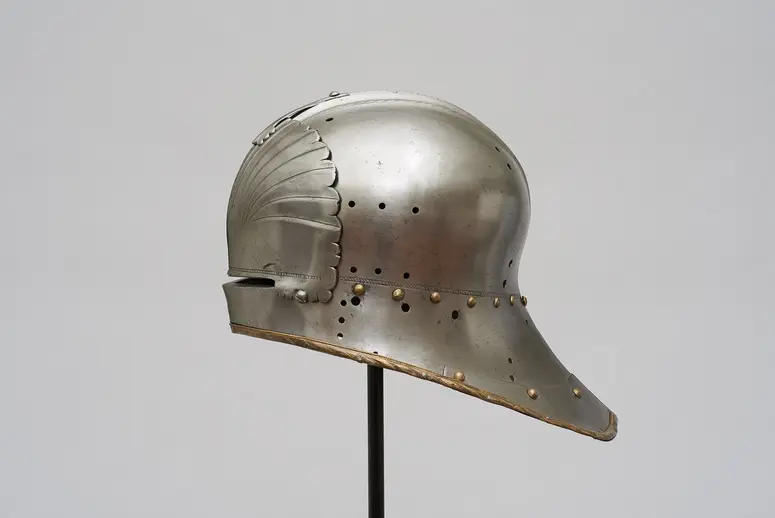
Maximilian I. (1477-1519), seit 1493 deutscher König, 1508 Kaiser c. 1495
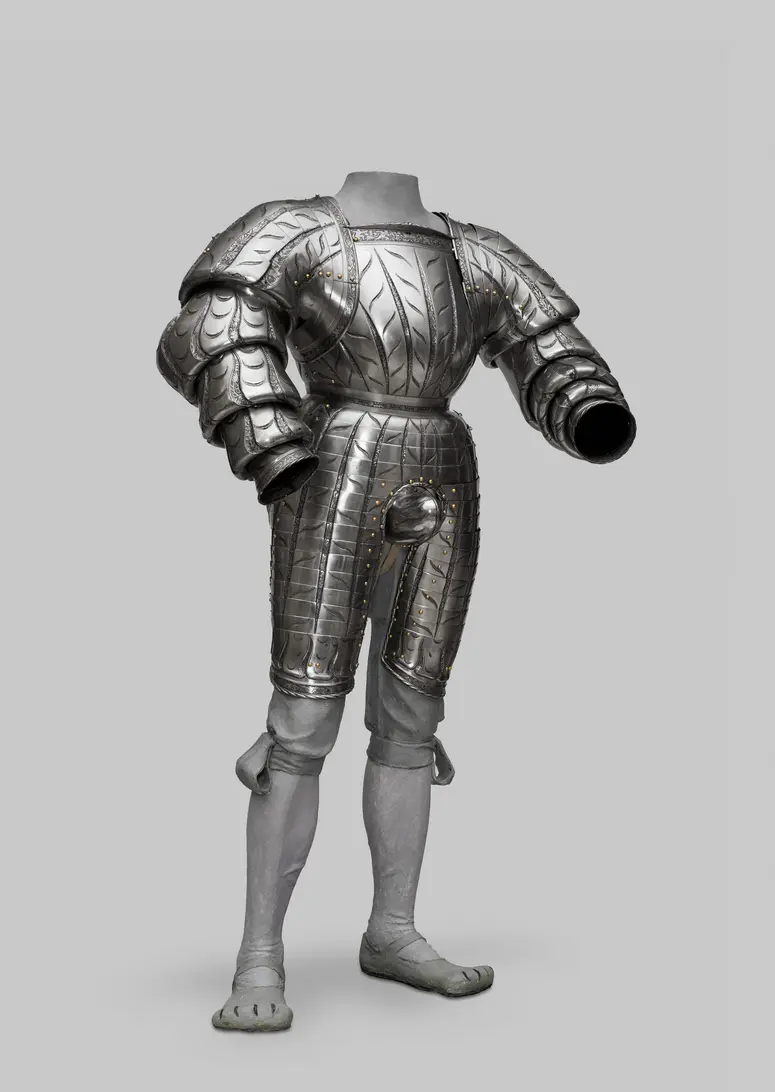
Reichsfreiherr Wilhelm Sohn d. Caspar von Rogendorf 1523

Philipp II. (1556-1598), König von Spanien, seit 1580 als Philipp I. König von Portugal 1544

Karl I. (V.) (1516-1556), als Karl I. König von Spanien, ab 1519 deutscher König, ab 1520 Kaiser c. 1512-1514

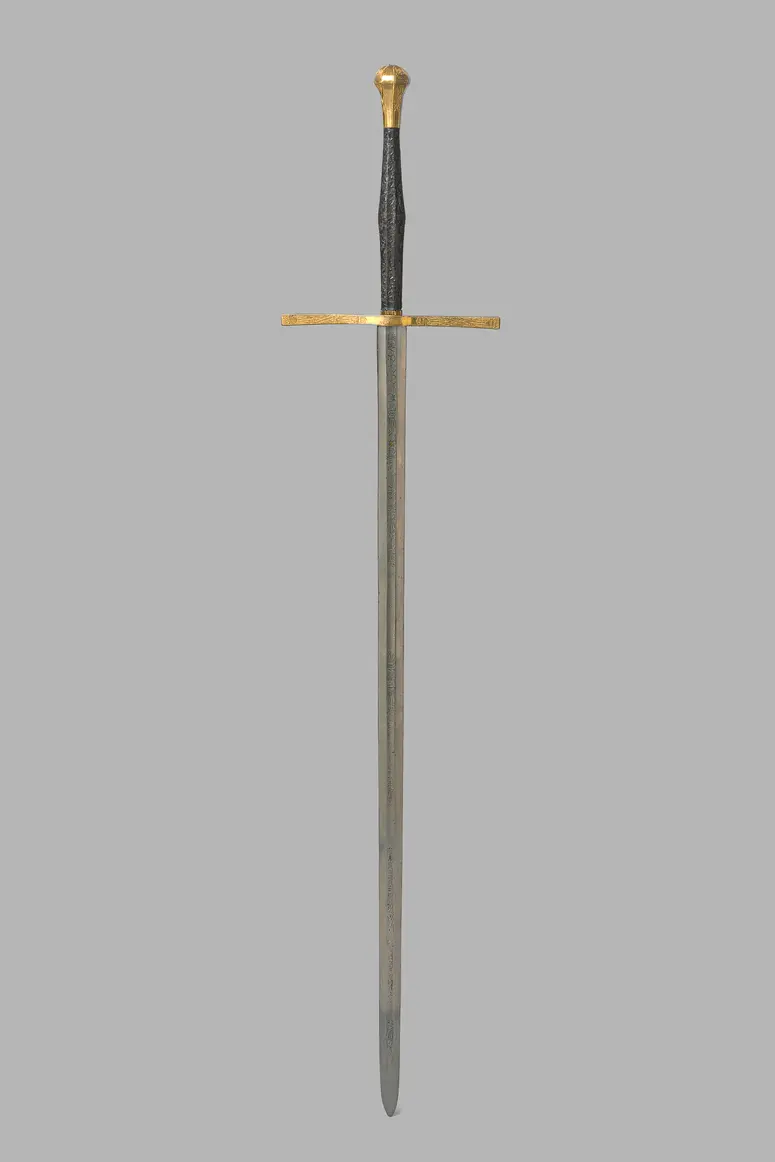

Ferdinand II. (1564-1595), Erzherzog von Österreich und Landesherr von Tirol 1547
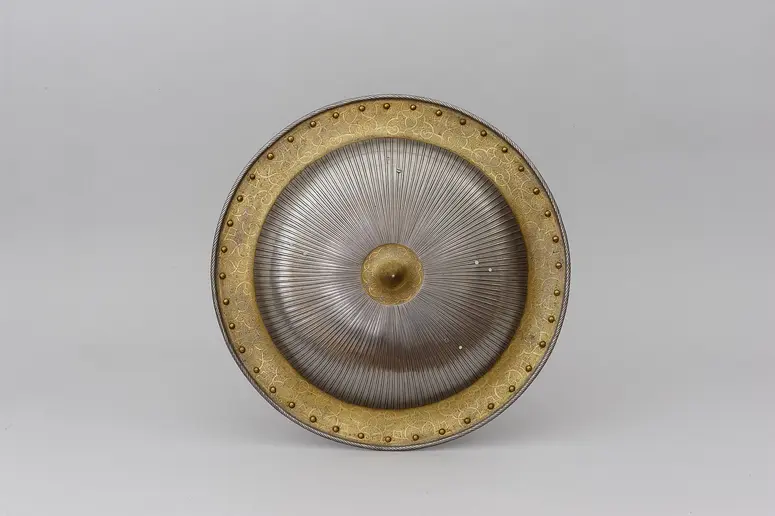
Karl von Österreich, Sohn des Tiroler Landesfürsten Erzherzog Ferdinands II. von Habsburg und der Philippine Welser 1568 - 1570

Maximilian I. (1477-1519), seit 1493 deutscher König, 1508 Kaiser c. 1485
Rudolf II. (1576-1612), Kaiser, römischer König ab 1575, König von Ungarn ab 1572, von Böhmen se 1571(?)
Sigismund (1439-1496), Erzherzog von Österreich 1483 - 1484