Mechanical breastplate for the joust of war
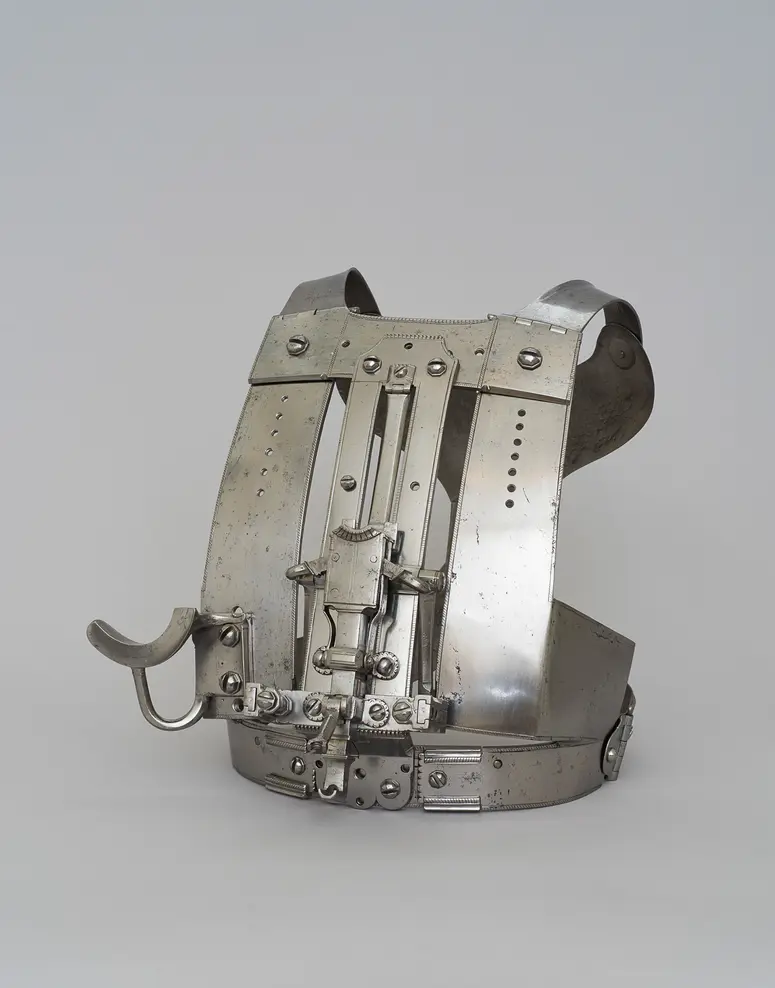
This breastplate is a mechanical masterpiece from the late Middle Ages. Only three such breastplates have survived: this one, another in Vienna (inv. B 25), and one in Paris (Musée de l’Armée, inv. G 528). Gothic detailing such as, for instance, the trefoil pattern on the brass wheels suggests that this breastplate is the oldest of the three. Although the three breastplates differ in the way their mechanisms are constructed, all were part of the equipment designed for a spectacular sub-group of hastiludes. They held in place a shield that was released and catapulted high into the air when hit by the opponent’s lance. In some of these jousts, for instance the mock joust of war with ‘exploding’ shields (Rennen mit geschifteten Tartschen), the shield, when catapulted into the air, also released the iron plates mounted on its front. Such spectacular effects enhanced the drama of a hit for both participants and spectators.
The breastplate comprises a steel frame connected by shoulder clasps with a (now lost) backplate. The mechanism described above is mounted in the centre; it has two levers, two brass rolls, and a hidden spring mechanism. Note, on the right, the lance rest on which the knight couched his weapon.
The two breastplates now in Vienna belonged to Archduke (later Emperor) Maximilian I, a passionate patron of chivalry and jousting. In 1480, such a breastplate is mentioned in a list of pieces of armour delivered by Lorenz Helmschmid, an armourer from Augsburg, to Maximilian in the Low Countries.
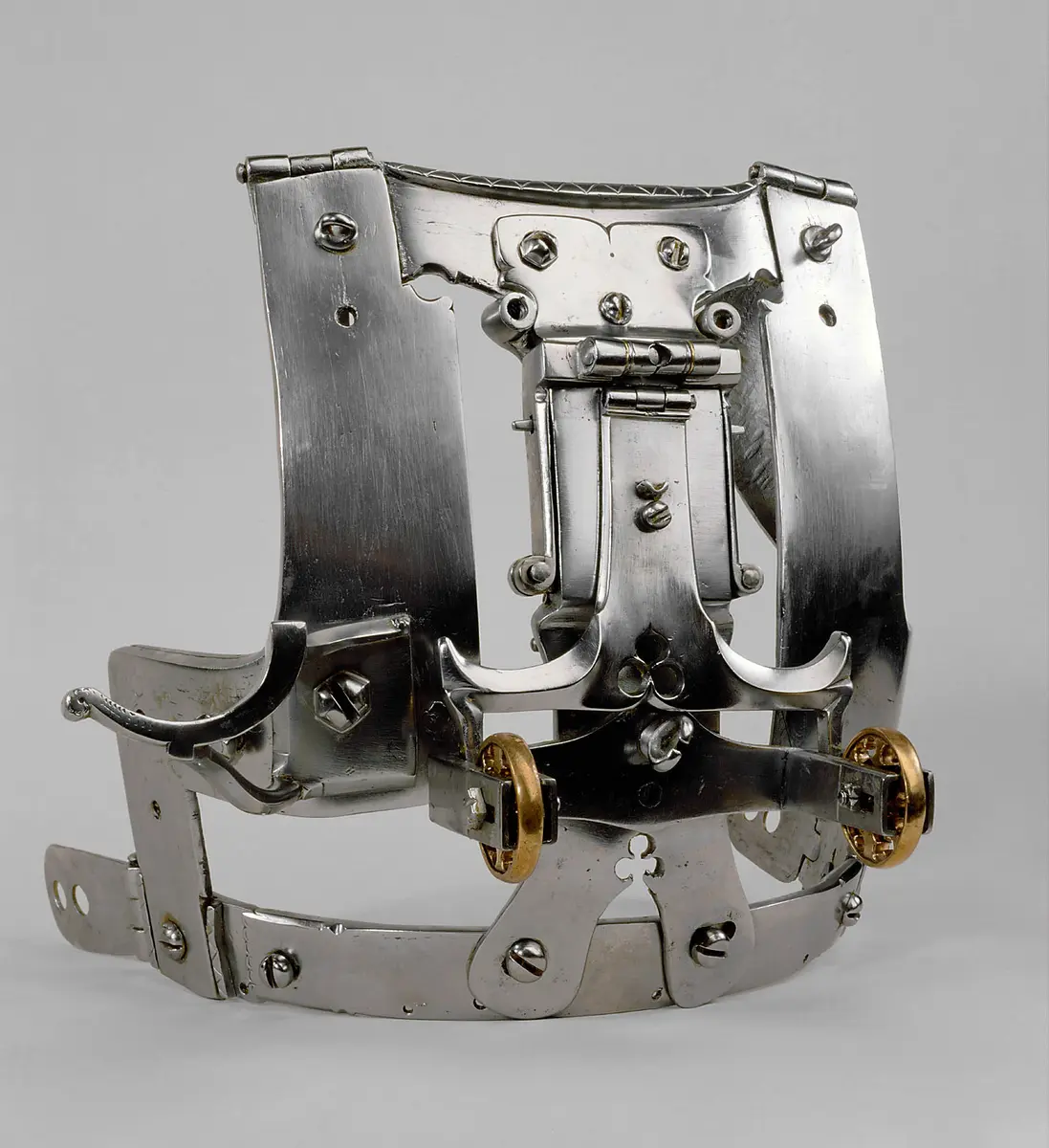
This breastplate is a mechanical masterpiece from the late Middle Ages. Only three such breastplates have survived: this one, another in Vienna (inv. B 25), and one in Paris (Musée de l’Armée, inv. G 528). Gothic detailing such as, for instance, the trefoil pattern on the brass wheels suggests that this breastplate is the oldest of the three. Although the three breastplates differ in the way their mechanisms are constructed, all were part of the equipment designed for a spectacular sub-group of hastiludes. They held in place a shield that was released and catapulted high into the air when hit by the opponent’s lance. In some of these jousts, for instance the mock joust of war with ‘exploding’ shields (Rennen mit geschifteten Tartschen), the shield, when catapulted into the air, also released the iron plates mounted on its front. Such spectacular effects enhanced the drama of a hit for both participants and spectators.
The breastplate comprises a steel frame connected by shoulder clasps with a (now lost) backplate. The mechanism described above is mounted in the centre; it has two levers, two brass rolls, and a hidden spring mechanism. Note, on the right, the lance rest on which the knight couched his weapon.
The two breastplates now in Vienna belonged to Archduke (later Emperor) Maximilian I, a passionate patron of chivalry and jousting. In 1480, such a breastplate is mentioned in a list of pieces of armour delivered by Lorenz Helmschmid, an armourer from Augsburg, to Maximilian in the Low Countries.
Owner:
Maximilian I. (1477-1519), seit 1493 deutscher König, 1508 Kaiser (1459 - 1519) DNB
Time:
c. 1490
Object Name
Mechanisches Bruststück
Culture
Süddeutsch (Innsbruck?)
Material/technology:
Iron, forged, partly engraved, partly cut. Wheels: brass.
Dimensions:
GI: H 50 cm x B 47 cm x T 24 cm
L. (mit aufgestellten Bügeln): 50 cm
L. (ohne aufgestellte Bügel): 36 cm
Gewicht: 6,75 kg
Copyright
Kunsthistorisches Museum, Hofjagd- und Rüstkammer
Invs.
Hofjagd- und Rüstkammer, B 21
Browse more
Similar items you might be interested in
Maximilian I. (1477-1519), seit 1493 deutscher König, 1508 Kaiser c. 1495
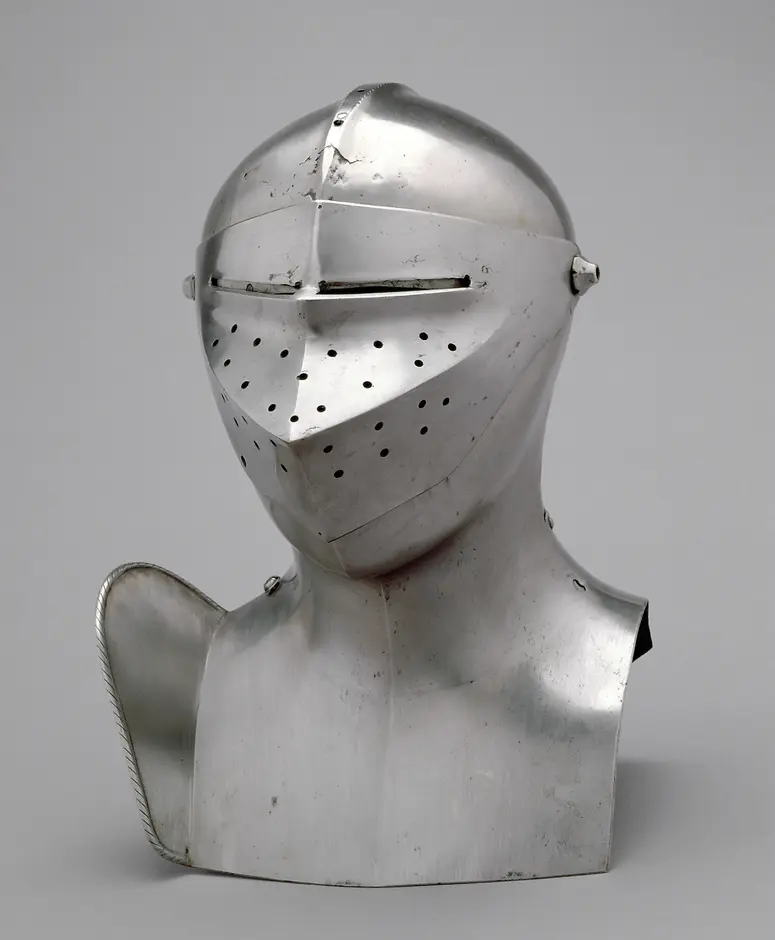
Maximilian I. (1477-1519), seit 1493 deutscher König, 1508 Kaiser um 1485
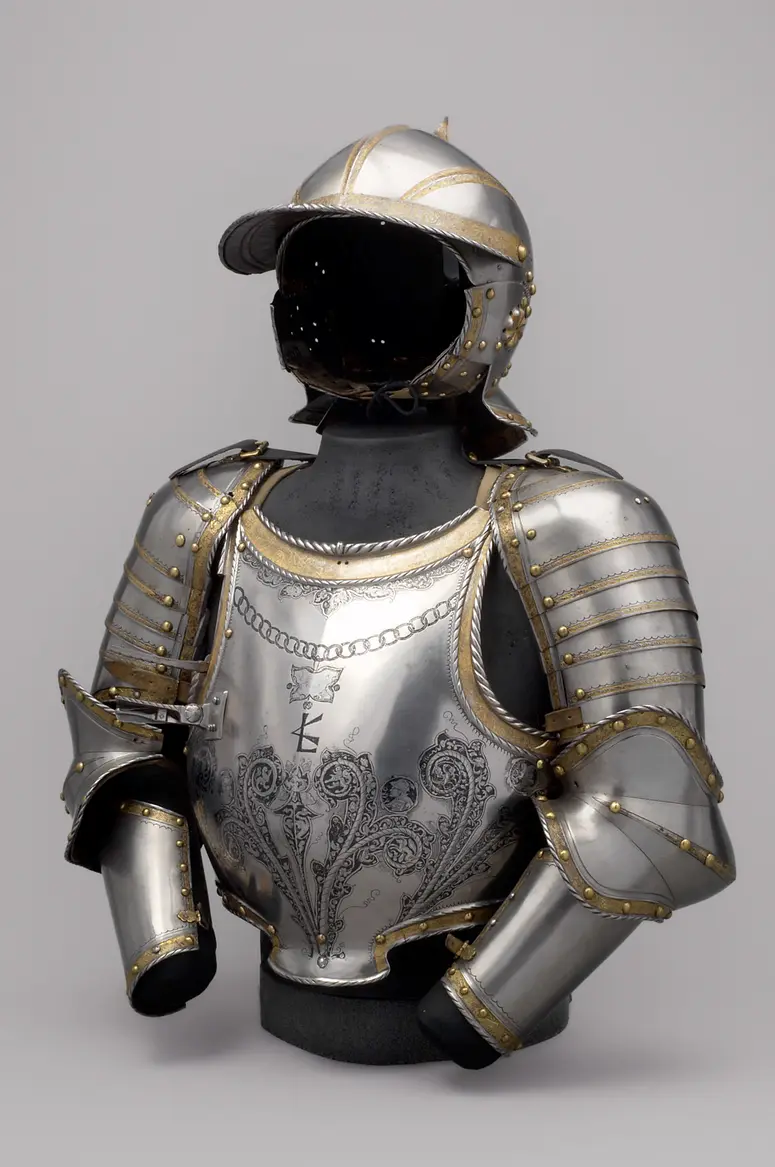
Konrad von Boineburg (von Bemelberg) um 1535/40
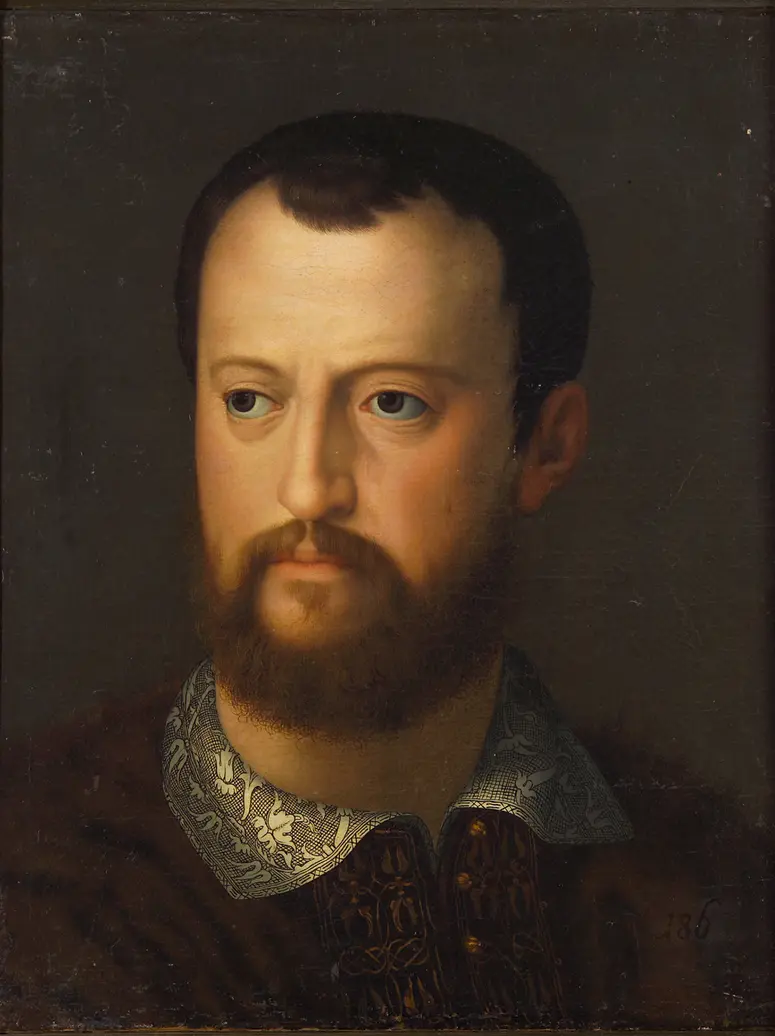
Großherzog Cosimo I. (1519-1574) von Toskana, Bruststück Agnolo di Cosimo, gen. Bronzino um 1560
Kaiser Rudolf II. (1552-1612) im Harnisch, Bruststück Martino Rota um 1576/80
Eleonore von Toledo (1522-1562), Großherzogin von Toskana, Bruststück Agnolo di Cosimo, gen. Bronzino 2. Drittel 16. Jahrhundert
Moritz Sohn des Wilhem von Oranien 1590-1595
Maximilian II. (1564-1576), Kaiser datiert 1557