Feldflasche
vor 1581 | Rudolf II. (1576-1612), Kaiser, römischer König ab 1575, König von Ungarn ab 1572, von Böhmen se
This leather bottle was first listed in the inventory of the estate of Ferdinand II, Archduke of Austria, compiled after his death in 1596. It was displayed on the first shelf of the seventeenth cupboard in his Kunstkammer at Ambras Castle near Innsbruck, the ‘various objects cupboard’ (variokasten), together with other Turkish artefacts: ‘A Turkish bottle, covered in red leather, with sophisticated work in leather in many different colours embroidered on it’ (Ain Turggische flaschen, mit rot leder uberzogen, mit suptiller arbait von leder allerlai farben darauf gestept). The 1788 inventory is even more detailed, making the identification straightforward: ‘A leather bottle, its red ground delicately covered with pierced blue-and-white leather, with a red silk strap’ (Eine lederne Flasche, roth im Grunde und mit durchbrochenen blauen und weisen leather zierlich überzogen, mit einer rothseidenen Tragschnür).
The oval bottle is tapered at the top and ends in an elongated neck. It is made of differently coloured leather, and the red ground on both sides is decorated with grey-blue moresques and stylized white flowers. Gold-thread embroidery creates the illusion of pearls. The fastidiously turned horn stopper has an ivory tip. Note also the small spout covered with red leather that has its own tiny ivory stopper.
Such bottles came to Europe as diplomatic gifts from the Sublime Porte. In 1581, Sultan Murad III sent such a bottle to Emperor Rudolf II in Prague (un fiasco di cuoio lavorato; ‘a worked leather flask’), together with an invitation to attend the festivities to mark his son’s circumcision. We know this because the Venetian ambassador Alberto Badoer reported it to Doge Nicolò da Ponte in a letter dated 12 September 1581. Rudolf II replied to this diplomatic gesture by dispatching a chain and a number of goblets valued at 4,000 guilders.
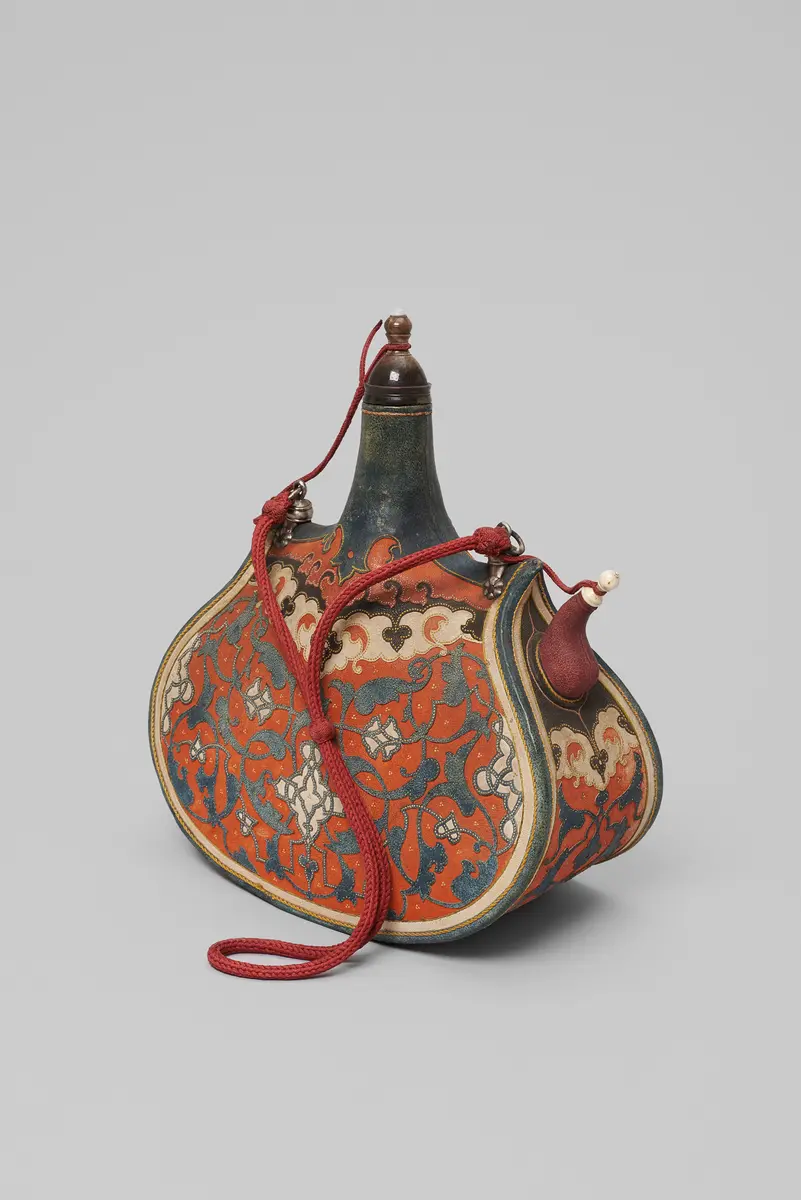
This leather bottle was first listed in the inventory of the estate of Ferdinand II, Archduke of Austria, compiled after his death in 1596. It was displayed on the first shelf of the seventeenth cupboard in his Kunstkammer at Ambras Castle near Innsbruck, the ‘various objects cupboard’ (variokasten), together with other Turkish artefacts: ‘A Turkish bottle, covered in red leather, with sophisticated work in leather in many different colours embroidered on it’ (Ain Turggische flaschen, mit rot leder uberzogen, mit suptiller arbait von leder allerlai farben darauf gestept). The 1788 inventory is even more detailed, making the identification straightforward: ‘A leather bottle, its red ground delicately covered with pierced blue-and-white leather, with a red silk strap’ (Eine lederne Flasche, roth im Grunde und mit durchbrochenen blauen und weisen leather zierlich überzogen, mit einer rothseidenen Tragschnür).
The oval bottle is tapered at the top and ends in an elongated neck. It is made of differently coloured leather, and the red ground on both sides is decorated with grey-blue moresques and stylized white flowers. Gold-thread embroidery creates the illusion of pearls. The fastidiously turned horn stopper has an ivory tip. Note also the small spout covered with red leather that has its own tiny ivory stopper.
Such bottles came to Europe as diplomatic gifts from the Sublime Porte. In 1581, Sultan Murad III sent such a bottle to Emperor Rudolf II in Prague (un fiasco di cuoio lavorato; ‘a worked leather flask’), together with an invitation to attend the festivities to mark his son’s circumcision. We know this because the Venetian ambassador Alberto Badoer reported it to Doge Nicolò da Ponte in a letter dated 12 September 1581. Rudolf II replied to this diplomatic gesture by dispatching a chain and a number of goblets valued at 4,000 guilders.
Time:
vor 1581
Object Name
Feldflasche
Culture
Türkisch (osmanisch)
Material/technology:
Leder und Lederappliken, teils gefärbt. Seidenfäden. Goldlahn. Eisen. Horn. Bein.
Dimensions:
H 30,5 cm x B 26 cm x T 13,5 cm
Copyright
Kunsthistorisches Museum, Hofjagd- und Rüstkammer
Invs.
Hofjagd- und Rüstkammer, C 28
Browse more
Similar items you might be interested in

Leopold V. (1619-1632), Erzherzog und Graf von Tirol, Bischof von Passau und Straßburg 1628
Jagdbesteck (bestehend aus einem Waidblatt, einer Gabel und acht Aufbruch- und Zerwirkmessern) mit Lederetui; Armbrust; Flaschenzugwinde; Jagdarmbrust; Säule einer Armbrust; Armbrust; Deutsche Winde J. Löwy, K. und K. Hof-Photograph, Kunst- und Verlagsanstalt (Wien) 1892
Flaschenkürbis, Schnitzarbeit, Naturalie, Kürbis Ende 16. Jahrhundert
Johann Caspar Schenck Mitte 17. Jahrhundert

Ösenflasche der White Painted Ware: Schnurösen Zyprisch, Bronzezeit, Mittelzyprisch 1800 - 1725 v. Chr.

Ferdinand II. (1564-1595), Erzherzog von Österreich und Landesherr von Tirol vor 1596

Ludwig XII. (1498-1515), Herzog von Orléans, König von Frankreich, 1499, 1500-1512 Herzog von Mailan zwischen 1499 und 1514
Flasche der White Painted IV Ware: Liniendekor Zyprisch, Bronzezeit, Mittelzyprisch 1725 - 1625 v. Chr.