Zeremonienschwert der Ungarischen Gesellschaft vom Drachen
um 1433 | Sigismund (1387-1437), König von Ungarn, ab 1419 König von Böhmen, ab 1411 deutscher König, ab
This sword was probably the ceremonial sword of the Societas draconis, the Society of the Dragon (Order of the Dragon), founded by Sigismund of Luxembourg as King of Hungary in 1408. Sigismund founded this order of chivalry to defend Christendom against ‘heathens and schismatics’ (hostes fidei Christianae … ac etiam malos christicolas). For him, the order was primarily an instrument of secular politics, first in Hungary and then in the Holy Roman Empire. After Sigismund’s death, the Societas draconis flourished under his successors Albert II, King of the Romans, and Emperor Frederick III. Under Matthias Corvinus, King of Hungary, membership seems to have been regarded as no more than a mark of distinction.
The dragon sword has a pommel comprising two circular oblique disks similar to the ones found on ear daggers, a type of dagger that made its way from the Islamic world to Europe via Spain and Italy. The carved ivory handle imitates the twisted tusk of a narwhale, then regarded as the horn of the legendary unicorn. The crossguard is shaped like a coiled golden dragon. The blade is etched on both faces with gilt garlands and crosses and the inscriptions (in majuscules) REX VNGARIE and COLOMANVS.EPS (Lat. episcopus, bishop). This may be a reference to Coloman, King of Hungary, who had been Bishop of Eger or Várad in his youth.
The dragon sword may be connected with Sigismund’s coronation as German Emperor, which took place in Rome in 1433. The chronicles of Verona and Mantua record that following his coronation, Sigismund appointed a number of noblemen from these two cities to the order; among those from Verona was the Condottiero Luigi dal Verme, Count of Sanguinetto.
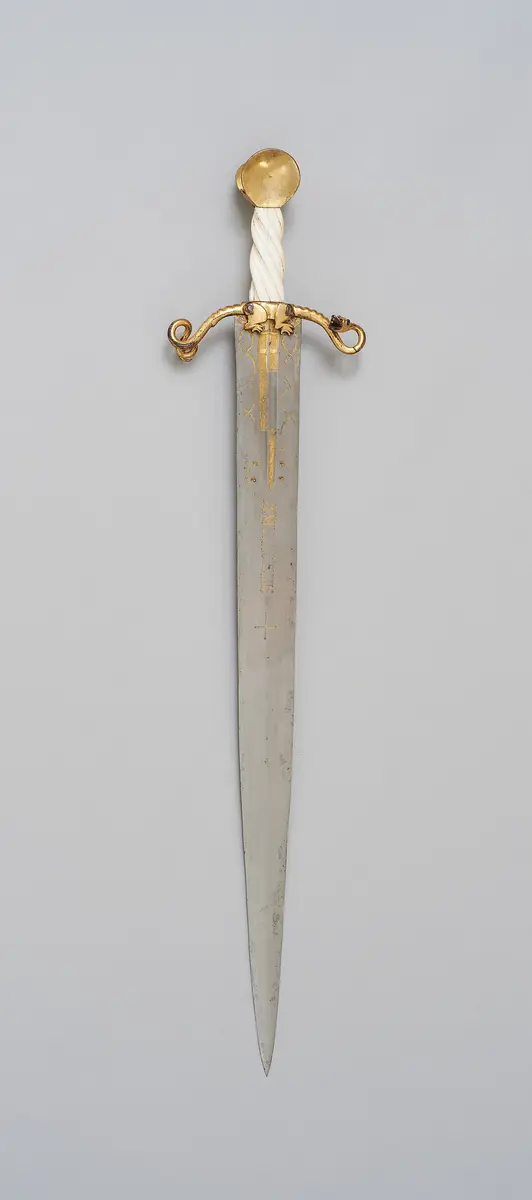
This sword was probably the ceremonial sword of the Societas draconis, the Society of the Dragon (Order of the Dragon), founded by Sigismund of Luxembourg as King of Hungary in 1408. Sigismund founded this order of chivalry to defend Christendom against ‘heathens and schismatics’ (hostes fidei Christianae … ac etiam malos christicolas). For him, the order was primarily an instrument of secular politics, first in Hungary and then in the Holy Roman Empire. After Sigismund’s death, the Societas draconis flourished under his successors Albert II, King of the Romans, and Emperor Frederick III. Under Matthias Corvinus, King of Hungary, membership seems to have been regarded as no more than a mark of distinction.
The dragon sword has a pommel comprising two circular oblique disks similar to the ones found on ear daggers, a type of dagger that made its way from the Islamic world to Europe via Spain and Italy. The carved ivory handle imitates the twisted tusk of a narwhale, then regarded as the horn of the legendary unicorn. The crossguard is shaped like a coiled golden dragon. The blade is etched on both faces with gilt garlands and crosses and the inscriptions (in majuscules) REX VNGARIE and COLOMANVS.EPS (Lat. episcopus, bishop). This may be a reference to Coloman, King of Hungary, who had been Bishop of Eger or Várad in his youth.
The dragon sword may be connected with Sigismund’s coronation as German Emperor, which took place in Rome in 1433. The chronicles of Verona and Mantua record that following his coronation, Sigismund appointed a number of noblemen from these two cities to the order; among those from Verona was the Condottiero Luigi dal Verme, Count of Sanguinetto.
Owner:
Sigismund (1387-1437), König von Ungarn, ab 1419 König von Böhmen, ab 1411 deutscher König, ab (1368 Nürnberg - 1437 Znaim, Mähren) DNB
Time:
um 1433
Object Name
Zeremonienschwert der Ungarischen Gesellschaft vom Drachen
Culture
Oberitalien
Material/technology:
Klinge: Eisen, geschmiedet, teils geätzt, teils feuervergoldet. Parierstange: Eisen, geschmiedet, feuervergoldet. Heft: Elfenbein, gedrechselt. Knauf: Messing, feuervergoldet. Scheide: Leder, teils geprägt.
Dimensions:
Schwert: L 94 cm x B 20,5 cm x T 7 cm
Scheide: L 79,5 cm x B 7,3 cm x T 3,5 cm
Schwert Gewicht: 1 kg
Signed
keine
Inscribed
Schwert: Klinge: auf der einen Seite: "REX.VNGARIE", "COLOMANVS.EPS" (episcopus)
Stamp / markings
auf der Klinge je Seite vier Abdrücke einer undeutlichen Marke
Copyright
Kunsthistorisches Museum, Hofjagd- und Rüstkammer
Invs.
Hofjagd- und Rüstkammer, A 49
Browse more
Similar items you might be interested in
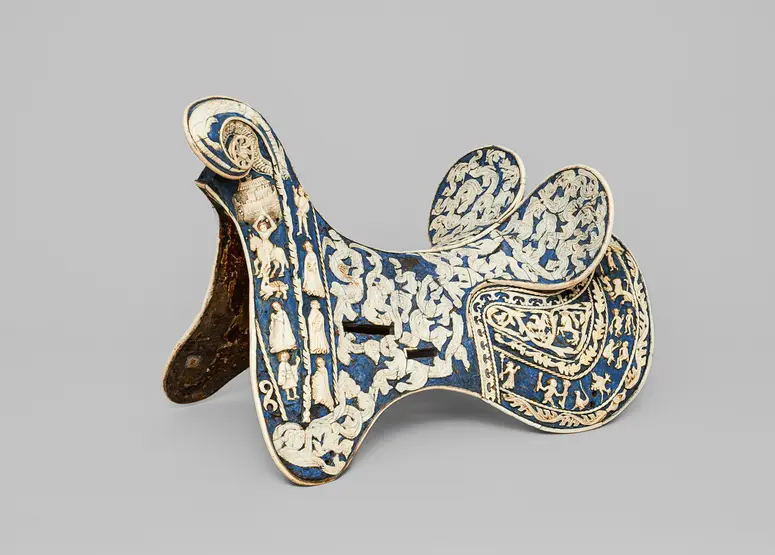
Kaiser Albrecht II. (V.) von Habsburg 1438/1439

Sigismund III. (1587-1632), König von Polen und Großherzog von Litauen um 1600
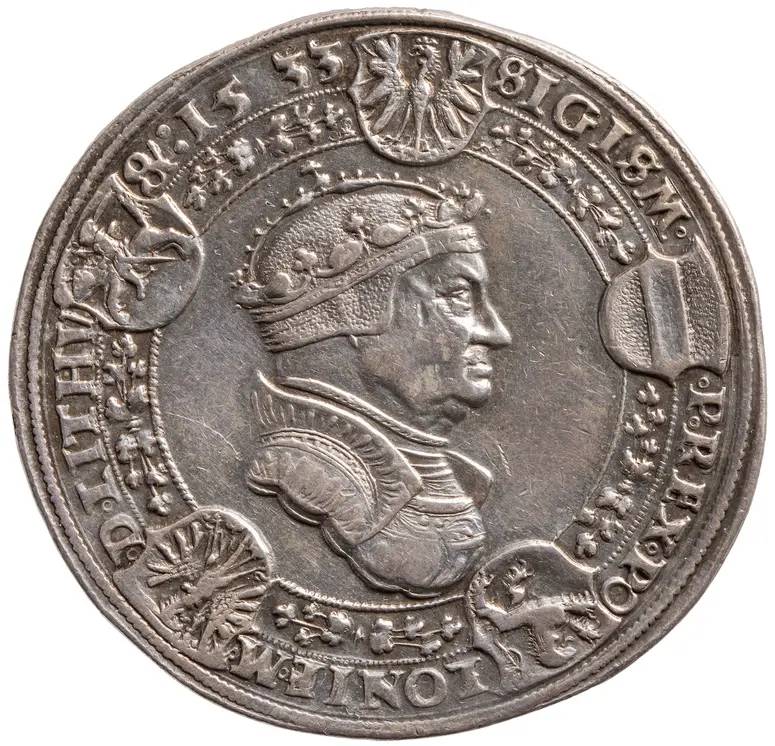
Sigismund I. (1506-1548), König von Polen, als Sigismund II. Großherzog von Litauen 1533
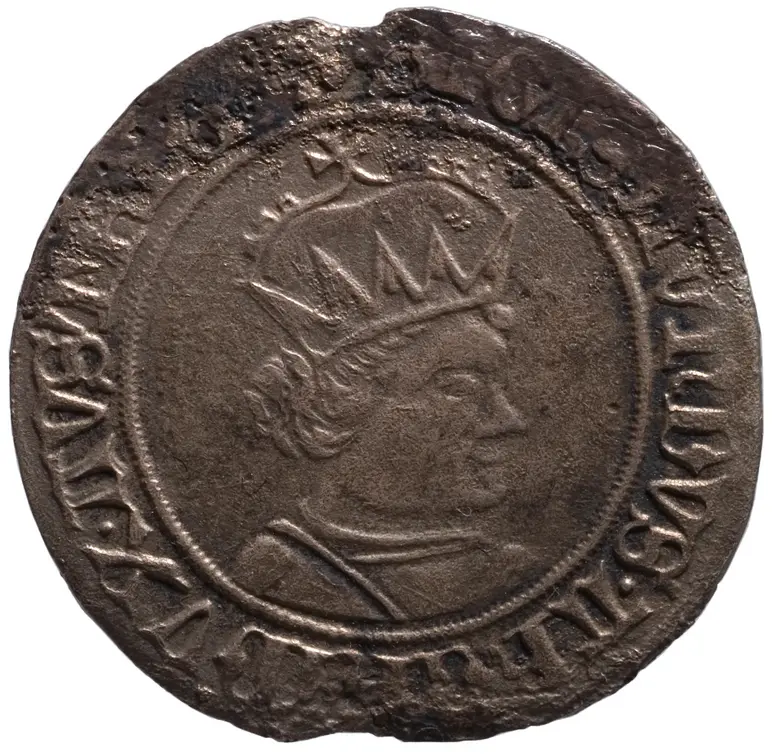

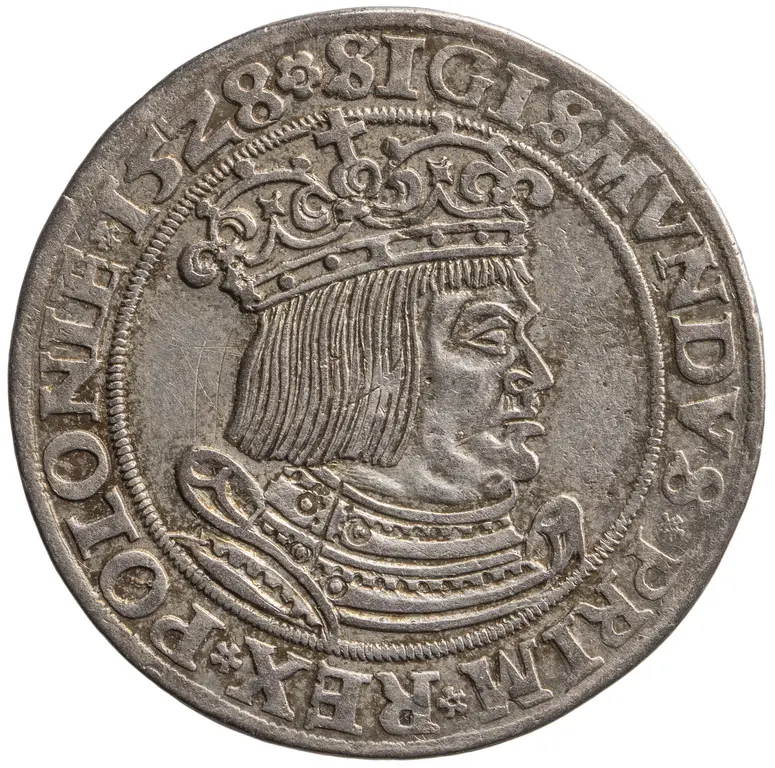
Sigismund I. (1506-1548), König von Polen, als Sigismund II. Großherzog von Litauen 1528