Radschlossgewehr
This wheellock gun belonged to Sigismund III Vasa, who was elected King of Poland and Grand Duke of Lithuania in 1587 and became King of Sweden in 1592. His arms are on the butt: the quartered shield (half party per pale and per fess escutcheon) twice repeats the arms of Poland (eagle argent) and of Lithuania (an armoured knight mounted on a horse salient), with the arms of Sweden (a shield azure, quartered by a cross Or, in the first and third fields three open crowns Or placed two above one, in the second and third fields three sinister bendwise streams argent, a lion crowned with an open crown Or armed gules) and of the House of Vasa (Bendwise azure, argent and gules, a vasa Or) in the centre. The main shield is surmounted by a royal crown. Barrel and lock are not signed, but on the gun’s butt is the signature of an otherwise anonymous gunsmith: HL-F (presumably HL fecit: ‘HL made it’). In the holdings of the Imperial Armoury is another wheellock gun (inv. D 67) by this gunsmith but without the arms of its owner.
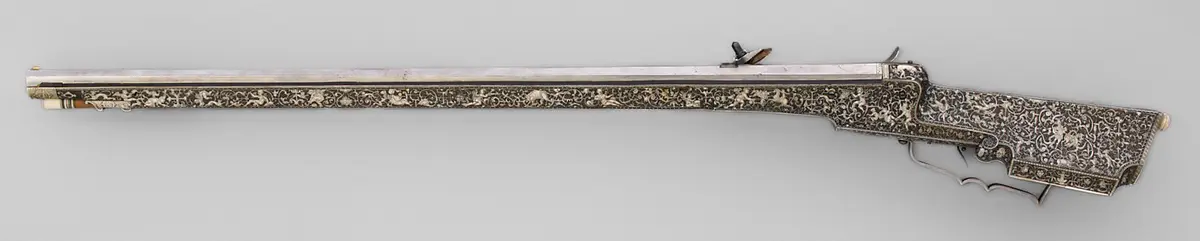
The entire surface of the mounting is covered with a detailed pattern of garlands and decorative bands that form the setting for countless allegorical figures, putti, animals, and mythical creatures. On the bottom of the fore-end eight female figures line up, some of which can be identified as personifications of the Virtues, for instance Justitia clutching sword and scales. A cavalry battle is depicted on the lockplate, perhaps an allusion to the long wars that Sigismund III fought against his successor Charles IX following his loss of the Swedish throne. He hoped to win back his crown and further the Catholic ascendancy in Sweden. It may well be a depiction of Swedish mounted soldiers armed with pistols being routed by Polish cavalrymen sporting pointed helmets, swords, and lances.
The weapon was in the collection at Ambras Castle but was only identified beyond doubt in 1819. We do not know how or when it came to Austria. It may have been a gift from Sigismund to Emperor Ferdinand II, the brother of both of his wives, Archduchesses Anna and Constance.
This wheellock gun belonged to Sigismund III Vasa, who was elected King of Poland and Grand Duke of Lithuania in 1587 and became King of Sweden in 1592. His arms are on the butt: the quartered shield (half party per pale and per fess escutcheon) twice repeats the arms of Poland (eagle argent) and of Lithuania (an armoured knight mounted on a horse salient), with the arms of Sweden (a shield azure, quartered by a cross Or, in the first and third fields three open crowns Or placed two above one, in the second and third fields three sinister bendwise streams argent, a lion crowned with an open crown Or armed gules) and of the House of Vasa (Bendwise azure, argent and gules, a vasa Or) in the centre. The main shield is surmounted by a royal crown. Barrel and lock are not signed, but on the gun’s butt is the signature of an otherwise anonymous gunsmith: HL-F (presumably HL fecit: ‘HL made it’). In the holdings of the Imperial Armoury is another wheellock gun (inv. D 67) by this gunsmith but without the arms of its owner.
The entire surface of the mounting is covered with a detailed pattern of garlands and decorative bands that form the setting for countless allegorical figures, putti, animals, and mythical creatures. On the bottom of the fore-end eight female figures line up, some of which can be identified as personifications of the Virtues, for instance Justitia clutching sword and scales. A cavalry battle is depicted on the lockplate, perhaps an allusion to the long wars that Sigismund III fought against his successor Charles IX following his loss of the Swedish throne. He hoped to win back his crown and further the Catholic ascendancy in Sweden. It may well be a depiction of Swedish mounted soldiers armed with pistols being routed by Polish cavalrymen sporting pointed helmets, swords, and lances.
The weapon was in the collection at Ambras Castle but was only identified beyond doubt in 1819. We do not know how or when it came to Austria. It may have been a gift from Sigismund to Emperor Ferdinand II, the brother of both of his wives, Archduchesses Anna and Constance.
Owner:
Sigismund III. (1587-1632), König von Polen und Großherzog von Litauen (1566 - 1632) DNB
Artist:
Monogrammist HL (HL.F) (deutsch, um 1600) DNB
Time:
um 1600
Object Name
Radschlossgewehr
Culture
Süd- oder Ostdeutsch
Material/technology:
Blankes Eisen, feine, gravierte Beineinlagen, gebläutes Eisen, Elfenbein, Hirschhorn, schwarzgefärbte Asphaltmasse
Dimensions:
L 115,5 cm; 3,8 kg
Stamp / markings
Kolbenschuh:
+ polnisch-schwedisches Königswappen Sigismunds III. Wasa (1566-1632).
+ Monogramm des Büchsenschäfters (HL.F, wohl HL fecit)
Copyright
Kunsthistorisches Museum, Hofjagd- und Rüstkammer
Invs.
Hofjagd- und Rüstkammer, D 68