Taufkännchen
1601-1605 | Jan Vermeyen
The present small ewer is a masterpiece of Rudolphine court art and was probably created in Prague between 1601 and 1605. The fine goldsmith's work and some ornamental details suggest a connection with the Rudolphine Crown (Inv. No. SK_WS_XIa_1) and the attribution of the piece to Jan Vermeyen and his workshop is thus very likely. Just beneath the vertex of the elegantly raised handle is the Habsburg coat of arms (a split shield with Austria and Burgundy). Since it does not feature a national emblem, the small ewer was probably not intended for the emperor but rather for an archduke. Thus only the former Archduke Ferdinand can be considered as the intended recipient. In 1600 the later Emperor Ferdinand II had married Maria Anna of Bavaria, who bore him seven children. The small ewer was most likely made because the large ewer of the "lavabo" set (Inv. No. SK_WS_XIV_5 und SK_WS_XIV_6), which was used for christenings, proved to be too large and heavy.
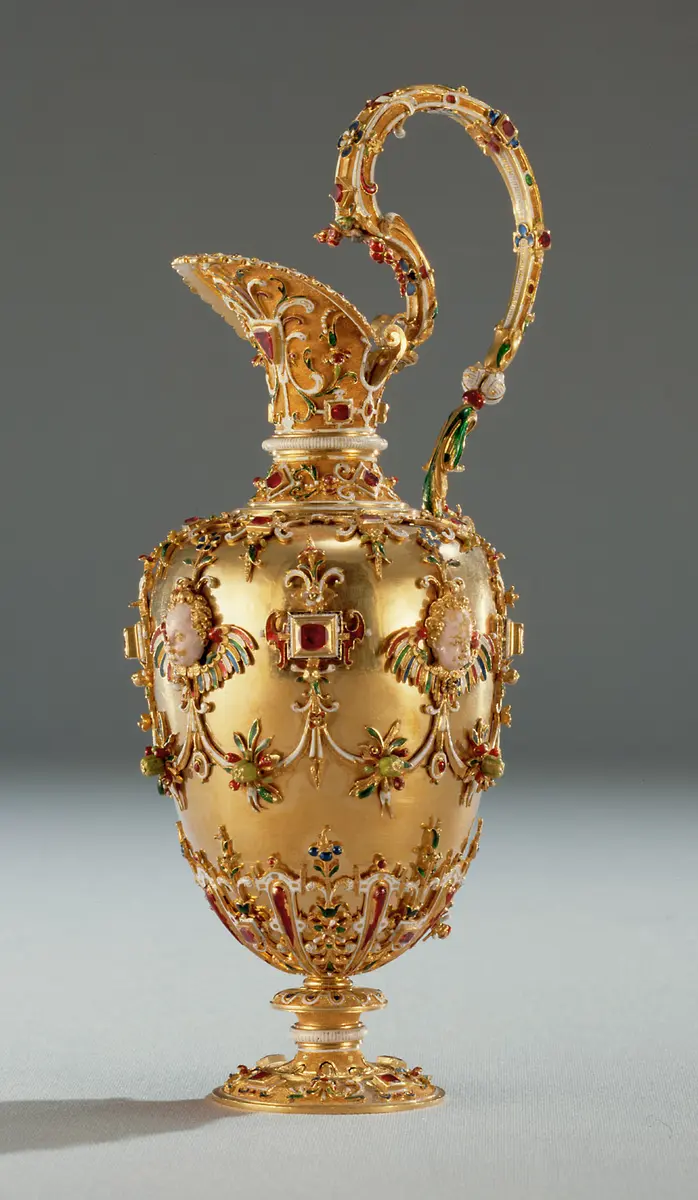
The present small ewer is a masterpiece of Rudolphine court art and was probably created in Prague between 1601 and 1605. The fine goldsmith's work and some ornamental details suggest a connection with the Rudolphine Crown (Inv. No. SK_WS_XIa_1) and the attribution of the piece to Jan Vermeyen and his workshop is thus very likely. Just beneath the vertex of the elegantly raised handle is the Habsburg coat of arms (a split shield with Austria and Burgundy). Since it does not feature a national emblem, the small ewer was probably not intended for the emperor but rather for an archduke. Thus only the former Archduke Ferdinand can be considered as the intended recipient. In 1600 the later Emperor Ferdinand II had married Maria Anna of Bavaria, who bore him seven children. The small ewer was most likely made because the large ewer of the "lavabo" set (Inv. No. SK_WS_XIV_5 und SK_WS_XIV_6), which was used for christenings, proved to be too large and heavy.
Attributed to:
Jan Vermeyen (vor 1559 Brüssel - 1608 Prag) DNB
Time:
1601-1605
Object Name
Gefäß; Kanne; Liturgisches Gerät; Taufzeug
Culture
Prag
Material/technology:
Gold, teilweise emailliert, Rubine / gegossen
Dimensions:
H. 15,5 cm
Copyright
Kunsthistorisches Museum, Weltliche Schatzkammer
Invs.
Schatzkammer, WS XIV 7