Sogenannter Beutel König Stephans von Ungarn
2. Hälfte 11. / 12.- Jahrhundert
This red silk pouch is first mentioned in the inventory of the Capuchin Treasury in 1752, and described there as the purse (Latin: crumena) of King Stephan of Hungary (died 1038). There is, however, 110 historical foundation for this tradition. It is rather a unique item of inestimable value from the early period of Russian art and one of the earliest surviving pieces of Russian embroidery, perhaps even the earliest. The exact function of the pouch is uncertain, but it was probably intended to hold relics. Hardly any comparable textiles have survived; however, dating and localisation can be narrowed down somewhat in the light of the characteristics of the inscriptions. The front of the pouch is entirely covered in costly gold embroidery enclosing medallions with figures embroidered in silk. The effect is similar to that of splendid mosaics or pieces of goldsmiths'art. The high standard of the needlework - there are almost 700 stitches in one square centimetre - indicates that it originated from an important centre of embroidery, possibly from one of the great Russian convents. In the centre on the front, Christ is seated on his Throne, surrounded by the four archangels, a seraph, a cherub, St. Basil and St. Nicholas. The names of the persons represented are given in Cyrillic script. The back bears further Cyrillic inscriptions. The cruciform frame contains an extended version of Psalm 33,22 ("Let thy mercy, O Lord, be upon us, now and for ever"), and on the lower edge Psalm 67,1 ("God be merciful unto us, and cause his face to shine upon US"). Both texts figure prominently in the liturgy of Greek-Orthodox ritual. The pouch is fastened by means of a pin which is passed through the narrow hinge-like fittings attached to the edges. The inventory of 1752 records that the large smoky quartz was attached to the pouch. Its mount has been fitted in between the hinges, one of which appears to have been damaged in the process. This and the garnet cross are obviously later additions, as is the braid above the fastening (perhaps from the l7th century?). This piece was until recently called marsupium, a term which was, however, not used for the pouch until the 2Oth century.
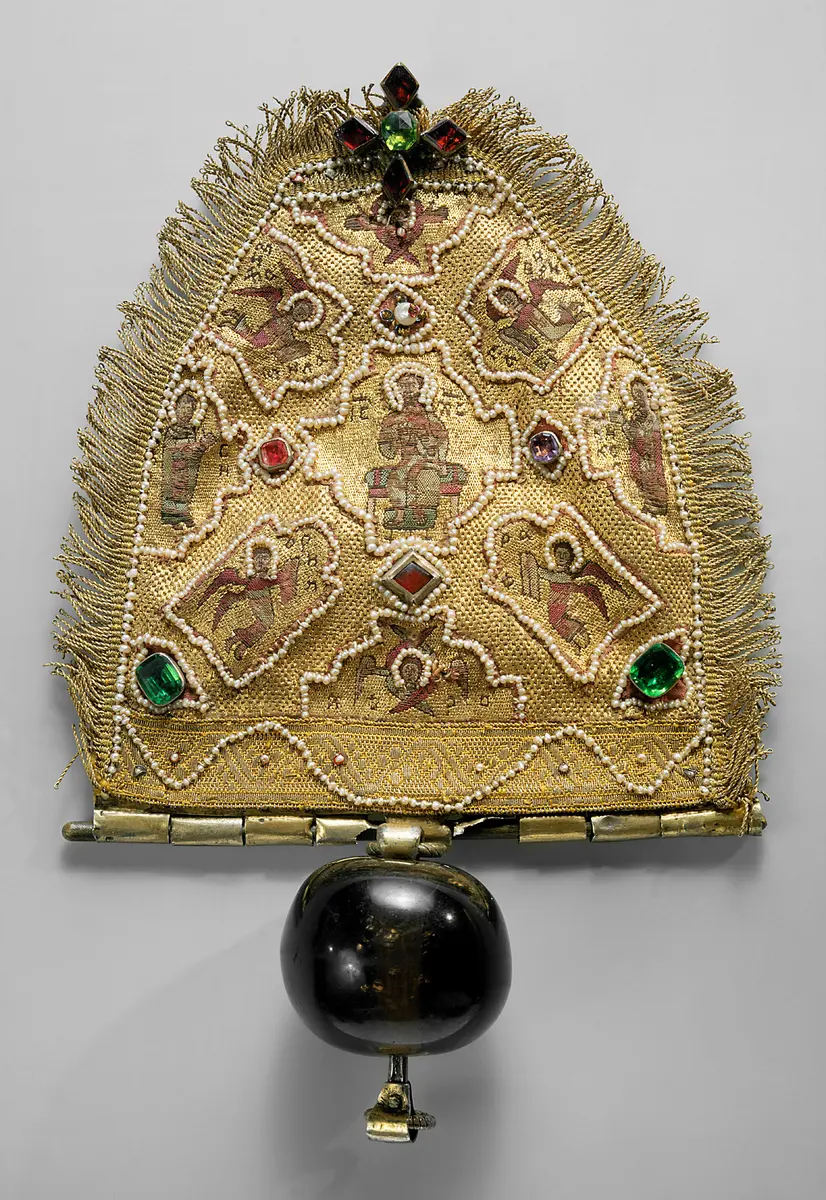
This red silk pouch is first mentioned in the inventory of the Capuchin Treasury in 1752, and described there as the purse (Latin: crumena) of King Stephan of Hungary (died 1038). There is, however, 110 historical foundation for this tradition. It is rather a unique item of inestimable value from the early period of Russian art and one of the earliest surviving pieces of Russian embroidery, perhaps even the earliest. The exact function of the pouch is uncertain, but it was probably intended to hold relics. Hardly any comparable textiles have survived; however, dating and localisation can be narrowed down somewhat in the light of the characteristics of the inscriptions. The front of the pouch is entirely covered in costly gold embroidery enclosing medallions with figures embroidered in silk. The effect is similar to that of splendid mosaics or pieces of goldsmiths'art. The high standard of the needlework - there are almost 700 stitches in one square centimetre - indicates that it originated from an important centre of embroidery, possibly from one of the great Russian convents. In the centre on the front, Christ is seated on his Throne, surrounded by the four archangels, a seraph, a cherub, St. Basil and St. Nicholas. The names of the persons represented are given in Cyrillic script. The back bears further Cyrillic inscriptions. The cruciform frame contains an extended version of Psalm 33,22 ("Let thy mercy, O Lord, be upon us, now and for ever"), and on the lower edge Psalm 67,1 ("God be merciful unto us, and cause his face to shine upon US"). Both texts figure prominently in the liturgy of Greek-Orthodox ritual. The pouch is fastened by means of a pin which is passed through the narrow hinge-like fittings attached to the edges. The inventory of 1752 records that the large smoky quartz was attached to the pouch. Its mount has been fitted in between the hinges, one of which appears to have been damaged in the process. This and the garnet cross are obviously later additions, as is the braid above the fastening (perhaps from the l7th century?). This piece was until recently called marsupium, a term which was, however, not used for the pouch until the 2Oth century.
Time:
2. Hälfte 11. / 12.- Jahrhundert
Object Name
Reliquiar (?); Reliquienbeutel (?); Textil
Culture
Russisch
Material/technology:
Textil; Seide, Leinen, Goldfadenstickerei, Seidenstickerei, Silber, vergoldet, Topas, Perlen, Granate, Glassteine / gestickt
Dimensions:
H. 15,5 cm, B. 13,5 cm
Inscribed
russisch
Copyright
Kunsthistorisches Museum, Geistliche Schatzkammer
Invs.
Schatzkammer, GS Kap 186