Sogenannte "Orsini - Bombe"
This ovoid steel grenade has ten pistons formerly set with the grenade’s blasting caps. Through an opening at the bottom (which would then be bolted shut), the hollow interior could be filled with bullets and gunpowder.
This type of bomb is named after Felice Orsini. Together with three fellow conspirators, the Italian revolutionary tried to assassinate Napoleon III, Emperor of the French, in Paris on 14 January 1858, by lobbing several such grenades at his carriage. The emperor was not hurt, but some members of his Life Guard were killed, and many bystanders were injured by the grenades, which also caused serious damage to property. The conspirators – besides Orsini they were Antonio Gomez, Guiseppe Andrea Pieri, and Carlo di Rudio – were soon apprehended. Following a sensational trial, Orsini and Pieri were executed on 13 March 1858.
During the trial, Orsini claimed Napoleon III’s lack of support for Italian unification was the main cause for the country’s inner turmoil. This led Napoleon to intervene in the neighbouring country the following year and, in collaboration with Sardinia-Piedmont, to support Italian unification. In June 1859, the French defeated the Austrians at Magenta and Solferino. Austria was forced to cede Lombardy, and this proved a vital impulse for Italian unification.
The bomb is inscribed in ink: Verona December 1863. Italian independence fighters may have planned to use it for a similar but ultimately abandoned assassination attempt on Emperor Franz Joseph.
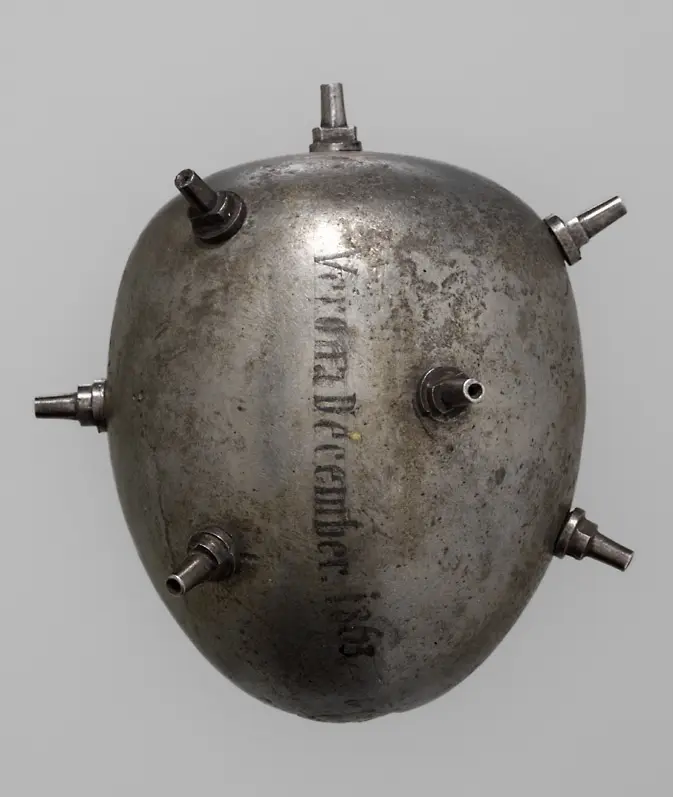
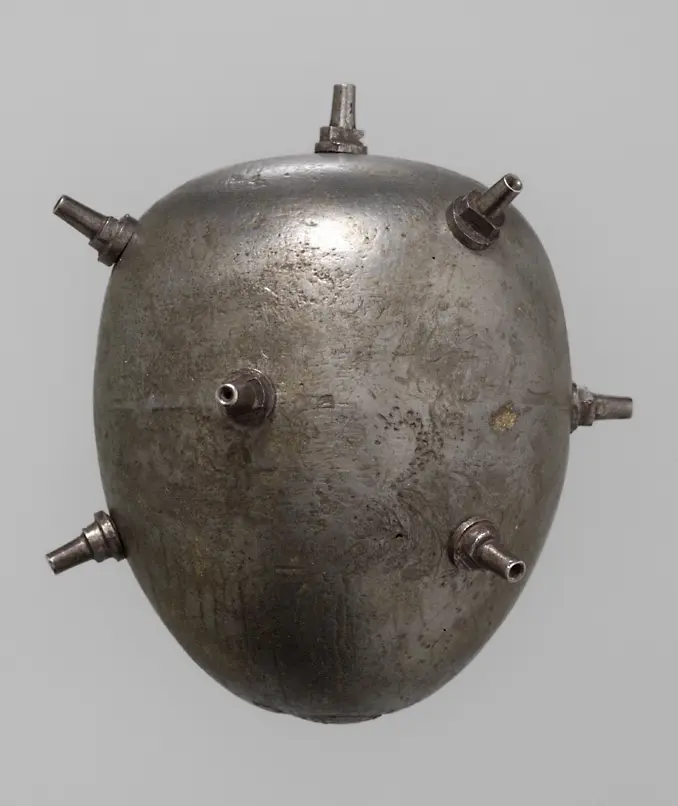
This ovoid steel grenade has ten pistons formerly set with the grenade’s blasting caps. Through an opening at the bottom (which would then be bolted shut), the hollow interior could be filled with bullets and gunpowder.
This type of bomb is named after Felice Orsini. Together with three fellow conspirators, the Italian revolutionary tried to assassinate Napoleon III, Emperor of the French, in Paris on 14 January 1858, by lobbing several such grenades at his carriage. The emperor was not hurt, but some members of his Life Guard were killed, and many bystanders were injured by the grenades, which also caused serious damage to property. The conspirators – besides Orsini they were Antonio Gomez, Guiseppe Andrea Pieri, and Carlo di Rudio – were soon apprehended. Following a sensational trial, Orsini and Pieri were executed on 13 March 1858.
During the trial, Orsini claimed Napoleon III’s lack of support for Italian unification was the main cause for the country’s inner turmoil. This led Napoleon to intervene in the neighbouring country the following year and, in collaboration with Sardinia-Piedmont, to support Italian unification. In June 1859, the French defeated the Austrians at Magenta and Solferino. Austria was forced to cede Lombardy, and this proved a vital impulse for Italian unification.
The bomb is inscribed in ink: Verona December 1863. Italian independence fighters may have planned to use it for a similar but ultimately abandoned assassination attempt on Emperor Franz Joseph.
Owner:
Franz Joseph I. (1848-1916), Kaiser von Österreich, König von Böhmen und Ungarn (1830 Wien - 1916 Wien) DNB
Time:
1863
Object Name
Sogenannte "Orsini - Bombe"
Culture
Italien
Material/technology:
Eisen, gegossen. Beschriftung: Tinte (?).
Dimensions:
L: 10,7 cm × B: 10 cm × T: 9,5 cm
Gewicht: 1,2 kg
Inscribed
auf der Außenseite Inschrift mit Tinte: “Verona December 1863”
Copyright
Kunsthistorisches Museum, Hofjagd- und Rüstkammer
Invs.
Hofjagd- und Rüstkammer, A 1764