Schwert, Schlachtschwert, Zweihänder, Bihänder
1570-1590
This two-handed sword is a traditional typ of cutting weapons. In the course of the 16th century, all these weapons changed into ornamental and parade weapons for guardsmen, and were increasingly rarely intended for actual use in battle. To achieve the correct leverage, the warrior had to hold the long sword with two hands because of its weight and length. The two-handed sword has a wavy blade, with two short fullers, on both sides the initials "S" and four times the mark "A".
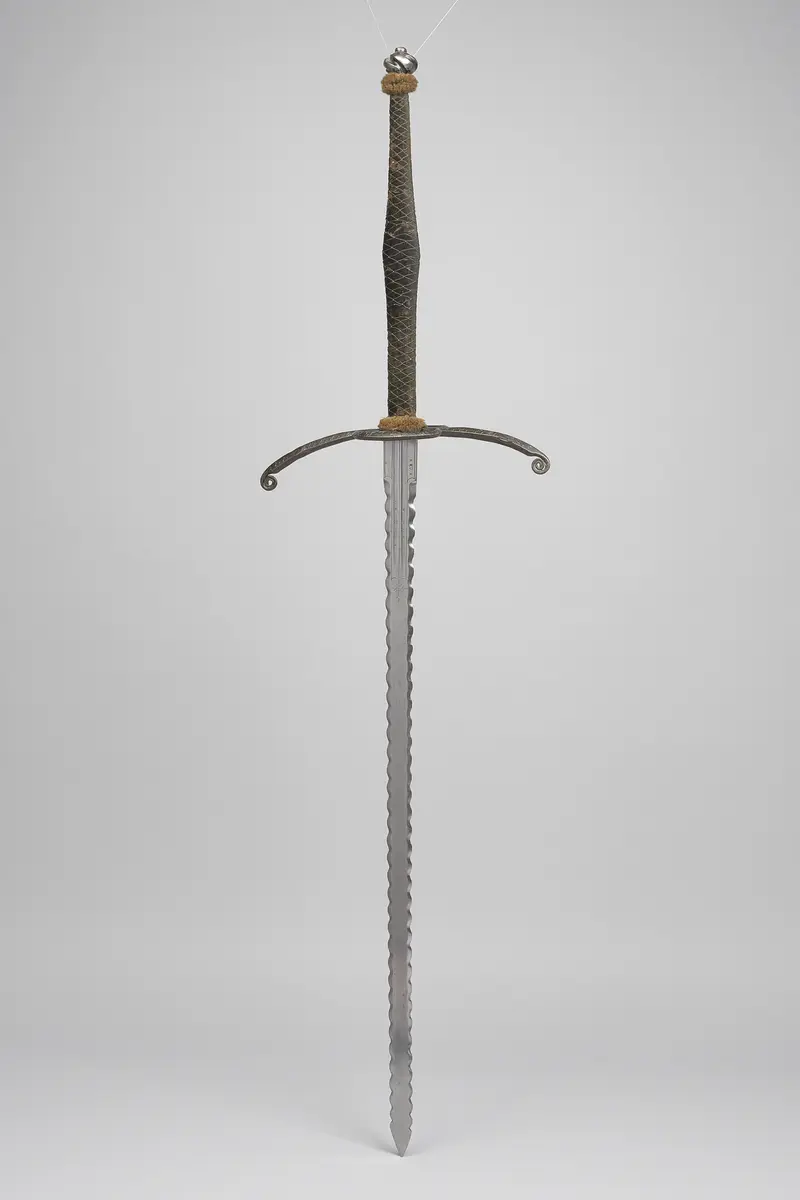
This two-handed sword is a traditional typ of cutting weapons. In the course of the 16th century, all these weapons changed into ornamental and parade weapons for guardsmen, and were increasingly rarely intended for actual use in battle. To achieve the correct leverage, the warrior had to hold the long sword with two hands because of its weight and length. The two-handed sword has a wavy blade, with two short fullers, on both sides the initials "S" and four times the mark "A".
Time:
1570-1590
Object Name
Zweihänder (Schlachtschwert), Schwert, Bihänder
Culture
Deutsch, München ?
Material/technology:
Eisen ?, Messingdraht, Samt
Dimensions:
Klinge: L. 108,5 cm
Inscribed
an der Klinge beidseitig 2 mal die Initiale S und 4 mal die bekrönte Marke A
Stamp / markings
4x Marke A an der Klinge beidseitig
Zeichen könnten auf den Münchner Meister Standler hinweisen
Copyright
Schloss Ambras Innsbruck
Invs.
Schloss Ambras Innsbruck, WA 139