Mann (?) mit Tympanon
7. - 6. Jh. v. Chr.
A figurine of a standing tambourine-player. Cylindrical, wheel-made, hollow body that splays at the lower part. Head mold-made, fixed on the top of the body through a tenon. Almost no indication of neck. The face was made from an old mold. The arms, handmade, were added separately. They are both bent to hold a small disc-shaped tambourine. The left hand holds the tambourine, with the right hand the figure plays the tambourine. The figure’s conical headdress is not enough to determine the sex. Black paint for the headdress, red and black around the short neck. Red paint for the arms and the tambourine. Black painted band along both sides of the body, two horizontal bands across the waist, from which hang three short vertical bands, obviously indicating the garments and accessories.The figurine is of a type known from numerous examples found at a sanctuary site in Kamelarga, north-west of Kition, which was partly excavated by John L. Myres in 1894. The terra-cotta and limestone figures found in this sanctuary are now mostly in the Cyprus Museum, but there are numerous examples elsewhere, especially in the Ashmolean Museum, Oxford. The sanctuary may have been founded in the seventh century B. C. and it existed to the Hellenistic period.
A. Bernhard-Walcher u.a., Die Sammlung zyprischer Antiken im KHM. Sammlungskataloge des KHM Bd. 2, Wien 1999 (V. Karageorghis)
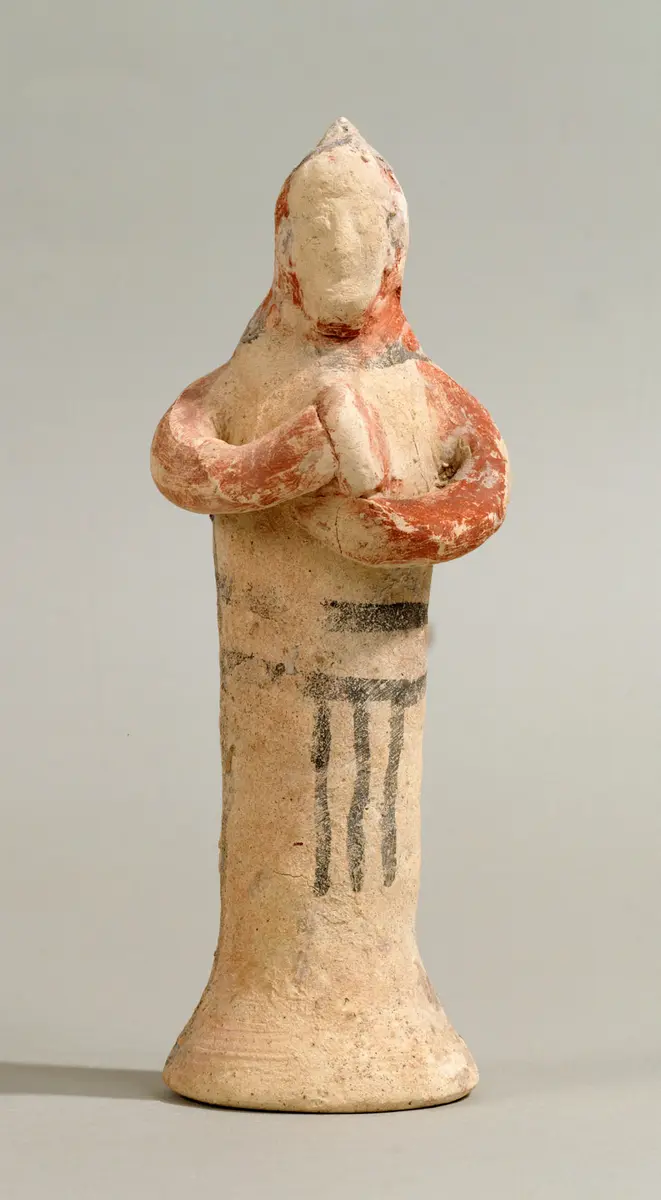
A figurine of a standing tambourine-player. Cylindrical, wheel-made, hollow body that splays at the lower part. Head mold-made, fixed on the top of the body through a tenon. Almost no indication of neck. The face was made from an old mold. The arms, handmade, were added separately. They are both bent to hold a small disc-shaped tambourine. The left hand holds the tambourine, with the right hand the figure plays the tambourine. The figure’s conical headdress is not enough to determine the sex. Black paint for the headdress, red and black around the short neck. Red paint for the arms and the tambourine. Black painted band along both sides of the body, two horizontal bands across the waist, from which hang three short vertical bands, obviously indicating the garments and accessories.The figurine is of a type known from numerous examples found at a sanctuary site in Kamelarga, north-west of Kition, which was partly excavated by John L. Myres in 1894. The terra-cotta and limestone figures found in this sanctuary are now mostly in the Cyprus Museum, but there are numerous examples elsewhere, especially in the Ashmolean Museum, Oxford. The sanctuary may have been founded in the seventh century B. C. and it existed to the Hellenistic period.
A. Bernhard-Walcher u.a., Die Sammlung zyprischer Antiken im KHM. Sammlungskataloge des KHM Bd. 2, Wien 1999 (V. Karageorghis)
Time:
7. - 6. Jh. v. Chr.
Object Name
Statuette
Culture
Zyprisch
Location of discovery:
Kamelarga (bei Larnaka, Zypern)
Material/technology:
Ton hellgelblich; Körper auf der Scheibe gefertigt, Kopf in einem Model geformt, Arme handgefertigt; Bemalung rot und schwarz
Dimensions:
H. 18,6 cm
Copyright
Kunsthistorisches Museum, Antikensammlung
Invs.
Antikensammlung, V 2004
Provenance
Ashmolean Museum Oxford; aus den Ausgrabungen von John L. Myres 1894; 1905 Geschenk