Jagdtasche, Falknertasche
um 1430
This bag comprises two trapeze-like leather pouches. Note the toothed fringes following the side seams of the pouches, and the three small tassels along the bottom. The soft leather is gathered at the opening, which is fitted with a curved clasp made originally of gilt brass and decorated with a tiny fantastic palace.
This miniature edifice boasts tiny filigree towers, niches, and pinnacles. It is flanked by two dragons and two lions and surmounted with a small domed building. Over the entrance marking the central axis of the palace stands an unidentified figure, and the back of the clasp is decorated with fields of thistles on a cross-hatched ground. The bag is opened by gently twisting the upright figure, which unlocks the closing mechanism so that the front of the brass ornamentation (with the two lions and the lower part of the building) folds forward. The thin metal band on the upper end of the clasp allows the wearer to attach the bag to his belt or a strap.
The object is generally described as a game bag or falconer’s bag. We know that such small bags were part of late medieval hunting equipment – see, for example, Gaston Phébus’s Livre de la chasse (‘Book of the Chase’, early fifteenth century). De arte bersandi, a thirteenth-century treatise on hunting, advised ‘hunters to choose a bag with a strap; it should contain an extra bowstring, twine, a firestone, a fire steel and tinder, glue, a pair of scissors, a knife, a file, and a whetstone’.
Belt bags were also worn as elegant accessories at court or for festivities. Among the most important pictorial sources for this are Netherlandish tapestries such as the Caesar series (Netherlandish, 1450–70) and the Trajan and Herkinbald tapestry (Tournai (?), 1440–50), both of which are now in Berne. An illustration in Freydal (c.1512/13), the tournament book of Emperor Maximilian I, depicts an elegant procession of hunters entering a hall. In this miniature the courtiers, disguised as falconers, carry hunting swords and bait as well as falconer’s bags, their shape similar to our bag, bar the missing brass ornamentation.
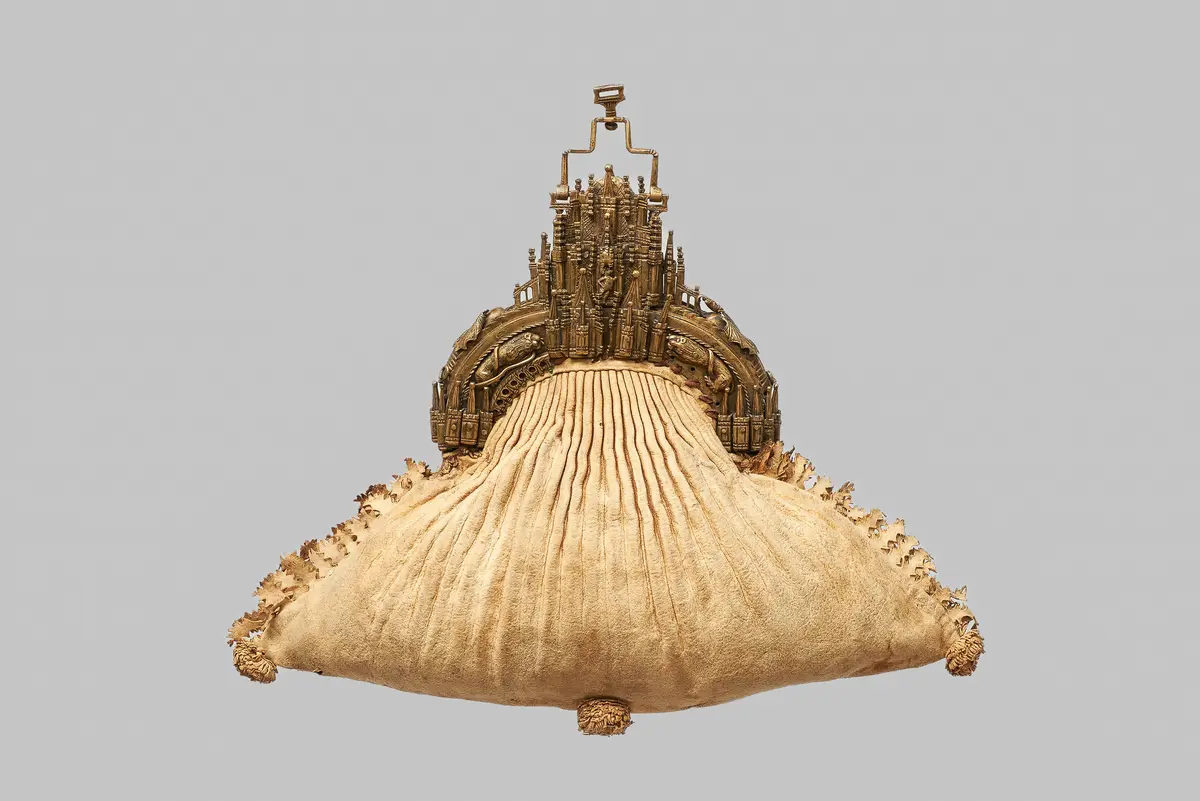
This bag comprises two trapeze-like leather pouches. Note the toothed fringes following the side seams of the pouches, and the three small tassels along the bottom. The soft leather is gathered at the opening, which is fitted with a curved clasp made originally of gilt brass and decorated with a tiny fantastic palace.
This miniature edifice boasts tiny filigree towers, niches, and pinnacles. It is flanked by two dragons and two lions and surmounted with a small domed building. Over the entrance marking the central axis of the palace stands an unidentified figure, and the back of the clasp is decorated with fields of thistles on a cross-hatched ground. The bag is opened by gently twisting the upright figure, which unlocks the closing mechanism so that the front of the brass ornamentation (with the two lions and the lower part of the building) folds forward. The thin metal band on the upper end of the clasp allows the wearer to attach the bag to his belt or a strap.
The object is generally described as a game bag or falconer’s bag. We know that such small bags were part of late medieval hunting equipment – see, for example, Gaston Phébus’s Livre de la chasse (‘Book of the Chase’, early fifteenth century). De arte bersandi, a thirteenth-century treatise on hunting, advised ‘hunters to choose a bag with a strap; it should contain an extra bowstring, twine, a firestone, a fire steel and tinder, glue, a pair of scissors, a knife, a file, and a whetstone’.
Belt bags were also worn as elegant accessories at court or for festivities. Among the most important pictorial sources for this are Netherlandish tapestries such as the Caesar series (Netherlandish, 1450–70) and the Trajan and Herkinbald tapestry (Tournai (?), 1440–50), both of which are now in Berne. An illustration in Freydal (c.1512/13), the tournament book of Emperor Maximilian I, depicts an elegant procession of hunters entering a hall. In this miniature the courtiers, disguised as falconers, carry hunting swords and bait as well as falconer’s bags, their shape similar to our bag, bar the missing brass ornamentation.
Time:
um 1430
Object Name
Jagdtasche, Falknertasche
Culture
Süddeutsch
Material/technology:
Messingblech, teils graviert. Messing, teils gegossen, teils graviert. Leder.
Dimensions:
H 29 cm x B 33,5 cm x T 9 cm, 0,55 kg
Copyright
Kunsthistorisches Museum, Hofjagd- und Rüstkammer
Invs.
Hofjagd- und Rüstkammer, D 7