Diana with Nymphs and the Day’s Kill
1650 | Jan Fyt
Here the chaste deity, Diana, and her nymphs relax at the end of a successful day out hunting: she has placed a triumphant foot on a slain roe buck. The crescent on her forehead identifies her as the goddess of the moon. She is the protectress of women and girls, mistress of animals, and goddess of the hunt; but as she remains unmarried, she also symbolizes freedom without boundaries. The boisterous greyhounds best express her joie-de-vivre. The artist was inspired by van Dyck’s rather than by Rubens’ ideal of beauty.
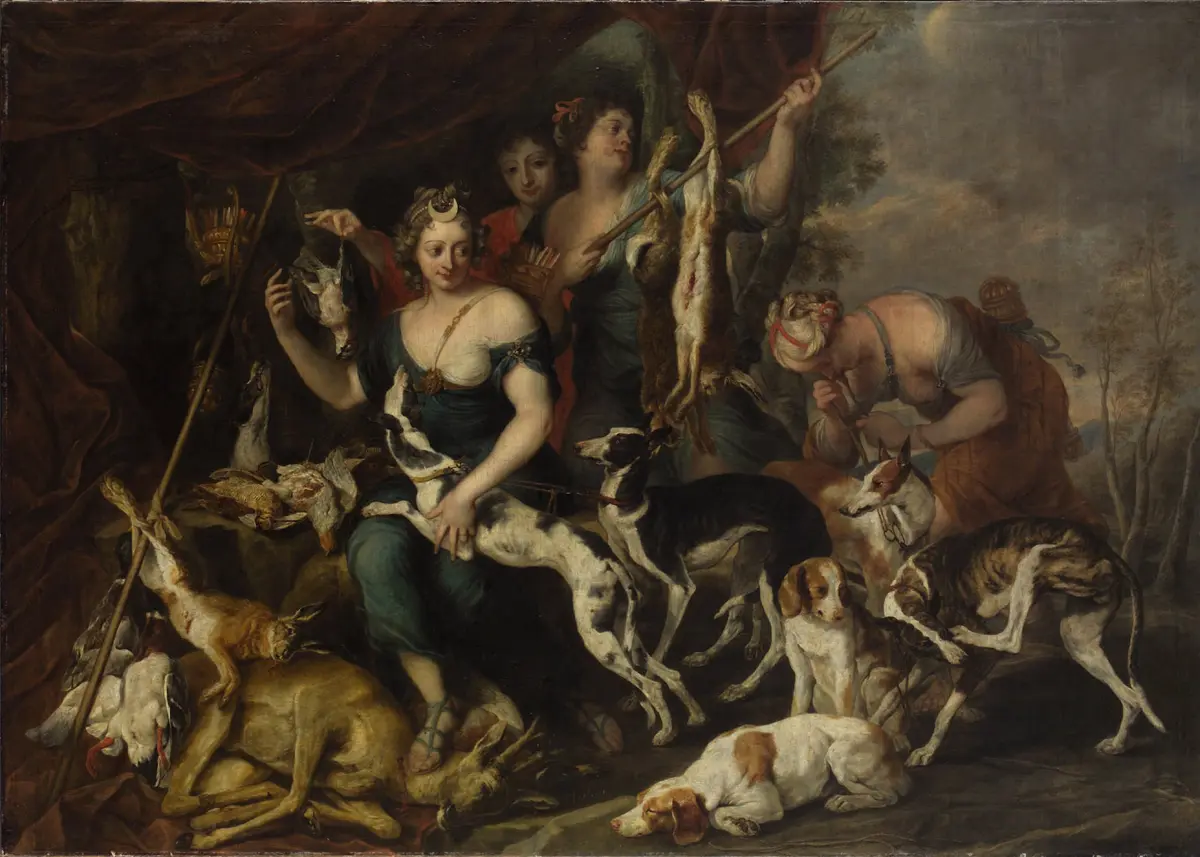
Here the chaste deity, Diana, and her nymphs relax at the end of a successful day out hunting: she has placed a triumphant foot on a slain roe buck. The crescent on her forehead identifies her as the goddess of the moon. She is the protectress of women and girls, mistress of animals, and goddess of the hunt; but as she remains unmarried, she also symbolizes freedom without boundaries. The boisterous greyhounds best express her joie-de-vivre. The artist was inspired by van Dyck’s rather than by Rubens’ ideal of beauty.
Time:
1650
Object Name
Painting
Culture
Flemish
Material/technology:
Canvas
Dimensions:
207 cm × 291 cm
Framed (gallery frame with inscriptions): 221 cm × 304,5 cm × 7 cm
Signed
Inscribed in the bottom centre: Ioannes. Fyt 1650
Copyright
Kunsthistorisches Museum, Gemäldegalerie
Invs.
Gemäldegalerie, 706
Provenance
Collection Leopold Wilhelm
Browse more
Similar items you might be interested in
Landschaft in Suffolk J. Löwy, K. und K. Hof-Photograph, Kunst- und Verlagsanstalt (Wien) 1888 bis 1891
Gundakar Fürst Dietrichstein (1623-1690) Jan Thomas um 1667
Infantin Margarita (1651-1673), Kaiserin, im Theaterkostüm Jan Thomas 1667
Kaiser Leopold I. (1640-1705) im Theaterkostüm, in ganzer Figur Jan Thomas 1667
Das Tischgebet J. Löwy, K. und K. Hof-Photograph, Kunst- und Verlagsanstalt (Wien) 1888 bis 1910
Seehafen - im Vordergrund Ruinen und Figuren J. Löwy, K. und K. Hof-Photograph, Kunst- und Verlagsanstalt (Wien) 1888 bis 1910