Das österreichische Erbpanier
1705
Among the oldest privileges of the rulers of Austria was that of having the hereditary banner carried before them. For this reason, the banner is regarded as one of the archducal insignia of Austria above and below the Enns, whose respective arms adorn the sides of this swallow-tailed banner. Emperor Leopold I bestowed the hereditary office of Grand Standard-Bearer of the Hereditary Banner of Austria above and below the Enns as a hereditary male fief upon the Counts of Abensperg and Traun; their arms are also embroidered on both sides of the banner. The first member of this house to hold the hereditary office was Otto Ehrenreich Count of Abensberg and Traun, Knight of the Order of the Golden Fleece, whose arms and monogramme arc engraved on the point of the banner. He performed the duties of the office of standard-bearer for the first time at the ceremony of Hereditary Homage to Emperor Joseph I on 22. 9. 1705. It appears that the banner was made for this occasion. Attested to in 1731, in the inventory of the Small Privy Treasury of Emperor Karl VI, it was transferred from the Imperial-Royal Privy Revenue Office in 1779.
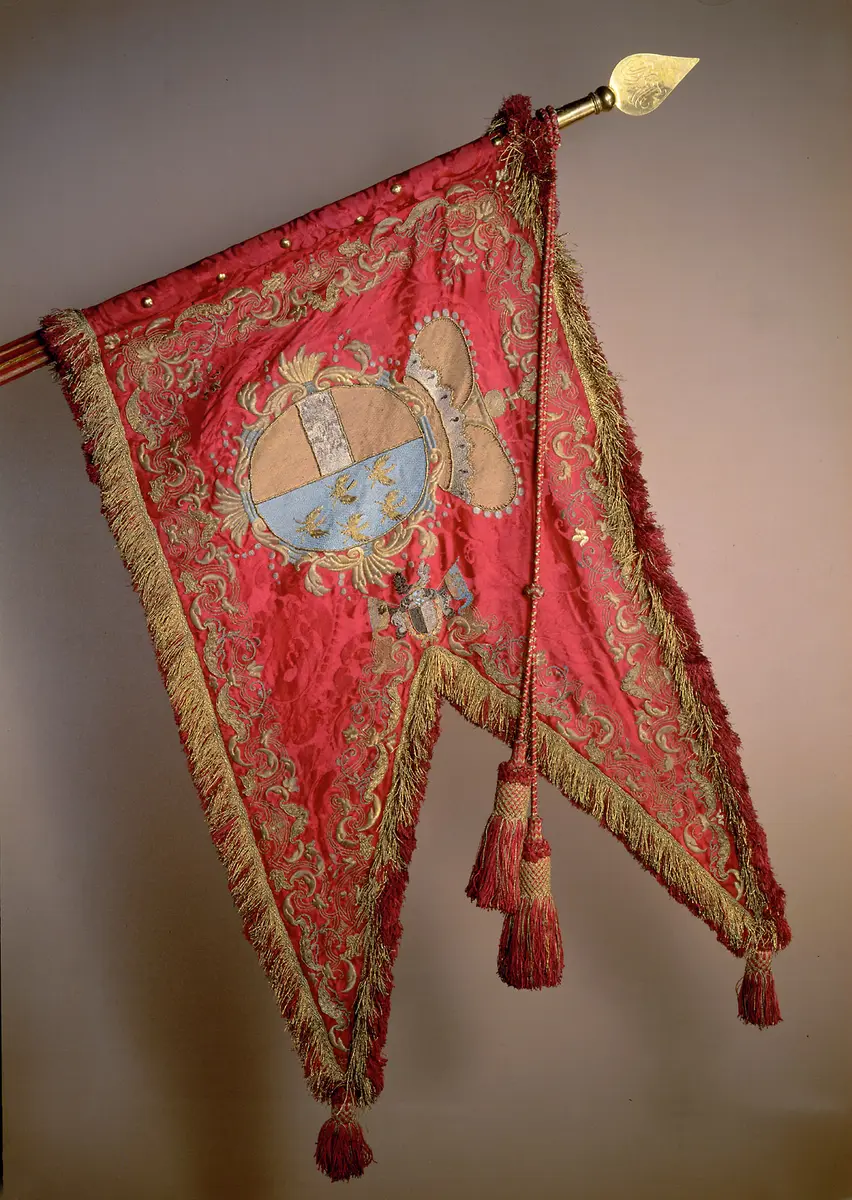
Among the oldest privileges of the rulers of Austria was that of having the hereditary banner carried before them. For this reason, the banner is regarded as one of the archducal insignia of Austria above and below the Enns, whose respective arms adorn the sides of this swallow-tailed banner. Emperor Leopold I bestowed the hereditary office of Grand Standard-Bearer of the Hereditary Banner of Austria above and below the Enns as a hereditary male fief upon the Counts of Abensperg and Traun; their arms are also embroidered on both sides of the banner. The first member of this house to hold the hereditary office was Otto Ehrenreich Count of Abensberg and Traun, Knight of the Order of the Golden Fleece, whose arms and monogramme arc engraved on the point of the banner. He performed the duties of the office of standard-bearer for the first time at the ceremony of Hereditary Homage to Emperor Joseph I on 22. 9. 1705. It appears that the banner was made for this occasion. Attested to in 1731, in the inventory of the Small Privy Treasury of Emperor Karl VI, it was transferred from the Imperial-Royal Privy Revenue Office in 1779.
Time:
1705
Object Name
Insigne; Textil
Culture
Österreichisch
Material/technology:
Fahnenblatt: roter Seidendamast mit Gold, Silber und Seide bestickt; Fransen, Schnur und Quasten: rote Seide und Gold. Fahnenstange: Holz, rot, gold und silber gefaßt; Spitze: Messing, vergoldet. Bandelier: roter Samt und rote Seide, mit Gold, Silber und Seide bestickt; Beschläge: Messing, vergoldet
Dimensions:
Fahnenstange: L. 248 cm
Copyright
Kunsthistorisches Museum, Weltliche Schatzkammer
Invs.
Schatzkammer, WS XIV 34