In interdisciplinary cooperation, aspects such as polychromy as a means of visual design, ancient colour symbolism or the use of different painting techniques will be investigated.
A special research focus is on objects of the Mithras cult from Carnuntum and the Vienna Basin and the significance of colour in a religious and ritual context.
Development of investigative methods
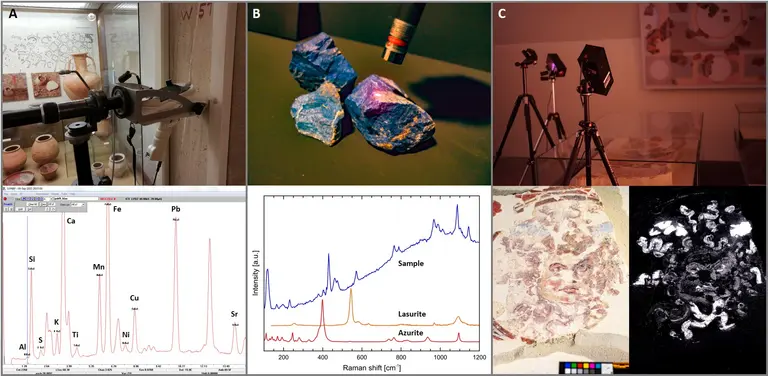
The aim of the material-analytical investigations is to detect the remains of pigments that were once applied, even if they are barely or no longer visible to the naked eye. Supplemented by classical methods of light and electron microscopy, the focus is on non-invasive methods. In addition to digitisation and modelling, primarily multi- and hyperspectral analyses, light spectroscopic methods and X-ray fluorescence analysis are used. Exploring the possibilities and limitations of current techniques is an integral part of the project, as is the development of new methods.
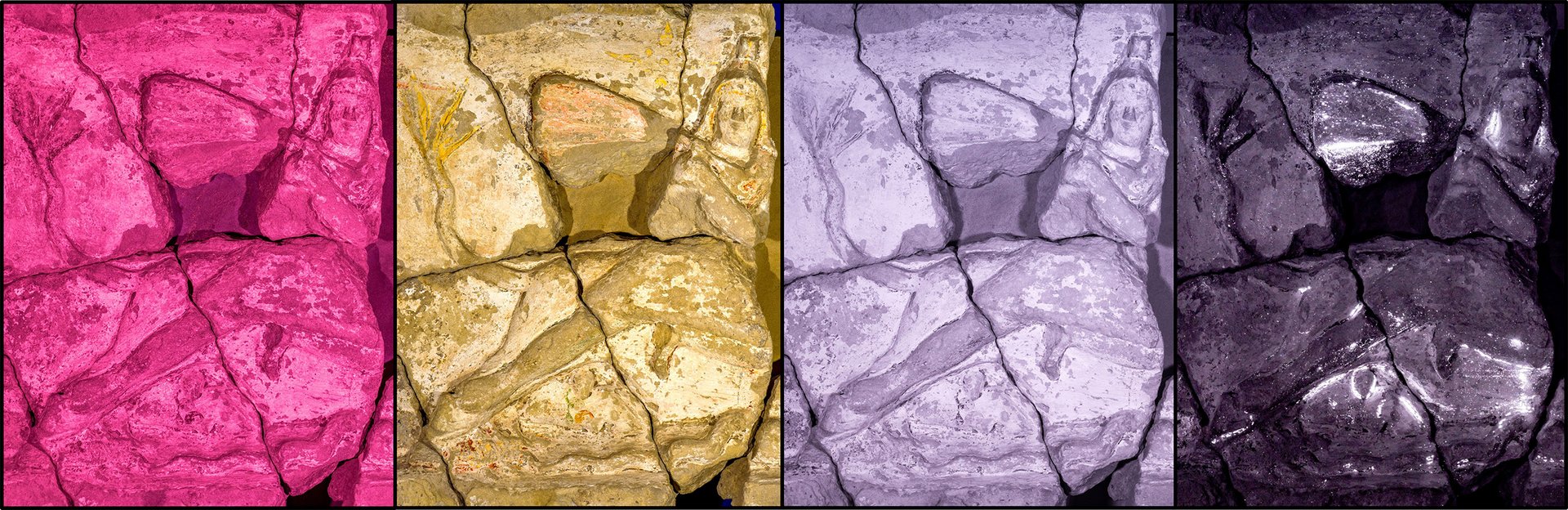
Project goals
The project crosses archaeological and chemical-physical data and combines scientific and cultural-historical questions in order to open up new fields of research and of application for monument conservation, museology and knowledge transfer.
Project lead
- Gabrielle Kremer (Koordination)
- Robert Linke
- Georg Plattner
- Eduard Pollhammer
Team
- Robert Krickl
- Nirvana Silnovic
- Stephanie Stoss
- Malgorzata Mozdyniewicz
Cooperations
- Austrian Archaeological Institute, Austrian Academy of Sciences
- Federal Monuments Authority Austria
- State Collections of Lower Austria, Office of the Lower Austrian Federal Government
- Vienna University
Duration
2021 – 2025
Financial support
ÖAW | Heritage Science Austria
Pitch Black – Colourful?
Current research on polychromy in antiquity, Vitrine EXTRA #6
Special presentation within the frame of the research project Polychromon
Duration: 21 February - 31 August 2025
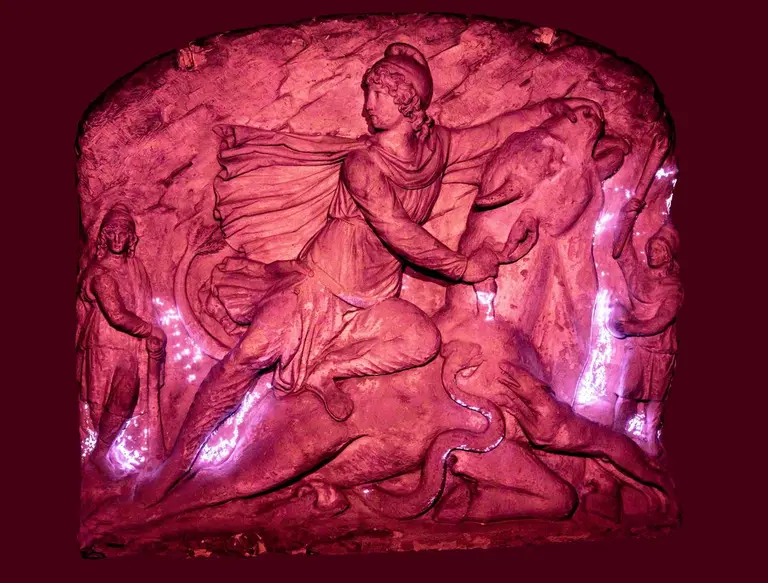
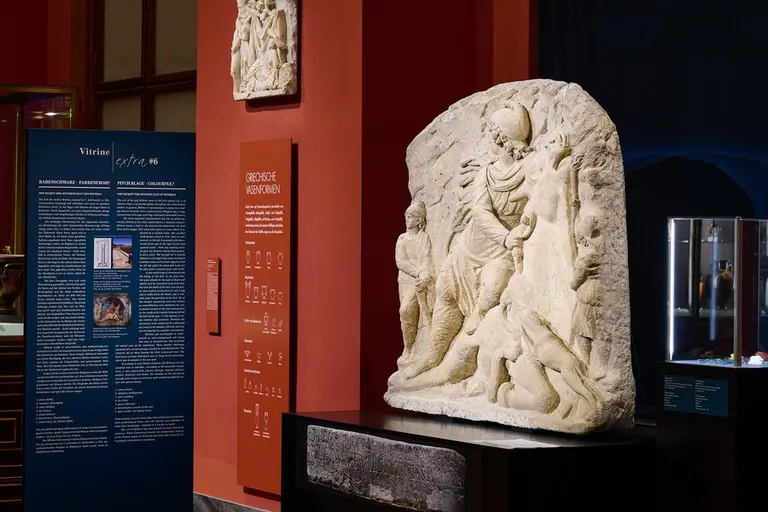
The special presentation Vitrine EXTRA, which periodically showcases different ancient objects as temporary additions to the permanent exhibition at the Collection of Greek and Roman Antiquities in the Kunsthistorisches Museum, explores the colorful traces of Greco-Roman antiquity in its sixth edition. Based on a relief depicting the god of light, Mithras, the presentation highlights the vibrant polychromy of Roman statues and monuments – impressively showcasing how colorful they originally were!
About the exhibition
Greco-Roman antiquity was once much more colourful than it appears to us today. Many statues, monuments, and architectural elements were richly painted in colours that over the course of centuries have often not survived. This multi-colour phenomenon (polychromy) has been intensively studied for a number of years, and now for the first time this research is concentrated in the Danube area around Vienna and Carnuntum. The interdisciplinary research project Colours revealed – Polychromy of Roman monuments of the Danube provinces, with the aid of scientific methods, searches for remains of colour pigments which were once applied to the stones and are now scarcely, or not at all, visible to the naked eye. With non-invasive methods such as multispectral analysis – the investigation of the interaction of different materials with diverse forms of light – even the smallest traces of colour can be detected.
In the early summer of 1816, a relief depicting the bull-slaying god Mithras was discovered in the vineyards near Stixneusiedl (Lower Austria). The upper part, including Mithras’ torso, was missing. Later that same year, the artifact was transferred to the imperial collections in Vienna and handed over to the k. k. Münz- und Antikenkabinett – the predecessor of today’s Collection of Greek and Roman Antiquities. Even at the time of its discovery, the numerous preserved traces of ancient paint were admired, and, fortunately, a rough cleaning – which was quite common at the time – was avoided.
Since its discovery more than 200 years ago, the relief has undergone no significant restoration interventions – apart from the addition of the lost upper half and the overpainting of the ancient color traces in the early 19th century. This provides ideal conditions for examining the ancient paint layers today using modern methods. In 2023/24, the relief was comprehensively documented, conserved, and restored. During this process, overpainted or later concealed areas were uncovered once again.