The project is a collaboration between the Department of Ancient History, Papyrology and Epigraphy at the University of Vienna, the Collection of Greek and Roman Antiquities at the Kunsthistorisches Museum in Vienna, and the Computer Vision Lab (CVL) at the Vienna University of Technology (TU Wien), and is led by the Etruscologist Prof. Petra Amann (University of Vienna).
Over 3000 bronze mirrors are currently known. They are made of a special alloy and have a highly polished surface that served as a mirror and were produced from the second half of the 6th century BCE until the 2nd century BCE. This period clearly illustrates the development from early outstanding examples of the Etruscans’ high level of craftsmanship in bronze working to mass production in the final two to three centuries. Within this group, there are various forms, such as handle mirrors or box mirrors with relief decoration. The majority of the handle mirrors feature line drawings on the reverse, depicting scenes from (mostly) Greek mythology. These may be supplemented by inscriptions in the Etruscan language. The images enrich our knowledge of Etruscan culture in many ways, particularly regarding art history, but also concerning religion and mythology, as well as social history.

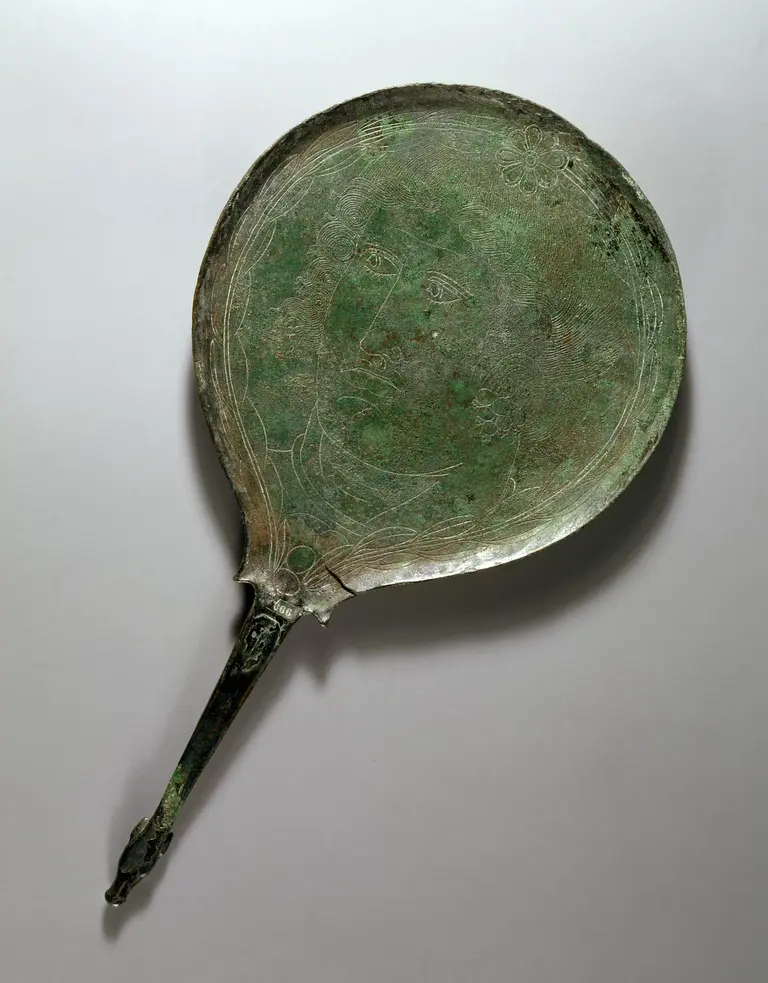
Der Spiegel zeigt einen Frauenkopf in Dreiviertelansicht, geschmückt mit einem Halsreif und einem großen Ohrgehänge aus einer halbrunden Scheibe und traubenförmig angeordneten Kugeln. Ein aufsteigender Blätterkranz mit einer Blüte und mit Beeren rahmt das Bild. Der mitgegossene Griff endet in Form eines Rehkopfes. Aufgrund der birnenähnlichen Form der Scheibe kann der Spiegel Werkstätten aus dem südöstlich von Rom gelegenen Praeneste (heute Palestrina) zugeschrieben werden.
Title:
Griffspiegel praenestinischer Form: Kopf einer Frau mit traubenförmigem Ohrschmuck und Halsreif
Time:
2. Hälfte 4. Jh. v. Chr.

Title:
Griffspiegel praenestinischer Form: Peleus und Thetis
Time:
2. Hälfte 4. Jh. v. Chr.

Title:
Griffspiegel praenestinischer Form
Research into Etruscan mirrors began as early as the 19th century, but it is only since the 1980s that the specimens held in museums or related collections have been systematically examined and published in a standardised manner in a scholarly series, the Corpus Speculorum Etruscorum. The individual volumes are organised by country and museum (or collection) and are published at irregular intervals; 35 volumes are currently available. To date, a presentation of Etruscan mirrors in Austria has not yet been included in this renowned series.
The aim of the project is to close this gap and to publish the approximately 60 Etruscan mirrors in Austrian museums and collections in a comprehensive scholarly manner. This also includes the graphic representation of the objects using the latest techniques in digital image documentation, whereby precise tracings from 3D scans are to be created in collaboration with the CVL at TU Wien. The majority of the mirrors (handle and box mirrors) are held in the Collection of Greek and Roman Antiquities at the Kunsthistorisches Museum in Vienna, including early examples as well as those bearing inscriptions or rare mythological scenes; some of these are previously unpublished.
Project leader
Univ.-Prof. Mag. Dr. Petra Amann, Department of Ancient History, Papyrology and Epigraphy, University of Vienna
Cooperation partners
- Kunsthistorisches Museum, Vienna, Collection of Greek and Roman Antiquities
- Computer Vision Lab (CVL), TU Wien
Project team
- Mag. Karoline Zhuber-Okrog, Collection of Greek and Roman Antiquities, Kunsthistorisches Museum
- Mag. Bettina Vak, Collection of Greek and Roman Antiquities, Kunsthistorisches Museum
- Dr. Martina Grießer, Conservation Science Department, Kunsthistorisches Museum
- Dr. Katharina Uhlir, Conservation Science Department, Kunsthistorisches Museum
- Dr. Raffaella Da Vela, Department of Ancient History, Papyrology and Epigraphy, University of Vienna (from 1 August 2025)
- Sindy Kluge, M.A., Department of Ancient History, Papyrology and Epigraphy, University of Vienna (until 31 January 2025)
- Simon Brenner, MSc, Computer Vision Lab (CVL), TU Wien
- Mag. Brigitte Boll, freelance conservator
Funding
- FWF – Austrian Science Fund (P33721)
- KHM-Museumsverband
Project duration
2021 – 2027
Publications
- Karoline Zhuber-Okrog, Hier stimmt doch etwas nicht! Vier angeblich etruskische Spiegel in der Wiener Antikensammlung, in: Monica Baggio – Elisa Bernard – Monica Salvadori – Luca Zamparo (Eds.), Anthropology of Forgery. A multidisciplinary approach to the study of archaeological fakes, Antenor Quaderni 46, Padua 2019, 77–86
- Karoline Zhuber-Okrog, Etruskische Spiegel der Antikensammlung des Kunsthistorischen Museums in Wien, in: Marion Meyer – Verena Gassner, Standortbestimmungen. Akten des 12. Österreichischen Archäologentages vom 28.2. bis 1.3.2008 in Wien, Vienna 2010, 147–150