Kreuzpartikel-Pacificale: Christus als Weltenherrscher
1726 datiert | Johann Baptist Känischbauer von Hohenried
In 1711, Emperor Karl VI received a particle of the Cross set with brilliants as a gift from Pope Clemens IX, and commissioned a gold pacificale for it from his court jeweller, Johann Baptist Känischbauer von Hohenried. In the form of a triumphal monument, the piece is intended to evoke the Redemption of the world through Christ's death on the cross, which simultaneously established his dominion over the world. The four symbols of the Evangelists provide the basis of the composition, above which, floating on a cloud, is a globe of rock crystal surrounded by a laurel wreath and the inscription: NASCENDO TULIT, MORIENDO RELIQUIT (he received it at birth, and relinquished it at death). In side the sphere is the particle of the cross as the centre of the world. Above, on the zenith, appears the Redeemer bearing the banner of the resurrected, his hand raised in benediction. Represented by the figure of a timeless, eternal child, he is surrounded by an aureole of polished glass pastes (formerly diamonds) and gold. The gold smith probably owed the conception of this magnificent composition to the outstanding Baroque architect Johann Fischer von Erlach, who had already introduced the central motif of a globe combined with a cross in the high altar of the pilgrimage church at Maria Zell (1693, completed by Känischbauer in 1722). Känischbauer succeeded in retaining the basic monumental character of the piece through generous handling of the embossed work, thereby creating one of the most important achievements of Baroque goldsmiths'art. Beneath the moveable bull symbol is the signature: JO. KÄNISCHBAUR / V. HOHEN RIED / R. K. M. KAMER / KÜNSTLER / 1726.
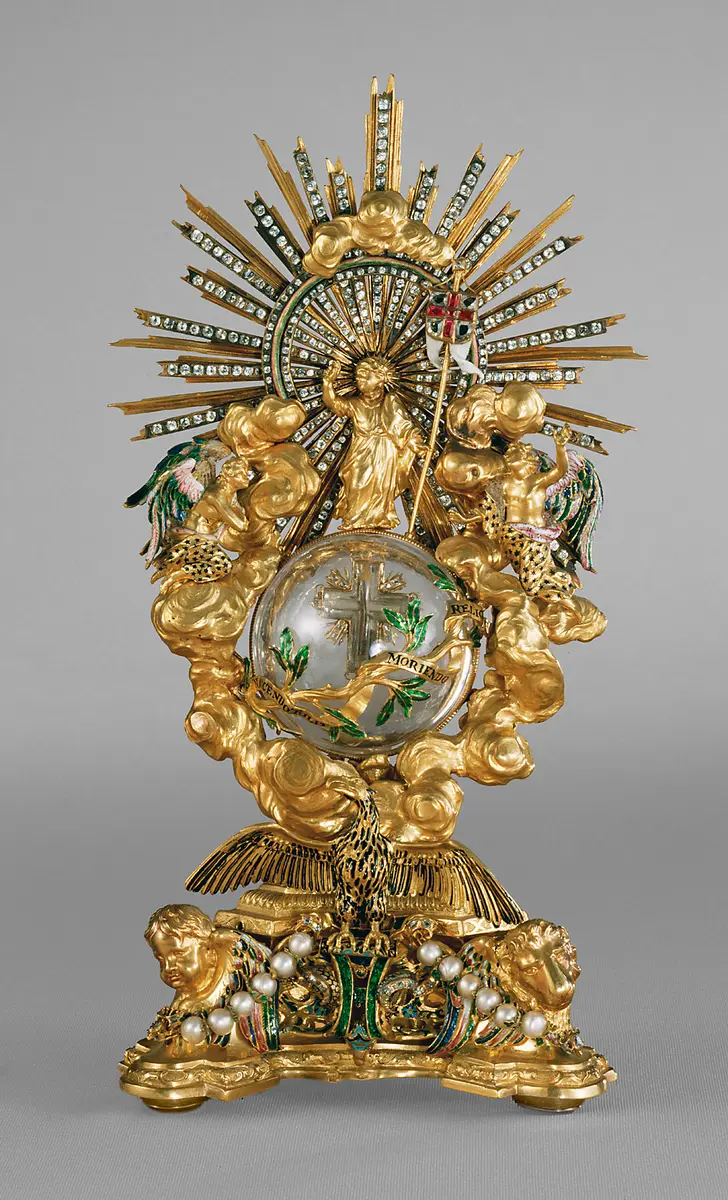
In 1711, Emperor Karl VI received a particle of the Cross set with brilliants as a gift from Pope Clemens IX, and commissioned a gold pacificale for it from his court jeweller, Johann Baptist Känischbauer von Hohenried. In the form of a triumphal monument, the piece is intended to evoke the Redemption of the world through Christ's death on the cross, which simultaneously established his dominion over the world. The four symbols of the Evangelists provide the basis of the composition, above which, floating on a cloud, is a globe of rock crystal surrounded by a laurel wreath and the inscription: NASCENDO TULIT, MORIENDO RELIQUIT (he received it at birth, and relinquished it at death). In side the sphere is the particle of the cross as the centre of the world. Above, on the zenith, appears the Redeemer bearing the banner of the resurrected, his hand raised in benediction. Represented by the figure of a timeless, eternal child, he is surrounded by an aureole of polished glass pastes (formerly diamonds) and gold. The gold smith probably owed the conception of this magnificent composition to the outstanding Baroque architect Johann Fischer von Erlach, who had already introduced the central motif of a globe combined with a cross in the high altar of the pilgrimage church at Maria Zell (1693, completed by Känischbauer in 1722). Känischbauer succeeded in retaining the basic monumental character of the piece through generous handling of the embossed work, thereby creating one of the most important achievements of Baroque goldsmiths'art. Beneath the moveable bull symbol is the signature: JO. KÄNISCHBAUR / V. HOHEN RIED / R. K. M. KAMER / KÜNSTLER / 1726.
Artist:
Johann Baptist Känischbauer von Hohenried (1668 Angern/NÖ - 1739 Wien) DNB
Time:
1726 datiert
Object Name
Liturgisches Gerät; Reliquiar; Pacificale;
Culture
Wien
Material/technology:
Gold, teilweise emailliert, Bergkristall, Diamanten, Rubine, Perlen, Glassteine, Silber, vergoldet, Eisen
Dimensions:
H. 25,3 cm, B. 12,3 cm, T. 8 cm
Signed
JO. KÄNISCHBAUR V. HOHEN RIED R. K. M. KAMER KÜSTLER 1726
Inscribed
"NASCENDO TULIT, MORIENDO RELIQUIT"
Stamp / markings
R 3, Nr.7942; Wr. Repunze 1806/07; Wr. Befr. stempel 1809/10
Copyright
Kunsthistorisches Museum, Geistliche Schatzkammer
Invs.
Schatzkammer, GS D 39