Taufkanne und Taufschüssel der Taufgarnitur
1571 | Spanisch
Made from about 10.5 kg of gold, this precious set along with 10,000 guilders was the wedding present of the Carinthian estates (thus the Carinthian coat of arms on the body of the ewer and at the centre of the basin) to Archduke Charles of Inner Austria and Maria of Bavaria. It was presented to the couple by the head of government in the province, Georg, Count Khevenhüller, on 11 September 1571 in Graz. From the estate of Maria the set came into the possession of the son of this marriage, the later Emperor Ferdinand II (1578-1637), who brought it to Vienna and deposited it in the Treasury. Fortunately, the set was not melted down - which often happened with gold objects when money was short - because the imperial family used the basin at least for christenings. This tradition was maintained until the end of the monarchy, although the set, which was intended as a "lavabo", i.e., for washing one's hands at the table, does not bear any religious motifs. At that time gold was not yet hallmarked. However, the style and numerous details of the work suggest that the set is the work of a Spanish goldsmith, although it is not yet known whether it was created in Spain or Vienna. Several Spanish goldsmiths worked at the Vienna court of Emperor Maximilian II (1527-1576) and his Spanish wife. On the other hand there were also close connections with the Madrid court of Philip II (1527-1598). If the precious work was created in Spain, it most likely contains gold from the New World.
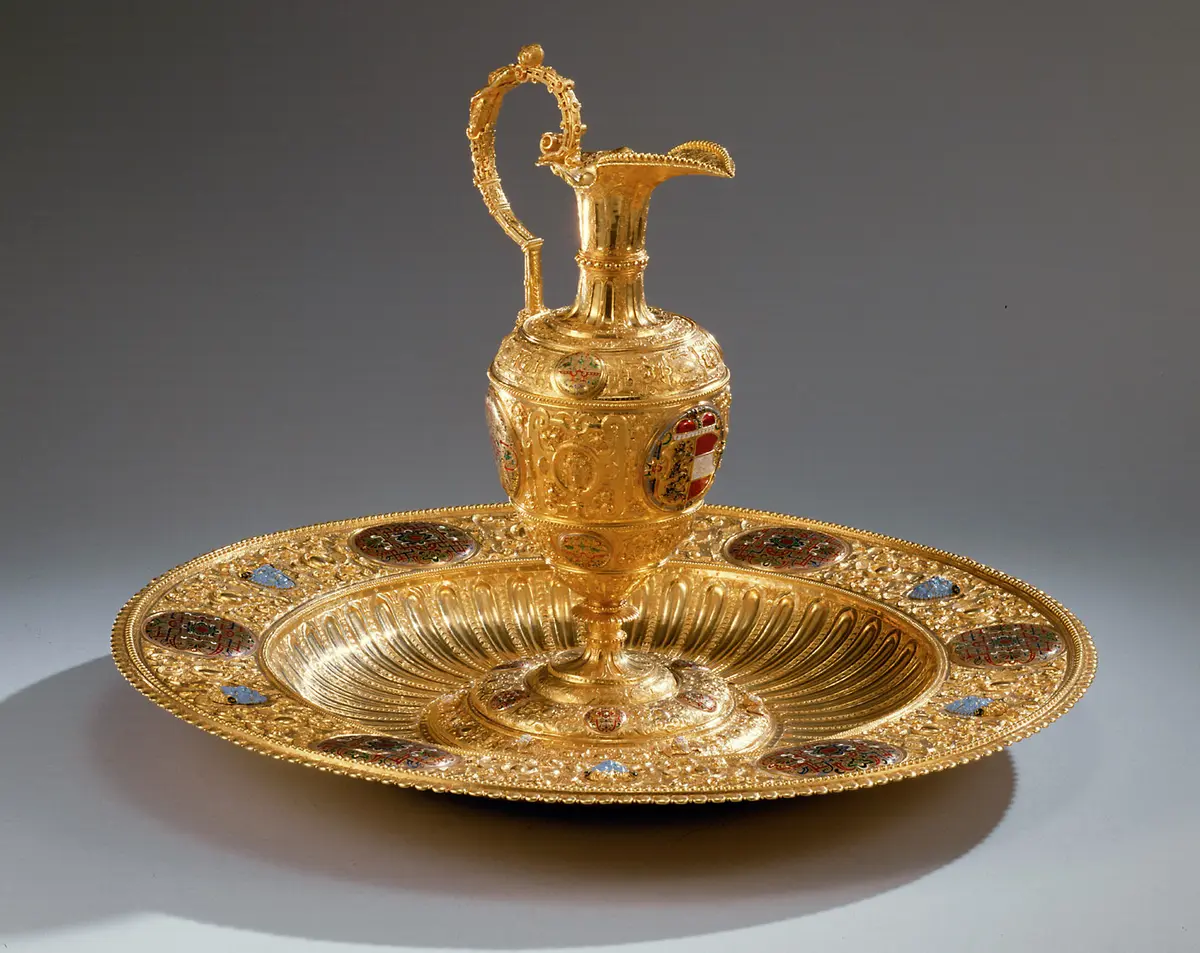
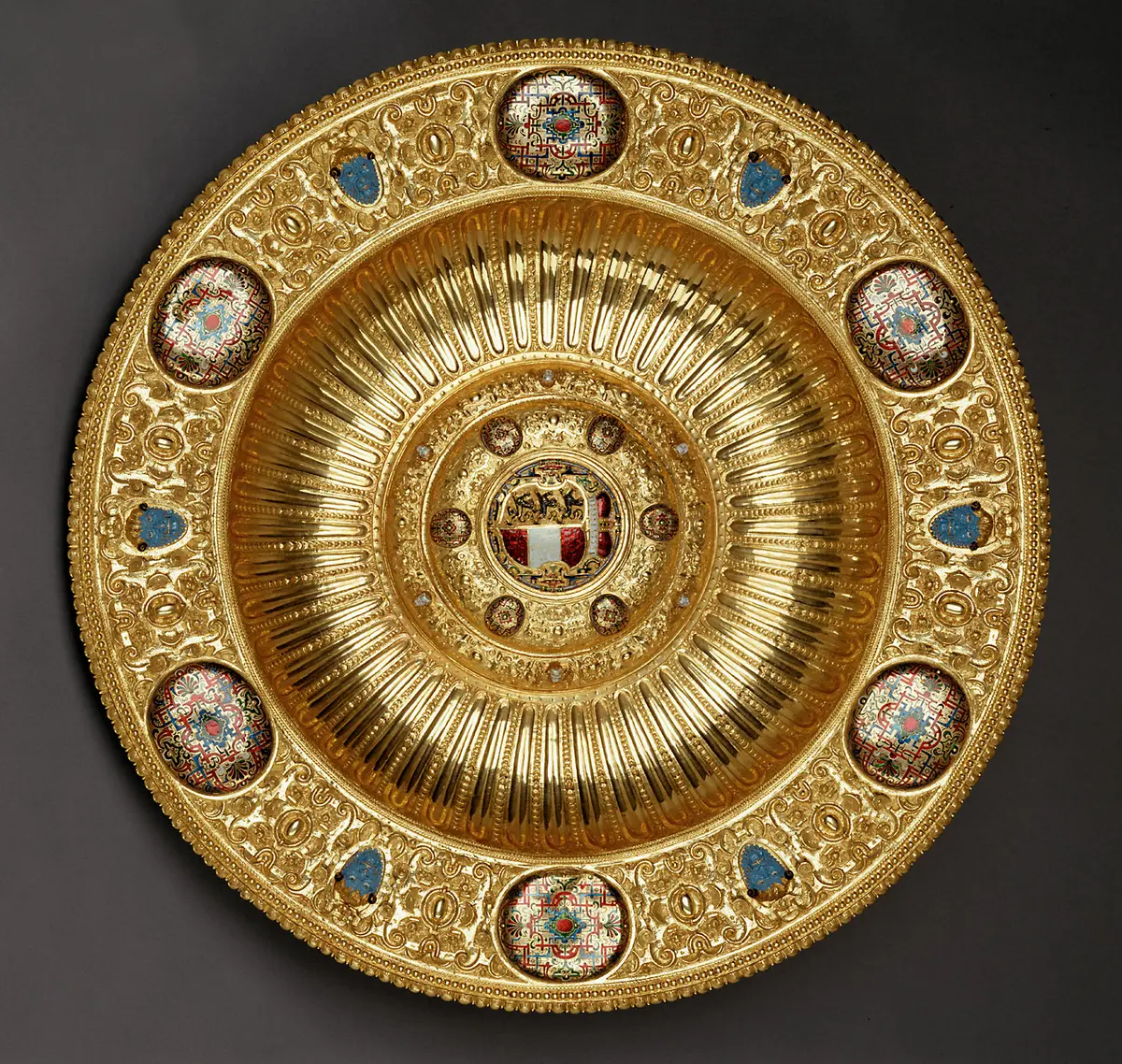
Made from about 10.5 kg of gold, this precious set along with 10,000 guilders was the wedding present of the Carinthian estates (thus the Carinthian coat of arms on the body of the ewer and at the centre of the basin) to Archduke Charles of Inner Austria and Maria of Bavaria. It was presented to the couple by the head of government in the province, Georg, Count Khevenhüller, on 11 September 1571 in Graz. From the estate of Maria the set came into the possession of the son of this marriage, the later Emperor Ferdinand II (1578-1637), who brought it to Vienna and deposited it in the Treasury. Fortunately, the set was not melted down - which often happened with gold objects when money was short - because the imperial family used the basin at least for christenings. This tradition was maintained until the end of the monarchy, although the set, which was intended as a "lavabo", i.e., for washing one's hands at the table, does not bear any religious motifs. At that time gold was not yet hallmarked. However, the style and numerous details of the work suggest that the set is the work of a Spanish goldsmith, although it is not yet known whether it was created in Spain or Vienna. Several Spanish goldsmiths worked at the Vienna court of Emperor Maximilian II (1527-1576) and his Spanish wife. On the other hand there were also close connections with the Madrid court of Philip II (1527-1598). If the precious work was created in Spain, it most likely contains gold from the New World.
Artist:
Spanisch
Time:
1571
Object Name
Gefäß; Kanne; Liturgisches Gerät; Taufzeug
Culture
Spanisch oder Wien
Material/technology:
Gold, teilweise emailliert / getrieben
Dimensions:
Taufkanne: H. 34,5 cm, Gewicht 3350 g
Taufschüssel: Dm. 61,5 cm, Gewicht 7220 g
Copyright
Kunsthistorisches Museum, Weltliche Schatzkammer
Invs.
Schatzkammer, WS XIV 5 und WS XIV 6