Die blaue Tunicella (Dalmatika)
1. Hälfte 12. Jahrhundert | Palermo, Königliche Hofwerkstätten
The garment has the shape of a dalmatica (a loose unbelted garment with full sleeves) with a narrow upper body, sleeves that narrow towards the lower edge, and a skirt that broadens towards the hem because of lateral inserts. Samite (incised silk) was the material used for both the plain blue and the patterned red of the hem and cuffs - dyed with indigo and madder (vegetable dyes). The wide hem is bordered on either side by a double row of pearls, while the border is decorated with lilies and palmettes embroidered with couched gold thread. The technique used in the embroidery is so similar to that of the Coronation Mantle that it may be assumed they were created at the same time. The embroidery on the cuffs is unusual: rows of pearls frame palmette motifs, the insides of which have been filled with little gold tubes that were pressed flat after they were sewn on, in a technique that is believed to be unique. The lower edge of the cuffs is decorated with violin-shaped appliqués mounted with cloisonné enamels and set close together. Their style and technique are so similar to the enamel on the Coronation Mantle that there can be no doubt that the two objects are related. The neck opening of the garment has a tablet-weave border 3 cm wide with pearls sewn on to create a contour. It is the same as that on the Alba. In the first verifiable reference to the Tunicella it is called "a blue gown" in a document dated 1350 in which the transfer of the imperial treasure to Charles IV is confirmed. However, a reference in the inventory of 1246 to a "gown of samite" also documents the Tunicella. At the coronation the Tunicella was worn under the Alba (Inv. No. SK_WS_XIII_7).
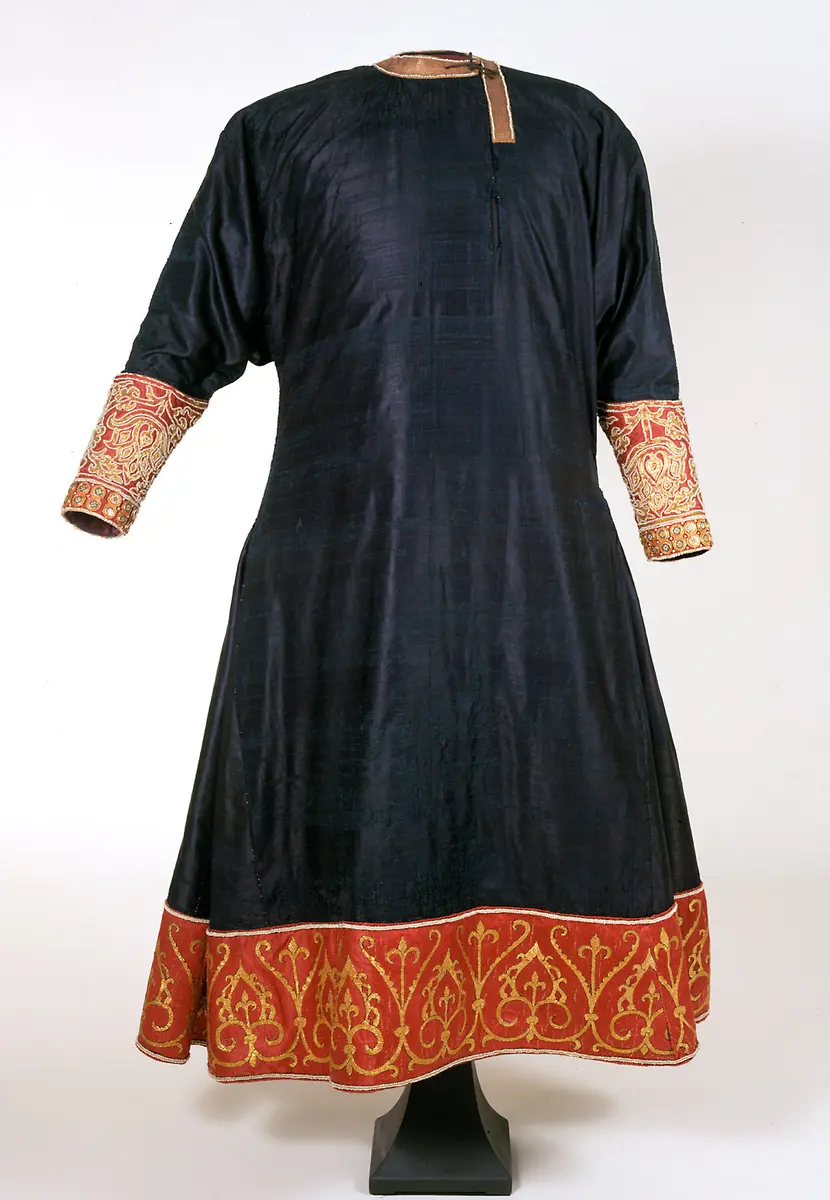
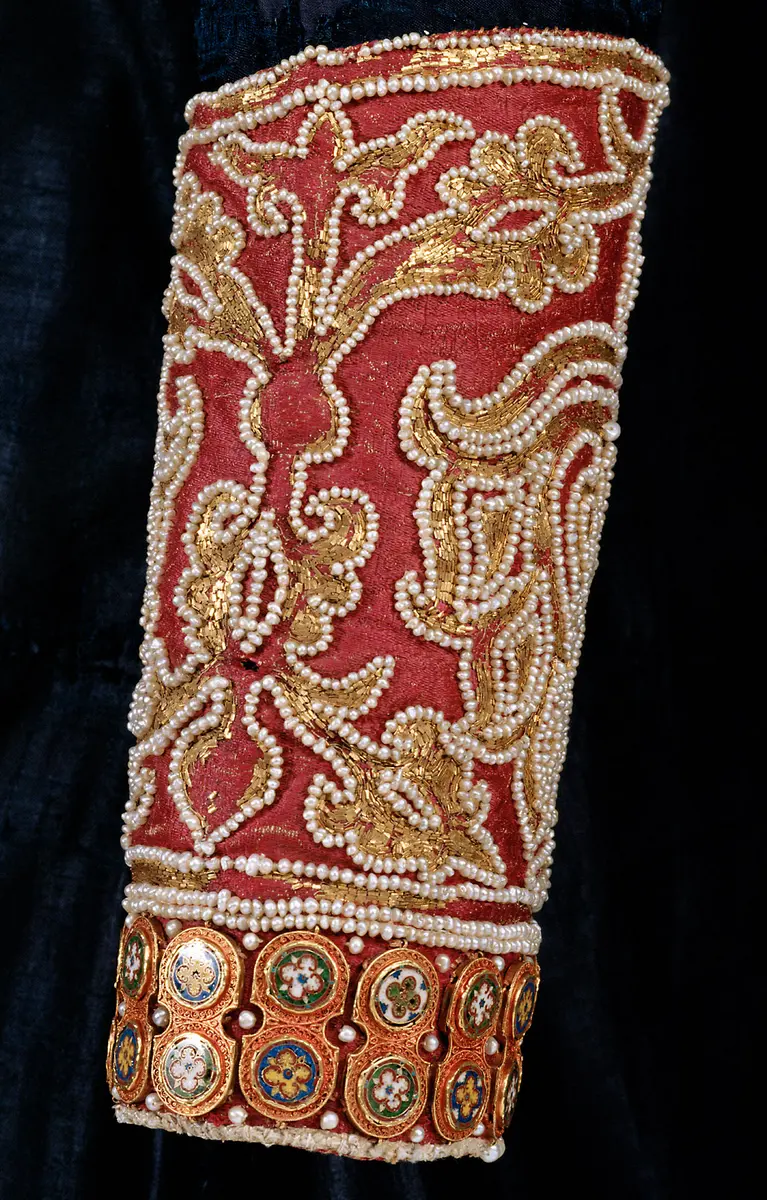
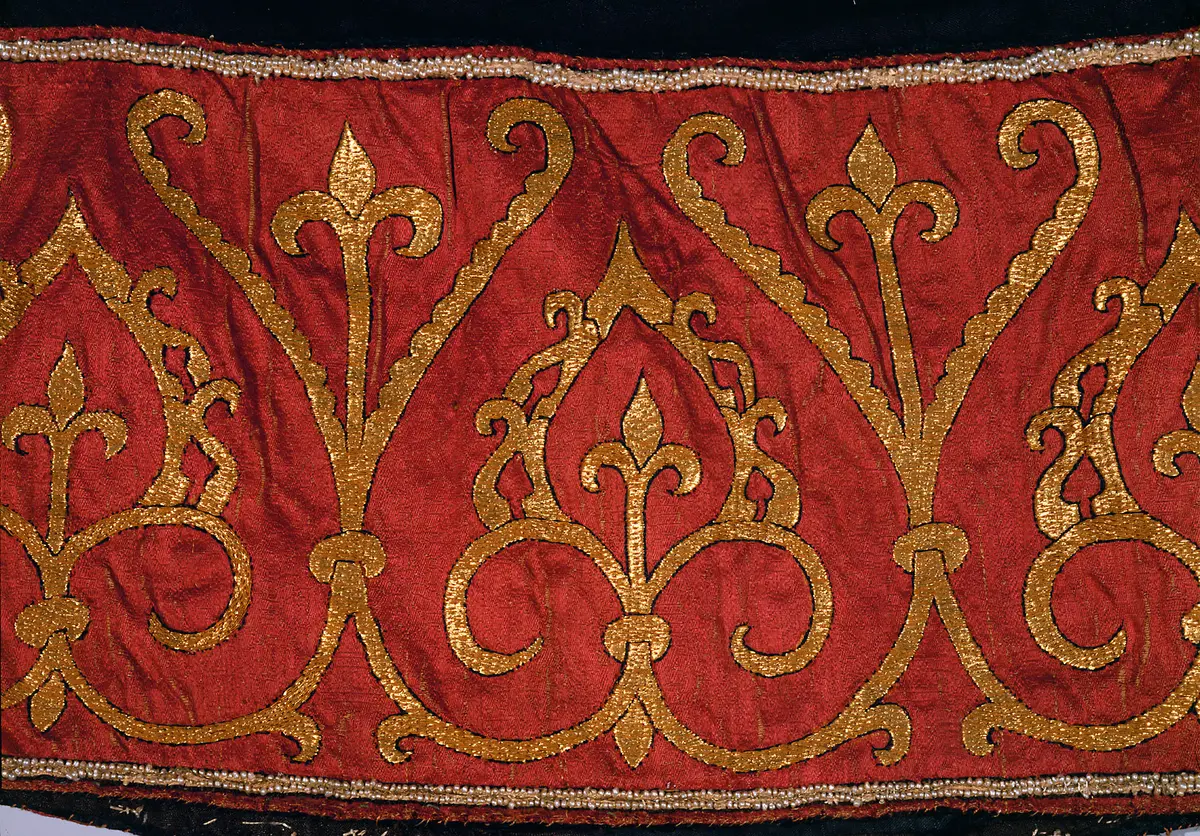
The garment has the shape of a dalmatica (a loose unbelted garment with full sleeves) with a narrow upper body, sleeves that narrow towards the lower edge, and a skirt that broadens towards the hem because of lateral inserts. Samite (incised silk) was the material used for both the plain blue and the patterned red of the hem and cuffs - dyed with indigo and madder (vegetable dyes). The wide hem is bordered on either side by a double row of pearls, while the border is decorated with lilies and palmettes embroidered with couched gold thread. The technique used in the embroidery is so similar to that of the Coronation Mantle that it may be assumed they were created at the same time. The embroidery on the cuffs is unusual: rows of pearls frame palmette motifs, the insides of which have been filled with little gold tubes that were pressed flat after they were sewn on, in a technique that is believed to be unique. The lower edge of the cuffs is decorated with violin-shaped appliqués mounted with cloisonné enamels and set close together. Their style and technique are so similar to the enamel on the Coronation Mantle that there can be no doubt that the two objects are related. The neck opening of the garment has a tablet-weave border 3 cm wide with pearls sewn on to create a contour. It is the same as that on the Alba. In the first verifiable reference to the Tunicella it is called "a blue gown" in a document dated 1350 in which the transfer of the imperial treasure to Charles IV is confirmed. However, a reference in the inventory of 1246 to a "gown of samite" also documents the Tunicella. At the coronation the Tunicella was worn under the Alba (Inv. No. SK_WS_XIII_7).
Time:
1. Hälfte 12. Jahrhundert
Object Name
Textil; liturgisches Gewand; Krönungsornat
Culture
Sizilien
Material/technology:
Textil; blauer Samit, roter gemusterter Samit mit Goldstickerei, Goldröhrchen, Goldappliken mit Zellenschmelzemail und Filigran, Perlen, Brettchengewebe
Dimensions:
L. 141,5 cm, B. 171,5 cm
Copyright
Kunsthistorisches Museum, Weltliche Schatzkammer
Invs.
Schatzkammer, WS XIII 6