Silberschale mit Allegorie der Fruchtbarkeit
2. Hälfte 1. Jh. v. Chr.
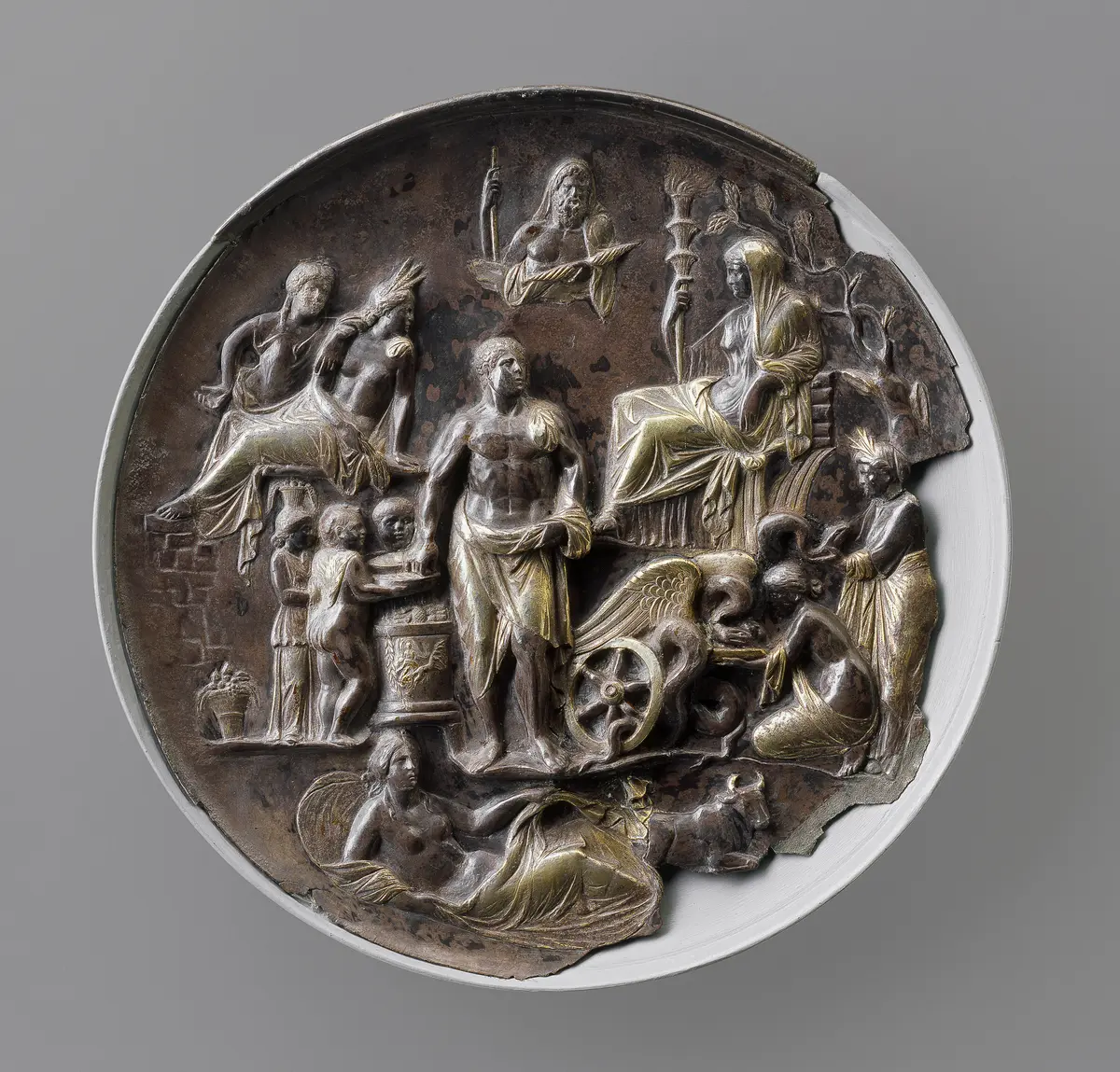
Amidst a mythical landscape or sacred precinct, which is suggested by terrain lines, a tree at the right edge and an altar, stands the son of King Celeus of Eleusis, Triptolemus, conducting a sacrifice before climbing into a serpent-drawn chariot to take grain to mankind at the behest of the goddess Demeter. Demeter is sitting with veiled head and a burning torch in her hand on a throne of ears of grain, where she accepts the sacrifice. The participants have been masterfully grouped around the central figure within the round confines of the bowl. Because of the eye-contact between Triptolemus and Demeter, he turns his gaze away from the sacrificial rite. With his right hand he reaches for the sacrificial cake, which three children are presenting to him on a platter. Between them stands a round altar with a relief depicting the abduction of Persephone by Hades; mourning her daughter, Persephone, prevents the growth of grain. Triptolemus is depicted as als curly-headed hero with a mantel around his hips. Below him is lying a cow as a symbol of Gaea, the personification of the fruitful earth, and above him the father of the gods, Zeus, with sceptre and thunderbolt. At the left above and the right below are depicted two Horae, respecitively, the personifications of the seaons. Spring and Summer are observing the events, while Autumn and Winter are occupied with the two snakes. The bowl is a unique masterpiece and in the tradition of Classic-Hellenistic silversmith work it must have been created for a special occasion. The depiction of Triptolemus is reminiscent of portraits of Ptolemaic kings and supports the assumption that the artworks dates from the closing years of Hellenism. The rulers of classical antiquity often identified themselves with mythical figures in order to convey generally applicable political messages.
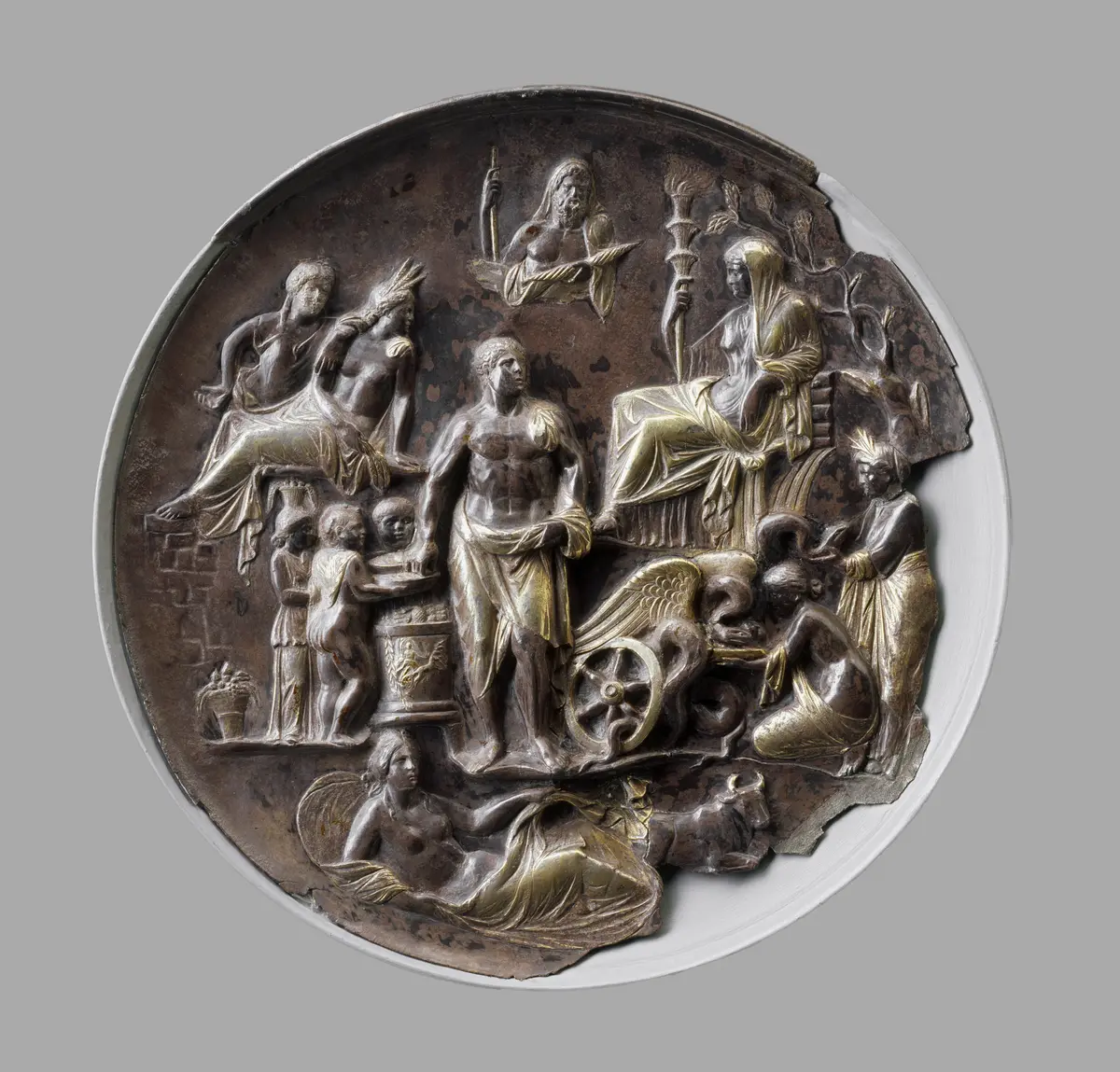
Amidst a mythical landscape or sacred precinct, which is suggested by terrain lines, a tree at the right edge and an altar, stands the son of King Celeus of Eleusis, Triptolemus, conducting a sacrifice before climbing into a serpent-drawn chariot to take grain to mankind at the behest of the goddess Demeter. Demeter is sitting with veiled head and a burning torch in her hand on a throne of ears of grain, where she accepts the sacrifice. The participants have been masterfully grouped around the central figure within the round confines of the bowl. Because of the eye-contact between Triptolemus and Demeter, he turns his gaze away from the sacrificial rite. With his right hand he reaches for the sacrificial cake, which three children are presenting to him on a platter. Between them stands a round altar with a relief depicting the abduction of Persephone by Hades; mourning her daughter, Persephone, prevents the growth of grain. Triptolemus is depicted as als curly-headed hero with a mantel around his hips. Below him is lying a cow as a symbol of Gaea, the personification of the fruitful earth, and above him the father of the gods, Zeus, with sceptre and thunderbolt. At the left above and the right below are depicted two Horae, respecitively, the personifications of the seaons. Spring and Summer are observing the events, while Autumn and Winter are occupied with the two snakes. The bowl is a unique masterpiece and in the tradition of Classic-Hellenistic silversmith work it must have been created for a special occasion. The depiction of Triptolemus is reminiscent of portraits of Ptolemaic kings and supports the assumption that the artworks dates from the closing years of Hellenism. The rulers of classical antiquity often identified themselves with mythical figures in order to convey generally applicable political messages.
Time:
2. Hälfte 1. Jh. v. Chr.
Object Name
Schale
Culture
Römisch
Location of discovery:
Aquileia (Italien)
Material/technology:
Silber, vergoldet
Dimensions:
663 g, 29,5 cm
Copyright
Kunsthistorisches Museum, Antikensammlung
Invs.
Antikensammlung, VIIa 47
Provenance
Cassis, Graf J. F. de; 1825 Geschenk