Rennzeug
um 1495
The Joust of war (»Rennen«), one of the two main forms of equestrian tournay, was a more sophisticated development of the joust of peace (»Stechen«); it’s goal was to unhorse one’s opponent using a sharp lance and at the same time to splinter the weapon upon striking the adversary. The jousting armour developed around 1480/90 and resembled the late-Gothic field armour. The jouster’s arms were protected solely by a »targe« (broad shield), his right hand by the »vamplate« on the lance, and his legs by »jousting sockets« (thigh protection in cuisse-form), screwed together to the saddle. Characteristic features include the streamlined shaped »sallet« (jousting helmet), the reinforced part of the helmet, termed »racing beard«, and the »lance-rest« and »queue« attached to the breastplate and used to support the lance.
The masters of the jousting armours were the Augsburg armourers Lorenz Helmschmid (flor. 1467–1516) and Jörg Helmschmid (flor. 1467–1504). Together with Konrad Seusenhofer, the plattner family was one of the most famous producers of armour, whose products were not only technical but also decorative masterpieces of armament production around 1500. Both armour sets exhibited at Ambras Castle had belonged to Emperor Maximilan I and Archduke Ferdinand II put the heirlooms of his great-grandfather in the Ambras collection.
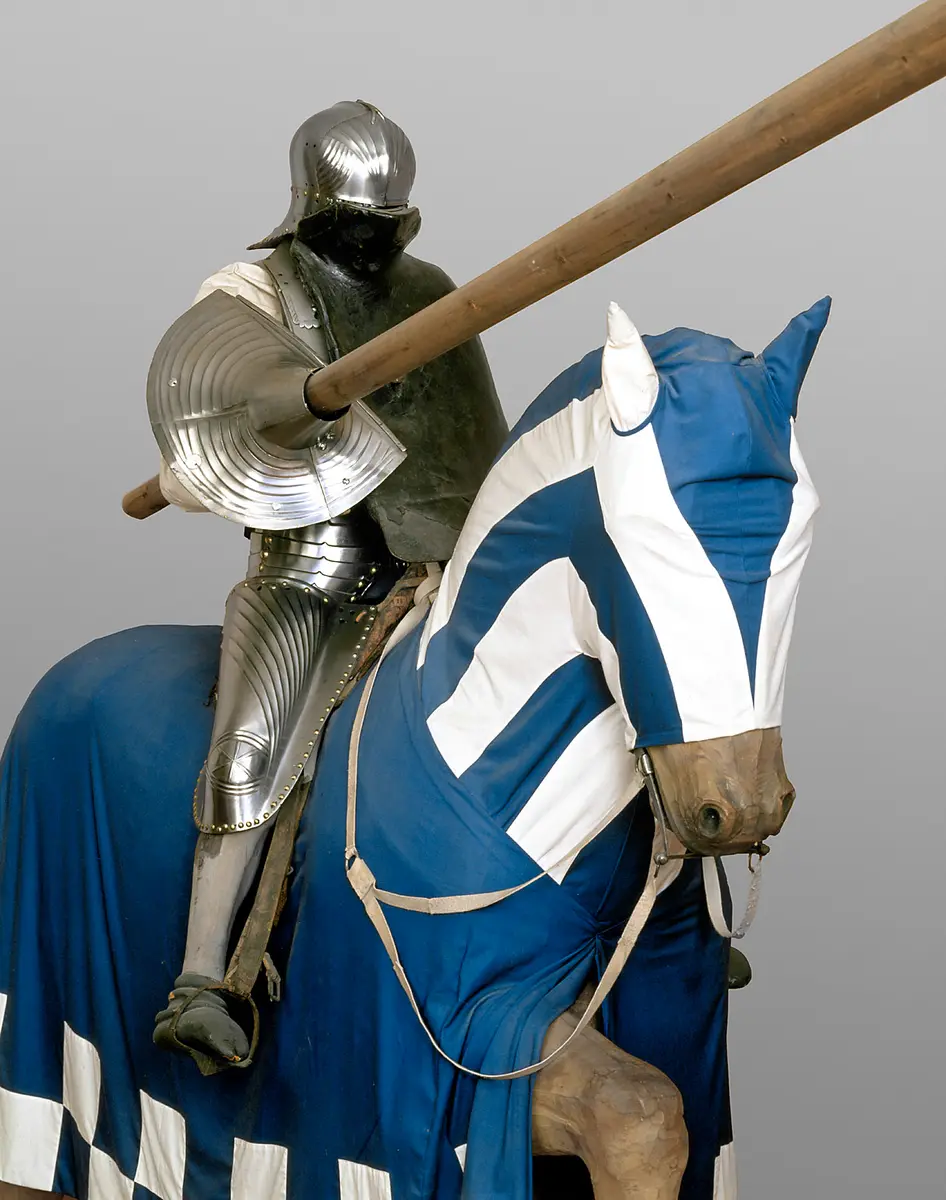
The Joust of war (»Rennen«), one of the two main forms of equestrian tournay, was a more sophisticated development of the joust of peace (»Stechen«); it’s goal was to unhorse one’s opponent using a sharp lance and at the same time to splinter the weapon upon striking the adversary. The jousting armour developed around 1480/90 and resembled the late-Gothic field armour. The jouster’s arms were protected solely by a »targe« (broad shield), his right hand by the »vamplate« on the lance, and his legs by »jousting sockets« (thigh protection in cuisse-form), screwed together to the saddle. Characteristic features include the streamlined shaped »sallet« (jousting helmet), the reinforced part of the helmet, termed »racing beard«, and the »lance-rest« and »queue« attached to the breastplate and used to support the lance.
The masters of the jousting armours were the Augsburg armourers Lorenz Helmschmid (flor. 1467–1516) and Jörg Helmschmid (flor. 1467–1504). Together with Konrad Seusenhofer, the plattner family was one of the most famous producers of armour, whose products were not only technical but also decorative masterpieces of armament production around 1500. Both armour sets exhibited at Ambras Castle had belonged to Emperor Maximilan I and Archduke Ferdinand II put the heirlooms of his great-grandfather in the Ambras collection.
Time:
um 1495
Object Name
Rennzeug
Material/technology:
Blankes Eisen, Leder
Signed
keine
Inscribed
in Bart, Brust und Schößen: "H"
in Rücken: "G"
Stamp / markings
auf Bart, Brust, Magenblech und Rüsthaken ein Kreuz (??)
Copyright
Kunsthistorisches Museum, Hofjagd- und Rüstkammer
Invs.
Hofjagd- und Rüstkammer, R V