Reliquienkreuz König Ludwigs des Großen von Ungarn; sogenanntes Anjou - Kreuz
1370/82 | Pietro di Simone da Siena
This patriarchal cross contains several particles of wood, once adored as fragments of the True Cross, fitted together and preserved under plates of rock crystal. The particles are enclosed between the five arms of the alliance of Hungary and Anjou on the sides and above, and the arms of the kingdom of Poland below. The emblems refer to King Louis the Great of Hungary (1326-1382) from the house of Anjou-Naples, who was also king of Poland after 1370. Familial connections between Naples and Hungary enabled Louis to commission artists in Venice, Tuscany and Naples as well as to summon Italian artists to the Hungarian court. Certain aspects of the enamel on the golden reliquary cross correspond to enamel work in Naples and favour an Italian attribution. In accordance with the treaty of partition, the cross, in the treasury at that time, was handed over to Hungary. Only later was it discovered to be a forgery; a trusted restorer substituted it for the original, which he sold in the late 19th century. In 1957, an extraordinary stroke of good fortune enabled the Kunsthistorisches Museum to acquire the base from a museum in London and the cross from a private collection in Copenhagen, so that the original cross is now back in Vienna.
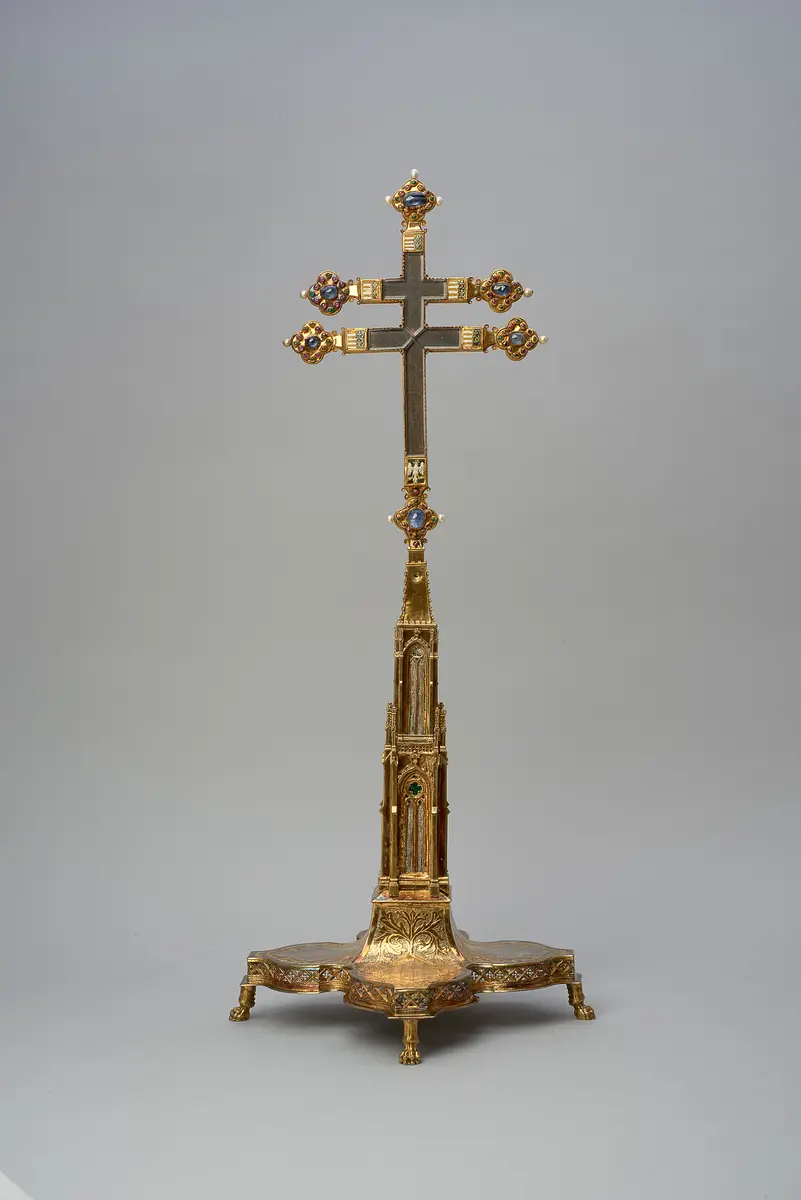
This patriarchal cross contains several particles of wood, once adored as fragments of the True Cross, fitted together and preserved under plates of rock crystal. The particles are enclosed between the five arms of the alliance of Hungary and Anjou on the sides and above, and the arms of the kingdom of Poland below. The emblems refer to King Louis the Great of Hungary (1326-1382) from the house of Anjou-Naples, who was also king of Poland after 1370. Familial connections between Naples and Hungary enabled Louis to commission artists in Venice, Tuscany and Naples as well as to summon Italian artists to the Hungarian court. Certain aspects of the enamel on the golden reliquary cross correspond to enamel work in Naples and favour an Italian attribution. In accordance with the treaty of partition, the cross, in the treasury at that time, was handed over to Hungary. Only later was it discovered to be a forgery; a trusted restorer substituted it for the original, which he sold in the late 19th century. In 1957, an extraordinary stroke of good fortune enabled the Kunsthistorisches Museum to acquire the base from a museum in London and the cross from a private collection in Copenhagen, so that the original cross is now back in Vienna.
Succession:
Pietro di Simone da Siena (?)
Time:
1370/82
Object Name
Reliquiar; Kreuzreliquiar
Culture
Ungarn
Material/technology:
Gold, Silber, vergoldet, Email, Edelsteine, Perlen, Bergkristall
Dimensions:
H. 67,2 cm
Kreuz: H. 33,7 cm
Inscribed
"VERA PARTICVLI SANCTA CRVCIS"
Copyright
Kunsthistorisches Museum, Geistliche Schatzkammer
Invs.
Schatzkammer, GS D 251