Porträtkopf eines jungen Mannes
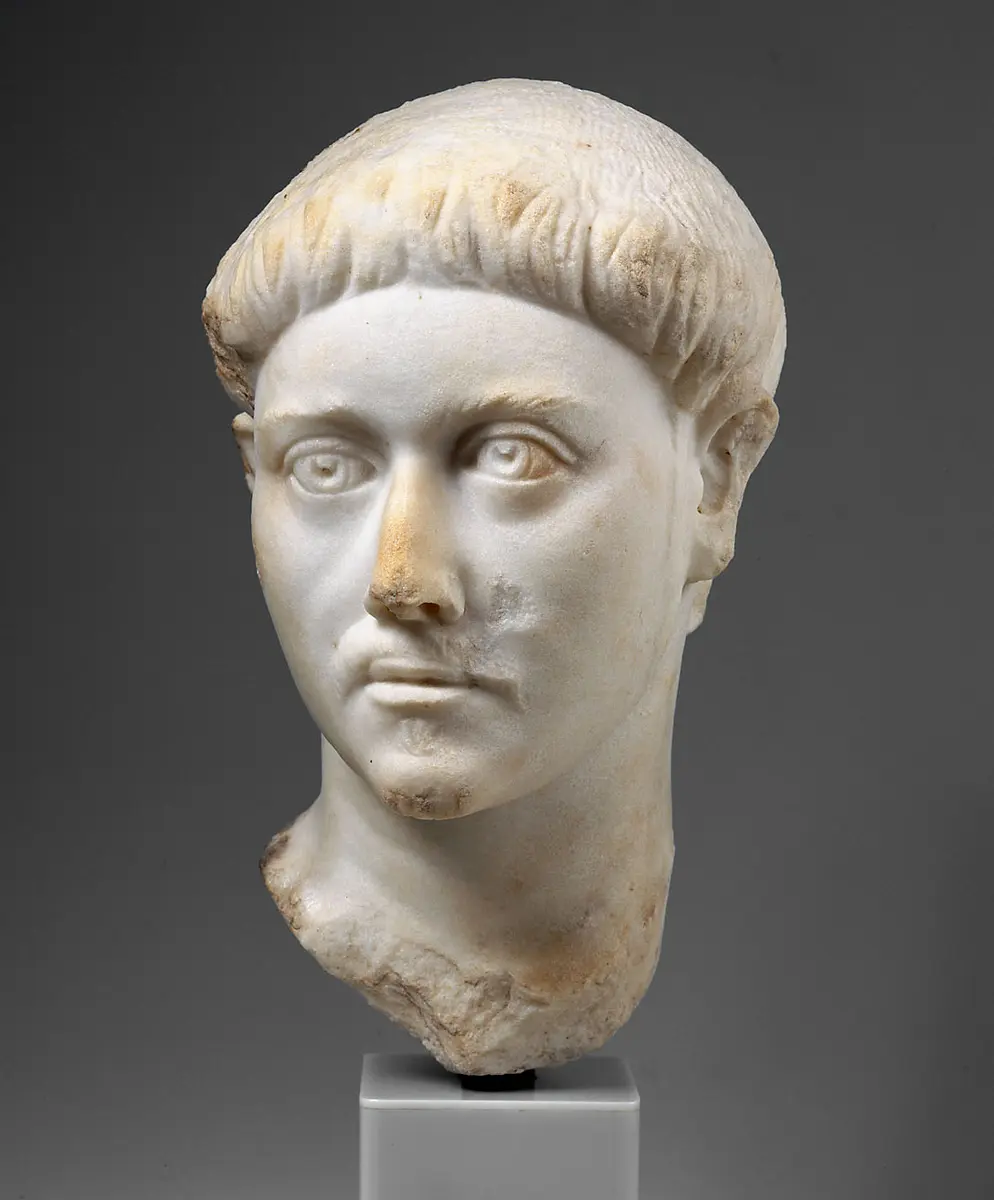
Das Porträt eines jungen Mannes stammt von einer Büste oder Statue, die Kante im Nacken weist auf ein hochgezogenes Kleidungsstück (Mantel) hin. Das kurz geschnittene, kappenartige Haar verläuft in einem flachen Bogen um die Stirn und bildet im Nacken eine kleine „Rolle“. Der Jüngling trägt den sogenannten Jugendbart mit langen Koteletten, Oberlippenbart, Bartfliege und Kinnbärtchen. Das Bildnis kann gut mit den ersten Porträts Konstantins des Großen auf Münzen verglichen werden, zu denen es in Hinblick auf Frisur, Bart und Profilansicht viele Ähnlichkeiten gibt. Technische Details etwa an den Haaren am Oberkopf, der Mundpartie und der unteren Gesichtshälfte weisen auf eine spätere Überarbeitung hin.(M. Laubenberger)
Title:
Porträtkopf eines jungen Mannes
Time:
Anfang 4. Jh. n. Chr.
Object Name:
Porträtkopf
Culture:
Römisch
:
Ephesos Theater (Selçuk, Kleinasien, Türkei)
Material/technology:
Marmor
Dimensions:
35,3 cm × 20,5 cm × 24,2 cm
Copyright:
Kunsthistorisches Museum Wien, Antikensammlung
Invs.:
Antikensammlung, I 856
Provenance:
Sultan, Abdul, Hamid, II.; Österreichische Ausgrabungen in Ephesos; Geschenk an Kaiser Franz Joseph; 1911 nachträglich inventarisiert