Panzerstecher
um 1530 | Kasim-Beg
This estoc (thrusting or armour-piercing sword) is one of only a handful of Turkish objects in the Imperial Armoury that found its way to Vienna as booty and not as a diplomatic gift. It is first listed in the 1593 inventory of the Armoury of Heroes assembled by Ferdinand II, Archduke of Austria at Ambras Castle near Innsbruck as ‘Cassan Bey’s sword’ (Cassenbegs stecher). In the inventory of the archduke’s estate compiled in 1596, it is described as ‘Cassan Bey: a sword in an all-silver scabbard’ (Cassan Beg: Ain stecher in ainer ganz silbern schaiden).
Kasim Bey, a scion of the Mihaloglu family that could trace its roots back to the early fourteenth century, was the leader of an Ottoman contingent (akinji) soundly defeated by imperial troops near Baden, south of Vienna, in September 1532. In the summer of that year, only three years after they had unsuccessfully besieged Vienna for the first time in 1529, a large Ottoman army again marched against the Habsburg domains. This time they targeted eastern Styria, but Kasim Bey and his troops decided to absent themselves from the main force to lay waste to large swathes of Lower Austria. On their return from these raids, Kasim Bey and his men unexpectedly encountered an imperial army led by Elector Palatine Frederick II and Sebastian Schertlin of Burtenbach. On the night of 18/19 September 1532, Kasim Bey’s troops were wiped out in the Battle of Leobersdorf-Enzesfeld, and Kasim Bey presumably fell in battle near Enzesfeld early on 19 September.
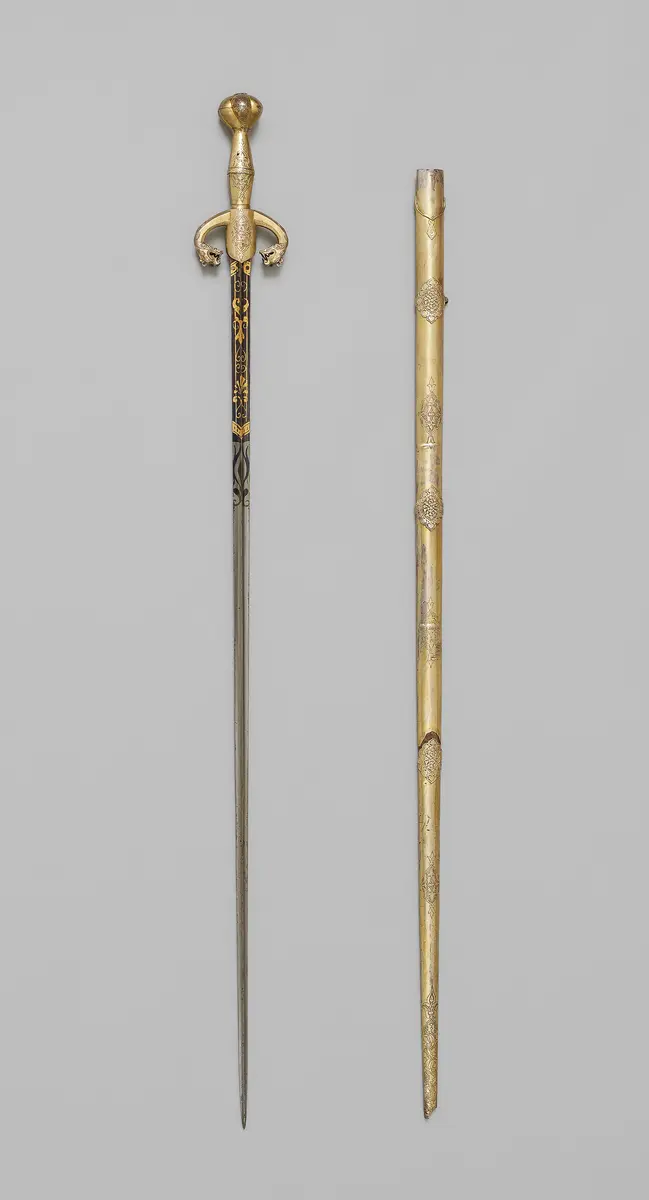
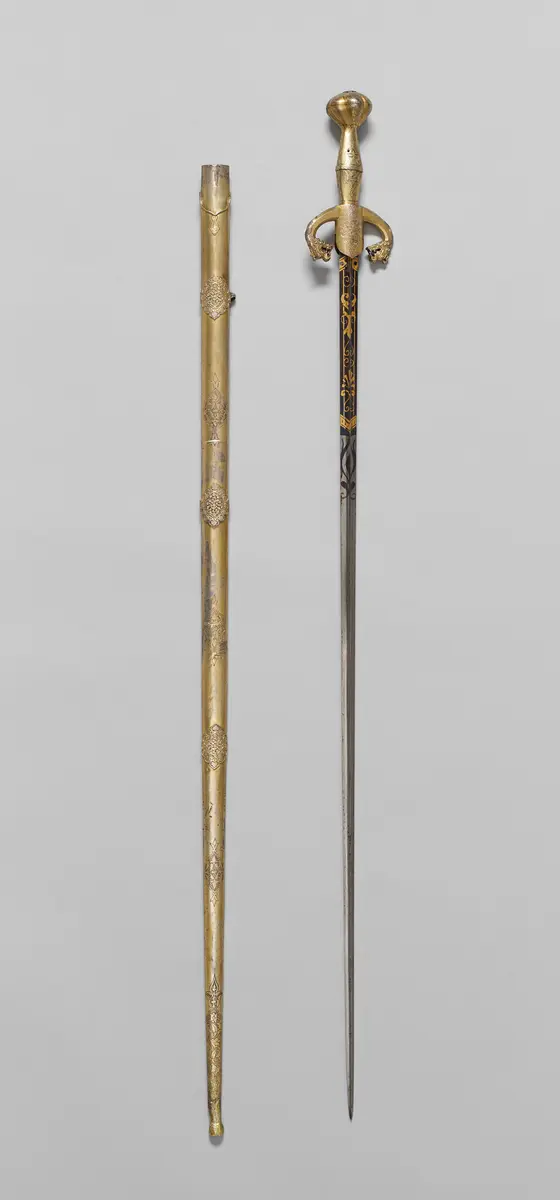
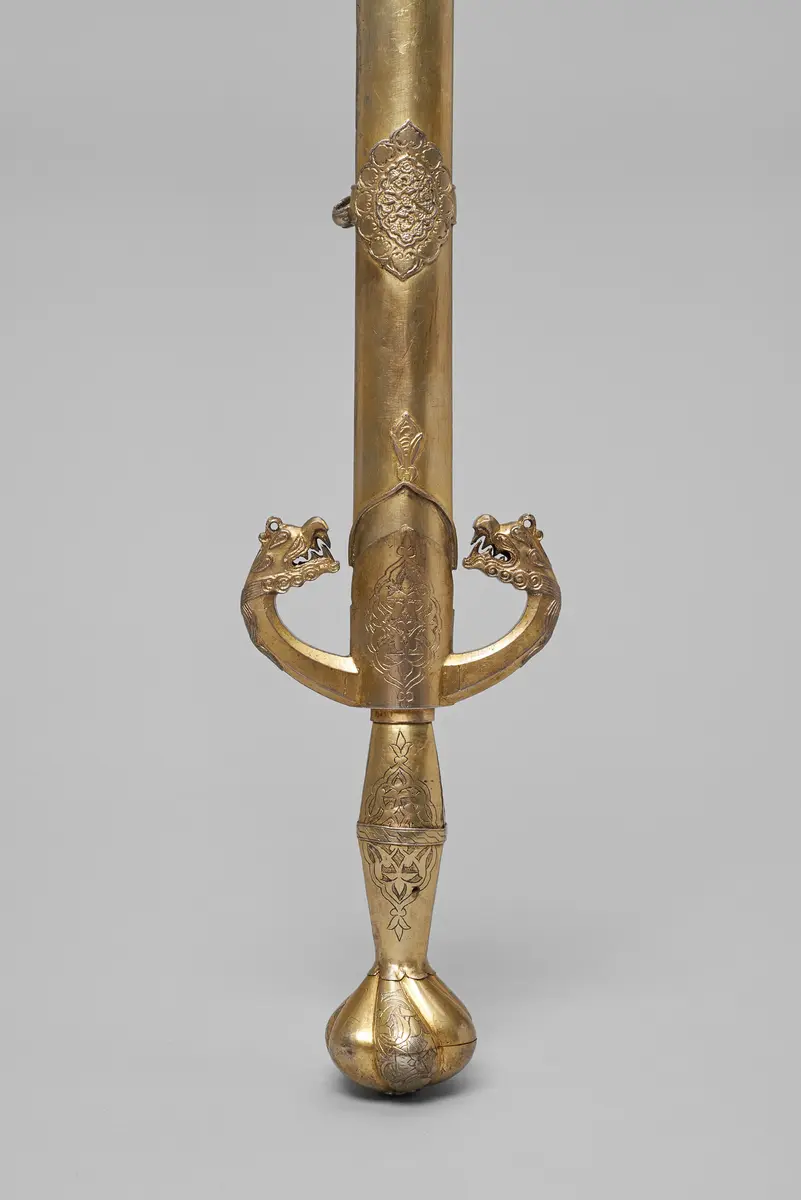
The gilt silver estoc has a pear-shaped pommel and a downward-arching crossguard that ends in dragons’ heads. Just above the grip, the blade (which has a rhombic cross-section) is decorated with fire-gilt ornaments on a blued ground. The blade features medallions, some of which were cast and originally enamelled, others engraved. The button at the end of the scabbard is lost. Estocs were popular in the early modern era, especially in eastern Europe, as they were able to pierce the mail shirts then ubiquitous in the region.
This estoc (thrusting or armour-piercing sword) is one of only a handful of Turkish objects in the Imperial Armoury that found its way to Vienna as booty and not as a diplomatic gift. It is first listed in the 1593 inventory of the Armoury of Heroes assembled by Ferdinand II, Archduke of Austria at Ambras Castle near Innsbruck as ‘Cassan Bey’s sword’ (Cassenbegs stecher). In the inventory of the archduke’s estate compiled in 1596, it is described as ‘Cassan Bey: a sword in an all-silver scabbard’ (Cassan Beg: Ain stecher in ainer ganz silbern schaiden).
Kasim Bey, a scion of the Mihaloglu family that could trace its roots back to the early fourteenth century, was the leader of an Ottoman contingent (akinji) soundly defeated by imperial troops near Baden, south of Vienna, in September 1532. In the summer of that year, only three years after they had unsuccessfully besieged Vienna for the first time in 1529, a large Ottoman army again marched against the Habsburg domains. This time they targeted eastern Styria, but Kasim Bey and his troops decided to absent themselves from the main force to lay waste to large swathes of Lower Austria. On their return from these raids, Kasim Bey and his men unexpectedly encountered an imperial army led by Elector Palatine Frederick II and Sebastian Schertlin of Burtenbach. On the night of 18/19 September 1532, Kasim Bey’s troops were wiped out in the Battle of Leobersdorf-Enzesfeld, and Kasim Bey presumably fell in battle near Enzesfeld early on 19 September.
The gilt silver estoc has a pear-shaped pommel and a downward-arching crossguard that ends in dragons’ heads. Just above the grip, the blade (which has a rhombic cross-section) is decorated with fire-gilt ornaments on a blued ground. The blade features medallions, some of which were cast and originally enamelled, others engraved. The button at the end of the scabbard is lost. Estocs were popular in the early modern era, especially in eastern Europe, as they were able to pierce the mail shirts then ubiquitous in the region.
Time:
um 1530
Object Name
Panzerstecher
Culture
Türkisch
Material/technology:
Klinge: Eisen, geschmiedet. Dekor: teils gebläut, teils feuervergoldet (Goldschmelz). Parierstange, Griff, Knauf: Silber, teils gegossen, teils feuervergoldet, teils graviert. Holz. Scheide: Silber, getrieben, feuervergoldet, teils graviert. Appliken: Silber, feuervergoldet, teils graviert, Email (nur noch fragementarisch erhalten). Holz.
Dimensions:
Panzerstecher: L 114,5 cm x B 10,5 cm x T 4,8 cm
Gewicht Panzerstecher: 0,85 kg
Scheide: L 109 cm x B 4,2 cm x T 2 cm
Gewicht Scheide: 0,50 kg
Copyright
Kunsthistorisches Museum, Hofjagd- und Rüstkammer
Invs.
Hofjagd- und Rüstkammer, C 162