Orphica
between 1795 and 1802 | Joseph Dohnal
The early Biedermeier period saw numerous attempts to make instruments portable so that they could be played in the open air. Although the design of the piano hardly lends itself to this idea, there were attempts to make a portable version even of this heavy and bulky instrument. The portable piano is the invention of Carl Leopold Röllig, an employee of the Vienna Court library. He gave the instrument the evocative name orphica. It took the form of a harp lying flat on its side and when played it was hung from the shoulder like a lute or a guitar, or it was placed on the player’s lap. (rh)
Lit.: Rudolf Hopfner: Masterpieces from the Collection of Historic Musical Instruments. A Short Guide through the Kunsthistorisches Museum Vienna, Vol. 1, Vienna 2019
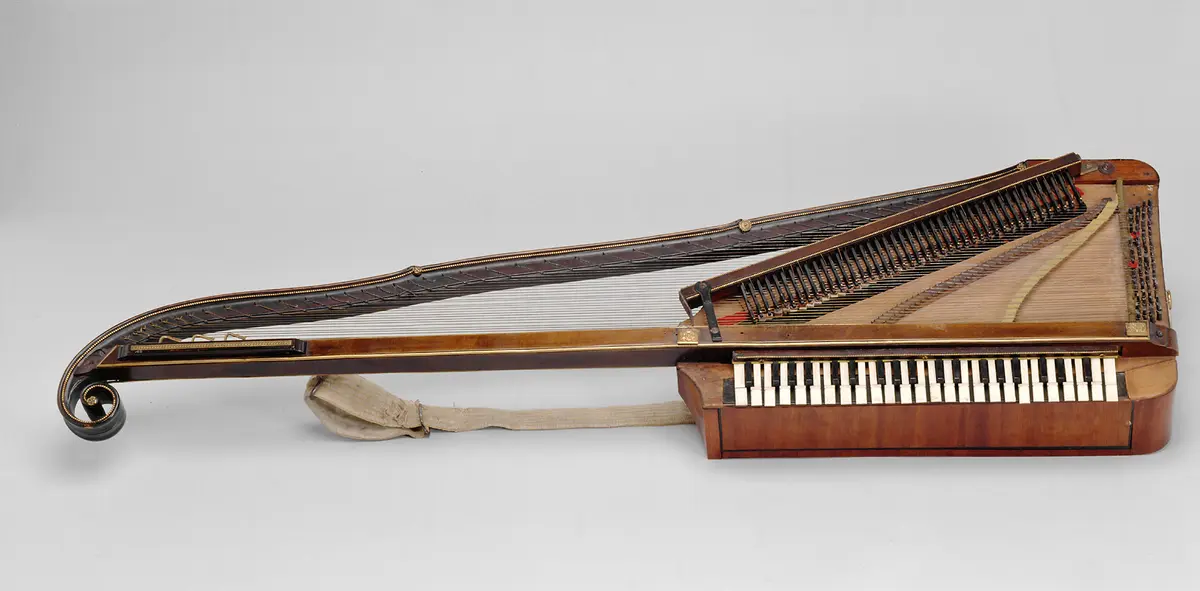
The early Biedermeier period saw numerous attempts to make instruments portable so that they could be played in the open air. Although the design of the piano hardly lends itself to this idea, there were attempts to make a portable version even of this heavy and bulky instrument. The portable piano is the invention of Carl Leopold Röllig, an employee of the Vienna Court library. He gave the instrument the evocative name orphica. It took the form of a harp lying flat on its side and when played it was hung from the shoulder like a lute or a guitar, or it was placed on the player’s lap. (rh)
Lit.: Rudolf Hopfner: Masterpieces from the Collection of Historic Musical Instruments. A Short Guide through the Kunsthistorisches Museum Vienna, Vol. 1, Vienna 2019
Manufacturer:
Joseph Dohnal DNB
Time:
between 1795 and 1802
Object Name
Orphica
Culture
Austria, Vienna
Dimensions:
1210 mm x 355 mm x 135 mm
Copyright
Kunsthistorisches Museum, Sammlung alter Musikinstrumente
Invs.
Sammlung alter Musikinstrumente, 601