Oktogon (Grab der Arsinoe)
Hergestellt 1977 - 1978
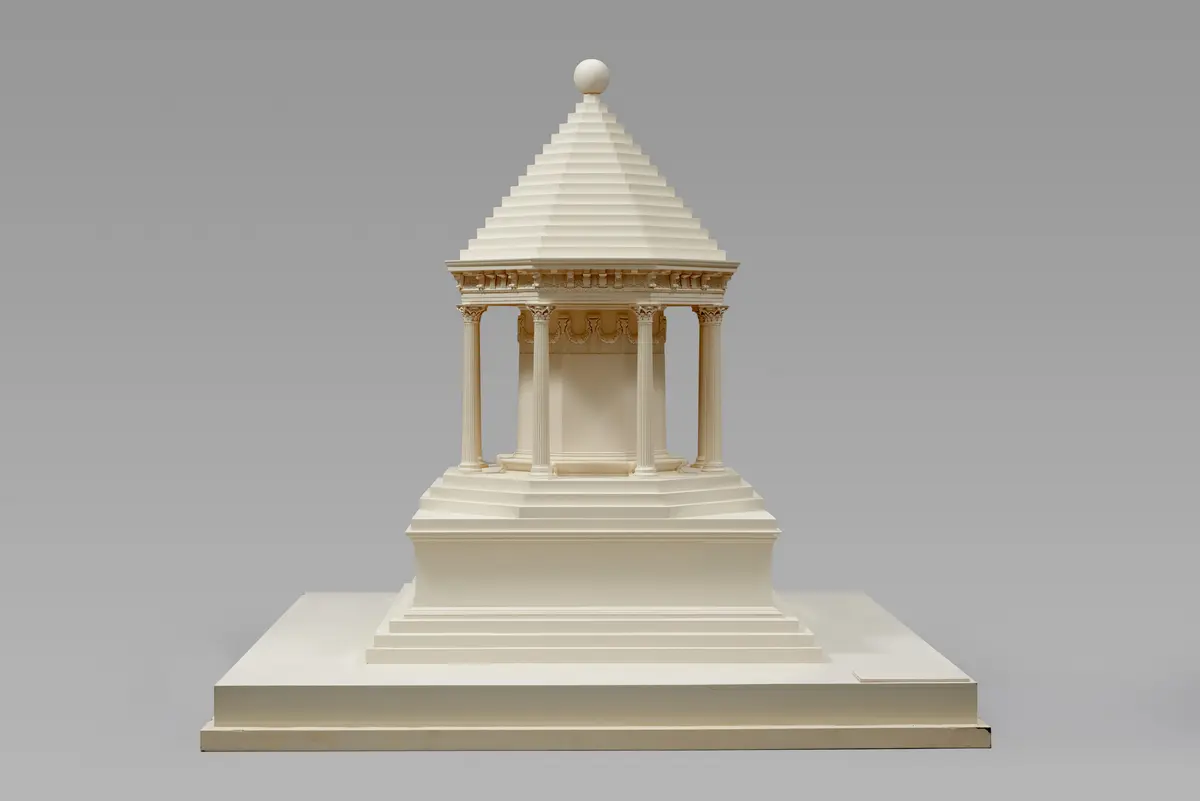
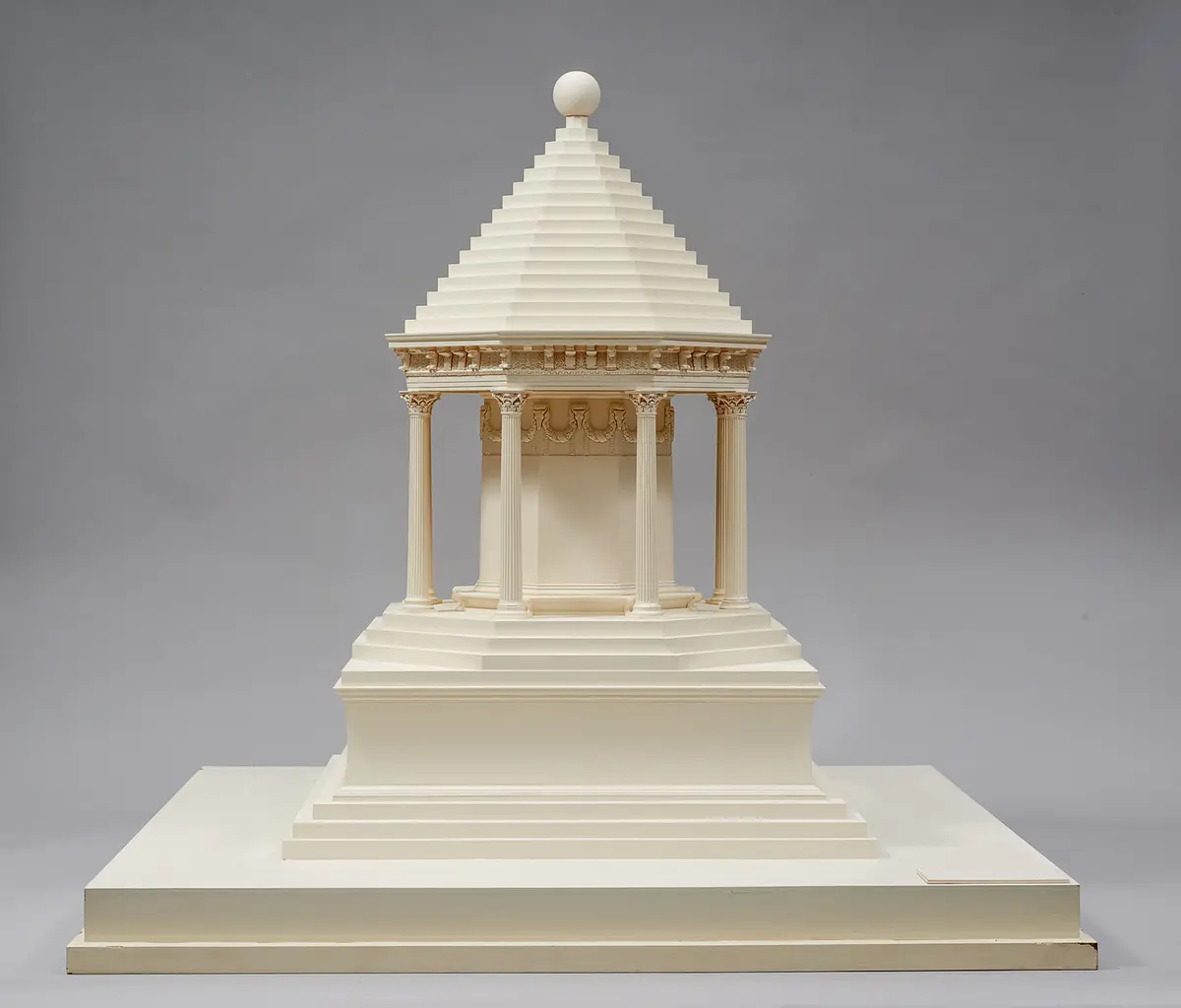
Model of the Octagon (Inv.-nos. I 1633 a-m): The Octagon is a sepulchre set up at a prominent crossroads in the centre of Ephesus. Its marble-clad base has survived at Ephesus, and it contains a tomb housing an unembellished marble sarcophagus. In classical antiquity, burials within the city walls were prohibited for religious and hygienic reasons. Exceptions were only made for important personages such as kings, donors, the city’s founder(s) or heroes. The skeleton found in this sarcophagus, however, was that of a young woman who had not yet turned eighteen! Without an inscription it was initially difficult to identify her. Comparisons with securely dated buildings date the Corinthian capitals and the details of the entablature to the late first century bc. The building’s unusual shape comprising an octagonal upper part references Egypt and Lybia. Pharos, the famous lighthouse at Alexandria in Egypt and one of the Seven Wonders of the Ancient World, also featured an octagonal section. These hints allowed us to identify the deceased as a Ptolemaic princess, Arsinoe IV, Cleopatra’s younger sister. Arsinoe’s competing claims to the throne of Egypt led Caesar to exile her to the sanctuary of Artemis at Ephesus. The Artemision’s privilege of offering asylum is based on the legend that the Amazons had been granted asylum here. But Cleopatra continued to regard her sister as a threat and persuaded Marc Anthony to have her murdered at Ephesus in 41 bc. This monstrous sacrilege visited on the goddess Artemis was only atoned many years later: Augustus re-established »law and order« and proclaimed a new »golden age«. The erection of this monumental tomb must be seen in this context. Some of the architectural details are unusual for Asia Minor and had only recently been developed in Italy, which suggests that this impressive edifice was not only commissioned by Augustus but also built by his architects and craftsmen.
Model of the Octagon (Inv.-nos. I 1633 a-m): The Octagon is a sepulchre set up at a prominent crossroads in the centre of Ephesus. Its marble-clad base has survived at Ephesus, and it contains a tomb housing an unembellished marble sarcophagus. In classical antiquity, burials within the city walls were prohibited for religious and hygienic reasons. Exceptions were only made for important personages such as kings, donors, the city’s founder(s) or heroes. The skeleton found in this sarcophagus, however, was that of a young woman who had not yet turned eighteen! Without an inscription it was initially difficult to identify her. Comparisons with securely dated buildings date the Corinthian capitals and the details of the entablature to the late first century bc. The building’s unusual shape comprising an octagonal upper part references Egypt and Lybia. Pharos, the famous lighthouse at Alexandria in Egypt and one of the Seven Wonders of the Ancient World, also featured an octagonal section. These hints allowed us to identify the deceased as a Ptolemaic princess, Arsinoe IV, Cleopatra’s younger sister. Arsinoe’s competing claims to the throne of Egypt led Caesar to exile her to the sanctuary of Artemis at Ephesus. The Artemision’s privilege of offering asylum is based on the legend that the Amazons had been granted asylum here. But Cleopatra continued to regard her sister as a threat and persuaded Marc Anthony to have her murdered at Ephesus in 41 bc. This monstrous sacrilege visited on the goddess Artemis was only atoned many years later: Augustus re-established »law and order« and proclaimed a new »golden age«. The erection of this monumental tomb must be seen in this context. Some of the architectural details are unusual for Asia Minor and had only recently been developed in Italy, which suggests that this impressive edifice was not only commissioned by Augustus but also built by his architects and craftsmen.
Time:
Hergestellt 1977 - 1978
Object Name
Modell
Material/technology:
Plexiglas, weiß gespritzt, Maßstab 1 : 25 / Hergestellt 1977-1978 / H. Kropf Modellbau, Graz
Copyright
Kunsthistorisches Museum, Antikensammlung
Invs.
Antikensammlung, XIV Z 268
Provenance
Hergestellt im Auftrag des KHM, Graz, 1970er Jahre
Browse more
Similar items you might be interested in