Kreuznagel - Reliquiar
um 1650
Two angels, kneeling on clouds, clasp two curved palm trunks, which meet to form a wreath composed of flowers and precious and semi-precious stones. Between the trunks is a large emerald, decorated with the initials IHS (Jesus) in rock crystal. This costly setting was made around the middle of the 17th century for what is one of the most famous relics of the Ecclesiastical Treasury. Displayed in the almond-shaped glass receptacle is the nail with which the right hand of Christ was supposedly affixed to the cross. It is accompanied by the seal of Pope Innocent II (pope from 1130 to 1143), who testifies in a document (copy, 17th century ?) that Emperor Conrad III (ruled 1138-1152) presented it to him for certification. The relic presumably arrived in Vienna as a present to Emperor Ferdinand III, although no relevant sources regarding its provenance are extant. The first report of its presence in the Ecclesiastical Treasury occurs in 1660 (itinerary of J. J. Müller). At that time, visitors would rub their rosaries against the glass receptacle in the hope of receiving the nails widely extolled healing power by transference. The goldsmiths work was probably executed in Augsburg; the stones and the enamel flowers of the frame are closely related to other pieces made there.
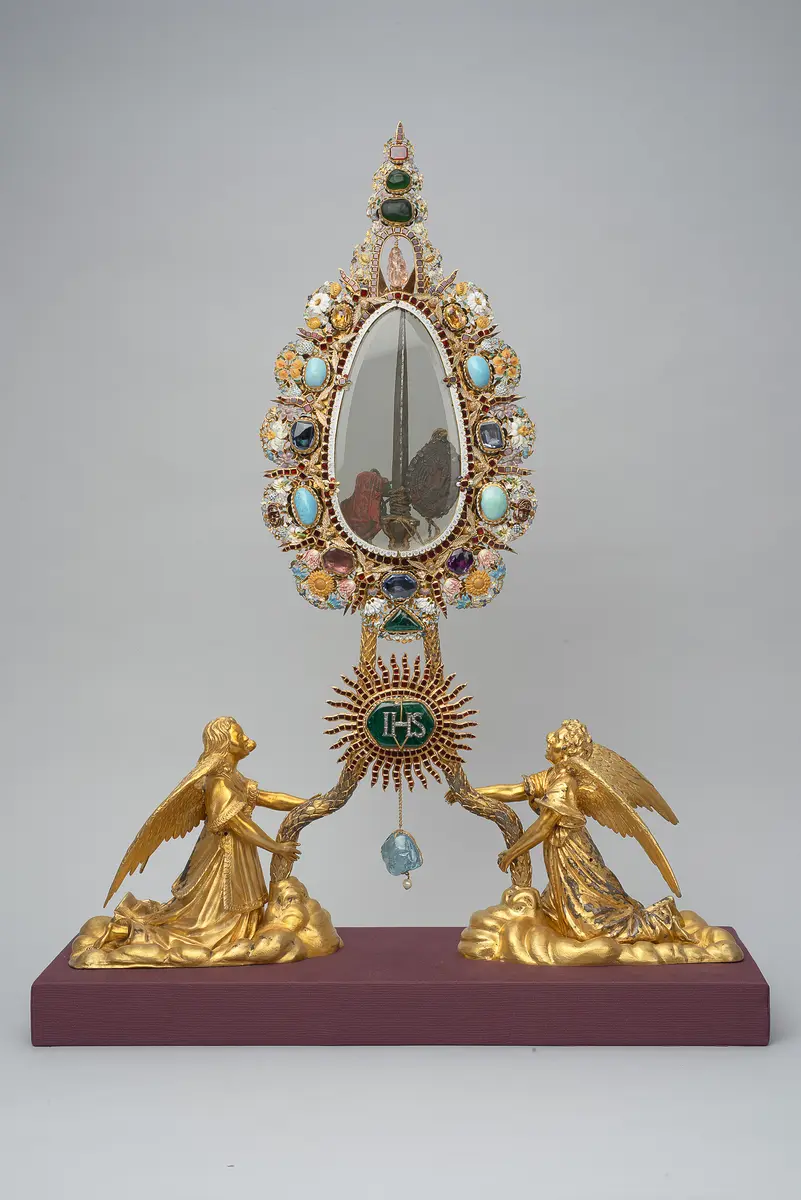
Two angels, kneeling on clouds, clasp two curved palm trunks, which meet to form a wreath composed of flowers and precious and semi-precious stones. Between the trunks is a large emerald, decorated with the initials IHS (Jesus) in rock crystal. This costly setting was made around the middle of the 17th century for what is one of the most famous relics of the Ecclesiastical Treasury. Displayed in the almond-shaped glass receptacle is the nail with which the right hand of Christ was supposedly affixed to the cross. It is accompanied by the seal of Pope Innocent II (pope from 1130 to 1143), who testifies in a document (copy, 17th century ?) that Emperor Conrad III (ruled 1138-1152) presented it to him for certification. The relic presumably arrived in Vienna as a present to Emperor Ferdinand III, although no relevant sources regarding its provenance are extant. The first report of its presence in the Ecclesiastical Treasury occurs in 1660 (itinerary of J. J. Müller). At that time, visitors would rub their rosaries against the glass receptacle in the hope of receiving the nails widely extolled healing power by transference. The goldsmiths work was probably executed in Augsburg; the stones and the enamel flowers of the frame are closely related to other pieces made there.
Time:
um 1650
Object Name
Reliquiar
Culture
Augsburg
Material/technology:
Gold, Silber, vergoldet, teilweise emailliert, teilweise bemalt, Messing bemalt, Smaragde, Saphire, Topase, Amethyste, Türkise, Aquamarin, Hyazinth, Granate, Bergkristall, Perlen, Glas
Dimensions:
H. 79,6 cm, B. 59,5 cm, T. 16 cm
Stamp / markings
Wr. Repunze 1806/07; Silberprobe
Copyright
Kunsthistorisches Museum, Geistliche Schatzkammer
Invs.
Schatzkammer, GS D 62