Falknertasche, Jagdtasche
Frühes 17. Jahrhundert
Falconers used such bags as this while out hunting to carry food and treats – usually small pieces of meat – for their falcons. They could also hold game, and they were slung over the shoulder or, more rarely, attached to the belt. The opening was usually closed with ingenious lacing, enabling the falconer to open and close the bag with one hand (his falcon sat on his other hand).
The shape of a falconer’s bag changed little over the centuries. As early as the fifteenth century, it had already acquired the typical trapeze shape, as can be seen in an early example also now in the collection in Vienna (see inv. D 7). The bags of the falconers depicted in the monumental set of woodcut prints Triumphs of Maximilian (Hans Burgkmair the Elder, first edition 1526) are of this shape as well.
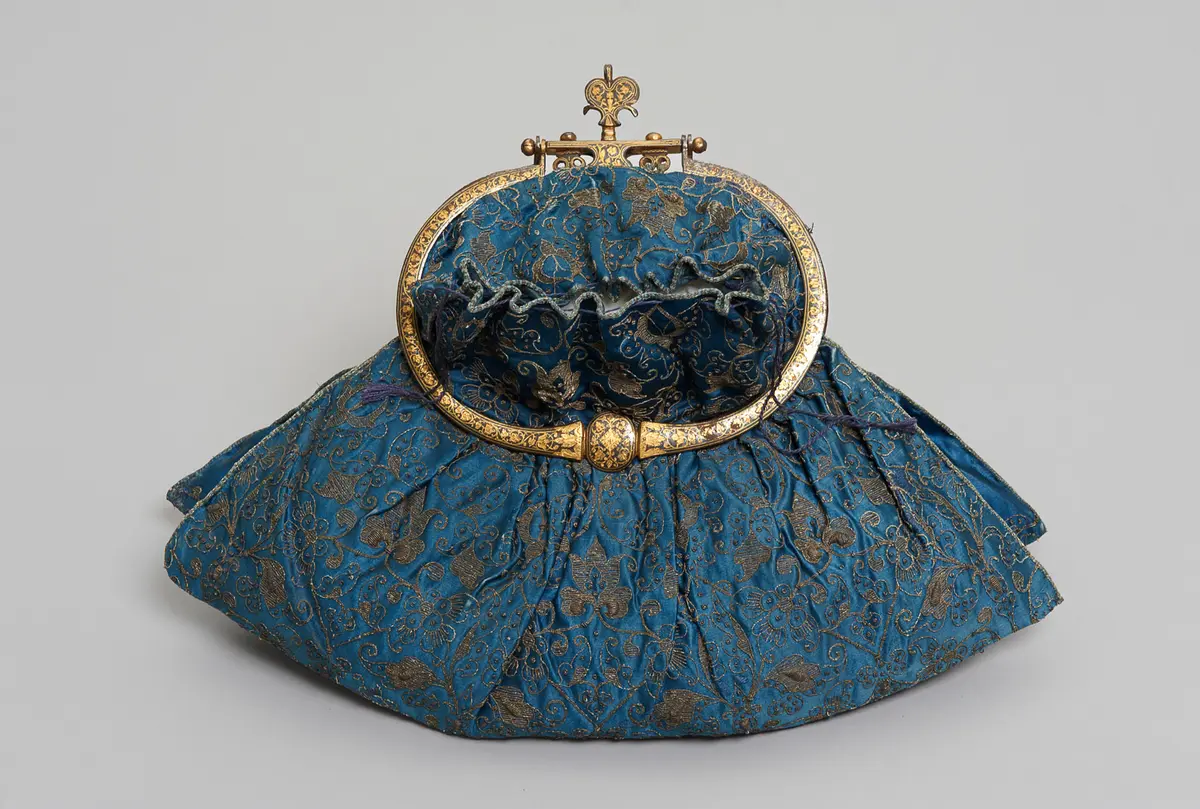
Falconry was a decidedly elite type of hunting, which is why equipment like this falconer’s bag were often sophisticated, costly accessories that reflect contemporary fashion. The bag is probably the work of an Italian artist. It comprises two pouches made of blue silk, their exteriors decorated with moresque plant motifs in soutache or Russia braid (decorative braid used for trimming). Handle and clasp are embellished with foliage damascened in gold on a blued ground.
The Imperial Armoury houses several other luxurious falconer’s or hunting bags produced in the seventeenth and eighteenth century, including one made of pink silk with silver embroidery for the head falconer of Christoph Wilhelm Count Thürheim, Hereditary Falconer of Upper Austria (inv. A 2289). Thürheim used the bag at the splendid festivities held to celebrate the hereditary homage of the Estates of Upper Austria for Emperor Charles VI in September 1732 at Linz.
Falconers used such bags as this while out hunting to carry food and treats – usually small pieces of meat – for their falcons. They could also hold game, and they were slung over the shoulder or, more rarely, attached to the belt. The opening was usually closed with ingenious lacing, enabling the falconer to open and close the bag with one hand (his falcon sat on his other hand).
The shape of a falconer’s bag changed little over the centuries. As early as the fifteenth century, it had already acquired the typical trapeze shape, as can be seen in an early example also now in the collection in Vienna (see inv. D 7). The bags of the falconers depicted in the monumental set of woodcut prints Triumphs of Maximilian (Hans Burgkmair the Elder, first edition 1526) are of this shape as well.
Falconry was a decidedly elite type of hunting, which is why equipment like this falconer’s bag were often sophisticated, costly accessories that reflect contemporary fashion. The bag is probably the work of an Italian artist. It comprises two pouches made of blue silk, their exteriors decorated with moresque plant motifs in soutache or Russia braid (decorative braid used for trimming). Handle and clasp are embellished with foliage damascened in gold on a blued ground.
The Imperial Armoury houses several other luxurious falconer’s or hunting bags produced in the seventeenth and eighteenth century, including one made of pink silk with silver embroidery for the head falconer of Christoph Wilhelm Count Thürheim, Hereditary Falconer of Upper Austria (inv. A 2289). Thürheim used the bag at the splendid festivities held to celebrate the hereditary homage of the Estates of Upper Austria for Emperor Charles VI in September 1732 at Linz.
Time:
Frühes 17. Jahrhundert
Object Name
Falknertasche, Jagdtasche
Culture
Wohl italienisch
Material/technology:
Seide, bestickt mit Silberlahn (Soutache). Netz: Seide, Silberlahn, Goldlahn. Eisen, teils gebläut, teils mit Gold tauschiert.
Dimensions:
L 45 cm x B 54 cm x T 13 cm
Copyright
Kunsthistorisches Museum, Hofjagd- und Rüstkammer
Invs.
Hofjagd- und Rüstkammer, D 258