Empress Maria Theresa
1750 | Matthias Donner
In the eighteenth century, classical antiquity again became very fashionable; these portrait busts of Maria Theresia and her husband Emperor Francis I, too, reflect this. They were commissioned for a small room in the Treasury in Hofburg Palace where ancient coins were displayed. Both the sitters’ classicizing attire and the Latin inscriptions on the bases allude to this. Maria Theresia is celebrated as “Juno Mon(eta)”, the Roman goddess of the city, who was frequently depicted on coins. Both busts are by the sculptor Matthäus Donner, the younger brother and pupil of the celebrated Georg Raffael Donner.
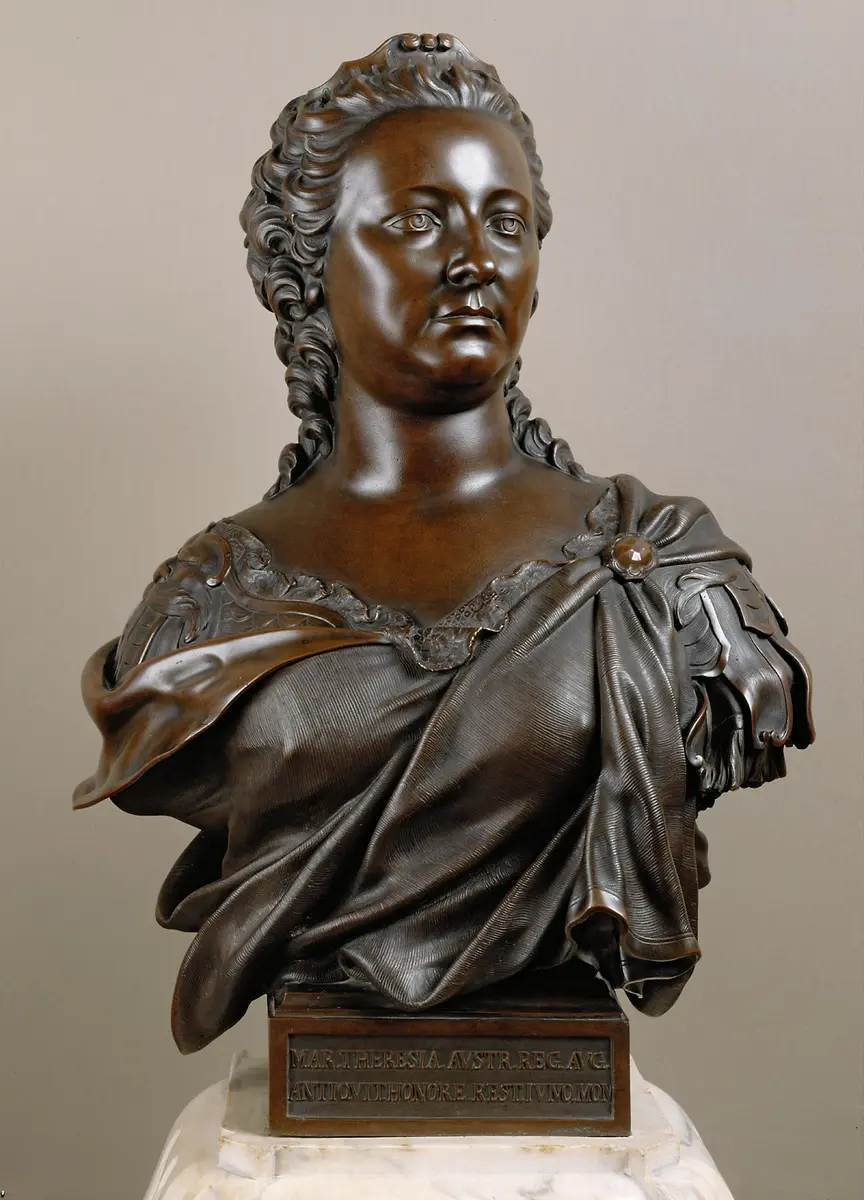
In the eighteenth century, classical antiquity again became very fashionable; these portrait busts of Maria Theresia and her husband Emperor Francis I, too, reflect this. They were commissioned for a small room in the Treasury in Hofburg Palace where ancient coins were displayed. Both the sitters’ classicizing attire and the Latin inscriptions on the bases allude to this. Maria Theresia is celebrated as “Juno Mon(eta)”, the Roman goddess of the city, who was frequently depicted on coins. Both busts are by the sculptor Matthäus Donner, the younger brother and pupil of the celebrated Georg Raffael Donner.
Artist:
Matthias Donner (1704 Eßling bei Wien - 1756 Wien) DNB
Depiction/Person:
Maria Theresia (1740-1780), Königin von Ungarn und Böhmen, Kaiserin (1717 Wien - 1780 Wien) DNB
Time:
1750
Object Name
Portrait head; Bust; Bronze sculpture
Culture
Vienna
Material/technology:
Bronze
Dimensions:
H. 68 cm
Signed
M. Donner, Fecit. 1750
Inscribed
"MAR(IA). THERESIA. AVSTR(IACA). REG(INA). AVG(VSTA). ANTIQVIT(ATIS). HONORE. REST(ITVTO). IVNO. MON(ETA)."
Copyright
Kunsthistorisches Museum, Kunstkammer
Invs.
Kunstkammer, 6142