Ecce Homo
The scene was rarely depicted in Italy but can probably be explained by the Flemish origins of the man who commissioned it. The figure of Christ though conspicuously moved to the side still attracts all our attention due to the picture’s brilliant composition. The excited young man to the left acts as the compositional introduction while the view of the soldier’s back leads our gaze up to the protagonist. The double eagle and the signature “EQUES CES” further to the right are the artist’s homage to the imperial court whose official painter Titian had become in 1533.
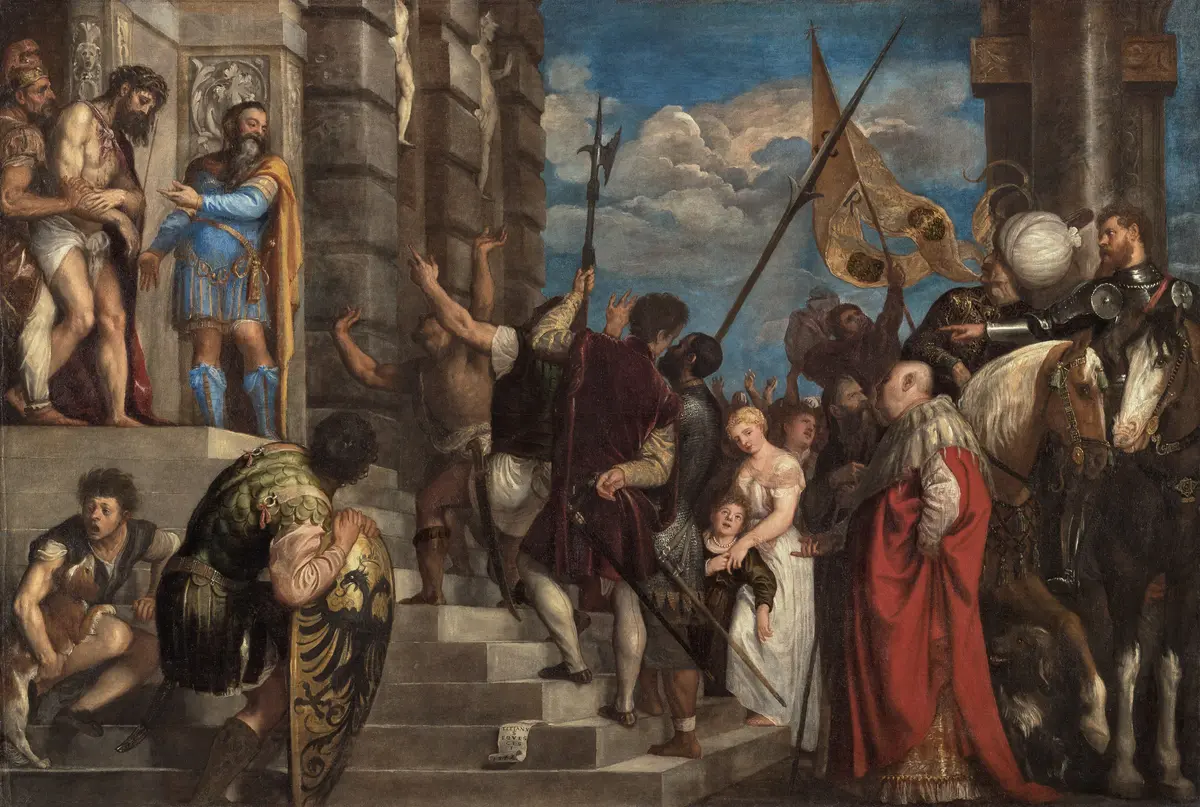
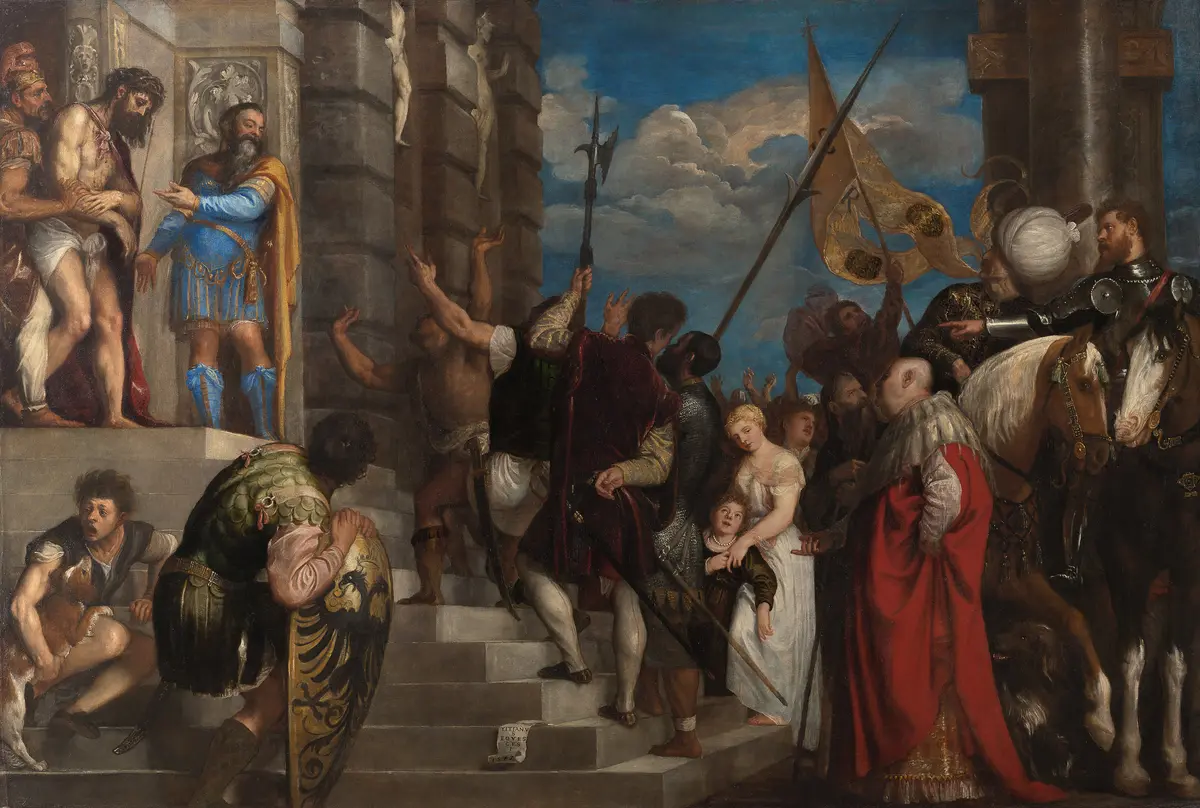
The scene was rarely depicted in Italy but can probably be explained by the Flemish origins of the man who commissioned it. The figure of Christ though conspicuously moved to the side still attracts all our attention due to the picture’s brilliant composition. The excited young man to the left acts as the compositional introduction while the view of the soldier’s back leads our gaze up to the protagonist. The double eagle and the signature “EQUES CES” further to the right are the artist’s homage to the imperial court whose official painter Titian had become in 1533.
Artist:
Tiziano Vecellio, gen. Tizian (um 1488 Pieve di Cadore - 1576 Venedig) DNB
Time:
1543
Object Name
Painting
Culture
Italian, Venetian
Material/technology:
Canvas
Dimensions:
242 cm × 361 cm
Framed: 284 cm × 404 cm × 16 cm
Signed
Inscribed at the bottom centre of the label: TITIANVS EQVES CES F. 1543
Copyright
Kunsthistorisches Museum, Gemäldegalerie
Invs.
Gemäldegalerie, 73
Provenance
Painted for the Venice based Flemish merchant Giovanni d'Anna; Until 1621 d'Anna family; 1621-1648 Coll. Buckingham; acquired in 1649