Die Stephansbursa
1. Drittel 9. Jahrhundert
St. Stephen's Purse is a reliquary in the form of a purse (pilgrim's bag). The original wooden core contains hollow recesses in which relics were once kept. Only the largest relic compartment at the bottom still conceals a relic, a small piece of fabric that was, however, added later. According to an old tradition, the Purse once contained blood-soaked soil from the martyrdom of St. Stephen. Recent examination of the materials has strengthened the probable verity of the tradition that St. Stephen's Purse was placed during coronations in the Palatine Chapel of Aachen (Aix-la-Chapelle) in a niche created for it in Charlemagne's marble-slab throne. At first glance, the dense decoration on the display side of the reliquary - precious stones and pearls in sunk settings of various height - creates an impression of unorganised riches. Upon closer examination, however, the formal intention of the arrangement of the stones becomes evident: bands of cabochon stones (they have been smoothed and polished but are not facetted, the latter reflecting a technique that was developed only later) frame the entire front, dividing it into a box and roof and along the central axis. The main axes thus create a cross of jewels and can be interpreted as a crux gemmata, the imperial sign of victory, comparable to the Imperial Cross (Inv. No. SK_WS_XIII_21). On the sides of the Purse are medallions stamped into gold foil, mysterious depictions of fishermen, falconers, bird-hunters and a goddess of vengeance, which are stylistically related to the contemporary book illumination at the court school of Charlemagne (early 9th century). The back of the Purse originally shared this design, but during the Empire period - probably around 1827 in Vienna - it was recovered with gilt silver foil. The top ornament of the reliquary was probably added in the 15th century.
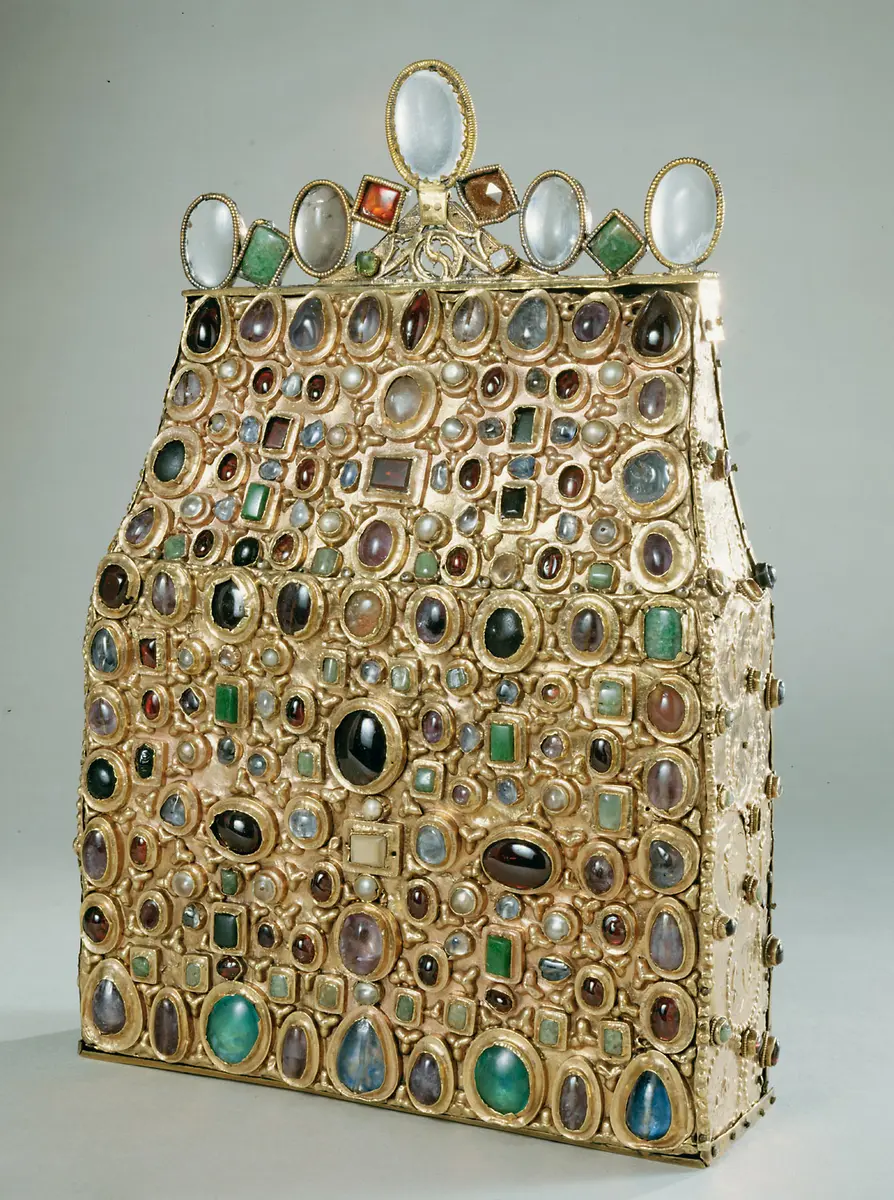
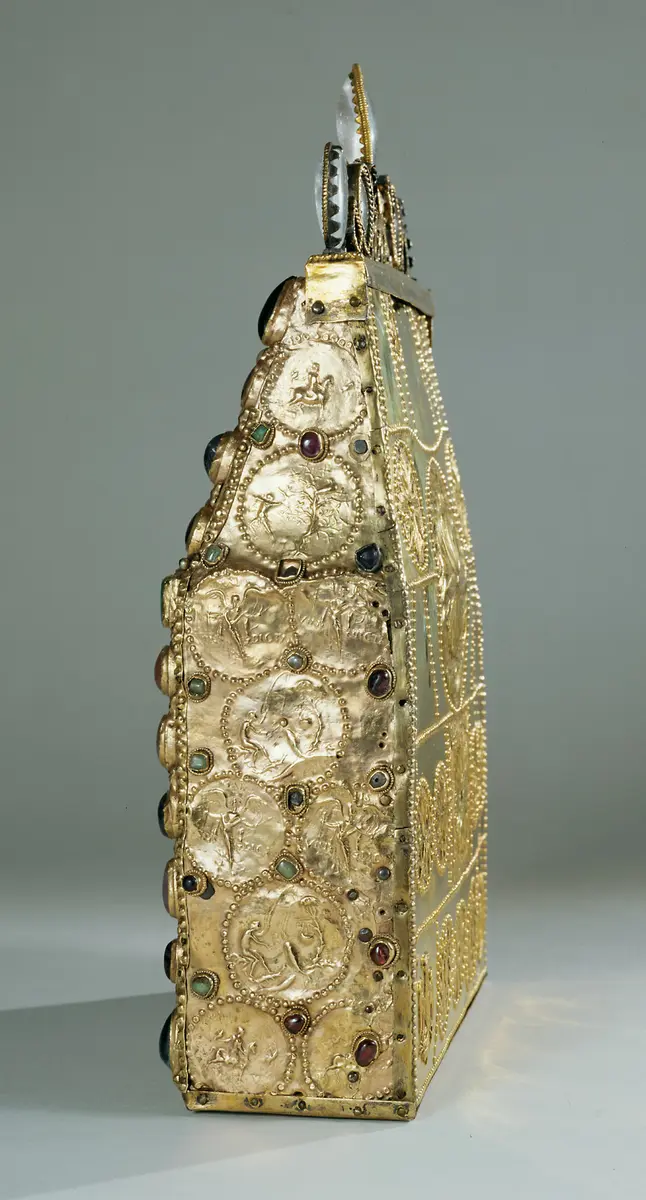
St. Stephen's Purse is a reliquary in the form of a purse (pilgrim's bag). The original wooden core contains hollow recesses in which relics were once kept. Only the largest relic compartment at the bottom still conceals a relic, a small piece of fabric that was, however, added later. According to an old tradition, the Purse once contained blood-soaked soil from the martyrdom of St. Stephen. Recent examination of the materials has strengthened the probable verity of the tradition that St. Stephen's Purse was placed during coronations in the Palatine Chapel of Aachen (Aix-la-Chapelle) in a niche created for it in Charlemagne's marble-slab throne. At first glance, the dense decoration on the display side of the reliquary - precious stones and pearls in sunk settings of various height - creates an impression of unorganised riches. Upon closer examination, however, the formal intention of the arrangement of the stones becomes evident: bands of cabochon stones (they have been smoothed and polished but are not facetted, the latter reflecting a technique that was developed only later) frame the entire front, dividing it into a box and roof and along the central axis. The main axes thus create a cross of jewels and can be interpreted as a crux gemmata, the imperial sign of victory, comparable to the Imperial Cross (Inv. No. SK_WS_XIII_21). On the sides of the Purse are medallions stamped into gold foil, mysterious depictions of fishermen, falconers, bird-hunters and a goddess of vengeance, which are stylistically related to the contemporary book illumination at the court school of Charlemagne (early 9th century). The back of the Purse originally shared this design, but during the Empire period - probably around 1827 in Vienna - it was recovered with gilt silver foil. The top ornament of the reliquary was probably added in the 15th century.
Time:
1. Drittel 9. Jahrhundert
Object Name
Reliquiar
Culture
Karolingisch (Aachen ?)
Material/technology:
Goldblech über Holzkern, RS: Silber, vergoldet, Edelsteine, Perlen, Glas
Dimensions:
H. 32 cm, Gewicht 2640 g
Inscribed
"MALIS VINDICTA"
Copyright
Kunsthistorisches Museum, Weltliche Schatzkammer
Invs.
Schatzkammer, WS XIII 26